 Hacker Cinema
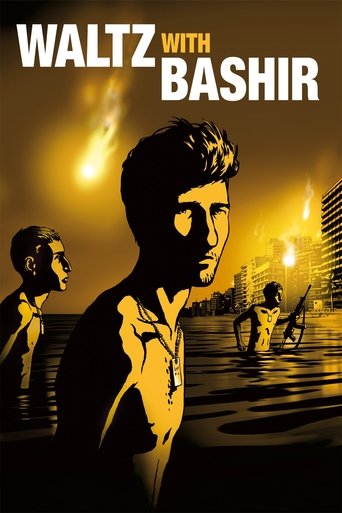
Waltz with Bashir
ואלס עם באשיר
2008 · Film · documentary · 90 min
Directed by Ari Folman
A film director from Israel interviews fellow veterans of the 1982 invasion of Lebanon to reconstruct his own memories of his term of service in that conflict.
1 positive2 neutralfrom 3 commenters
Where to watch
No streaming data for this title.






3 comments on Hacker News
It's fine to be future oriented, to share development, the problem is any religious destiny/racist element.
I'm not sure what you mean by "woke disease," but consumerism involves evaluation.
Oct 7 was horrible, but it didn't come out of nowhere. Sabra and Shatila, for example (Waltz with Bashir being a very good Israeli film on the topic), and the many thousands of people killed mutilated or displaced in their usual unhelpfully disproportionate response..
War movies produced in Israel are also a distinctly different experience from American ones.
They tend to be made by veterans of those wars, after the ~20 year gap that seems pretty standard for the PTSD barrier to crack. e.g. the best ones made about the Lebanon War (what Israel calls its intervention 1982-2000 in the Lebanese Civil War) all came out within a couple of years of each other:
* Lebanon (2009)
* Waltz with Bashir (2008)
* Beaufort (2007)
And the first of the good Yom Kippur War (1973) films is probably Kippur (2000), with the long-development-time miniseries Valley of Tears (Sha'at Ne'ila) only coming out last year.
Not quite enough time has passed for films about the heaviest fighting of the 2nd Intifada to be made - the closest thing I can think of is the TV show Fauda (2015-present) but that's a somewhat different genre.
We can deal death out without bias such as physical strength or ability using weapons.
Two people enter two different boxes that contain a button each. Only one can leave because one of the boxes is a suicide box. They choose the box they enter to prevent systematic bias/corruption.
The purpose of this process isn't a boring version of The Hunger Games. It is to prevent the greater problem of civil conflict and ultimately save more lives.
It is a symbolic act, a ritual. There are actually many societies where a human or animal is blamed for a 'global' problem the tribe has, and then killed which removes the tension and the danger it created.
The most obvious example of this is Christianity. It involves a scapegoated individual being murdered in order for the tribe to reform itself, which although I am not a Christian, does seem to be a description of what happened.
The reverse process also occurs. When a leader like Arch Duke Ferdinand is assassinated, the event becomes a symbolic fulcrum through which human society demanded blood. Violence is like a chain reaction.
Here is a modern example. Bachir of Lebanon:
https://en.wikipedia.org/wiki/Bachir_Gemayel
"On 14 September 1982, Bachir was addressing fellow Phalangists at their headquarters in Achrafieh for the last time as their leader and for the last time as commander of the Lebanese Forces. At 4:10 PM, a bomb was detonated at the headquarters, killing Bachir and 26 other Phalange politicians...
Habib Shartouni, a member of the Syrian Social Nationalist Party and also a Maronite Christian, was later arrested for the assassination. His sister was living in the apartment above the room Bachir was in. He had visited her the previous day and planted the bomb in her apartment. The next day, he called her and told her to get out of the building. Once she was out, he detonated the bomb from a few miles away from the building. When he came back to check on his sister, he was immediately arrested. He later confessed to it, saying he had done this because “Bachir had sold the country to Israel.” A reporter was heard telling him "You didn't kill a man, you killed a country." He was imprisoned for 8 years, until Syrian troops took over Lebanon at the end of the war and freed him on 13 October 1990..."
In my model the reporter understands something very important.
Had Habib Shartouni been ritually (which is another way of saying 'publicly orchestrated') killed, the anger could have found a resting place at his grave.
What happened next is illustrated in the remarkable anime Israeli film "Waltz with Bashir".
https://en.wikipedia.org/wiki/Waltz_with_Bashir
"The Sabra and Shatila massacre was the killing of between 762 and 3,500 civilians, mostly Palestinians and Lebanese Shiites, by a militia close to the Kataeb Party, also called Phalange, a predominantly Christian Lebanese right-wing party in the Sabra neighborhood and the adjacent Shatila refugee camp in Beirut, Lebanon.
The massacre was presented as retaliation for the assassination of newly elected Lebanese president Bachir Gemayel, the leader of the Lebanese Kataeb Party."
So that is my position. Human society can use ritual as a social 'hack' to prevent a high blood price.
One obvious example is in the present with the increasing tensions in Europe due to the migrant/refugee crisis in the Mediterranean. While I do not condone violence I also believe the act of ritually killing (I won't mention anybody or anything specifically to avoid being controversial) would prevent (what I believe to be) much more exaggerated violence later on.
This would have to be done officially by the State and in the full public eye.
This is a strange subject, but it is only what we see of ourselves, we are strange animals. Many modern phenomenon, 9/11, Black Lives Matter are related to this subject.