 Hacker Cinema
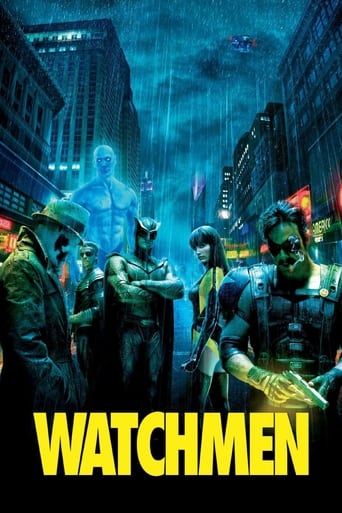
Watchmen
2009 · Film · 163 min
Directed by Zack Snyder
In a gritty and alternate 1985, the glory days of costumed vigilantes have been brought to a close by a government crackdown. But after one of the masked veterans is brutally murdered, an investigation into the killer is initiated. The reunited heroes set out to prevent their own destruction, but in doing so they uncover a sinister plot that puts all of humanity in grave danger.
30 positive6 negative3 mixed45 neutralfrom 84 commenters
Where to watch
No streaming data for this title.
85 comments on Hacker News
> First, the people who work at Patreon are special, beautiful humans, through and through. The energy that our team has for Patreon’s mission is a force of nature. So many wonderful humans are going to lose their jobs today in an especially painful moment and market. I am the person responsible for that decision, and I take that with the utmost seriousness.
Reminds me of Ozymandias speech when he says to Dr. Manhattan, that he has personally exprienced the pain of millions of New Yorkers he is about to decimate in the Nuclear attack.
In both the Watchmen graphic novel and the 2009 film adaptation, Ozymandias (Adrian Veidt) claims that he deeply feels and absorbs the psychic pain and deaths of the millions of people he kills. He views this immense personal suffering as his own tragic sacrifice for the greater good of humanity.
Ohh that's interesting. Never heard that quote from him I don't think. I like Alan Moore's perspective on life. Seems like he had an interest more in the ancient arts, but more from an intellectual perspective.. Thanks for the reminder. I need to look at his behind the scenes stuff. I remember watching a documentary on the Watchmen (2009 film) DVD when I was a kid. Maybe it was in that. Looks like he is doing short courses this days [0]
[0]: https://www.bbcmaestro.com/courses/alan-moore/storytelling
https://en.wikipedia.org/wiki/I_Aim_at_the_Stars
> Despite his moral quandaries, von Braun participates in the Nazi's V-2 rocket program during World War II to further his ambitions in rocket engineering. The film carefully depicts his efforts to reconcile his love for scientific exploration with the knowledge that his work is being used for destructive purposes.
I have a similar short story idea where a person of the calibre of Elon Musk who works so hard is made to feel and see his successful moonshot projects being used for destroying and subjugating nations. This would be similar to Oppenheimer. Another twist I can take with the story is Hero "Elon" knows about this outcome but still in the hope of change in institutional ideology over decades hopes for better use for his technology. In the movie Watchmen, Ozymandias feels the pain of millions he is going to kill to save future billions.
Watchmen: Killing millions to save billions
https://www.youtube.com/watch?v=Tu2DdkOxLNs
I have seen a few normally progressive types act quite conservative puritan over the NSFW ChatGPT thing. It seems there are quite a lot of people consider things to be uniformly good or bad and their opinion of the whole colours their opinion of the parts.
OpenAI are in a difficult position when it comes to global standards. It's probably easier to see from outside of the United States, because the degree to which the historical puritanism has influenced everything is remarkable. I remember the release of the Watchmen film and being amazed at how pervasive the preoccupation with a penis was in the media coverage.
Fun random fact, the tool used to animate the smurfs hats in 3 out of 4 CG smurfs films, was actually created for Doctor Manhattan’s junk for the original Watchmen film.
Your point "high tech, low life" just makes me feel that maybe cyberpunk is dead because it is the present.
I recently re-watched the Watchmen movie, and it really feels analogous to this tiny bit of dialogue:
Nightowl: Whatever happened to the America Dream?
The Comedian: What happened to the American Dream? It came true! You're looking at it
In regards to cyberpunk we just didn't quite get to ubiquitous body modifications but ticked most of the other boxes.
Looked this up I had no idea. I only watched the watchmen movie and never realized the threat was aliens like I was thinking. I thought it was Dr Manhattan being perceived as an evil guy by the general population.
I think programming people to believe there’s a credible ET threat would be kind of cool. It would never affect them, and it would be hard to prove or disprove either way. And people would rather err on the side of expansion and survival, than extinction.
> [...] doesn’t change the fact the show is being edited on Macs. Which makes me not see the point in the article.
I don't know what else to say, other than to show again this full quote: "These editors aren't working on Macs, per se. They're working around them". The point is not that they're not using Macs, he knows they are.
What you're doing is like seeing the scene[1] from the Watchmen movie where a character in prison says "I'm not locked in here with you. You're locked in here with me", and then thinking "Wow, that character was totally wrong! Of course he was locked in there with them, he was in a prison!".
[1] warning: graphic violence: https://www.youtube.com/watch?v=d0-EuoBjkKI
Comics have a huge impact on pop culture. They form the basis for some of the biggest budget TV shows and movies which last for a long time in our collective consciousness: The Dark Knight series, Watchmen, the Avengers, etc.
Several just on their own are huge cultural juggernauts: Calvin and Hobbes, Peanuts, XKCD, Penny Arcade, etc.
I don't know why you think comics are. Trojan Horse for ESG/activism. Like all media, they seek to reach wider and wider audiences, for a good chunk of time, the best perceived way to do that was to diversify those offerings. Even if that didn't end up working (assuming your POV in good faith), that doesn't mean it was a "Trojan horse for activism" anymore than the rise and fall of the shonen genre in manga was a subversive attempt to inject masculinity into the populace.
What you term as ESG and all is not a shadowy cabal to force people to think a certain way. It's just companies trying to do what sells. You forget that in the beginning it did work, which is why it caught on.
'Remember his big publicity stunt of declining his name to appear on the Watchmen movie credits? Yet he had no issue taking the payday from DC that started it all'
Because back then Comics book industry was not the same, he sold his story and rights to DC and the contract specified that if DC stopped selling the book after a period of time, the rights would revert back to him. Alas, he wrote Watchmen, it's never been out of print he has not been allowed to reclaim his own work.
A lot of his complaining about Movie/Comic book companies comes from the perspectivie of a creator who has lost control of his creations, and is doing what he can to protest that.
I love Alan's work but he is also kind of an idiot on many issues
He rails against the interactions of fans and large conglomerates but he was happy to cash checks anytime his work went up for sale
Remember his big publicity stunt of declining his name to appear on the Watchmen movie credits? Yet he had no issue taking the payday from DC that started it all
I've read everything he has written including his novels...but, shut up Alan
Some that haven’t been mentioned yet: Matinee, The First Great Train Robbery, Dave, Ghibli movies (Laputa, Mononoke, Totoro, Kiki, …), Mad Max 2, Nightmare Before Christmas, Edge of Tomorrow, Tremors, Godzilla Minus One, Watchmen, The Fly, Dark City, Passengers, Predestination, Strange Days, WarGames, Tron, Timecrimes, Sneakers, The Frighteners.
This reminds me of a famous quote coined by the famous comic book artiste Alan Moore which is, "quis custodiet quie custodiet" which is Spanish for "Who Watches the Watchmen" (refers to his famous graphic novel and cinema film as well)
Also I believe it was Abbie Hoffman (famous 1960s peace activist) who famously is quoted as saying, "let he who fights dragons be careful not to become a dragon himself, and if he shall stare into the abyss, so too may he become an abyss" - so that basically means if you fight criminals all day even with the best of intentions, the wear & tear of it over time might eventually turn you into a criminal too
>The MCU was the height of films because it managed to wrangle more than half-a-century of comic book lore (much of it previously deemed unfilmable) into a coherent and compelling multi-film epic that was both entertaining and (lightly) philosphical and political.
That's more of a parlor trick than art. "See how much simplistic comic book storytelling randomness I can fit in 30+ movies, and even live room for 70% of it be explosions and fight scenes".
>it was an unprecedented undertaking involving the hard work of tens (hundreds?) of thousands of talented artists and technicians across the globe
"Talented" is begging the question.
IMNSHO, not only is the writing, acting, and directing mediocre by-the-numbers blockbuster crap, but even what they supposedly do best (the special effects and fights and such) are shodilly made.
There are movies made from comics that are worth a damn cinematically (Logan, Sin City, Watchmen, Constantine) but 99% of MCU is not in that set.
The curriculum consists of reviewing the history of comic books, reading a lot of comic strips, and watching several graphic novel driven movies such as Superman and Watchmen.
It is a consumption course. Kids don’t actually learn how to write graphic novels. That might actually might be worthwhile.
I realised recently that most media recommenders don't work for me because they are based on genre. If you like The Watchmen film, you're sure to like Marvel films because they're also action, and based on comics. We see you listened to Pearl Jam a lot, you're going to get a kick out of Nirvana.
That's just not how I work. I like _good_ stuff, I don't confine myself to genres, I'll go anywhere if it's half decent. I want a service that says hey, you listened to Benny Goodman's Sing Sing Sing, you should check out The Thirteenth Floor Elevators' first album.
The only recommendation that kinda works for me is based on an aggregation of what other people listened a lot to. Sure on small data sets that is probably going to be genre biased, but on large sets it can start working and break out of that.
Watchmen the movie isn't bad either.
Comics! I recently finished Wanted (which made for a shitty movie, but a decent comic) and Watchmen (I despair I hadn't gotten around to it sooner).
Now I'm planning to read V for Vendetta, The Killing Joke, Batman: Year One, and some more. I've finally come around to comics as an art form, and I couldn't be happier!
> And I defy you to find a mainstream film with a moment as horny and gay as the Sexy Saxophone Solo from The Lost Boys.
It was that, but strangely Tim Cappello is not gay.
FWIW, I don't care much about screen chemistry. But friend of mine and her husband are both huge film buffs. The last one which really got her worked up watching was Watchmen in 2009. The author seems to have a point.
On the other hand, my wife likes a good love story on screen where sex is not the focus, but emotions. She's a big fan of K-Dramas, and feels like the stories would be impaired by introducing sex (which inevitably would be part of it in American drama).
The scope of this complaint seems to mainly be blockbuster films, I suppose.
It was a key element of Watchmen. The movie changed the common enemy from aliens, but kept the general concept. It wasn't the governments that created it, but rather the governments were duped into believing it.
The soundtrack to Koyaanisqatsi is also used in the opening scene of Alan Partridge: Alpha Papa (2013), which pairs a deep feeling of foreboding over footage of the beaches of Norfolk.
While it might appear to be an incongruous choice to open a comedy film, I note that Koyaanisqatsi, Watchmen (book and film) and Alan Partridge are all works primarily concerned with whether it is in our own nature to destroy ourselves, and whether we might deserve it.
Spoiler for The Watchmen:
The Watchmen has two examples (comic and movie) that I thought might work, if they were really pulled off.
However, even then I agree with the other comments currently posted that there would still be deniers, who would ultimately win.
Maybe humanity could pull it off, but if they could I'm not sure we'd be able to sustain it.
We're good at short term disasters, but not at preventing them, or following through with the lessons we've learned.
The answer is that it's all conceptual. There is no real, objective scale to the universe, you're picking a reference point which can feed the monster inside you called depression. It's just as valid to pick a different scale and focus on that. I say that like it's easy, but it's not, it's a struggle, but being aware of it is the first step. It's about where you direct your attention, and how you react to what your attention is focused on. Negativity breeds more negativity, and to break this cycle you must find ways to reverse its polarity. To me that is creative endeavors, which are like dropping a bottled message in the ocean of time hoping that someone in a distant future, in a world I wouldn't recognize, might pick it up and gain something from it. I have that hope because I know I've had that happen to me from people long dead before I was born.
As for reading material, I'd actually recommend Watchmen, the character arc of Dr. Manhattan is pretty much centered around this issue.
> “Hundreds of thousands of adults [are] lining up to see characters and situations that had been created to entertain the 12-year-old boys – and it was always boys – of 50 years ago. I didn’t really think that superheroes were adult fare. I think that this was a misunderstanding born of what happened in the 1980s – to which I must put my hand up to a considerable share of the blame, though it was not intentional – when things like Watchmen were first appearing. There were an awful lot of headlines saying ‘Comics Have Grown Up’. I tend to think that, no, comics hadn’t grown up. There were a few titles that were more adult than people were used to. But the majority of comics titles were pretty much the same as they’d ever been. It wasn’t comics growing up. I think it was more comics meeting the emotional age of the audience coming the other way.”
> He thinks that’s not just infantile but dangerous. “I said round about 2011 that I thought that it had serious and worrying implications for the future if millions of adults were queueing up to see Batman movies. Because that kind of infantilisation – that urge towards simpler times, simpler realities – that can very often be a precursor to fascism.” He points out that when Trump was elected in 2016, and “when we ourselves took a bit of a strange detour in our politics”, many of the biggest films were superhero movies.
Gioia's point about the worship of tragic, and sometimes even pathetic figures in modern fiction is right on the mark. He brings up Walter White as one example, but what I immediately had to think of when he talked about Marvel characters was Watchmen, Alan Moore's satire of that culture. What was so striking about the movie version in particular was how many people thought Rorschach was some kind of badass anti-hero, rather than the mentally ill Randian megalomaniac that he intended him to be. People didn't even get it any more, quoting an interview he gave on the topic: (https://www.stevensurman.com/rorschach-from-alan-moores-watchmen-does-he-set-a-bad-example/)
"So, I thought, ‘Alright, if there was a Batman in the real world, he probably would be a bit mental.’ He wouldn’t have time for a girlfriend, friends, a social life, because he’d just be driven by getting revenge against criminals… dressed up as a bat for some reason. He probably wouldn’t be very careful about his personal hygiene. He’d probably smell. He’d probably eat baked beans out of a tin. He probably wouldn’t talk to many people. His voice probably would have become weird with misuse, his phraseology would be strange. “I wanted to kind of make this like, ‘Yeah, this is what Batman would be in the real world.’ But I had forgotten that actually to a lot of comic fans that smelling, not having a girlfriend—these are actually kind of heroic. So actually, sort of, Rorschach became the most popular character in Watchmen. I meant him to be a bad example, but I have people come up to me in the street saying, ‘I am Rorschach! That is my story!’ And I’ll be thinking, ‘Yeah, great, can you just keep away from me and never come anywhere near me again for as long as I live?’”"
when I read this I noticed how much this actually sounds like WW and how unironically celebrated the character was, in contrast to his family in particular online.
> This is the main reason I don't like superhero films. There is no sense of danger or vulnerability. It's just people in fancy jumpsuits doing acrobats around explosions till they win the day. I prefer main characters dying / at severe risk of dying. Give me tragedy. Show me vulnerable people who grow and become stronger.
It's hard to pull off: you kill off the main character in a series, and the show can go on. You kill off the protagonist in a movie and it's the end of the movie, and the entire franchise.
Watchmen followed the graphic novel very closely, so maybe you might enjoy those super heroes.
I don't think it's much of a cycle, there has been a constant undercurrent of "mature" cynical superhero comics and movies for decades now. In the '00s we had the Christian Bale Batman movies, and adaptations of V for Vendetta and Watchmen. In the '10s we had Deadpool and the Zack Snyder DC movies with their unprecedented cynical take on Superman. It all continues today with Venom and Batman spinoffs.
Surely the whole point of Watchmen was that superheros aren't better than other people. For the last couple of decades cinema's been reinventing (male) superheroes as "complex characters" with flaws, moral weaknesses and questionable motivations.
Like you say, maybe I'm remembering selectively but I think that's less the case for Black Widow, Captain Marvel or Wonder Woman than it is for Iron Man, Superman or Batman.
Can you imagine Marvel greenlighting a female-led equivalent of Logan?
For what it's worth, I now regret saying anything, and will try to restrain myself from saying anything else.
> Edit: Maybe it's a bad idea to say this out loud, but when you get protagonists who are "just born preternaturally awesome", they're generally female, right? I'm not sure the same trend applies for male protagonists.
I think this is a bit of selective memory ala: https://xkcd.com/385/
Did you have particular movies in mind with this? The whole Marvel universe is riddled with male protagonists who are simply better than other people. That's the whole schtick that the Watchmen criticises.
No, think about Star Wars. Luke doesn't believe in the Force, doesn't believe Obi Wan is anything but a crazy old man. He has to come to his realization himself and then find the Force in himself. He isn't gifted with it. That truly is a big difference between the classic hero's journey and the newer 2010s films where people just have a magic power.
And people are sort of sick of it. It's why Watchmen or Guardians of the Galaxy stand out against so many boring superhero movies. Because a hero needs to be unwilling, unable, and unbelieving... and possibly not even a very good candidate for heroism. Hollywood shortened the journey with the classic stupid "karate montage to music" thing in the 80s. But now it's just like, oh jeez wow I have a superpower! Cool! So ultimately, who cares? Who can relate to that?
Look at Greek mythology. No one could understand why Zeus got all pissed off, but he was Zeus. He was kind of inscrutable. Man related to demigods who carried our emotions and message as envoys. Or, take Star Trek. Spock is half-human. He serves as a bridge between the alien logic and the emotional, rational part of our nature. We know we should eventually evolve to be like Vulcans, but we value our dirty humanity. So Spock, by occasionally regressing to his human side, is our proof that our humanity itself has value.
There's no humanity in a superhero who's just born with superpowers. That's Zeus. A great hero is like Spock, or Luke Skywalker, someone fighting their inner nature. Otherwise all conflicts are just eye candy, external, and ultimately CGI bullshit.
I haven't seen any One Punch Man, but I don't doubt good writers can make any character interesting. Doctor Manhatten in Watchmen was basically a deity and didn't ruin the film with the snap of his fingers. Dr Who never loses and can still have good stories.
I was more going for: with Tobey Macguire's Spiderman, Doctor Octopus was holding Aunt May from a building and taunting Spiderman with dropping her; the world was not at stake, the city was not at stake, almost nobody else in the city knows or cares who she is. I didn't think Spiderman would lose, but I felt like it mattered and that it was in some way difficult for Peter Parker to deal with, he had to take a chance, risk something, "only just" caught her. CGI tentacles didn't look realistic because they aren't a real thing, and that wasn't a dealbreaker. Nowadays a cloud opens up into an interdimensional portal and a flood of metal-living-skeleton-alien invasion spaceships fly through and it couldn't matter less if it tried; they are a swarm of whocares for the Avengers to punch through, which they do easily and uninterestingly and they didn't miss out on anything happening really. CGI isn't ruining it, bad plot is ruining it. Building turns to dust as thing crashes and explodes, is so overdone that's not even interesting by itself.
Compare to early Hulk who was on his knees in a field against two(!) sonic beam tanks owned by the US Army, with only Banner's love of Liv Tyler to make him stand up and fight. Small scale and he was never going to lose, but this was the US Army against the unknown, Banner and the General's daughter, and it mattered. When Hulk threw the tanks, they were CGI and a bit unrealistic, but so what, that isn't immersion breaking. Watching Hulk fight now is like seeing Star Trek's Lt Worf punch a Romulan spaceship while it explodes over The Fonz jumping a shark on a surfboard. It's not the CGI which makes it bad.
On the YouTube Pitch Meetings channel, one of the recurring jokes critiquing films is the 'writer' describing the plot of a film and getting to a point where a character dies, and the 'executive' does a "who was that? Should I care, because I don't feel anything right now" reply. I don't need the hero to lose, or the CGI to be unnoticable. I want to feel like something is at stake which matters. CGI punchups may as well be watching a 2 hr demo of Street Fighter II.
Alan Moore for me. Lots of people know Watchmen is about what would "really" happens if super heroes existed, and that lived rent free in my mind for years.
But 2 things really made it click. Alan saying Rorschach (who I thought was a great character) was basically Batman-in-the-real-world, which killed Batman for me. The nail on the head was this video https://www.youtube.com/watch?v=Z2yZwh_gCIU about Marvelmen and I don't remember if it's in the video or I read somewhere else, but it's when a super-hero that can manipulate reality, which in fact there's about a hundred of them in Marvel / DC, decides money is the root of all evil and vanishes money from the planet, and the world descends in complete chaos.
And now that actually lives rent free for me, as a young men angry at the hyper-capitalism and consumption we live in, who used to occasionally think the world would be better without money, I now realize that would indeed plunge humanity into a freaking mess.
I now enjoy watching Marvel and DC movies for the spectacle and action scenes, but I sorta don't enjoy most comics (at least the superhero genre) anymore.
What I think it's funny is that it just took me a long time to realize this. Actual superhero writers know exactly who they're writing for, angsty 13-year boys, see for example the interview here https://www.youtube.com/watch?v=6dfI_2dscGE
Most of the time flops have had too much material cut out to hit runtime requirements ("nobody will watch a 3 hour movie!"). Kingdom of Heaven, Batman v Superman, Watchmen, Alien3 all get better with restored material.
Blade Runner is interesting as there are 3 different versions, all about the same length but with some very different scenes. Theatrical also has a terrible voice over which was later removed.
The Shining is one that gets better when shortened - most feel that the 119 minute European version is better than the 144 minute US cut.
Apocalypse Now is interesting - Redux (193 minute) is a slog compared to theatrical (147); but Final (182) is probably the best version and a great example of the balance needed.
There's also the video 'How Star Wars was saved in the edit' which has a lot of good information on what editing can do. The video has kindof been co-opted by the internet as definitive proof that George Lucas is a talentless hack, but it's really not that much different than what happens on every other film. https://www.youtube.com/watch?v=zEHRNS-Scrs
The superhero genre already went through the deconstruction phase. The Watchmen comic book is from 1986. It did not kill the genre - if anything it revitalized it by introducing new themes. Frank Millers The Dark Knight was supposed to deconstruct and subvert Batman, but instead revitalized the character, so he is now the most popular superhero.
On film, the Watchmen movie predates the current Marvel movie wave which mean we got the reconstruction before the genre it was supposed to reconstruct. There have also been several superhero-team parodies like "The Specials" before we got the serious versions.
So it is safe to say the genre will not be killed by deconstructions, subversion and parodies. The genre will die when the audience lose interest and the moves stop making a profit. Subversions will probably help keep it alive longer.
If you are not a fan of the genre you probably hope the superhero genre will soon end its dominance of the cinema box office. But don't hold your breath.
Unlike the movies, The Watchmen graphic novel takes the time to point out Veidt's homage
I haven't read Watchmen, but the movie is very very good. The others you mentioned are just OK, true.
Does anyone have an example of a book they love that was turned into a movie or TV series that they also loved? I find it is generally not the case.
A Clockwork Orange... the movie was OK, but the book was much much more enjoyable IMHO.
Lord of the Rings... I would say I enjoyed the movies a lot.
Altered Carbon... I liked the book a bit better, although the writing wasn't the greatest.
Watchmen... the graphic novel was much better and enjoyable than the movie.
It is bad on many levels - inconsistent camera positioning is a rookie mistake and is wearing on the viewer, and much of the exposition is painfully heavy-handed, while much (most?) of the dialog is propagandistic.
On the other hand, GoT does the same sort of thing in reverse; technical polish and a realistic aesthetic are the vehicle for a different set of propositions about how the world works. One genre uses fantastical formalism while another relies on fantastical plots.
It's interesting to contrast these two with more subversive explorations of the same forms, like Shadow and Watchmen (the movie; I haven't seen the TV reimagining yet though people seem to be raving about it).
This is the same guy who claimed The Watchmen could never be made into a film; "could only work in a comic" were his actual words. I thought the movie, while not great, deep, or even a top-twenty-superhero film, was a fantastic rendition of the graphic novel. He still refuses to have anything to do with that legacy, and that's fine. I'm not looking to Alan Moore for film reviews or really, any commentary on modern society.
> I wonder if Moore would be as critical if instead of there being 20+ Marvel Character Universe movies in the span of 10 years there had only be say 4 or 5?
Almost certainly, he did write the Watchmen after all.
Lots of people have been exposed to Watchmen - his book about masks (vigilantes, no more "super" powered than the hero of any Hollywood movie they won't die if shot but they can't fly), but he'd also by that point written Miracleman - which is about supers (whose identity may not even be a secret, since they are to varying extent god-like and it hardly matters). In both cases Moore covered all the ground popular culture still thinks is radical and interesting today and went beyond it - thirty years ago.
Miracleman in particular has a lot of stuff about abuse of power, the title character has been brain-washed basically by the government, so as to have a tame superhero who can be sent out to do whatever they want. Once he is free and understands what's going on he doesn't beat up muggers, or even corrupt politicians, he destroys _capitalism_ and remakes the whole world as a utopia. Moore was done with the book at that point.
And so here we are in 2019 and people haven't moved on to even where Moore was in the 1980s, that's got to be fairly frustrating.
I don't see it any differently than the rise of science fiction as a genre. Science fiction can be a platform for storytelling, but it can also be a dumb excuse to use special effects, or to fantasize about the future, or any other amount of vapid justifications. If you blow it off completely due to the few movies you've seen, you're gonna miss out on a lot of excellent storytelling. For example, if you've dismissed The Watchmen or The Dark Knight because you think Iron Man is dumb, you're missing out.
There's no timelier follow up to Alan Moore's stance on superhero culture than Damon Lindelof's Watchmen which is currently in the middle of its first (and likely only) season run on HBO: https://www.hbo.com/watchmen
It's not only a high-flying feat of television writing, acting, and directing. It's something Moore will likely never endorse or even see (he's apparently denounced any adaptation/continuation of his work) and yet embodies the spirit of Watchmen better than anything I've ever seen in the genre.
Lindelof and Chernobyl creator Craig Mazin records an hourlong podcast (https://www.hbo.com/watchmen/watchmen-listen-to-official-podcast) for HBO talking about the genesis of show, its relationship with the Zach Snyder movie (respect for the form, detachment from the execution and alterations), and the very subject of this BBC piece: people who wear masks to enact vigilante justice are and should be concerning.
The parallels between 1985 and 2019 malaise, worldwide unrest, and that awful feeling that something's not quite right with the way the world is running are incredible well capture by the show.
Whether you've read the graphic novel or not, I can't recommend watching HBO's Watchmen enough. Even if you dismiss it as an unworthy heir to Moore and Gibbon's work, you will without a doubt be blown away by the show and how impeccably crafted it is.
For detail-hungry folks, the show's writing staff is release ancillary material that expands on the world (re)building within the show at https://www.hbo.com/peteypedia. Obviously don't read this before you watch each specific episode.
PS: I found the premise of the Amazon's The Boys interesting but beyond some impressive sequences and shocking twists, the show's writing is a bit too cynically shallow for its own good. There's not much commentary beyond the rottenness of (almost) every character in the show and that ends up feeling a little too much of one-note throughout the whole season.
Do we benefit from drawing lines between "cinema" and... whatever you might call a Marvel film? What do we call a Marvel film, if not "cinema"?
Further, why isn't anything at risk? Infinity War got about as close to real risk as any MCU film has so far, and I think if Mr. Scorsese watched that film he'd realize it's actually possible to create emotional drama within the context of a "Marvel Movie".
Also, are we really drawing the line arbitrarily at Marvel specifically? Where does "Joker" fit? Watchmen, The Dark Knight, Wonderwoman, 300, Scott Pilgrim, V for Vendetta? What about undeniably "Marvel" films like Logan, and Into the Spiderverse? Do we dismiss all media sourced from the pages of comics, or just the MCU specifically?
I ask both to make a rhetorical point, and because I genuinely don't understand. Mr. Scorsese writes this opinion piece like there's a shared understanding of what a "Marvel movie" is, but I don't know that there is such an understanding.
As i like to put it: you can write a story about how the prince rides in on the white horse and rescues the princess from the tower, and that's just normal, but if you have the princess save the princess, now we're getting political.
To paraphrases something I can't remember the origins of: we are most deeply embedded in ideology when we don't recognize it as ideology / post-ideology is the ultimate ideology.
Or, to quote David Foster Wallace:
>There are these two young fish swimming along, and they happen to meet an older fish swimming the other way, who nods at them and says, "Morning, boys, how's the water?" And the two young fish swim on for a bit, and then eventually one of them looks over at the other and goes, "What the hell is water?"
And, might as well add Zizek:
>That is why we are also unable to shake so-called ideological prejudices by taking into account the pre-ideological level of everyday experience. The basis of this argument is that the ideological construction always finds its limits in the field of everyday experience - that it is unable to reduce, to contain, to absorb and annihilate this level. [...] Does not this everyday experience offer an irreducible resistance to the ideological construction?
>The answer is, of course, no. If everyday experience offers such a resistance, then the anti-Semitic ideology has not yet really grasped us. An ideology is really ‘holding us’ only when we do not feel any opposition between it and reality - that is, when the ideology succeeds in determining the mode of our everyday experience of reality itself.
>---THE SUBLIME OBJECT OF IDEOLOGY
---
>even when the old star trek stuff, which is also quite diverse, is well regarded
Roddenberry would be denounced as the king of social justice warriors if he were writing today. (So would Rod Serling.) Star Trek, Stars War, Dr Who, etc are always okay in the past sense (no matter how bad the individual episode / movie) exactly because they are part of the past, and they cannot and never will change, which, to me, points to the real desire, the real anxiety, of those at present as being one a perpetual potential for alteration, much like a hypochondriac: there's no state of not being sick, only the state of not being sick yet, so the true desire is to be sick, because that is definitive.
And I keep imagining (comics / manga are what I've been seeing the most of this in lately) that if you imagined an alternative history where Alan Moore came along now, there would be no end of youtube videos and blog vitriol about him ruining Swamp Thing with agenda stuff and killing the superhero genre with Watchmen. But, since that's in the past, it can be safely embraced. Much like Martin Luther King, Jr: reviled up until death, after death, the establishment can lionize him. The dead don't talk back when someone puts words in their mouth.
On the one hand a certain vocal contingent of the audience does not want change, but instead wants the same story repeated ad infinitum, even though they say the opposite. The problem is it's not like heroine, where you simply have to increase the dosage until death, instead in must be continually new/different and yet the same, which quickly becomes untenable.
>1984, Farenheit 451, Ayn Rand's works
Interesting how is likely to be called art tends to be dystopian, isn't it? I have this paper somewhere [but that I cannot find for the life of me to link] that puts froward the idea that the dystopian subset of science fiction was allowed to become respectable in the mid twentieth century because it reflected the bourgeoisie's own anxieties about themselves and externalized an internalized death wish.
Other examples of Amazon self-censoring despite the govt saying they are not considering censoring online content.
* Pixelated nudity in shows like Californication and The Man In The High Castle and films like Watchmen and The Godfather
* The Grand Tour had an episode which involved animal carcasses. All of it was removed.
My $0.02 on this difference between Amazon and Netflix. This is Netflix's primary business, while Video is an afterthought for Amazon compared to the retail business. A boycott of their retail business would be catastrophic, whereas a few people canceling their subscription over self-censorship is a non-issue.
Amazon can also potentially be shaken down for protection money. It would work like this. "Hi, we're from this political party and we're considering making these videos a major issue. Meanwhile, would you consider making a donation to our election campaign?"
"Watchmen"
https://www.imdb.com/title/tt0409459/
A couple of good quotes:
"This skepticism about Wakanda is both Black Panther’s greatest strength and, ultimately, the reason its climactic battle lets down the rest of the movie just a little bit. But it’s also part and parcel of Marvel’s recent slate of movies, which has been interested, more than ever, in the idea that American hegemony and military power maybe isn’t everything it’s cracked up to be — even as every movie seems to conclude with a big shrug. “Well?” the films seem to ask. “What else are you gonna do?”"
Well? What else are you gonna do?
"In the deconstructionist corner are works like the comic Watchmen or even the Pixar film The Incredibles. The former asks what kind of psychological trauma you’d have to experience to think putting on a costume and beating people up is the way to live your life; the latter flirts with objectivism in its insistence that everybody is special but some people are more special than others. (The Incredibles remains the best superhero movie, but it’s constantly about two adaptation choices away from becoming a straightforward rendition of Atlas Shrugged — for kids!)"
I'm going to have to think about that last one.
Huh. Once upon a time, as a young boy, I had dreams of becoming a writer.
A couple of years ago I actually started writing what might have become a novel. But I remember that back then, it changed the way I watched movies and TV programs. And I started having on an almost regular basis these epiphanies of things about writing that people can learn in college in the USA. I do not remember what movie, series, scene or character triggered that one, but the "biggest" one I got was that in real life, Good and Evil exist only as approximations. Asymptotically, if you will. (Almost) Nobody is purely good or evil. And even the people we consider evil, tend to see themselves as good. And they consider us evil.
Sorry to pull a Godwin in the first round, but consider a prime example if ever there was one: Even Hitler did think of himself as basically good. He ordered unspeakable atrocities, but from his point of view, it all served the greater Good and was therefore justified. The question of how somebody could arrive at such a fucked up value system will probably never be answered to anyone's satisfaction.
Or Captain Ahab. He has a twisted moral compass, but again, from his point of view, he is doing "the right thing"(tm). Or Major Weissmann, Dominus Blicero. And often enough it is just egotism, "I want to be super-duper rich", or "I want to rule the ENTIRE world!" And what a crap job that would be! Does nobody ever think of that? No wonder terrible villains fail to conquer the planet, they are idiots. But to get a villain with depth - or at least the illusion of it - we need somebody who has another goal than just petty materialistic things or power over people. OH!! Watchmen!!!
So that particular epiphany taught me that a good (meaning "halfway believable") "villain" never does anything "evil" for its own sake, but from their own perspective, the villain does what needs to be done, terrible as it may be, because it serves a higher purpose, whatever that may be. Although I wonder about Judge Holden, he was an awesome antagonist, but I think he would have considered "good" and "evil" irrelevant. Anton Chigurh, too. He is possibly the closest anyone has come to creating a character that is pure evil. Then again, neither of these two has depth.
Here are my recommendations:
* Sunshine: I'll second this one, about a crew on a mission in space, turns into a different kind of film in the second half, which many people didn't like; has breathtaking visuals and a strong soundtrack.
* Her: A guy falls in love with an AI; has a wonderful atmosphere
* Gattaca: Set in a future of genetic engineering and how the protagonist fights against class discrimination
* Ex Machina, this was pretty hyped I'd say, but takes the opposite approach of Her and shows us the dangers of AI
* The Day the Earth Stood Still: a representative of aliens arrives on earth to tell humans to knock off their douchebaggery; still highly relevant today
* Metropolis: a silent film with a powerful score, set in a future with a large class disparity where the workers rebel
Honorable mentions that I'm not sure are really sci-fi: Brazil, The Prestige, Watchmen
Did no one else immediately think about the plot to Watchmen (the graphic novel, not movie)?
It's definitely something Watchmen movie Nixon would say.
> Now that I think about it, the movie Ender's Game was pretty faithful to the source novel, but probably fell down as a movie because of it.
I felt the same way about Watchmen. The film is remarkably faithful (mostly), but I guess the flow/rhythm/pacing just doesn't work the same way on-screen as it does on-page.
Interestingly, there are examples of the book author also being the screenwriter and doing a fairly loose adaptation. The most prominent example that comes to mind is The Princess Bride; the book had a much darker and more cynical tone than the film.
Going to repeat a lot of what has been said so far:
- Minority Report (The TV show isn't bad either)
- Ex Machina
- District 9
- Elysium
- Oblivion
- Edge of Tomorrow
- Looper
- I am Legend
- Her
- The Martian
- The Matrix (Only 2 & 3 if you're super bored)
- Basically any of the Mad Max series
- Firefly (TV show, movies are OK)
- Dark Matter (TV show)
- Snow Piercer
- American Ultra
- Last Witch Hunter (more fantasy than SciFi)
- Riddick
- Dredd
- X Files (I mean, it's not NOT scifi...)
- Treasure Planet (Yes, the animated one)
- Atlantis: The Lost Empire (Gets a bad rap for being animated, but it has it's own language and everything)
- Serial Lain Experiments (anime)
- Watchmen
- The Dark Knight
- Inception
- The Prestige (technically SciFi)
I can go on for hours
Rorschach.
http://www.imdb.com/title/tt0409459/
This doesn't come off as particularly convincing. Is the argument that Fast and Furious movies are "challenging, emotional journeys" while Iron Man isn't?
What I do find a bit concerning is the avalanche of super hero movies. While I've been raised on a diet of French and US comics, and like a good braindead super hero movie (or even less braindead, like Watchmen), monocultures are not a good thing. More variety would be nice. But thinking they are more silly than generic Hollywood blockbusters is a weird complaint.
Yep. See Watchmen (the book, not the movie) for an extended look into what kind of batshit people would ever want to be a "superhero".
I grew up in Norway. The pivotal moments of the 80's for me were things like going to school in 1986 and exchange dark jokes about the radiation clouds heading our way from Chernobyl. Or waking up my parents to tell them about the assassination of the Swedish prime minister Olof Palme. And Tiananmen Square. Hardly uplifting moments. And an endless stream of civil wars where the insurgents and governments where alternately supported by the Soviet Union and the US.
It was reflected everywhere in popular culture too: One one hand you had the excesses, but on the other you had the post-apocalyptic movies as you point out, and comics. I remember in particular Watchmen, which to me in many ways captures that feeling amazingly well. (I didn't actually read the original when it was released; but I very much remember the discussions around it, and remember seeing the ominous front pages in the news stand as they were released)
Ironically, the Watchmen movie caught a lot of flack when it was released for the music choices, many of which seemed strange to those not growing up during that era, or perhaps not growing up in Europe during that era (though set largely in the US, Watchmen is very much British in sensibilities - not surprising given Alan Moore). But songs like Nena's 99 Luft Baloons captured the feeling perfectly for me. A lot of the music in Watchmen was what I listened to in the 80's when I was feeling in melancholic mood...
(And since I brought up comics, there's of course Frank Millers "The Dark Knight Returns")
A lot of the light-hearted music and movies from the 80's feel like shallow veneer over that darker undercurrent.
I watched most of the Marvel movies and I have the same opinion, Avengers was one of the worst IMO, I enjoyed most of the X-Men ones, "First class" in particular.
My favorites super hero movies are not Marvel, I would put The Dark Knight at number 1) and Watchmen at number 2).
I didn't actually read Watchmen until after seeing the movie, despite very well remembering seeing it in my local stores when I was a kid, and remembering what a splash it made. At the time, it did not appeal to me for exactly the reasons it is great and stands out: It gave superheros a grown up treatment.
Reading it now, it stands out to me first and foremost as a symbol of typical British deadpan satire, applied to superhero stories, just as the "normal" superhero stories themselves were more out there than ever.
While the shops were full of series with superheros in costumes trying to beat each other in most ridiculous abuse of colour and spandex (incidentally, I think the moment it became truly clear how ridiculous many of these costumes were, was as Hollywood started trying to give them bigger budget treatments, only to find out how incredibly hard it is to put them on a movie screen without making it comical), saving the world with more and more ridiculous deus-ex-machina and bizarre powers, there was a series about a bunch of semi-retiree "superheros" without powers, full of moral issues and drenched in cold war seriousness. (Sure, the cold war was everywhere in comics, up to and including playing central roles in origin stories, but rarely given a grown up treatment).
While X-Men, for example, issue after issue had characters whine about how they could not justify killing without ever getting into the meat of the issue (despite the occasional fantastic story line like Days of Future Past), here was a series where someone who had been presented as one of the heroes was prepared to go to that kind of length to re-make the world in a way he thought better. Where one of the "heroes" dies in the first issue, only to have his image ripped to pieces bit by bit. Where all of the heroes are deeply human and flawed, and not necessarily in ways that made you like them more for it. And the eventual-antagonist wasn't stopped at the last minute, with the countdown on a doomsday device at 1, and there was no great save.
It also different in presentation: Readers were treated as grown ups with more than 5 minute attention spans, while if you read X-Men from there period, the amount of unnecessary exposition is tedious to the extreme. I'm actually re-reading those issues now, and it is fascinating to see how much I've "supressed" from my childhood. E.g. the amount of times the saw it as necessary to explain the powers of every single member of the team, or have characters carry out de-facto silent soliloquys rather than trust that the reader would be able to figure things out for themselves, is just bizarre seen with modern eyes.
Note that Watchmen was not the only series to do better there, by far. Phantom for example, amongst many, did not have nearly the amount of exposition, to name another "superhero" without special powers. And more serious literary treatment was also not new (including Alan Moore's fantastic run on Swamp Thing), but it stands out for its combination.
It was "superheroes" in the real world given a serious literary treatment against a dark and serious backdrop, handling moral issues seriously. And it was a clever caricature and satire over a genre that itself largely is a caricature, but that very often is not very clever caricature.
I'm unsure if "role" is a useful way to think about the Watchmen. Since the 60's there have been plenty of "adult" comics with sex and violence, and with the Watchmen being released in 1986 (I think), the adult themes weren't anything new. The "new" things I remember about The Watchmen, at the time, were (1) increased popularity of a mature themed story, and (2) the sales success of an adult themed story by a major publisher.
Similar could be said for the "Superhero without superpowers" plot device, and "Heroes with fairly regular human problems" plot device. The plot devices were old and well tested by the time they were used in The Watchmen.
On the other hand, the idea of using a limited series outside of the normal (cannon) universe to both introduce new heroes and kill them off in the same book/series was a deviation from the usual comics industry methods (for maximizing profits). Of course, DC eventually did a follow-on prequel "Before Watchmen" in 2012 after the release of the movie adaptation of the original in 2009. The price of success in comics is typically repeated dilution.
Permanently killing heroes became normalized in 1988 with "A Death In The Family" when they killed the second Robin in Batman (and started the "Replaceable Robin" and/or "Replaceable Sidekick" trope).
I've never seen the Watchmen as an analogy to the comics industry. After all, it was from one of the big two publishers. To me, the Watchmen was mostly just a product of its time; at the height of the seemingly endless threat of the cold war when everyone wanted the cold war to end. The trope of "endless threat resolved with substantial losses and significant change" was fairly prevalent in stories from the mid 80's. To some degree, the trope is still reused in current works, but to a far lesser degree. The toughest thing to grasp is what the mid-80's were like, and unless you're in your mid-40's or older, it will be tough for most to imagine. If I didn't know what the time was like, I doubt I'd consider the Watchmen to be such a fantastic story.
I am sure i am not the right person to answer that question. I am convinced it is an important role, but i could be wrong. But i will try.
Watchmen was not so much a satire, but a humanized version of what a superhero could be. But that is eclipsed through the end by its deep sociological question and its dubious answer. For me, the genesis of the comic genre that deal with mature subjects for mature audiences.
For me these were the guidelines used by Hollywood to make the comics to cinema transiction right. Teenagers by themselves can sustain the comic business, but not the movie business. So i understand the role of the Graphic Novel as the ingredient needed to make comics an art media for ali audiences. Something that Pixar made for animations through clever humour, for example.
the Pruit Igoe music has been repurposed for a number of other films. You will hear it a lot in the Watchmen adaptation. Also visually, this film basically invented the city-as-a-circuit-board visual metaphor.
... I think the movie that came out of Watchmen is pretty much proof of the conjecture that it was unfilmable. The director tried very hard to be faithful to the original - the changes were minor (some added ultra-violent fight scenes, and changing the nature of the SQUID) but the film that came out just wasn't very good. Some of the cast chewed the scenery a bit harder than was strictly necessary, but no film is going to have perfect acting. And yet somehow it just was such a mess. A shame, since I loved Moore's book.
Watchmen is a book that's designed to be read over and over and your own pace, with more to notice each time through. I think everybody skims the Black Freighter stuff the first time. Comics are so short that a good re-reading experience is prettymuch intrinsic to separating a decent comic from an excellent one. That doesn't really translate to film, since all the details and layers of the story just make the movie feel too dense.
Reminds me of the movie Watchmen, they said that was unfilmable as well. It was probably a tougher screenplay to write imo.
e: grammar
The timeless story of Ozymandias -- https://en.wikipedia.org/wiki/Ozymandias -- (if you don't know the 1818 sonnet by Shelley, read it before downvoting. It's relevant and timeless)
I met a traveller from an antique land
Who said: "Two vast and trunkless legs of stone
Stand in the desert. Near them on the sand,
Half sunk, a shattered visage lies, whose frown
And wrinkled lip and sneer of cold command
Tell that its sculptor well those passions read
Which yet survive, stamped on these lifeless things,
The hand that mocked them and the heart that fed.
And on the pedestal these words appear:
`My name is Ozymandias, King of Kings:
Look on my works, ye mighty, and despair!'
Nothing beside remains. Round the decay
Of that colossal wreck, boundless and bare,
The lone and level sands stretch far away".
EDIT: Thanks for the link to the excellent Breaking Bad video. For what it's worth, I haven't seen an episode since season 3 so didn't realize the coincidence. My pop culture connection would have been to Watchmen.
I recalled the dialogue from the film The Watchmen.
> The Comedian: What happened to the American Dream? It came true! You're looking at it!
Well, since the only thing I know about you is that you're on HN, and you haven't told us what you like or don't, or what you've already watched, you're going to get a load of essentially mainstream sci-fi. But that's your own fault.
Cypher - apparently unpopular with everyone except me, but I found it a very stylish, PKD-esque exploration of identity.
The Prestige - this one you'll probably hear elsewhere. It's mostly about the lengths to which someone is willing to go to be the very best at what they do - which obviously has some relevance for the HN crowd.
Watchmen - the only movie I watch again and again. It might be different for those who lived through it, but I love the way it can effortlessly evoke a very different era, cold-war paranoia, vietnam... a real sense of change.
Children of Men - arguably this shouldn't qualify as exceptional, and there's a lot less to say about it. What it is is some very good straight-up action, and then underlying that is a tale of how people respond to the inevitability of death. It's a simple film at heart, but I found it a very moving one.
Princess Mononoke - again, a real sense of the times changing, of conflicts that have to be resolved not by returning to the status quo but by moving forward somehow. Moral complexity everywhere, with no side being outright good or evil. And a beauty to it all even amidst the violence.
I've been confused by Netflix's business strategy for a while. I'm not much of a business guy, so maybe I'm just missing something.
I've made do for movies with the channels that came along for the ride when I subscribed to the minimal cable TV package that got me the nerd channels (Science, Discovery, Nat Geo, History, and so on). I've got quite a backlog of movies I'm waiting for.
Recently, I caught a movie (How to Train Your Dragon) on TV that I liked so much that I simply had to go buy a copy on Blu Ray. This also necessitated buying a Blu Ray player. I picked a Blu Ray player that also plays streaming content from the internet and supports pretty much everything other than iTunes.
I then started researching the streaming services (both subscription and rental), seeing how well they covered the movies I'd seen in the last couple of months on TV (HTTYD, Star Trek, Kung Fu Panda, District 9, Watchmen, Shrek Forever After, Happy Feet, Tangled, Bolt, Despicable Me, Monsters vs. Aliens, Fargo, Fantastic Mr. Fox), as well as how well they covered movies still on my backlog, plus assorted movies I'd like to rewatch.
Here's what I found. Neither Amazon nor Netflix subscription streaming provided good coverage of the movies I'd recently seen, the movies on my backlog, or the movies I want to rewatch.
The streaming rental services were a bit better, but still missing a lot.
Netflix's disc subscription service, on the other hand, covered pretty much everything.
So here is where I get confused. Netflix seems to think their future is in their streaming subscription service. This seems to me to be a pretty risky basket to put all their eggs into, because it seems to me that Amazon will have an easier time fixing their weaknesses compared to Netflix than Netflix will have fixing their weaknesses compared to Amazon.
Amazon's weakness compared to Netflix is that Netflix apparently has more content (that's what people tell me, although for the movies I'm interested in they seem about the same). To fix that, Amazon just needs to make some licensing deals. They don't have to build out a lot of new infrastructure or enter a new line of business or anything like that. It's a "write a check" problem for them.
Netflix's weakness compared to Amazon is that Amazon subscription streaming is part of Amazon Prime--and there are good reasons to have Prime besides the streaming. I got it for the shipping savings, and I'm also enjoying the Kindle lending library. (Brick and mortar retailers, like Barnes and Noble, and Best Buy, seem to be doing their best to drive people to Amazon, and so I see Amazon Prime becoming more and more common--but this is best left for another rant).
This makes the question for a lot of people "Netflix in addition to Prime?" rather than "Netflix or Prime?". That's a much harder case for Netflix to make. As I said, for the movies I've checked there are very few on Netflix that are not on Prime--it would cost me less to simply rent those movies. As Amazon closes the gap on content, "Prime plus rental" will become a better choice than "Prime plus Netflix" for more and more people.
It seems to me that Netflix's best weapon against Amazon is their disc subscription service. It provides the most content (both recent and older). It provides the highest quality content. It provides extras (commentary, deleted scenes, and all the other nifty things that come on disc besides just the movie).
Yet Netflix treats their disc service almost as if it is an embarassment. There's no link on their main page for it. It only seems to be mentioned in their FAQ, where they imply that it is an add-on service to the streaming service, and give no link to details.
"Briefly, the categorical imperative states: “Act only according to the maxim whereby you can, at the same time, will that it should become a universal law.” Whoa! That certainly describes the extreme nature of tons of the protagonists/antagonists of these various films. From Bane and Batman in The Dark Knight Rises to everyone in Inception, the idea of finding a universal truth and then applying it (sometimes forcefully) onto everyone seems to be exactly what’s at the core of all these movies."
Philosophy grad here. Absolutely none of these characters are exemplary of Kantian moral philosophy. That goes for about 99% of blockbuster heroes.
The key thing to understand is that 'universal' is a technical term in Kantian philosophy. Kant doesn't use this term to designate a relationship like that between a genus and its species, a class and its instances, or a set and its members. 'Universal' in Kant is synonymous with 'necessary', as in, "all stones necessarily fall back down to the ground if I throw them in the air." So what the categorical imperative really says is, "Live your life as if it were a force of necessity", or a more humanist formulation, "Live your life as if you were fulfilling your duty." If that sounds weird, realize that Kant doesn't think altruism qualifies as a foundation for morality because it's still based on pleasure, which for him brings us right back to egoism.
In terms of blockbusters, Watchmen's Rorschach or The Dark Knight's Joker are better approximations.
> Exactly the same thing is happening in the movie industry.
And I personally hate it. I remember a time when "blockbusters" included stuff like Total Recall, Die Hard, Terminator II or Aliens, I just want that again. There's still the casual Sucker Punch or Watchmen, but they're too few and far between.
Even if you view them by genre, it makes little sense. Like in sci-fi, Avengers is #1 (which I thought was a boring movie full of cliches), whereas the brilliant Watchmen is ranked #1780.
WTF?
I couldn't disagree more, and forgive me for saying, but I believe this to be an incredibly shallow summation of what is an amazingly deep and moving piece of art and perspective from a historic time in our (US) nation (the Cold War).
I believe the ultimate theme of Watchmen is this:
"In an irrational world, only the irrational becomes rational."
This theme is pervasive throughout the novel:
_ Regular people donning masks to fight crime at little personal gain and great personal expense.
_ Horrific and violent crimes disregarded as minor indiscretions of a time past.
_ An all-powerful god, resigned to do nothing due to the ineffectiveness of doing anything.
This theme climaxes when Ozymandius, the universally recognized "most intelligent man in the world," (translated, "most rational") illustrates exactly this point when in order to save a world on the brink of irrational self-destruction, theatrically stages an alien invasion, something which simultaneously changes nothing, yet everything, in order to save it.
Even the all powerful god recognizes this seemingly illogical and horrific solution as the ultimate most perfectly rational means to save an irrational world from itself.
In the end, the story's hero, Rorschach, the consistent (and author appointed) voice of reason amidst a delusional world, is rendered ineffective and unable to make a difference, an impediment on the path to salvation to be destroyed by its god, Dr Manhattan.
Let that last point sink in for a moment, and you'll understand the implications of this theme; it's the final scene of an epic novel:
__the world's last rational man is an obstruction to the survival of an irrational world.__
The theme itself is startling in its simplicity, and the impact of watching its very real once impactful characters, heroes and anti-heroes, struggling to come to grips with their irrelevance in an irrational world can be moving and profound in its implications.
Watchmen is a postmodern thesis. Whether you share in the postmodern sentiment, understanding the context is incredibly rewarding, emotional and thought provoking.
Tragically, the movie's creators did not understand this and lost the the whole point and very soul of the novel, transforming the antihero, Ozymandius, into a lunatic and villain. Understandably, this is likely the source of your misunderstanding. Ironically, the replacement of the antihero with a villain could itself be construed as an unintended commentary on the persistence of our world's delusions.
The theme itself is metaphorically mirrored internally within the "Tales of the Black Freighter" story. The Black Freighter is a tale of a hero's lamentable decent into darkness as he loses his grip on reality to become the villain he was running from by ultimately in ignorance murdering his last tie to his world (the light), his wife. It's a commentary on the world of Watchmen itself (the world in which the heroes exist, not the heroes themselves), and the manner in which they metaphorically murdered their once heroes and only hope of salvation to descend into irrational darkness. Make no mistake too, the salvation brought about by Ozymandius is no salvation, but instead the coup de grace of a once rational world's beyond salvation ultimate embracement of the darkness, the conclusion of the novel.
The greatest tragedy of all though, is the spiritual death of its heroes. Alan Moore sums it up well with his inversion of the famous satirical quote, modernly taken as a criticism against political corruption, "Quis custodiet ipsos custodes?" ("Who watches the watchmen?"):
"'They're watching out for us, who's watching out for them?'"[1]
In an irrational world, only the irrational is rational, and the core of who we are becomes backwards and called into question. Do we define ourselves by the changing world around us and betray who we once were, forcing us to withdrawal into ourselves, Nite Owl, or do we "Rage, rage against the dying of the light" to our ultimate destruction, Rorschach?
Or do we embrace the darkness, as Ozymandius did, or as so poignantly put by Harvey Dent / Two-Face in The Dark Knight:
"You either die a hero or you live long enough to see yourself become the villain."
____ Update
This post led me to read a little more on Moore's own interpretation of his work, and while Alan intention is for us to question the need for heroes, and a call to personal responsibility, specifically anti-Reagan, I don't find this to be inconsistent with my analysis. I would add this:
My romanticism of the heroes may at first blush seem inconsistent with Moore's intent. However, as you can see in my conclusion, I point out that the heroes themselves become corrupted by their own roles in a world that rejects them. Moore himself is equally inconsistent in his own analysis of his work, claiming it to be a criticism of the Reagans ("invulnerable" "heroes") of the worlds that lead us to the brink of madness, yet it's the world that rejects the heroes in its madness that drives itself to brink of extinction.
Moore said writing Watchmen allowed him "to purge himself of his nostalgia for superheroes." Something I feel is best illustrated in the inconsistencies between his own motivations and my analysis.
[1] http://www.tcj.com/a-portal-to-another-dimension-alan-moore-dave-gibbons-and-neil-gaiman/
>While it's great to understand the psychology behind the characters, this knowledge doesn't really make the movie or knowledge that much better.
Disagree with this so much. Knowing the depth and psychology of the characters is what makes the Watchman so much more interesting than say Superman or even my favorite superhero, Batman. Watchmen is very open and honest about the fact that people who would do this are probably riddled with psychological issues. I also like the subtle suggestion the book makes that most superheroes would fall onto the reactionary side of conservatism. I doubt there would be many incredibly liberal people out there taking the law into their own hands, but for some reazon the first time I noticed this mentioned was in Watchmen. Just a brilliantly written story with incredibly deep and realistic characters.
I wouldn't get too excited...it's been in development hell pretty much since the book was published. God knows how many writers have actually had a go at it, but I'm willing to bet a dozen or so (usually when a director gets attached they re-write the script with their preferred screenwriter).
You end up with this situation where the studio has to release something, because they've spent so much money buying the options, paying for ump-teen rewrites, etc. Studios don't account this as a 'loss', since in theory they will make the money back when the film is released. There comes a point in development hell where you have to release something, because either a) your losses on the film are at a point where you can't keep rolling them over, or b) your options are going to expire - and if you're the studio executive who decides not to make the film and commit that loss to paper you can bet you won't be with the studio for much longer.
The best case is you end up with something like Watchmen (which had been in development for about 20 years and had half a dozen big name directors attached, like Gilliam and Aronofsky). The final result is a reasonable film, although one that doesn't really compare to the source material and is fairly quickly forgotten. The worst case is the film doesn't get made (although if you're passionate about the source material you might argue this was the best case all along).
This is a big simplification - in true Hollywood style, it's a lot more complex (Snow Crash actually bounced from Paramount to Disney and back again - the fact Disney was unable to do anything with it isn't really a good sign). What you can pretty much guarantee is that at the end of it you end up with a film that's average at best. It's a vicious cycle: say Joe Cornish writes a great script, but Paramount insist on some rewrites. Joe Cornish then has to drop out, because the rewrites cause the schedule to clash with another project. Another director comes on, and he insists on new rewrites to accomodate his style. Etc, etc etc.
Just because nobody's done it right yet doesn't mean it can't be done. I'm surprised to see such a sentiment in these parts.
It wasn't until I read The Watchmen that I had found a graphic novel that couldn't have been done better as a movie or television series. Some art lives in its medium, some defines it. This may be a defining piece.
Consider things like movie rights. It's not unusual for there to be a very long time lag between print publication and the release of a movie version (e.g., Watchmen or Hitchhiker's guide). I've always liked the idea of setting copyright to expire n years after the expiration of the copyright owner (where n is long enough to handle the "take care of my family when I die" and "don't disincentivize publishing stuff made by older people" issues). n = 20 is my arbitrary proposal. Copyright owned by deathless entities (corporations and such) maxes out at another arbitrary number (I like 40) and there are no options for renewals in either situation.
> I had a really quick look and couldn't see a way to email him so I didn't bother.
It's at the very bottom of the page, under all the ratings:
> Questions / comments can be directed to aaron@andcuriouser.com.
It's sort of a footnote, so it's probably easy to miss.
> I'll use it more for the information than the ratings.
The ratings, from what I can tell, are correct more often than they're not. If the ratings look good, and you're interested in the movie, I'd say go for it.
A coworker once told me he doesn't pay attention to bad ratings anyway. He said that if a movie gets a good review, then it's probably at least worth watching because people were finding good things to say about it. If it gets negative reviews, it could just be that it wasn't what the reviewer was expecting or wasn't up to their particular standards. Think of Watchmen: that movie was heavily advertised as an explosive action superhero movie, but those bits are a very brief tangent on an otherwise slow moving character study. It's a good movie, but a lot of people were probably pissed off when they saw it. Still more were probably pissed off because it didn't live up to the book in their minds.
Either way, I've been using that site since before the RT integration, and it was always useful. I check it every couple of days and add interesting things to my list/instant queue. It's nicer, to me, to have a textual list of new movies in chronological order than it is to have graphical listings by genre where new things get drown out by less recent, but still "newish" listings in the genre.
This article points out that movies are now excessively marketing-driven, and suggests that the reason is that the generation born in the 1960s suffers from "arrested development" — i.e. psychological neoteny — to a unique degree, and that they now control Hollywood. Although it does not offer any evidence to support either of these propositions, it suggests that Top Gun or the Reagan administration might be the cause of the neoteny.
In reality, marketing-driven movie are nothing new. In the 1960s, they were called "exploitation" films; "exploitation" was the 1960s movie-biz term for "marketing". The crucial question is, why is so much of the movie business organized around exploitation films today? And an unsupported psychological hypothesis doesn't cut it as an answer.
Here's an idea that seems at least as good as the answer proffered by the article. The internet makes word-of-mouth travel a lot faster now. It used to be that the box-office receipts of a stinker movie would decline over the first few weeks after its release. Now, they decline even during the opening weekend. (I haven't verified that, but it seems like it ought to be easily verifiable.) People tweet about how bad the movie is even before they've finished watching it.
In turn, this word-of-mouth heightens the winner-take-all nature of the film industry; hit movies take home a bigger share of the total box-office receipts of the industry (unverified, but should be verifiable), with the result that more movies these days fail to even make back their production costs (unverified, but should be verifiable). In short, film production is a riskier investment than it used to be, and there's less that marketing money can do to rescue a stinker.
An economically rational response to this situation (assuming I'm correct!) would be to work harder to figure out which films are going to be hits and which are going to be flops, make the hits bigger hits, and spend less on the flops. For example, you could do any of the following:
• Value talent more highly. Talent can't stop a flop from being a flop, but it can make the difference between a hit and a mega-blockbuster.
• Don't spend anything on marketing. Release films in a single theater or a single city. If it takes off, print more copies. If GQ is to be believed, this would cut the cost of filmmaking in half, which would mean you could make twice as many movies.
• Release movies to audiences in episodes; start by releasing a half-hour pilot, and if it takes off, call the actors and director back to make another hour. This could cut the cost of filmmaking by more than a factor of 2, especially if the first part goes easy on the special effects, the music, that kind of thing. (In a way, that's what's happening with the sequel craze that the article is complaining about, but the difference is that you need to have the story arc planned out: Dune or Star Wars Episode IV or Babylon 5, not Fast Five.)
• Instead of a first episode, release an abridged version, maybe a half-hour. This has been done unintentionally and on a small scale for many years; think of Blade Runner and Blade Runner: the director's cut. The difference is that you can actually save money by not shooting the parts of the story that you leave out. Maybe instead of showing it in theaters, you can show it on Lifetime or HBO or something, or just on your web site.
• Instead of a pilot episode or abridged movie, do the first installment of the movie as a comic book. Comics have a lot in common with films: they're intensely visual and powerfully immersive, they even use cinematographic techniques, and a "graphic novel" is a lot closer in length to a movie than it is to War and Peace. These days, online, maybe you could even add a voiceover to your comic book. (Admittedly, filmstrips never really took off as a dramatic medium.) Again, in a sense, studios are doing this already; they're just not funding the production of the comics in the first place. They ought to. If there were ten times as many graphic novels coming out every year, they'd have a much better selection of audience-proven storyboards.
• Post trailers and teaser episodes on BitTorrent before you're done filming in order to see if they take off. It's no guarantee — lots of people will be willing to watch the movie for free even if they wouldn't shell out for a ticket — but if it flops there, it'll probably flop in the theater too.
• Cancel more films before they're even finished shooting. If your early indications are that it's not going to work out, don't try to rescue your investment by sending good money after bad, hiring a famous film editor to try to salvage something from the wreckage, nonsense like that. You need some kind of interim feedback on quality, of course, which is impossible to do reliably, although some of the approaches above might help. The big returns are going to go to the mega-hit films. Invest the money you would have invested in finishing the film in something that has a chance to be a mega-hit instead.
• Leave room in filming budgets for expansion. If early feedback (from the first episode, or just during screenings) is that the film is good, double the special-effects budget. Splurge on ADR and better music.
• Make more films, which means making a lot of low-budget films.
• Diversify your film investments; we should see more multi-studio films, just like we see lots of multi-VC-firm startups.
• Share the risk with the fans. Sell nonrefundable opening-night tickets before you're finished shooting, in order to raise money for the film. Give them cash back if the movie is a hit. Or sell the advance tickets in groups of four. (If the movie's worth watching, they can treat three of their friends for free.)
However, although as I said above, the studios are using some of these approaches, we're mostly seeing something else entirely. When you're used to a certain level of risk, and that level of risk goes up, your natural inclination is not to figure out how to take advantage of the new risk; it's to try desperately to push the risk back down. So, instead, we're seeing stupid moves like these:
• Release the film initially in more theaters, not less. That way, if it sucks, you might still make your money back before everyone sees their friends tweet about how it was so bad they walked out of the theater.
• Make films that people will want to see before they hear from anyone who's actually seen them: sequels, comic strips, toy brands. This is a necessary complement to releasing the film in a lot of theaters at once.
• Spend more on pre-release marketing instead of less. This slashes your maximum possible return on investment, but you have to do it if you're going to get people into all those theaters on opening weekend instead of a week later.
(The author's grudge against comic books is pretty embarrassing. Are you going to tell me Watchmen was infantilizing, not aimed at adults?)
Now, I admit I know little about business and nothing about the business of movies. So maybe these ideas are stupid.
Every one of those is on my list :)
I've read Watchmen, Everything is Illuminated, and Slaughterhouse Five. All were fantastic. The film adaptation of Everything is Illuminated was actually very good too.
I can't really tell what it does just by glancing at it.
The name implies that you track movies somehow, don't know what that means. "About" says you recommend movies. That's not the same as tracking movies, but maybe you recommend them by tracking them. I'll try to log in and see.
Tried logging in with facebook connect, it just brought me to another login page. So I created an account. I liked the are you human thing.
I did NOT like being confronted with an upgrade to premium proposition as the very first thing I saw after logging in the first time. Presumptuous. Let me use the thing at least once, so I can find out what it does, much less do I want to pay for it.
I added one movie. When the popup disappeared, my dashboard still said I haven't added any movies yet. Disconcerting. Had to click Movie Log and come back to Dashboard before my newly added movie showed.
What's that box with the string of blue pearls at the top of the dashboard?
I clicked Recommendations, and based on one movie entered I got recommendations. I think it's fair that the recommendations appear random, since I only entered one movie, but you do mention "secret sauce" as part of your methods. Based on your recommendations I think your secret sauce is a RNG; I entered Casablanca and you recommended Forrest Gump, Vertigo and Watchmen, among others.
That sideways Facebook thing over on the right is irritating, it covers up your Secret Sauce speech and I have to scroll the page around to move it away from the FB tab.
Signed out.
Clicked Sign In Using Facebook at the very top of the front page, and got ... a giant pixelated blowup of the Despicable Me picture that you feature on the front page, at this url:
http://test.themovietracker.com/iphone#home
None of the links do anything useful (because I'm not an iphone?).
Clicked Sign Out and I get a blank page and no page ever loads.
Back button to front page.
Clicked Sign In top right, and just for fun clicked the fconnect button in the popup. Same result as above, some kind of iphone-centric page.
Filled in my email and password, clicked Go Inside and got a blank page at this url:
http://test.themovietracker.com/process_ajax_login
Clicked on Create a New Account, and instead of creating a new account I filled in my email/passwd. Clicked Go Inside and was informed of bad login credentials. Tried again, and got the iphone page.
Went back to the create account page and tried logging in again. iphone. So I can't get in anymore.
The down side is that people rate up and down based on whether they agree with a comment instead of whether or not the comment was well crafted, high quality, and respectfully argued. If I make an off-topic post about how Watchmen was the best comic book movie of all time, that should not result in positive or negative ratings based on the opinion of the readers. Instead, it should be based on the quality of the input.
Cross-border ownership rights are enormously complex; international copyright laws make tax laws look simple, and that doesn't even take into account the differences in copyright laws between countries.
You hear about the conflict over the Watchmen IP rights, or Superman, or Terminator? Those all took place entirely within one country. Now try figuring out the rights for hundreds of shows, with hundreds of different writers and producers (including dozens of each for a single show), with rights spread out over multiple holders across multiple continents and countries with different IP and contract laws.
Difference between a TV show and a Hulu show: first and foremost, Hulu is available everywhere; a TV signal (however transmitted) is not. Hulu is on-demand. TV is not. Hulu requires a conscious effort by the viewer to select what to watch. TV is entirely passive, except for turning it on (and even that requires significantly less effort than starting up a computer). Hulu streams are individualized to each viewer; TV broadcasts are indiscriminate. There are more differences, but those are the big ones.
You can't actually recycle plastics like you can aluminum. Each time your reheat and remold the polymer it breaks down and eventually becomes unusable. Even when recycled plastic is used in industry it is typically Pre-consumer. e.g. when you go to the movie theater and get a "Watchmen" soda cup, sometimes they misprint whole batches. Those are ground up and mixed with virgin plastic before they ever leave the factory.
I am more excited for this movie than any other in recent memory. If you haven't read The Watchmen go get a copy and read it before March '09.
Another one: http://blog.wired.com/underwire/2008/11/ozymandias.html
and another: http://www.cinemablend.com/new/Watchmen-Gets-Another-Teaser-Poster-Updated-With-High-Res-10814.html