 Hacker Cinema
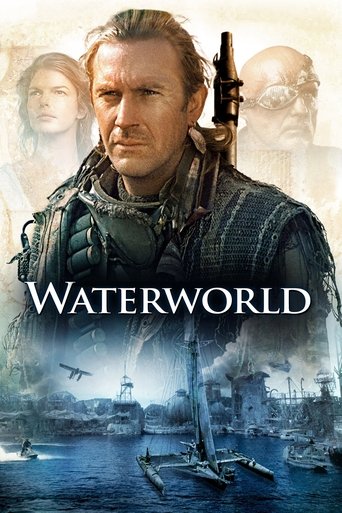
Waterworld
1995 · Film · 135 min
Directed by Kevin Reynolds
In a futuristic world where the polar ice caps have melted and made Earth a liquid planet, a beautiful barmaid rescues a mutant seafarer from a floating island prison. They escape, along with her young charge, Enola, and sail off aboard his ship. But the trio soon becomes the target of a menacing pirate who covets the map to 'Dryland'—which is tattooed on Enola's back.
4 positive8 negative16 neutralfrom 28 commenters
Where to watch
No streaming data for this title.

32 comments on Hacker News
It's up there with Waterworld and The Fifth Element, in that they're un-ironically some of my favorite films.
Waterworld is my partners favorite film of all time.
Maybe thst people didn't want to nitpick the most expensive film of its time? We can compare Waterworld to The Force Awakens if you wish, I suppose.
The Book of Eli War of the Worlds 2012 Day of the Triffids (TV series) The Bodysnatchers Waterworld The Postman Contagion
Seeing Costner...old...hurts in a weird way. He was in many ways my generation's James Dean, the cool man's man every kid wanted to be.
I never got cool, and now I'm "old" too, it just doesn't always set in until you see your hero looks old, too.
I think I've loved every movie he's been in, save maybe Waterworld. I have little doubt this one won't also be a success. Westerns have fallen out of fashion generally, so interested to see what spins he brings to modernize it, if any.
I ‘m watching “A new hope” and “Waterworld” and it’s amazing how practical effects can hold up. I’m not against CGI, but they’re all over the place in Marvel’s movies. Even “The Ten Commandments” is more watchable than “Love and Thunder”
There is no realistic scenario provided for by current scientific knowledge that would lead to that outcome. Waterworld was a film, not a textbook.
Something else I read reminded me Citizen Kane was submarined for years by the industry on Hearst's say-so.
But this is different: people are drifting away as eyeballs from arty films? Maaaybe, but also maybe not: I love scandi quirky sheep farmer love stories, maybe the foreign Oscar segment is alive and well?
Art films cost a frightening amount of money but far less than waterworld or heavens gate. It's all relative, when it comes to residuals and like citizen Kane, it can take time to get there.
Any time a social media system goes down, I feel like Depth Gauge in Waterworld[0].
It is an end (albeit temporary) to lack of social contact (because they are too busy to meet in person or talk to me face to face), but with an ironic boom, I only hear how miserable they are because the social media is down.
[0] https://www.imdb.com/title/tt0114898/characters/nm0696512
> Billionaires spend a small fraction of their money on superyachts and keep most of it invested which is the system working if you believe in it.
But in the event of a major war, and if it goes nuclear, biological or chemical, the billionaires can hole up on their yachts and ride it out in the relative safety of the middle of the ocean, just like the film Waterworld but less apocalyptic, so was the system working or is this why sanctions have been imposed? Its not like any of these billionaires can just take off now is it?
Yes. And the equipment. And the studio spaces. And the a-list actors/dir3ctors/producers who took home many millions each. 200million was once an insane budget (Waterworld) but with movies these day grossing into the billions (Endgame et al) 200mil is no longer a stretch.
Although terrifying, a map showing exposure would be fascinating. As an aside, this makes me instantly think of an old movie, Waterworld with Kevin Costner.
In honor of this movie, Kevin Costner's "Waterworld" was dubbed "Kevin's Gate" by press at the time.
In all seriousness, Cimino's magnum opus was just one of many high profile disasters that resulted from directors being given complete creative freedom throughout the 70s.
It turned out that having the suits breathing down the necks of filmmakers was, perhaps, not such a bad thing afterall.
The TV and film industries are heavily unionised across multiple sectors--tech, writers, actors, directors, etc.--and it's the norm to complete projects on time and on budget, or with immediate compensation for planning failures leading to overtime/crunch time. Think about the massive amount of content routinely produced for TV and film and tell me how unions make that impossible.
Somehow, the large investors still make lots of money. The primary effect of unions in this space seems to be that they put an actual dollar cost on poor management. When you hear about boondoggles like Heaven's Gate or Waterworld, what you hear isn't that unions screwed it up; you hear about the prima donna director who couldn't get it all "just so" with a couple hundred million to work with.
My employer, a digital services agency, pays hourly overtime of 1.5x. Then the professional PMs we have work very hard to accurately forecast and estimate. I've had crunch periods in which I've been paid overtime, but they're rare because the business has incentived itself to execute on-time and on-budget, mostly by not promising what we can't deliver and expecting the workers to pick up the slack.
Given the agricultural issues in that movie, perhaps the purification device was intended more to collect and concentrate the urea than to purify the water.
But that assumes the scriptwriter would have thought of that, which may be a stretch, given that Earth has insufficient water to cover all landmasses to a depth of 7 km. That would require about 3.6 billion cubic kilometers more water than already exists in the oceans, and there are only about 1.4 billion cubic kilometers of water on Earth to begin with, . Certainly there isn't that much locked up in glacial ice. That is only 26.5 million km^3, which is enough to raise sea level by a maximum of 52 m, far short of the 8 km it would take to cover everything but Mt. Everest.
Anyone who would skip that bar-napkin math was probably only putting that scene in specifically for the gross-out factor. It's just like Mad Max eating the can of dog food. Which is an apples-to-apples comparison, because Waterworld was written specifically to be an ersatz Mad Max.
You are correct, but I think your prediction false. We need to remember that "Hollywood" is a specific set of entities. We're not talking about independent film producers. We're talking about the largest film publishers. And those film publishers are like publishers in any other creative endeavor - they have been almost completely eliminated in having any business reason to exist. While their empires were built upon solving the problem of distribution, that no longer has any value whatsoever. In fact, due to the ways they built their distribution networks, they are severely hampered in the ways in which they can actually do distribution compared to purely digital/online firms. Distribution, the golden goose that made them billions, is now a noose around their necks. Whereas once they funded new productions as a side hustle, something that was necessary just so they had something to distribute, their role as a source of money is now the only thing they have to offer that has any value.
Anyone can distribute a movie. A clever 12 year old who knows how CDNs work can set up global distribution in their spare time for fun. This is a problem. Being reduced to a source of funds in a creative business is almost guaranteed business death. In the past, total control over the distribution chain allowed movie publishers to manipulate things to be profitable. There is a very inconvenient fact that businesses in the creative space have to deal with (although they never admit it, not even to themselves) : the public response to any creative work is random. Truly and perfectly random. There is nothing you can do to improve your odds, they remain even. Sure it seems like there are things you can do to bend things in your favor, like use big-name stars, throw a lot of money at the project, etc. But run the numbers. It doesn't work. Not even a little. For every Titanic or Avatar you have a Waterworld or an Ishtar. The book 'A Drunkard's Walk' has a couple chapters about the creative fields, book publishing and movie publishing specifically, where they go through the research and the numbers. It's just random. The audience is different every time, so it makes sense that the end result is randomness in the theaters on opening weekend and right after publication.
So what do you do if you're a business who wants to make money, and your industry has changed from being this thing you could control and make profitable, kicking your failures aside as fast as possible and keeping your successes around for as long as possible, to being mostly a game of chance? You lean on the little control you still have, of course, and movie companies definitely do that in the theaters. Good luck catching a movie after opening weekend if not many people showed up that weekend. Maybe go see Avengers: Endgame for the third time? But that's pretty limited in how much it helps. It still hurts badly to drop $10 million filming a movie and then having to kick it to Bluray or streaming after 4 days in cinemas. What you do is play it as safe as humanly possible. You don't take any chances. You make sure the movies have big names, have big special effects, have big budgets, and you definitely don't do anything that would ever risk limiting your market whatsoever. You don't mention religion, you stay away from politics, you absolutely prostrate yourself at the feet of anyone and try to make the most broadly palatable thing you can based on aggressive focus-testing, analytics, etc. You go wholesale soulless. It's the only option, really. And it probably still won't work. It will probably still catch up to them eventually. Because you can't escape the numbers, and big chances even on the safest bets at the craps table is still gambling.
The creative work will continue to come from independent filmmakers, and their destiny is bright. Not billion-dollar Avengers: Endgame bright, but bright enough to keep yourself warm beside and make a living off of. No longer do they have to keep their fingers crossed and hope Weinstein buys the rights and puts it on a shelf somewhere to prevent it from competing against him in the box office. They can sell to Netflix or Amazon or Disney or just "publish" the thing themselves. And a niche market is fine and survivable.
You ever see the movie Waterworld? Some people actually believe that to be a possibility.
Reminds me of the movie Waterworld.
>Although it is a huge risk, this is the modus operandi of Hollywood blockbusters, AAA games, and many live acts.
Statistical analysis suggests it is really just the same risk as a small production: 50/50. For every Avatar, there is a Waterworld.
>While it's true that you don't have a definite formula for success, the quality of the result is a thing you can control for in some degree just by hiring people with a track record(another avenue of capital: buy the visible superstars), and then providing them with this marketing infrastructure to work within.
That, too, has been extensively studied. For every star-studded mega-hit, there is a star-studded mega-flop... and a mega-hit populated only by unknown first-time actors. Once you look at all the data, there really isn't anything you can do to budge the needle. Big stars will not increase your chances of success. Big budgets will not increase your chances of acclaim. The only studies that have shown actual predictive power before the release of a media property dealt with Tweets sent within 48 hours of the public release. And obviously, it is quite a bit too late at that point to make funding decisions. This fact isn't new, history is littered with tales that show that even those whose sole career it is to spot and publish successful works have horrendous track records. I just read last night that in the 1970s, the book Zen and the Art of Motorcycle Maintenance was submitted over 200 times to publishers and once someone did agree to publish it, they expected to make no money on it. It almost instantly became the best-selling philosophy book of all time. Not even the most stellar hit can be spotted beforehand.
The book 'A Drunkard's Walk: How Randomness Rules Our Lives' has a couple chapters about this and I think explains it quite well. The main issue is that the audience is never the same. If a film hits the theater this week versus next week, the available audience is fundamentally just not the same people. Few people go to the theater every single week, so your ability to really nail the tastes of the audience of this weekend won't help you if you release the following weekend. They back this up with research, specifically including research about the factors you mentioned like star power, production budget, etc. The publishing industry has always been ruled by superstition because that's how human beings respond when put in a position of total randomness. They will say that certain publishing companies CEO is a 'tastemaker' and 'knows what the people want'... analysis, however, shows that the CEOs who had this reputation were actually benefitting from the success of projects started under the tenure of the prior CEO, then when the projects they themselves backed got made and didn't perform as well, they "hit a cold streak", left, then the next exec started getting credit for their later projects, and the cycle repeats itself. If you're in that industry and looking to make a career, it's hard to build upon an honest "well, I will roll the dice and hope for the best", so fanciful mythmaking is essentially encouraged.
I'm not aware of research specifically controlling for the random response of the public and examining the influence of marketing alone. It would be interesting to see. A battle for peoples attention is absolutely what it boils down to once the publishers lose control of distribution and can no longer meaningfully restrict what options the audience has which was always their primary means of ensuring a positive return despite random outcomes from each individual effort.
Very nice. In the 1990s, when I was doing Softimage physics plug-ins, I met the guy who did the first good water surface shader. The first application was Waterworld, which was such an awful movie the reputation rubbed off on his plug-in. Then he sold some to Titanic, and the business improved.
(Add-ons for Softimage were a crappy business. "400 people chasing $4M in revenue", one Softimage rep told me.)
Plinkett is saying that my brain noticed that the animation correctly accounted for the movement of the lamp. That is not an argument against not bumping the lamp in the first place.
I'll bet dollars to donuts that Howard the Duck, Waterworld, and every other big budget bomb you can think of has a lamp bumping in it. They were wastes of money in those movies, and if those movies had been successful like Who Framed Roger Rabbit, they still would have been wastes of money.
Like other posters have said, the author appears to be pointing out shortcomings with HTTP, not REST. Roy Fielding made it fairly clear that REST is not strictly associated with HTTP. REST, as an architectural style, is defined by a set of constraints: https://en.wikipedia.org/wiki/Representational_state_transfer#Architectural_constraints. Anything that meets these constraints is considered "REST". Most of the constraints sound like common sense for API design, and where most APIs are disqualified from being truly "REST" and merely "RESTish" is in trying (or not) to fulfill the Uniform Interface/HATEOAS constraint: that the client dynamically traverses information and operations from one resource to another via hypermedia links.
Interestingly there's yet a deeper problem with fully RESTful APIs (Hypermedia APIs), where REST's Stateless Protocol constraint combined with HATEOAS creates an API where clients need to undergo multiple HTTP round trips to load the data they need. For example, suppose your app lets users browse movies. You might have a sequence like:
client: "hey, I'm gonna act like a browser and hit api.com and take it from there" GET api.com => { "movies": { "rel": "content/movies", "href": "/movies" } }
client: "hmm, ok I guess I'll click the movies link" GET api.com/movies => { "items": { "count": 4, "prev": null, "next": "/movies/page/2", [ {"href": "/movies/1"}, {"href": "/movies/2"}, {"href": "/movies/3"}, {"href": "/movies/4"}, ] } }
client: "ok, I guess I'll fetch each of those movies (I kinda wish the server had just told me what those contents were in the first place)" GET api.com/movies/1... etc. => { "href": "/movies/1", "rel": "self", "title": "Waterworld", "image": "/images/waterworld.png", } ...
And don't forget the client-side logic to join/order all this data and handle errors. This problem is called "underfetching" and it's present in true REST APIs by design. Ironically, many "RESTful" APIs break from the REST constraints specifically to avoid this problem.
Another great article on REST APIs: https://martinfowler.com/articles/richardsonMaturityModel.html
Another interesting movie dealing with post-apocalyptic resource-constrained humans is Waterworld (1995).
But on the other hand, even if every non-floating glacier and snowpack melted and flowed into the ocean, that would only increase its mass by 2%. Combine that with the maximum thermal expansion from -4 C to 50 C, which would increase volume by 1.5% (and kill us all), and the highest the ocean could possibly rise above its current level is about 10m.
The highest storm surge ever recorded was about 15m. The tsunami waves from the destruction of Krakatoa ran up to 50m tall.
So now you are armed with the knowledge you need to scoff haughtily at scientifically inaccurate Hollywood movies. For further reference, 1 WTC is 541m tall, Empire State Building is 443m at the top of the antenna, BoA tower is 366m, Chrysler and Times are both 319m. NYC has more than 200 buildings over 150m. The Statue of Liberty is about 93m.
So when you see that scene in A.I. (2001) where the arm and torch of Liberty barely protrudes above the surface of the ocean, you can say, "Ha! The planet doesn't have that much water on it! Even on an ice-free Earth, and NYC in the heart of a hurricane storm surge the same size as the worst in recorded history, the water wouldn't even reach her big toe!" Waterworld (1995) is right out--the premise is scientifically impossible. You would have to systematically throw comets into Earth capture trajectories with a total mass of about 3x10^21 kg, adding double the current mass of all water on Earth, or about 1/2000 the current mass of the Earth. That's about the same amount as all the water on Europa.
It always amazes me how the people in the content creation industries keep their jobs. Even though comprehensive studies have shown that the public responds randomly to entertainment products, they still skate by claiming to 'know what the public wants.' Analysis of the decisions of past executives at movie companies showed that executives who were said to be "on a hot streak" were mostly benefitting from the results of projects started by their predecessors, and then when their "streak" ended and they left, their replacement got the same benefit from the projects they left in the pipeline.
The book 'A Drunkard's Walk' analyses various different industries and situations and shows where randomness shows up. The success of media is one of the strongest ones. No factor correllates with success. Not budget, star-power, genre, directors, nothing. For every runaway hit there are exactly as many abyssmal failures. Before Titanic hit theaters, film critics and industry insiders were dead certain that it would prove to be the most monumental theatrical failure in history, making Kevin Costner's Waterworld look like a walk in the park. Of course, they were wrong. They will always be wrong as often as they are correct. Their entire careers are built on, quite literally, absolutely nothing. These executives choose what gets produced, and they are incompetent at it. Yet they are paid millions of dollars. It's astonishing that they get so far with unmitigated bullshit.
This is why large movie production houses will die. Their performance has always been random in terms of producing successful content. But they always made up for it by having total control of the distribution. Now, distribution is worthless. Any 12 year old with an Internet connection can distribute media better than large corporations can. Take away that control and profit from distribution, and those companies will end up simply fading into bankruptcy after enough failed projects pile up.
The first episode of The Walking Dead comes to mind. I'd also volunteer Waterworld and The Day After Tomorrow, but those are a bit too obvious and not worth the money.
Production quality and artistic quality are not the same things.
Crouching Tiger, Hidden Dragon was a low budget film, for example. It's budget was about 9% of the budget of Waterworld.
In the film Waterworld, they have a device to purify urine - you crank the handle - but funnily enough they aren't using the device to clean seawater. Just another plot hole...
>In the pantheon of artistic endeavors ruined by a combination of hubris, too much money and too little discipline, Duke Nukem Forever now joins the likes of “Ishtar,” “Waterworld,” and “Spider-Man: Turn Off the Dark.”
It's actually funny that the author chose to compare computer game to two movies and a play. There are better (okay, more relevant for gamers) examples that pop into mind, like Daikatana or Doom 3.
P.S. And Waterworld is actually a quite entertaining movie.
I saw the movie Waterworld and I dont think I want to live that way. I've become quite fond of trees, mountains, open spaces, and long hikes without a lot of people around.
Anarchy sounds pretty silly to me. Friedman already says they will need police to make sure they aren't harboring terrorists. Sounds like laws and government to me. Building codes? I would think you would need those on a floating community. Maybe a fire department too. Probably like a community maintenance fee. Sounds like a tax to me. What do do with those citizens who cant care for them selves, the sick, the mentally ill, the young, the unskilled? Row them to the mainland ald let some government care for them?
Well, Pirates of the Caribbean has been a Disneyland staple attraction since the 1950's, so they've got nearly 50 years of data to go on, on whether they should continue it or not - it's exactly why they made the first film.
When you consider how much the first film made, given it's actual cost (and the acclaim Depp got for his character) - the 2nd and 3rd weren't really that much of a gamble, but one that ultimately paid off.
The film industry isn't entirely an exact science, WALL-E for example had an entirely different ending which Pixar redid after it's first screening, after Andrew Stanton realised he had made an error in the way the story flows.
You also have major blunders - Waterworld anyone? It cost nearly double the budget that was set aside for it and it's gross revenue was barely more than that. The budget doesn't take into account the marketing costs, so money was lost on that film.
Umm, its exactly what its about.
He's complaining that "the big evil internet" is killing their business, because more people are consuming more media.
Yet however, the actual data shows that ticket sales in cinema are actually going up, but not at the same rate of consumption of those films. The people that had no intention of paying top shelf price for those films are not.
Yet the budgets for films have gone way up so that these studio's can compete with each other. Yet, the growth of ticket sales hasn't grown at the same rate (while rentals have stayed fairly static, just the distribution channels have changed somewhat) - so their profit margins have become less.
So he's complaining that the people who had no intention of paying to see those films, are not paying to see those films and because they've chosen to raise the budgets of those films significantly, its killing their business.
http://en.wikipedia.org/wiki/List_of_most_expensive_films
Films like Titanic and Waterworld were notoriously expensive for their time. Now that's considered nearly an average budget for a blockbuster - inflation sure as hell hasn't gone up by that much, and costs of actual production have gone down with going to digital media, digital editing etc....
What they really need to focus on, is less extravagant budgets. Take a leaf out of the book of TV.
Lost, which is a notoriously expensive TV show to produce, cost $44 million dollars for the first season which consisted of 25 episodes at 44 minutes running time each... or roughly 0.04 million dollars per minute of entertainment for the end viewer.
Similarly, lets look at Spiderman 3.. Sony Pictures most expensive film, $258 million dollars cost with a running time of 139 minutes, or 1.86 million dollars per minute of entertainment for the end viewer.
See the big divide there? It's really a function of cost of production.