 Hacker Cinema
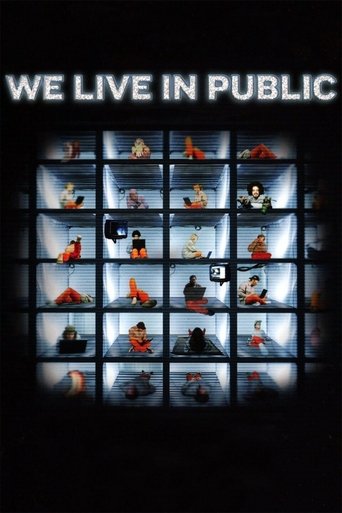
We Live in Public
2009 · Film · documentary · 89 min
Directed by Ondi Timoner
In 1999, Internet entrepreneur Josh Harris recruits dozens of young men and women who agree to live in underground apartments for weeks at a time while their every movement is broadcast online. Soon, Harris and his girlfriend embark on their own subterranean adventure, with cameras streaming live footage of their meals, arguments, bedroom activities, and bathroom habits. This documentary explores the role of technology in our lives, as it charts the fragile nature of dot-com economy.
19 positive6 neutralfrom 25 commenters
Where to watch
No streaming data for this title.
26 comments on Hacker News
Are you conflating telemetry with literally live-streaming your life to Meta? Because that's what makes the statement weird.
edit 2: OK, I see what you mean. But I'm wondering if it should be possible to consent to this via T&C. Basically the same issue as with many online services, turned up to 11, sure. And it involves OTHER people, who have not consented.
Stuff like this used to be outrage fuel even when it was more of a social experiment, e.g. the documentary "We live in public" or the "Big brother" TV show. By now, I'm sure there have been millions of influencers doing similar things, but it's very much not considered normal?
Streaming to an unknown number of employees might be considered different from streaming to the public, sure.
But the core question here is whether there's informed consent, and, IMO also, if it should be possible to consent to this when the other party is a company like Meta and the pretext is not deliberately seeking attention (like influencers and streamers do).
edit, clarified social media comparison
Yeah, the shift in acceptance is really interesting to see.
This documentary has always stood out to me:
https://en.wikipedia.org/wiki/We_Live_in_Public
While it's not explicitly stated, I would like to respectfully disagree with the notion that developers who avoid webcam use in virtual meetings are being "difficult" or impairing communication by omitting visual cues. Although non-verbal signals can enhance interactions, the insistence on webcam use neglects deeper issues of psychological comfort and privacy, which are particularly pertinent for individuals from minority groups or those with lower social status. For some, not displaying their environment might actually level the playing field.
Your point about body language is well-taken, but it’s crucial to recognize that much of human communication is rooted in biological signals that webcams simply cannot capture. These include oscillatory patterns in our nervous systems, pheromones, and pupil dilation—subtle cues that are crucial for face-to-face interactions but are lost in digital communication. If we find ourselves overly concerned about body language in pixelated, compressed, and inherently artificial digital formats, we might need to reconsider if remote work is suitable for us.
Moreover, it’s important to acknowledge that not everyone interprets social cues in the same way. Neurodivergent individuals, for example, may struggle more with deciphering body language, suggesting that the capacity to do so is not universal but rather a privilege.
Have you had a chance to watch We Live in Public? This documentary delves into an early internet experiment where constant surveillance led to significant stress and self-censorship among participants. Though not a direct analogue to virtual meetings, the film highlights the psychological toll of persistent observation—a toll that does not necessarily foster better communication or collaboration.
In my own experience, I've worked with several developers who prefer to keep their cameras off, and I've observed no detrimental impact on the quality of their work or on team dynamics. If you've noticed that developers who disable their cameras tend to be problematic, it might be worth revisiting hiring practices to ensure they align more closely with the diverse preferences and needs of tech talent.
As for my personal preference to keep the camera off, I prefer not to share too many details, but I've included links to several studies that discuss the broader implications of webcam use along with a more recent study about a potential camera alternative, biosignal data.
- https://ieeexplore.ieee.org/document/10599432 - https://psycnet.apa.org/buy/2021-77825-003 - https://tmb.apaopen.org/pub/nonverbal-overload/release/2 - https://www.tandfonline.com/doi/full/10.1080/13678868.2022.2047380#abstract - https://www.mdpi.com/2673-8104/3/1/10
There's a really interesting movie called "We Live in Public" that documents one of the early tech pioneers Josh Harris as he sells his internet radio company and then creates an underground CCTV community. It's fascinating and equally frightening how people behaved towards one another while sharing space and constantly watching each other. It reminds me a lot the relationship many twitch streamers have with their viewers. You can find the movie for free on Tubi (in the states at least).
There’s an awesome documentary on pseudo.com and the late 90s/ early 00 startup scene. https://en.wikipedia.org/wiki/We_Live_in_Public
It’s funny because there was a whole New York start up scene and basically none of them made it and all the big stuff that lived was west coast.
Just a reminder, if you haven't seen it yet be sure to check out the documentary "We Live in Public"!
> Not for the lols, I don't care how rich you are losing 44b hurts.
A band named KLF burned a million quid back in the mid 90s. It was ostensibly "performance art" [1].
In 2000 formative internet commerce pioneer Josh Harris blew about 80 million in a few weeks on an "arts project". He is the subject of Ondi Timoner's 2009 documentary "We Live in Public" [2] He described it as "liberating" and said that other dot-com millionaires had "wasted their money" and didn't "know how to live".
Maybe Elon fancies himself as an artist?
[1] https://en.wikipedia.org/wiki/K_Foundation_Burn_a_Million_Quid
[2] https://en.wikipedia.org/wiki/We_Live_in_Public
Josh Harris was also active in Video broadcast scene at that time https://en.wikipedia.org/wiki/Josh_Harris_(Internet)
"the greatest Internet pioneer you've never heard of," https://en.wikipedia.org/wiki/We_Live_in_Public Glorious train wreck, highly recommended watch.
>art project "Quiet: We Live in Public," an Orwellian, Big Brother concept developed in the late '90s which placed more than 100 artists in a human terrarium under New York City, with myriad webcams following and capturing every move the artists made.[3] The pièce de résistance was a Japanese-style capsule hotel outfitted with cameras in every pod, and screens that allowed each occupant to monitor the other pods
There is structural similarity between the two, but in Synechdoche, Caden’s (the director) life is the explicit subject of the intradiagetic (in-narrative world) film. [0] The subject of the OP uses Soviet-era Russia and its surveillance state as the (um) synechdoche to stand in for the apparatus of the cinematic production.
To my mind, this project more closely resembles the disastrous subject of the documentary We Live In Public [1]
[0] https://www.imdb.com/title/tt0383028
[1] https://www.imdb.com/title/tt0498329
Interesting documentary of a few others living on the web at the same time, with a huge budget. This film sticks with me. We live in public. https://www.imdb.com/title/tt0498329/
Funny, I just watched "We Live in Public" (https://www.imdb.com/title/tt0498329/) the other day, where Pseudo was giving people free _everything_ (room/food/drugs/shooting range/etc.), but their entire lives had to be recorded (one hundred people were living in this place together).
Absolute insanity, and I just found an interview with the director as well, Ondi Timoner (https://www.youtube.com/watch?v=OSTLRgyt7pU).
Movie recommendation: We Live In Public
Yep, that's it, and that's the documentary I've seen on it as well.
Here is why I find it relevant.
The article starts with:
> What could the internet have been? [...]
That's what the article is basically about.
Now, let me quote about the documentary:
> The film’s website describes how, “With Quiet: We Live in Public, Harris proved how, in the affiliate future of standard life online, we will willingly trade our privacy for the connection and peer recognition we all deeply desire. Through his experiments, including another six-month stint living under 24-hour home security camera systems online which led him to experience nervous breakdown symptoms. Josh Harris displayed the demonstration effect of the price we will all pay for living in public.” [1]
The art project we discuss proves that the way it has become (privacy-wise) was inevitable because people are willing to make that trade off. "The cloud", Facebook, and recently Facebook paying kids 20 USD to install a "VPN" (Onava) on their phone logging everything are just one of the many examples of that.
It needn't have gone that way, if we learned earlier from that documentary and applied legislation. We can still learn and adapt, if we vote for electorate who don't listen to the big money (basically, the "cloud providers").
[1] http://weliveinpublic.blog.indiepixfilms.com/
Not sure what that has to do with the topic, but I think you mean pseudo.com - there's a very entertaining documentary about it
https://en.m.wikipedia.org/wiki/We_Live_in_Public
I found the documentary on Josh Harris and the first internet television network fascinating
https://en.m.wikipedia.org/wiki/We_Live_in_Public
YC did a recent podcast with former Artforum editor Michelle Kuo on Experiments in Art and Technology
https://blog.ycombinator.com/experiments-in-art-and-technology-with-artforum-editor-michelle-kuo/
And then there's Mondo 2000. Defining periodical of "cyberculture". Remains deeply influential even today
https://archive.org/details/mondohistory
I'd also recommend the documentary "We Live In Public" as a cautionary tale regarding networked utopias ;)
If this interests you see the documentary We Live In Public. It's also about early life streaming: http://www.imdb.com/title/tt0498329/
You think in the future more people will sell their lives to the extent that they let others decide what to eat, what work to do, when to sleep, who to date and who not to date? That would mean we're going back in time.
I found the article a fascinating read, but the more I think about it, the more I realize how very, very wrong this is. It reminds me of ‘We Live in Public’, the documentary about Josh Harris' experiments. http://www.capitalnewyork.com/article/media/2010/11/709256/singularities-josh-harris
If you think the sociology of today's "visual social media" is interesting (whether or not you find it useful), I recommend watching "We Live In Public":
http://en.wikipedia.org/wiki/We_Live_in_Public http://www.imdb.com/title/tt0498329/
The art project it documents turned out to be quite prescient.
Thanks for the suggestions - "we live in public" is on netflix instant so will watch it sometime this week:
http://movies.netflix.com/WiMovie/We_Live_in_Public/70112751
We Live in Public is a great story of what happens when someone without any real interest in building a company, but with a massive ego, gets access to capital. Great, chilling film.
Startup.com is a good one. It's about a dot com that failed back in the 2000 internet bubble.
http://www.imdb.com/title/tt0256408/
Also, "We Live In Public" is a good one too.
http://www.imdb.com/title/tt0498329/
Simple example are many famous artists. They used to be considered quacks, people who are a waste of canvas, but ended up being very influental and quite an important part of our culture.
Or take a look at music bands. First few albums are smashing hits, then suddenly, no more takers. Everything they create is simply not accepted by the fans. The mojo is gone.
Perhaps startups are a bit less fragile, or I just don't know enough history, but I think similar patterns emerge if you look widely enough.
edit: actually, We Live In Public (movie) could be a good example. Josh Harris had a really really successful first venture, after the web1.0 crash, nothing he tried doing really caught on and became something. At the end of the movie about him, he's hiding from creditors in africa or something.
Josh Harris is nuts. Watch the documentary, We Live In Public, on Netflix. I personally think he was a casualty of the dot-com. The money and fame went to his head, and when the bubble burst, it took him down with it.
The documentary is definitely food for thought, and it was a mind-blowing social experiment. Building a business around it, however, is not possible. Josh knows it, he has tried and failed several times over the past 10 years, and it destroyed his life. He's a remnant from a past era who, sadly, has no place in today's world.
I became aware of time - and how I decided to spend it - in a way that I never had before. Questions consciously presented themselves at every turn: What am I doing right now? Am I doing something interesting? More importantly, is my lifestyle something I'm proud of? Forfeiting so much of my privacy forced me to start living up to my own standards. "Should I watch another episode of Law & Order? I'll work on that essay first." On the whole, I became more productive. And there was much less, if any, drifting between daily activities. [1]
I noticed a similar effect when I started writing down how I spend my time. But it's starting to fade a little, maybe I should try this method ... although it feels kind of cumbersome.
Self-reflection can really suck sometimes, keep it up! :)
Edit: also anyone who is interested in this general topic should watch We Live in Public. It's a very lovely grim reminder of all the things that can get really strange once you start sharing your life with everyone indiscriminately.
Now would be a great time to watch "we live in public," a great documentary about Josh Harris and his experiments on the topic of privacy in the modern era.