 Hacker Cinema
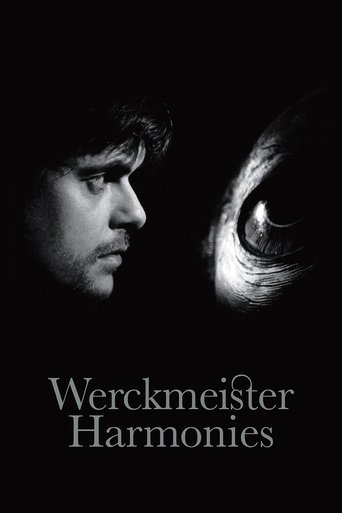
Werckmeister Harmonies
Werckmeister harmóniák
2001 · Film · 139 min
Directed by Béla Tarr
A naive young man witnesses an escalation of violence in his small hometown following the arrival of a mysterious circus attraction.
2 positive3 neutralfrom 5 commenters
Where to watch
No streaming data for this title.
Videos commenters linked
From YouTube links in the comments below. Most are clips and trailers; “Full” means the uploader says so.



5 comments on Hacker News
Thanks! Here's the full list: 2001: A Space Odyssey, 8½, Aguirre the Wrath of God, Ali: Fear Eats the Soul, All That Heaven Allows, Apocalypse Now, Ashes and Diamonds, A Woman Under the Influence, Barry Lyndon, Bicycle Thieves, Breathless, Casablanca, Céline and Julie Go Boating, Chinatown, Chinese Roulette, Citizen Kane, City Lights, City of Pirates, Contempt, Daisies, Damnation, Dishonored, Earth, Electra My Love, El Topo, Eraserhead, Eyes Wide Shut, Film Socialisme, Fitzcarraldo, Fuego en Castilla, Hiroshima Mon Amour, Holy Motors, Inauguration of the Pleasure Dome, In a Year with 13 Moons, India Song, Inland Empire, Irma Vep, Koyaanisqatsi, La Dolce Vita, La Jetée, Late Spring, L'Eau de la Seine, Le Voyage dans la Lune, Lolita, Los Olvidados, Lost Highway, Lucifer Rising, Man with a Movie Camera, Metropolis, Mirror, Mulholland Drive, Night Music, Ordet, Orpheus, Persona, Pickpocket, Playtime, Psycho, Rebecca, Rosemary's Baby, Rumble Fish, Scarface, Seven Samurai, Sherlock Jr., Singin' in the Rain, Stalker, Sunset Boulevard, Taste of Cherry, Taxi Driver, Testament of Orpheus, The 400 Blows, The Blood of a Poet, The Cabinet of Dr. Caligari, The Color of Pomegranates, The Green Ray, The Holy Mountain, The Isle, The Lady from Shanghai, The Night of the Hunter, The Passion of Joan of Arc, The Seventh Seal, The Spirit of the Beehive, The Tales of Hoffmann, The Tree of Life, The Turin Horse, Time of the Gypsies, Tokyo Story, Touch of Evil, Trans-Europ-Express, Ugetsu, Un Chien Andalou, Uncle Boonmee Who Can Recall His Past Lives, Vampyr, Videodrome, Wavelength, Werckmeister Harmonies, Wild Strawberries, Moonlight Sonata, Stellar, The Haunted House Biased toward European art cinema, experimental work, and directors who broke conventional narrative rules.
They truly feel like a match made in heaven. Krasznahorkai's own writing is lovely and lyrical, and Tarr's interpretation of it projects the same ideas onto the films but also in a way that makes it stand distinct as a medium.
I could watch this scene from Werckmeister Harmonies every day for the rest of my life: https://www.youtube.com/watch?v=_d5X2t_s9g8
And The Turin Horse as well: https://www.youtube.com/watch?v=8wPCkjN3n6s
Think of some magical Tarr adaptation of Seiobo There Below...
It is not easy to commit seven hours to a single movie; for me, Sátántangó was worth it. Warm up on Werckmeister Harmonies which is a short two hours since Bela Tarr isn't and doesn't need to be for everyone. That said, Sátántangó is in my top four movies of all time because of how well it reflects humanity and how much it says about how we interact with each other. (The cows are a metaphor for HN, obviously.)
You can't mention Krasznahorkai without Béla Tarr. Tarr's main filmography is basically Krasznahorkai's main bibliography: Damnation (1988), Sátántangó (1994), Werckmeister Harmonies (2000), The Man from London (2007), The Turin Horse (2011). I honestly say the films from Tarr are arguably the best book-to-film adaptations ever, especially Sátántangó, he is the master of literary filmmaking where the spirit of text comes across the screen perfectly.
It just means that melodies and harmonies are “supposed to be” sung and thus continuously pitched, where the ears of the musicians guide them to the proper harmonies. This is not feasible with keyboard or fretted instruments, so we have to make compromises if we want to play polytonal music on a single piano. 12-TET is a compromise that stood the test of time: ultimately a slightly “clangy” dominant seventh is preferable to the corrupt fifths and thirds you get with unequal temperaments.
I really don’t think there’s much more to it than that, except composers with picky ears should just bite the bullet with 17-TET or something. (I am a guitarist and sometimes I wish I had flatter thirds and tritones without having to bend the strings.) As shown off-handedly in the Werckmeister Harmonies novel and film, composers who get too deep into the weeds of temperament systems often find themselves confusing form with function and waging ideological battles, forgetting that the point of the exercise is create interesting music.