 Hacker Cinema
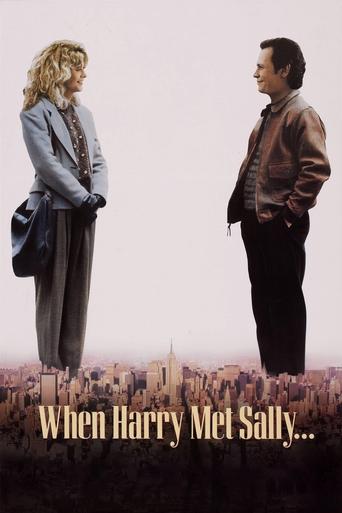
When Harry Met Sally...
1989 · Film · 96 min
Directed by Rob Reiner
Sex always gets in the way of friendships between men and women. At least, that's what Harry Burns believes. So when Harry meets Sally Albright and a deep friendship blossoms between them, Harry's determined not to let his attraction to Sally destroy it. But when a night of weakness ends in a morning of panic, can the pair avoid succumbing to Harry's fears by remaining friends and admitting they just might be the perfect match for each other?
5 positive11 neutralfrom 16 commenters
Where to watch
No streaming data for this title.
17 comments on Hacker News
> Games are doomed by femininity. Across media, genres marketed toward women are deemed lesser than their masculine counterparts: romance novels are trashy, chick flicks are shallow, and pop idols are embarrassing
This idea is trotted out but is really blatantly false when you think of it. Jayne Eyre, Wuthering Heights, Little Women, Pride and Prejudice, Sense and Sensibility. These books have all withstood the test of time and are considered fine literature but are absolutely feminine. Romance novels are considered less than because they are not good books, just in the sense that Conan the Barbarian is also considered not fine literature despite being dripping in masculinity.
Manhattan, Annie Hall, When Harry Met Sally. There are tons of "chick flicks" that are considered great films. Some directors like Catherine Breillat are extremely feminist in their works and well regarded directors with well regarded films in cinephile circles.
It becomes more challenging when the person is Carrie Fisher from When Harry Met Sally, “processing” the same information for years at a time. This is not a surprise. That he’s never going to leave her. You know the solution. You are the architect of your own stress. You’re torturing yourself for who? An audience of me?
I’ve watched that “you have a nail in your forehead” video again with the benefit of another ten years of life and it’s interesting how I saw what the women were saying the first time I watched it but on a rewatch it’s clearly making fun of her at least as much as him. You’re in the middle of a medical emergency and you want to just talk about it instead of calling 911. That’s a bridge too far.
And to think I always hated that trope in action and scary movies where the person wants to ask questions while being chased by a psychopath or a dinosaur. Compartmentalization is good - in appropriate doses.
> I live on a small farm with his wife, son, and two dogs.
Should you trust translations into English by someone who writes sentences like this? <joking>
In the movie When Harry Met Sally, Billy Crystal said hieroglyphics were actually a comic strip about a character named Sphinxy. Always hoped that was true.
I'd forgotten what an unusually strong and culturally-resonant line of movies the man had without (I think) the popular acclaim you might associate with them, like a low-profile Spielberg.
Spinal Tap
The Princess Bride
When Harry Met Sally
Sleepless in Seattle
Stand By Me
etc
A great loss, RIP
Can you believe that This is Spinal Tap, The Sure Thing, Stand by Me, Princess Bride, When Harry Met Sally, Misery, and A Few Good Men were all directed by the same man? What an eclectic set of masterpieces.
Three great movies that he directed that everyone around my age would be relatively intimately familiar with: This Is Spinal Tap, The Princess Bride and When Harry Met Sally
> Police are treating the deaths as apparent homicides. According to the L.A. Times, authorities have questioned a member of Reiner’s family in connection with the death. As of Sunday night, the LAPD have not officially identified a suspect, but Rolling Stone has confirmed that Reiner’s son, Nick, was involved in the homicide. A source confirmed to Rolling Stone that the couple’s daughter, Romy, found her parents’ bodies.
Alternative source:
> Senior law enforcement officials report that both had stab wounds
Tragic.
Anecdotally one thing I’ve noticed is that older films had much fewer characters.
Take a movie like When Harry Met Sally — there are basically four on screen characters, giving more time to build chemistry and relationships
I'm particularly glad to see the "Destroying culture" segment, though brief, as it touches on my main objection to modern advertising. In the piece, he mentions how an old work was re-purposed and "ruined" for him - though the phrasing sounds extreme, I completely understand. The concept described, as I interpret it, is about sparking an internal pleasure center for the purpose of inserting a commercial prompting to engage. This is especially problematic with "wants" type purchases - luxury items, status, etc. - compared to "needs" where a specific company is trying to differentiate itself from the pack.
I remember the hullaballoo when the Rolling Stones licensed "Start Me Up" to Microsoft. Last night, during the Superbowl, Meg Ryan and Billy Crystal reunited for a mayonnaise commercial aping a scene from "When Harry Met Sally" and I chuckled to myself how it was probably missing 2/3s of the viewership on the reference. Using Iggy Pop's "Lust for Life" by Carnival Cruise lines only sparks memories for me of Danny Boyle's "Trainspotting" and obviously they don't care. Same goes for when "Lord of the Rings" trailers had the Kronos Quartet playing under them, specifically the track featured in "Requiem for a Dream."
Honestly my breaking point was for a car insurance commercial where an accident occurred and the driver pulled an entirely new car from the trunk of the damaged car to represent the ease of returning to the prior state. It felt so absolutely deceptive I never will let it go. But that's not even the low point.
Pharmaceutical companies are now portraying "mini-movies" with the full narrative arc to create the sensation that a full and happy life is possible if only you ask your Doctor about some random-ass pill for a condition likely best treated by a change of lifestyle. The one I have in mind is a football coach where he's a family man, a teacher, and then gets a commemorative portrait unveiled at a game because he's so beloved. The culture damage of these bastardizations of narrative and story are a runaway freight train - always in slow motion mind you - and every time you see a historical figure selling you something, just remember that they're dead and couldn't complain. If it wasn't for Crispin Glover's lawsuit win all those years ago, Kurt Cobain might be selling anti-depressants and Jimi Hendrix a Kia or something.
I don't really care about technical specs of cameras or film or whatever, but I think the author is largely just wrong. At least on their comparison between Moonshot and When Harry Met Sally. Those are just different films. The Moonshot still is CLEARLY using color with great intention. It's not a realistic scene. It's a carefully designed shot. The characters, the coffee, and the table are yellow. The background is green. That's interesting. It makes the scene feel very small and intimate. The Harry diner scene is cluttered and chaotic. You have a bunch of background characters that add to the scene by looking at the main characters. You get a lot from this still. That's also interesting.
I have not seen any of these films
The author doesn't address that blockbuster movies have always found a "trendy look" and run with it. Is what she claims Netflix is doing any different than any other popular cycle in filmmaking?
"It's actually, specifically, about how movies these days look. That is, more flat, more fake, over-saturated, or else over-filtered, like an Instagram photo in 2012, but rendered in commercial-like high-def."
The "2012 Instagram filter" was pulled from the same playbook as the popular movies of the 2000-2010 era. However, the author isn't arguing that this trend has been taken too far; just stating that everything looks bland and the same. Of course, it does. Only some movies are original and try something new because audiences like familiar things. Successful visual storytelling methods are recycled just the same as scripts.
When comparing "When Harry Met Sally" and "Moonshot" the author says,
"... The latter is more polished and "perfect," but to what effect? It looks strange, surreal, both dim and bright at the same time. Everything is inexplicably blue or yellow, and glows like it's been FaceTuned. Meg Ryan and Billy Crystal, meanwhile, are sitting in a downtown New York deli that actually exists. The image is a little grainy, the lighting falling somewhere in the normal daytime range, and they look like regular human beings. ..."
One is a science fiction film the other is set in a New York deli. So they both don't want to evoke the same feeling in the setting to the audience.
I had to stop reading when the author said,
"At the risk of using an anonymous Redditor as an expert, lol, I found a comment under a thread called "Why do movies look so weird now?" that captures a lot of these same complaints:"
Then she goes on quote the Reddit comment. LOL right? The Redditor's comment was a single paragraph and summed up the author's entire point of view. She just went on to write a longer post that failed to say anything additional. Read the Reddit comment she quoted and skip the article.
For folks who don't want to click, the argument is Indiana Jones didn't have an impact on the outcome of the story; the Nazis still would have found the arc and died in the end.
It's an amusing idea, but I've always thought it was weird to call it a problem with the movie, as it would apply to the protagonist in a bunch of movies (spoilers abound in this extremely random assortment of movies off the top of my head):
* If Kurt Russel's character hadn't been in The Thing, everything that happened still would have happened
* If Harry and Sally hadn't been in When Harry Met Sally, New York would still be Yorking
* If Florence Pugh's character hadn't gone to Sweden in Midsommar, the tourists still would have died
* If Richard Dreyfuss's character hadn't been in Close Encounters of the Third Kind, the aliens still would have made contact, dropped off their old passengers, and picked up new passengers
* If Scott Pilgrim hadn't been in Scott Pilgrim, everyone would probably still just be hanging out more or less the same
* If Matt Damon's character hadn't been in The Martian, they would have all still ended up back on Earth
* If Rocky Balboa hadn't been in Rocky, probably two other people would have boxed and one of them would have won
To each their own, but for my money good stories are about character journeys, not about... I dunno, like, an accounting of what changed during the movie.
I agree (including When Harry Met Sally) if you include ~1935-1955 which was a of great experimentation. The films that held up well weren’t always the prize winners though.
I know this is an easy downvote and foolish statement, but I find very few pre-90s blockbuster movies to be watchable. Spielberg's movies hold up well though. There are a few others, like When Harry Met Sally, that I also still love.
Thank you friend :)
As dhess pointed out below it's a moment from a scene in the movie When Harry Met Sally. The wording above, however, is my own.
That scene just happened to pop into my head when I read the word defenestration, so I decided I'd like to "use it in a sentence". I've read some Pynchon in my time, too, so I have a penchant for densely descriptive prose. I'm glad it was appreciated.
I should have clarified: there's no sampling bias. These are incredibly popular movies. Here are some movies not on Netflix streaming that I've wanted to watch this year: Gladiator. Star Wars IV. Shawshank Redemption. The Wizard of Oz. When Harry Met Sally. The Princess Bride. All Star Trek movies. Goodfellas. Lord of the Rings. Gone with the Wind. All Godfather movies. Monty Python and the Holy Grail. Airplane. American Graffiti. The Usual Suspects. All Jim Carrey movies except a bad one (the Grinch) and one I've never heard of (the Number 23). Toy Story. There's Something About Mary. All Austin Powers movies.
The last time I tried searching for a good movie to watch on Netflix streaming, I gave up after 10 minutes. I'd think of one movie after another after another. Nothing was there. All it could suggest was "related titles," as if that's what I would want.
That said, I did not entirely agree with them :)
I agree that Kickstarter is unlikely to raise 300 million dollars for the next Hobbit trilogy. I disagree that a huge blockbuster will never be crowdfunded. Transformers, Harry Potter, and Avatar all cost less than 300 million dollars. 30 million people pre-paying 10 dollars is not ridiculous, when you look at how many people use Google, and how many users Facebook claims to have.
Surprisingly, movie studios don't necessarily fund the projects that they profit from. Since you mentioned LotR universe:
"New Line made enough pre-sales in foreign markets, and there were enough subsidies to pretty much cover their costs. New Zealand was not the only subsidy. There was also the British Commonwealth subsidy and the German tax subsidy in those days. New Line didn't have to put up any cash to make that movie."
Also movie studios consistently claim to not make profits from their movies.
"However, New Line later produced accounts showing that instead of making a profit, the movies made "horrendous losses". According to Hubbard: "We found it surprising because it was one of the biggest box office success of all time.""
Other funding options: a company could start making short films and then transition into making larger, more expensive ones once it gains the trust of its audience. The films could be broken into "episodes" to reduce the amount of money that each chunk would cost. This all ignores patronage, another alternative funding mode.
Lastly, most movies aren't blockbusters. Even if everything I just said is a lie, the vast majority of movies will be just fine, because their budgets are laughably small. District 9 was shot for 30 million dollars. Primer was shot for 7000 dollars. When Harry Met Sally cost 16 million dollars. Citizen Kane cost 15 million. Pretty Woman cost 14 million. The government funded BBC has produced such things like The Office, Monty Python, and Billy Elliot on less than 5 million each.
http://www.nzherald.co.nz/business/news/article.cfm?c_id=3&objectid=10693123
http://en.wikipedia.org/wiki/Hollywood_accounting#Examples
From a user's perspective, after describing your company as the "Airbnb of pet sitting" you may have to follow that up by describing what Airbnb is. My parents (the benchmark by which I judge all potential customers) would have know idea what Airbnb is...but they do know that their golden retriever needs a cheap place to stay while they go on a cruise next month. So the best way to describe it to them is:
Stayhound - we use social connections to help pet owners find pet sitters for less than kennels charge
I can't speak from experience with investors, but to me describing your business as the "X of Y" makes it sound derivative, like the old style of movie pitches (e.g. "it's When Harry Met Sally meets Beetlejuice...on the Titanic!"). I think it's better to succinctly describe your product or service, while avoiding marketingspeak or names of other companies. Of course, investors may think otherwise.