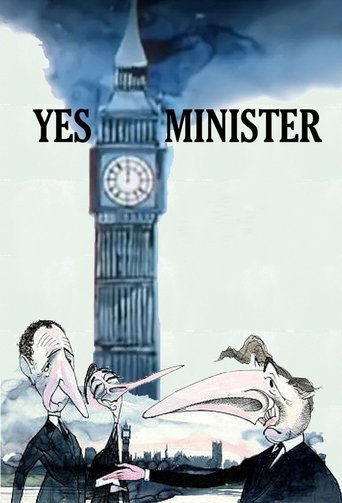
Yes Minister
1980 · TV series · 30 min episodes · 3 seasons
Created by Jonathan Lynn, Antony Jay
Satirical sitcom set in the office of a UK Cabinet minister, Jim Hacker MP, who struggles with Civil Service bureaucracy and political machinations as he tries to get on with government business.
57 positive3 negative2 mixed38 neutralfrom 100 commenters
Where to watch
No streaming data for this title.
112 comments on Hacker News
I'm reminded of an episode of Yes Minister with an empty hospital. The hospital has a full complement of administrative staff but no physicians or patients.
Here's a clip: https://www.youtube.com/watch?v=Eyf97LAjjcY
You know Yes Minister was a documentary, right? ;)
Buying from PWC reflects badly on them with us, because we know tech. It does not reflect badly with other civil servants, because PWC is a highly-respected organisation.
It's very similar to "No-one got fired for buying from IBM", which was a cliche because it was true.
Just like that excellent Yes Minister episode about hospitals - I imagine they have more then enough internal busywork so they have no time for their customers. Which the older am I the more this seems true.
I think Yes Minister has some good clips on YouTube but I can't watch it for a whole episode.
I think this episode of Yes Minister is rather relevant, albeit EU focused.
https://www.youtube.com/watch?v=ZVYqB0uTKlE
Actually the entire theme of Yes Minister, one of the best parodies of how the government is run is that not a single important decision or discussion is had in a public forum. Many episodes involve burying particularly incriminating official records.
While it's certainly possible that there was some sort of sinister plot here, it is also possible to read it as "overconfident outsider, who's actually kinda thick, tries to do government cost cutting without really understanding what the government is or does". And this happens _a lot_, though they're not usually given so much rope to hang themselves with. Like, this is fairly easy to read as incompetence, in a field where even people who actually know what they're doing really struggle.
There's a decent example in Yes Minister (episode 3: Economy Drive).
There's a great documentary on the topic, it's called "Yes Minister"
British TV is doing _great_ in the streaming era: black mirror, adolescence, peaky blinders, the crown, call the midwife, derry girls, downtown abbey; and so many great police procedurals: line of duty, endeavour, the bay, Sherlock, grace; even those Harlan coben miniserieses - the ones with at least one absurd plot twist per episode - are great fun!
While I’ll be among the first to moan that we’ll never see another red dwarf, python, tinker tailor/smiley’s people, yes minister, father ted [0] .. British tv is still producing great stuff.
It’s the “bureaucrats” in the bbc who are under threat from streaming. I’m not losing sleep!
[0] made in Britain; simply could not have been made in Ireland as was.
It shouldn't be market rate because you get job safety. Most have never worked in private sector before and has no idea.
Salary should be dependent on Jobs nature and ability. Not by grade. Currently it is simply a power structure and hierarchy.
People should be promoted on merit. Unfortunately most working in public sector lack the ability to judge. If you think power play, bureaucracy and failing up is a thing in large enterprise. You haven't seen civil servant yet.
I cant remember which party it was but stopped the Pay Band usage and everyone is simply paid by the starting rate. UK civil servant has basically stopped most salary increase for a long time.
Because of that, instead of pay raise a lot of people got promoted which is basically everyone in every department has inflated grades. These promotion are also problematic, again, not based on merit. There are now more SCS1 than ever.
40% of work are irrelevant and made up by seniors to improve their chance of promotion. Another 50% of the work are getting around bureaucracy, only 10% of the work are actually useful.
And there is no way to fix it. Ministers dont want to fix it because they rely on cvil servant to get things done. Civil servant internally lack the interest to reform. And if anything the power of a department is measured by how many staff it has.
But none of these are new. We are now close to 50 years since Yes Minister first aired. And the documentary remains relevant, and everyone should watch it if they want to understand more. And as far as I can tell, this is not UK specific.
The Complete Yes Minister, a novelization of the TV show, but probably more approachable. A kind of "high brow" skewering of politics and government. There's a lot of interplay between politicians and civil servants that mirrors some play between politicians and people, especially in the case of "systemic lag".
Erasure by Percival Everett. A book on racial conformity and expectations. A weird case where the movie (American Fiction) might be better than the book. Pretty easy and quick read however. I don't know what it was but this book has stuck with me ever since I've read it.
The Code Book by Simon Singh. This is the book that got me into cryptography. It's a bit old and outdated now (published in 1999) but it was responsible for forming a lifelong interest in me.
Arriving Today: From Factory to Front Door by Christopher Mims. The premise was supposed to be tracking a product from production to consumer, but then the COVID happened. The book turns into an exploration of how just in time production and supply lanes work today.
The Dictator's Handbook by Bruce Bueno de Mesquita. I had a professor who was friends with BBM, so when we were discussing selectorate theory we actually got to meet him. At it's core this is a cynical book about realpolitik, talking about how leaders get in power, stay in power, get money and foreign aid, and deal with revolutions and war. It is very political focused but the theory can be abstracted out to most big organizations. It fundamentally changed the way I look at interactions between countries. This is 100% a more mass market appeal book than the original paper (and imo a bit dumbed down) but everyone I've recommended it to has come back appreciative about it.
Can't get into it. But whatever about me, the wife straight up hated it. She's not a fan of LOTR and it felt way too LOTR, story wise. You're supposed to love the (beautiful or cutesy) entities, hate the (ugly, so obviously evil) entities, and care about wherever mysterious evil has gripped the land. You're supposed to want the protagonists to go on a quest that brings you on a rollercoaster of emotions etc. But I don't really care enough about anyone in this to finish the first episode.
My biggest gripe is that puppets have no facial expression, so this so-called "amazing voice acting" doesn't work for me. It feels like they're overacting to make up for lack of facial expression. Thing is, I've seen this work in shows like Yonderland where puppets make up less than 50% of the cast. If their human counterparts are good actors, the puppets interaction with humans work, especially if they have good lines and interesting characters (which, in the case of Yonderland, they do but with Dark Crystal they very much don't).
It's odd, but I also think that the CGI and lack of any physical actors is what kills this for me. I don't know anyone in the acting profession but one example I can relate is the amazing "Yes, Minister" political comedy series from the BBC on the early 80s. That was originally available as a radio show. Having watched and loved it, I decided to put the radio version on one day while cleaning. I had to turn it off. Even though it was the same cast of great actors, I think the fact that they were sitting around a bunch of microphones and not inter-acting completely stunted the dialog. I decided to put on the TV version and simply listen to it. Even though there were visual gags I couldn't see, it was far far better. Something about being the characters in costume, on a set, interacting with other actors, injected vitality and comic timing into the performance. You could listen between the lines and feel the gags you couldn't see.
I understand that a lot of time, effort, CGI went into this, but I just feel slapped in the face with beauty while not caring one jot about a single character. Or as the wife very uncharitably put it after 45 minutes "I hope all of these characters die in this".
Sometimes there are adult shows that also appeal to kids. Sometimes there are shows that appear to be aimed at kids but are really aimed at adults. But this wants to be the latter and fails as either.
As you mention "Yes, Minister", as a potential metaphor for truth...
That series was based on conversations between the writers and senior civil servants in UK Government. It was Margaret Thatcher's favourite show (she even wrote a scene to perform with the actors at some event or other), because in 1970s and 1980s Britain, it was incredibly on the money.
However, the more apt political comedy to reflect what modern politics looks like isn't "Yes, Minister" or "Yes, Prime Minister" (the sequel), but "The Thick of It", which shows well-meaning but put-upon civil servants dealing with the tyranny and abuse of special advisors and external consultants bullying and demeaning them at every turn. It, too, is based on conversations with real insiders in UK government.
I'll leave it to you to decide which is most apt for modern Washington, but there was a film of the latter mostly set in Washington, which tries to capture the tensions on that side of the Atlantic quite well, with the main joke being the UK's necessary subservience to a larger World power. It's worth a watch.
For my money, Musk looks a lot more like Malcolm Tucker than he does Jim Hacker.
My theory is that all the severed employees are doing various maintenance tasks to keep the floor functioning. Like the hospital in Yes, Minister that is closed to the public but has 500 employees, all of them overworked.[1]
Take O&D for instance, their full time job appears to be to just create art and handbooks used on the severed floor. Perhaps all the departments are like that. MDR could be doing some sort of ongoing maintenance for the severed system itself, like emotion or memory control of the employees on the floor.
I believe the "point" of the severed floor is not the actual work that's being done, but the act of keeping them occupied while they are experimented on. Besides Mark S and Cold Harbor, I believe there are hints of other experiments being run. The dreams Irving B has during work seem unique to him, and it's uniquely affecting his outie as well. I also believe recent events in Season 2 with Dylan G could be the start of another experiment.
^1: https://www.youtube.com/watch?v=JAk448volww
> Was it called "Yes Minister"? :-)
That show was more than a little bit of propaganda:
> In a 2004 documentary, Armando Iannucci compared Yes Minister to George Orwell's Nineteen Eighty-Four in how it has influenced the public's view of the state. Although Lynn comments that the word "spin" has "probably entered the political vocabulary since the series,"[4]
[…]
> Adam Curtis, in his three-part TV documentary The Trap, criticised the series as "ideological propaganda for a political movement",[14] and claimed that Yes Minister is indicative of a larger movement of criticism of government and bureaucracy, centred upon public choice economics. Jay himself supported this:
>> The fallacy that public choice economics took on was the fallacy that government is working entirely for the benefit of the citizen; and this was reflected by showing that in any [episode] in the programme, in Yes Minister, we showed that almost everything that the government has to decide is a conflict between two lots of private interest – that of the politicians and that of the civil servants trying to advance their own careers and improve their own lives. And that's why public choice economics, which explains why all this was going on, was at the root of almost every episode of Yes Minister and Yes, Prime Minister.[15]
> Jay, however, has elsewhere emphasized that he and Lynn were interested first and foremost in the comical possibilities present in government and bureaucracy and that they were not seeking to promote any agenda: "Our only firm belief on the subject was that the underlying conflicts between ministers and ministries were better brought out into the open than kept secret".[16]
* https://en.wikipedia.org/wiki/Yes_Minister#Politics
The composer you mention was the most prolific and talented creator of BBC TV show themes: Ronnie Hazlehurst. He usually did arrangement and production of the music as well.
Other famous themes he created: Are You Being Served?; Last of the Summer Wine; The Fall and Rise of Reginald Perrin; To the Manor Born; Yes, Minister (and Yes, Prime Minister); Blankety Blank; and The Generation Game. See his Wikipedia page for the full list: https://en.wikipedia.org/wiki/Ronnie_Hazlehurst
AFAIK, the main reason that he received no royalties is because BBC programmes generated no income. The BBC's commercial arm, BBC Worldwide, generates revenue through selling and licensing content, but that was created in the 1990s. I don't know whether the royalties situation has changed, but I doubt it.
So Hazlehurst wasn't well paid, nor were the recordings well funded. This is another great example of constraints triggering innovation: the theme for Are You Being Served? memorably uses the sounds of coins and cash registers, which was Hazlehurst's solution to not being able to afford proper percussion.
If you have two spare minutes now, watch Matt Berry's lovely tribute to Ronnie Hazlehurst, from Charlie Brooker's Screenwipe: https://www.youtube.com/watch?v=8Ui1rdhQljU
A way to think about it is, if you went into the liars house to prove him wrong, you could find one non-green hat to prove him wrong. If he has no hats you wouldn't be able to prove him wrong.
Which reminds me of a quote from the British TV series Yes Minister: "A good speech isn't one where we can prove he's telling the truth. It's one in which nobody else can prove he's lying!"
If you can, watch the (very) old TV series called "Yes Minister" from UK television (it's from the 70s/80s).
Sir Humphrey Appelby often explains to the Minister Jim Hacker how the Minister sets "policy" and it is the "humble public servants" that carry out that policy, having attended to the details that are required when dealing with the heavy business of government across departments, while leaving the Minister to concentrate on the "big picture", and doing his job, which is:
1. Defend the Ministry in Parliament
2. Make sure that the Ministry's budget is defended in Cabinet
> Civil servants are a-political so why would you need to fire them?
Have you watched the British documentary series "Yes, Minister"?
The media was lying all the time. It didn't start lying just after advent of social media. Just look at sitcoms like Yes Minister. The reason we now consider media to lie is because their lies are exposed, documented, tracked and refreshed to remind users not to trust them blindly.
I forget the name of the specific art style, but "exagerated noses" is a known caricature motif. You can see this vividly depicted in the opening sequence of the BBC's "Yes Minister" TV series from the '80s.
https://www.youtube.com/watch?v=BDEMthILzpA
I always think of this funny exchange about cold-war defense strategy, from the long-running British TV show "Yes Minister."
Longest clip I could find: https://www.youtube.com/watch?v=6Y-yyaWCgiQ
> 12 episodes total
I read John Cleese’s autobiography long ago and he mentioned the very different economics of TV in the UK vs the US.
I think it was either the lack of money going into UK TV shows or the lack of a profit motive that led to ridiculously short runs like that.
Fawlty Towers and Yes Minister are top quality shows that should’ve run for 10 seasons.
Luckily their system did better with this when Jeremy Clarkson’s Top Gear came around and we got a lot of that.
As always, Yes, Minister is more documentary than comedy: https://www.youtube.com/watch?v=KgUemV4brDU
If you extend the window a little bit, along Yes Minister, Idiocracy and Demolition Man (the last two being a documentary of our time filmed 20y ago).
Yes, Minister is amazingly relevant and fresh for a TV show from the last century. Human nature rarely changes, and bureacracy changes even more rarely.
Kind of reminds me of the Yes, Minister episode "The Compassionate Society"
Bernard: In fact, there are only 342 administrative staff at the hospital. The other 170 are porters, cleaners, laundry workers, cooks, etc.
Hacker: And medical staff?
Bernard: Oh, none of them.
Hacker: None?
Bernard: No!
Hacker: We are talking about St Edward's Hospital?
Bernard: Yes. It's brand-new and fully-staffed. Unfortunately, there were cutbacks, so there was no money for medical services.
Hacker: A hospital with over 500 non-medical staff and no patients?
That's #5 on the list of 5 Standard Excuses, from the 80s politics sitcom Yes Minister.
"It was an unfortunate lapse in judgment by an individual party, that has now been dealt with through internal disciplinary procedures".
In other words, nothing to worry about, we're squeaky clean again.
https://www.youtube.com/watch?v=6Y4PEqvk0Jg
One problem is that "self-awareness" has so many different meanings, it's hard to know which one is being discussed.
Any feedback loop has some dependency on its own prior state, but then the question is "what's awareness?", and "what's self?".
Awareness is "knowledge or perception" says a random dictionary, and I think we can reasonably state that AI have "perception"… as do single-celled bacteria.
What then is "knowledge"? My Philosophy A-level got as far as pointing out the problems with the definition "justified true belief" and then didn't give an adequate replacement. Me? I think "knowledge" is just the word for our own beliefs. It's like one of the Yes Minister quotes:
"""Oh, that's another of those irregular verbs, isn't it? I give confidential press briefings; you leak; he's been charged under Section 2a of the Official Secrets Act.""" - https://www.imdb.com/title/tt0751832/characters/nm0288621
I know, you believe, the AI is parroting its training set.
The concept of self is a whole extra can of similarly wormy worms.
Everything you need to know about government bureaucracy, including the EU’s, you can learn from watching the TV show “Yes, Minister.”
Utopia was one of the great political | civil service documentaries of the western world, up there with Yes, Minister and The Thick of It.
I think we are moving away from some of those principles, particularly with regard to privacy and the balance between individual rights vs society/government.
Attitudes have changed a lot.There is an episode of Yes Minister where the minister does not want to push a shared govt database law because of privacy concerns. Another where the idea of ID cards is called political suicide. Absolutely true at the time, but the former is happening, and the latter is still not with us the UK but its no longer unacceptable to push the idea.
Kids are growing up expecting to be tracked (a lot of parents use "apps" to track what their kids do) so it will become even more normalised. People are used to being tracked as the tradeoff for map apps. There is a lot of surveillance anyway (CCTV and face recognition, number plate recognition, paying by card) so its already normal
Ah, yes, the real-life version of that Yes Minister episode where Europe requires British sausages to be marketed as ‘emulsified high-fat offal tube’.
I spoke once to a cabinet minister from the Thatcher era, he said "you think Yes Minister is a comedy, we know it is a documentary."
If you want to understand how the EU works, like really understand how it works, my best advice is to binge watch 2 or 3 season of Yes Minister or Yes Prime Minister.
You'll realize most of it isn't stupidity, it's intentional.
Yes Minister is more accurate than quite a lot of documentaries…
>Are you under the impression that Yes Minister was a documentary?
Are you under the impression that it wasn't?
Trump years showed clearly how the career people could sabotage easily administration's agenda.
> And whomever has watched Yes minister knows who actually rules a country.
Are you under the impression that Yes Minister was a documentary?
> "explain that postgraduate education in the UK is largely a way of extracting money from foreign students."
"I've been everywhere - all over the USA, raising funds - trying to sell them the idea of an Oxford education"
"Africa is crawling with British Professors frantically trying to flog Sociology courses to the natives"
- BBC sitcom Yes Minister, circa 1982 - https://www.youtube.com/watch?v=WW7mhtp5a5E
This is a satirical point of the British TV show https://en.wikipedia.org/wiki/Yes_Minister. The high ranking civil servants, with nearly permanent positions, are in charge. The elected officials think they are in charge.
Or TLC as the learning channel or History channel (assuming these still exist).
There are also lots of "Open Government" initiatives that end up being about making everything as opaque and confusing as possible. There were (are?) popular in the "big data" era, though funnily enough, if you watch "Yes Minister!" from ~40 years ago, there is a similar gag about "open government" in the first few episodes, so it's not new.
See of course Orwell, "we care about your privacy" banners, etc. People like to lie as blatantly as possible.
Yes Minister is a documentary about pre-Thatcherite Britain.
1. The civil service has been hollowed out; it is now largely reliant on external consultancies and outsourcing firms for many important functions (e.g., Crapita).
2. It’s lost power at the same time. Simon Case is the weakest cabinet secretary in living memory. The last reasonably powerful cabinet secretary was Sir Jeremy. It’s not so much that parliamentary parties are in charge—though they’re not blocked; rather, nobody is in charge at all.
3. Political advisers now no longer find their path blocked to the same extent, but end up burnt out by political events: see the farce of Cummings’ plan to hire some mathematicians ending up cancelled because he couldn’t be bothered to filter out people unironically advocating the sterilisation of the Untermenschen. Since the SPAD system is so ad hoc, it of course manages even less than the Butskellite civil service did.
This is probably a good time to recall that polling in politics can be highly misleading. I recall an excellent segment on Yes, Minister that explains it [0, 1]. We really need to know the other questions they were being asked at the time to see if they were primed in some way.
A near majority being uncomfortable with white people would be outrageous, but Americans are usually pretty tolerant so it is likely that Rasmussen is playing games here.
[0] https://www.youtube.com/watch?v=G0ZZJXw4MTA
[1] https://www.springfieldspringfield.co.uk/view_episode_scripts.php?tv-show=yes-prime-minister-1986&episode=s01e02 - For people who like text, search for "Have another opinion poll done"
Total agreement. As a longtime anglophile, I believe the UK governance literally conforms to Yes Minister.There exists a strong bijection between any ongoing UK crisis and a corresponding Yes Minister episode. I have discovered a wonderful proof for this theorem but the HN margins are too narrow.
The fact is not everything was the EU's fault. There was a lot Westminster could have done to make things better. They choose not to and indeed actually gold plated many EU directives due to virtue signaling which made them much more difficult to follow.
That said not all the good stuff actually was caused by the EU either. I'd recommend watching Yes Minister but apparently that will get you put on a watchlist these days... https://www.reddit.com/r/ukpolitics/comments/1153smh/yes_minister_flagged_by_beleaguered_counterterror/?utm_source=share&utm_medium=mweb
The fact is politicians at all levels including EU take credit for things they didn't do and try to ignore the fallout from things they did. All the while blaming the voters. Mainly because changing public perception of policy choices takes time and effort and they have limited of both and tend to want to focus on things they actually care about.
I love that movie so so so much that an "Yes minister" really captures it all.
Growing up, my dad was a US Congressman (and later chief of staff of a different congressman's office and in retirement a minor functionary in the county tax office.)
I LOVED Yes, Minister and Yes, Prime Minister. To this day I ramble on about meeting minutes in attempted imitation of Humphrey Appleby.
I knew Jay and Lynn were onto something when my father watched 5 minutes of one episode and said "I ain't watchin' that bullshit. It's too much like work."
Speaking of chemistry, I caught the play at Chichester a while back (with different actors.) Perfectly good acting and perfectly good writing, but the "chemistry" was definitely different. Not better. Not worse. Just different.
If you’ve ever wondered why you like both Yes Minister and Clue (the 1985 movie), it’s because they both come from the pen of Jonathan Lynn.
Who can’t hear an echo of Sir Humphrey in this exchange?:
Colonel Mustard: "No" meaning "yes?" Look, I want a straight answer, is there someone else, or isn't there, yes, or no?
Wadsworth: No.
Colonel Mustard: No there is, or no there isn't?
Wadsworth: Yes.
I watched the Zelenskyy political comedy series [1], well, because of the implication. In the same period, 2015-2019, there is also Au service de la France [2]. They both have their moments, but they cannot deliver the constant overflow of satirical point-counterpoint in the same manner as Yes, Minister.
[1] Servant of the People, https://www.imdb.com/title/tt6235122/?ref_=nm_knf_t_3
[2] https://www.imdb.com/title/tt4367560/?ref_=fn_al_tt_1
"It would appear that the American report leaves some important questions unanswered, some of the evidence is inconclusive, some findings have been questioned, and the figures are open to interpretation and different results might come from a widened, more detailed study over a longer time scale." [1]—words that killed any possibility of science under the umbrella of the political since 1981.
I don't understand why the author needs to qualify: "Yes, Minister is one of the most seminal British political satires", it simply is the most seminal political satires [2], together with the follow-up, Yes, Prime Minister [3].
[1] Around minute 25 of the episode 4, season 2.
[2] Of course, some might say de gustibus, however, even Veep could not succeed in combining wit, humor, and relevancy in such a manner. Not to even mention the unique use of the English language: any of the Humphrey-ian soliloquyial verbiages is up there with any speech from Hamlet and above. The fact that there are so few episodes certainly helps in keeping the essence dense.
[3] https://www.imdb.com/title/tt0086831/?ref_=fn_al_tt_1
The scary thing about Yes Minister is that most episodes were based on actual events.
Seinfeld was the first good sitcom.
That's such a silly thing to say I'll assume it's intentionally provocative and not intended to be truthful rather than representing genuine ignorance.
But for anybody young enough/daft enough to take it seriously, check out
Fawlty Towers
Young Ones
Blackadder
Yes Minister
Dad's Army
Etc
Etc
That's just a quick UK list off the top of my head, I'll leave others to correct the parent comment with US (Bilko?, Cheers?, etc) and other national (Let The Blood Run Free?) suggestions...
> You'd think they would have learned something from the current chaos, but the messaging coming out of Whitehall suggests that they're just waiting for the current storm to blow over while not looking over the horizon at how to stop the next time.
The civil service are utterly incapable of responding to any crisis. In fact, I’d argue that “Yes, Minister” was more documentary than satire.
Dominic Cummings’s breakdowns of COVID behind the scenes paint the picture of chaotic dysfunction back then. Hard to believe anything will have changed since.
Try The New Statesman for a hilarious sitcom that sits right between Mr. Bean and Yes, Minister.
But we like to claim that Yes, Minister isn't a comedy at all, it's a documentary. ;-)
I have come to believe Yes Minister needs to be required viewing for everyone. Just yesterday, my son shared with me this excellent BBC look back at the show:
https://www.youtube.com/watch?app=desktop&v=GRocvuyAMeI
If you're a Yes Minister fan, it's a must see IMO.
I used to think Yes Minister was the least humorous comedy on television, and I could not for the life of me understand why my father liked it so much.
He lived under communism, with its dozen+ levels of government bureaucracy, so you can imagine why he thought it was hilarious.
Once I had worked as a consultant for government departments, I suddenly "got" it, and now Yes Minister is one of my favourite TV shows of all time. The bit about hospitals is all too true.
For example, just recently, I had to fill out a stack of paperwork to provision a virtual server for hosting an archived, read-only web site for data that hasn't changed since 2017 and has three (3) users. Literally a stack. As in, a pile. About a hundred pages, or a short novel. That nobody will ever read, except if the time comes to blame me for a shortcoming that they themselves could not have avoided.
This reminds me of a great scene[1] from the British show "Yes, Minister". It's from an episode called The Compassionate Society where a minister for Department of Administrative Affairs learns about a newly built hospital which has some 500 employees but no doctors & patients. The scene I linked is a conversation between the minister & his private secretary where the latter explains why administrators are essential no matter what.
[1] https://www.youtube.com/watch?v=JAk448volww
Full episode: https://www.youtube.com/watch?v=oLU-Evdlt-A
It's funny how close this argument mirrors a certain episode of Yes, Minister (https://youtube.com/watch?v=Zl0aEz34A4o)
Indeed, the BBC cannot give in to government pressure. It sets great store by factual accuracy. And if the defense of the realm is at stake, it has to be very responsible.
See the wonderful documentary^W comedy Yes, Minister.
https://www.youtube.com/watch?v=B9tzoGFszog
I don't know why you're surprised. The courts have shown time and again that they are part of the establishment (that includes the civil service and government), and will act in accordance with government wishes most of the time.
"Yes, Minister" was documentary not fiction (also, since we seem to be remaking/rebooting everything good, can we have an updated version of this, please?)
Yes, minister ... every time I feel down, I watch a couple of episodes ... restarts my day.
Hacker: Education in this country is a disaster. We're supposed to be preparing children for a working life. Three quarters of the time they're bored stiff!
Sir Humphrey: Well I should have thought that being bored stiff for three quarters of the time was an excellent preparation for working life.
- Yes Minister (Season 2, Episode 7 : National Education System)
You're entirely missing what the parent is talking about. Your point that "none of the characters giving voice to anything are sympathetic" is irrelevant. On the other hand:
> They’re portrayed as tragically ridiculous players vying for power and positive public image who’ll drop their “principles” at the drop of a hat if it suits them
This is exactly what the parent pointed out.
To make this even more clear, I made excerpts from the quote by Jay (creator of Yes Minister):
> this was reflected by showing that in any [episode] in the programme, in Yes Minister, we showed that almost everything that the government has to decide is a conflict between two lots of private interest [...]
> And that's why public choice economics, which explains why all this was going on, was at the root of almost every episode of Yes Minister and Yes, Prime Minister.
So both series ("almost every episode") were clearly conceived and executed as propaganda, whether you like it or not.
> Yes Minister and the follow up series Yes Prime Minister are the most rewtchable TV shows I've ever seen.
It had a brilliant and ideologically diverse writing team meaning no side was singled out. The principal actors were comedy geniuses. Plus, the writers eventually revealed they had political insiders feeding them material [1]. Apparently similar things to the Arab embassy security room bar scene actually happened!
[1] https://en.m.wikipedia.org/wiki/Yes_Minister
> When it was originally on air, it's said that the prime minister at the time, Margaret Thatcher, loved it. And it's still absolutely relevant and witty today.
Thatcher loved because it suited her ideology:
> Adam Curtis, in his three-part TV documentary The Trap, criticised the series as "ideological propaganda for a political movement",[16] and claimed that Yes Minister is indicative of a larger movement of criticism of government and bureaucracy, centred upon public choice economics. Jay himself supported this:
>> The fallacy that public choice economics took on was the fallacy that government is working entirely for the benefit of the citizen; and this was reflected by showing that in any [episode] in the programme, in Yes Minister, we showed that almost everything that the government has to decide is a conflict between two lots of private interest – that of the politicians and that of the civil servants trying to advance their own careers and improve their own lives. And that's why public choice economics, which explains why all this was going on, was at the root of almost every episode of Yes Minister and Yes, Prime Minister.[17]
* https://en.wikipedia.org/wiki/Yes_Minister#Politics
> There is a division of opinions by political scientists. Some of them cite the series for their accurate and sophisticated portrayal of the relationships between civil servants and politicians,[40] and are quoted in some textbooks on British politics.[6] However, other political scientists considered it a reflection of the public choice model, which encouraged a "conservative agenda of balanced budgets and reduced government spending".[41] The Washington Post considered its "ideas were at the center of the Thatcher and Ronald Reagan administrations in Britain and the United States, which favored cutting government and shifting its functions to the private sector".[42]
* https://en.wikipedia.org/wiki/Yes_Minister#Reception
From across the pond... Yes Minister and the follow up series Yes Prime Minister are the most rewtchable TV shows I've ever seen. When it was originally on air, it's said that the prime minister at the time, Margaret Thatcher, loved it. And it's still absolutely relevant and witty today.
This reminds me an episode of Yes Minister but I didn't expect it to go down that fast. Is it the same for STEM as well?
I've bought it on DVD years back, and still re-watch it somewhat regularly. Love that series... both of them (Yes, Minister and Yes, Prime Minister). That said, and as many echo again and again... for the technically skilled: piracy is an option. It's sad, but once you've exhausted a "reasonable" amount of effort to watch something legally, it's up to you how "bad" you feel for reverting to other means. Pretty sure any film enthusiast is faced with that conundrum on a regular basis.
side-note: I'm so happy to have found a reason to talk about the series. So many scenes are stuck in my head and come to mind when reminded about world affairs constantly. https://www.youtube.com/watch?v=o861Ka9TtT4 this one for example with Russia and Crimea (just an example off the top of my head)
It's not just Apple, almost all online services charge an extra to buy movies/tv shows compared to renting, even when it's impossible to get that movie out of the online service.
So now there is a whole variety of movies/shows you just can't buy ( unless they have a physical release). This is especially problematic for older shows, which don't have physical copies at all. For example, I've recently been trying to purchase Yes Minister (a BBC show from the 80s) and it's only available in locked down online streaming places like Youtube and Apple TV
> The TV show "Yes, Minister" […]
Was basically written as ideological propaganda, per the show creator:
> The fallacy that public choice economics took on was the fallacy that government is working entirely for the benefit of the citizen; and this was reflected by showing that in any [episode] in the programme, in Yes Minister, we showed that almost everything that the government has to decide is a conflict between two lots of private interest – that of the politicians and that of the civil servants trying to advance their own careers and improve their own lives. And that's why public choice economics, which explains why all this was going on, was at the root of almost every episode of Yes Minister and Yes, Prime Minister.[17]
* https://en.wikipedia.org/wiki/Yes_Minister#Politics
> The TV show "Yes, Minister"
The entire show is a jewel.
Highly recommended.
The TV show "Yes, Minister" was a truly amazing show because of the brilliant writing, and how humorously it could speak the truth:
Sir Humphrey Appleby: The Foreign Office is pro-Europe because it’s really anti-Europe. The civil service was united in its desire to make sure that the Common Market didn’t work. That’s why we went into it. Britain has had the same foreign policy objective for at least 500 years: to create a disunited Europe. In that cause we have fought with the Dutch against the Spanish, with the Germans against the French, French and Italians against the Germans, and the French against the Germans and Italians. Divide and rule, you see. Why should we change now, when it’s worked so well?
Jim Hacker: It’s all ancient history, surely.
Sir Humphrey Appleby: Yes, and current policy. We had to break the whole thing up, so we had to get inside. We tried to break it up from the outside, but that wouldn’t work. Now that we are inside, we can make a big pig’s breakfast of the whole thing! Set the Germans against the French, French against Italians, Italians against Dutch —The Foreign Office is terribly pleased! It’s just like old times!
Jim Hacker: Surely we are committed to the European ideal!
Sir Humphrey Appleby: Really, Minister!
Jim Hacker: If not, why are we pressing for an increase in membership?
Sir Humphrey Appleby: For the same reason. It's just like the United Nations, in fact. The more members it has, the more arguments it can stir up, the more futile and impotent it becomes.
Jim Hacker: What appalling cynicism!
Sir Humphrey Appleby: Yes. We call it diplomacy, Minister.”
https://www.youtube.com/watch?v=37iHSwA1SwE
> efforts of skilled and effective people.
This has been a truism for more than 100 years and has been mocked for as long it exists. There are entire "Yes Minister" episodes about "we use the usual formula: comparison with wages of industry leaders" (they use chairmen of BP and IBM for comic effect).
Also highly recommended is the episode where Sir Arnold leaves the civil service and looks for a suitable successor who will put jobs his way ... sorry, ask him to undertake the jobs.
Excerpt:
Sir Arnold: Also, I would like to be chairman of the Anglo-Caribbean Association, which would give me an opportunity ...
Sir Humphrey: ... to be of service.
Sir Arnold: Precisely, especially during the winter months.
"Yes, Minister" has an episode about a hospital with 500 employees and no patients: https://www.youtube.com/watch?v=JAk448volww
The show's creators said: "After inventing this absurdity, we discovered there were six such hospitals (or very large empty wings of hospitals) exactly as we had described them in our episode, notably one in Cambridgeshire in which there was only one patient: the Matron (head of nursing staff) who had fallen over some scaffolding and broken her leg."
I don't think everyone here is familiar with "Yes, Minister", so it would probably be best if you quote it.
For anyone else interested, the parent paraphrased a scene [0] from the legendary British sitcom "Yes, Minister" (~early 80s) where the civil servant Humphrey explains, in the most cynical manner possible, how the EU (at the time EEC) came to be.
[0] https://youtu.be/rvYuoWyk8iU?t=74
There's a nice episode of Yes, Minister showing why ID cards are a particularly thorny issue. One of the indicated reasons was how it's akin to Nazi armbands.
Thats ludicrous, no-one sane will commit collective suicide of the human race. This was well covered in the Yes Minister, which I consider a documentary: https://youtu.be/o861Ka9TtT4
Suppose, magically, the entire US navy was sank overnight. Would you rather loose some random war in a remote place or be "dying from nuclear annihilation"? Even if you were to loose Hawaii, if that worth the nuclear winter?
Secondly - Global trade is fragile - shipping just needs to become unsafe and disrupted. Even some dudes with AKs on a wooden boat managed to take control of oil tankers.
Imagine there were automated kamikadze-bot robo-submarines, shipping could become too dangerous. They could even be useless against military ships, just dangerous to commercial ones and too numerous / stealthy to control.
there are several brilliant documentaries[⁰][¹] about the inner political circles in Britain which make exactly the point GP is alluding to:
[⁰] https://en.wikipedia.org/wiki/The_Thick_of_It
[¹] https://en.wikipedia.org/wiki/Yes_Minister
This clip of the political sitcom Yes Minister from the 1980s is making the rounds on our social media, as it explains that thought process succinctly, and hilariously:
https://m.youtube.com/watch?v=qNjFIwRYEIo
All of Thatcher-In-The-Rye's tenure has been an extended 'Yes Minister' episode. Though I think the writers would never have gone quite as far as Boris 'Fuck Business' Johnson. Who may very well become our next PM.
Quite sure thats a Yes Minister episode.
I don't think ridicule is bad at all (and their episodes which were quite heavy on the union-bashing had quite a few nuggets of truth in their ridicule of middle management overruling common sense). But focusing on unions as the source of the problem is shifting the focus of criticism away from the actual source of issues -- austerity.
The workers (and thus the unions) were opposing government policies that were hurting them. Funnily enough (though unsurprisingly), strike rates as well as union membership fell under Thatcher because of her union reforms (which removed much of their bargaining power) -- and so the commonly held view of daily strikes in the 1980s (something Yes Minister capitalises on) isn't really an accurate portrayal.
By laying criticism on one and not the other, Yes Minister showed their Thatcher bias. And it's not at all a stretch to say they had a Thatcher bias -- Thatcher herself said that Yes Minister was her favourite show. So while Yes Minister was very heavily critical of the civil service, they weren't fundamentally critical of the views of the government. Thatcher was very strong on civil service reform too.
FB's public comments about these remind me a lot of the "5 Standard Excuses" scene in the '80s BBC sitcom Yes Minister, where a civil servant lists the best CYA mea culpas for politicians to use when something goes wrong.
1. It occurred before certain important facts were known, and couldn’t happen again
2. It was an unfortunate lapse by an individual, which has now been dealt with under internal disciplinary procedures.
3. There is a perfectly satisfactory explanation for everything, but security forbids its disclosure.
4. It has only gone wrong because of heavy cuts in staff and budget which have stretched supervisory resources beyond their limits.
5. it was a worthwhile experiment, now abandoned, but not before it had provided much valuable data and considerable employment.
Positing this for the lessons learned factor that founders and managers can take away for private businesses.
I've had a number of clients who had little if any onboarding or transition processes and/or lots of organizational debt [1]. I've lost count of the number of times where I was almost immediately delivering value to a new client by simply documenting what I discovered about the company and how it worked while I was onboarding myself.
It was quite fascinating to me that the US administration is required to onboard successor administrations by law. If I am not mistaking, the way we do the same across Europe is to keep the administration basically in place and only change the people at the very top. The UK case is delectably documented in the Yes, Minister sitcom [2].
[1]: https://steveblank.com/2015/05/19/organizational-debt-is-like-technical-debt-but-worse/
[2]: https://en.wikipedia.org/wiki/Yes_Minister
See https://en.irefeurope.org/Publications/Online-Articles/Regulatory-Capture-in-European-Evidence-Based-Policy-Making for lots of examples showing that regulatory capture is a real issue in Europe. The fact that you turn a blind eye towards it shows that jingoism isn't a purely American trait.
And for the record, I grew up in Canada. I am not opposed to the idea of regulation in principle. However every approach has failure modes. And regulation works a lot better in practice when you exercise skepticism about the actual aim as opposed to the stated one.
If you wish to build your skills at skepticism, I highly recommend watching the series Yes, Minister. It is from the UK in the 1980s. However the lessons about how bureaucrats manage to get their way while pretending to listen to politicians are timeless. It also came out much later that it is less fiction than it first appears - most episodes were based on actual incidents. And some were downright prophetic - compare https://www.youtube.com/watch?v=37iHSwA1SwE with actual British policy towards the EU since.
I have no reason to believe that the picture painted then of the bureaucracy in Whitehall is significantly better than the bureaucracy that has sprung up in the EU.
Yes Minister was a comedy show like HBO's Silicon Valley is a comedy show -- a farcical quasi-documentary
Yes, Minister was fed leaks from British government that became plotlines.
I feel compelled to add "Yes Minister" to your list, if only because of the excellent writing and characterisation of Sir Humphrey & Jim Hacker.
(There was a recent remake; it is not worth watching.)
Except it mostly doesn't work.
My dashboard has recommended Minions "because you watched The Thick Of It". Out of the whole list, only Yes Prime Minister comes close, and even at that it misses the (more) obvious Yes Minister series.
This kind of reminds me of this episode: https://en.wikipedia.org/wiki/Equal_Opportunities_(Yes_Minister)
I think the authors have nailed it. There is a lot of posturing, but at the end of the day, most people for whom it is all done, ostensibly, do not want quotas or special favors.
As in some many things regarding politics (in a broad sense of the word), my favorite take on this is by Yes, Minister, specifically the "Equal Opportunities" episode, which overall goes much in the same line as this article. Of course, the irony being that it was written by a man.
By the way, if you're interested, I beg you not to read the synopsis. Unlike most, this show has actual actors playing the parts, and they provide a much richer experience than just knowing the story.
See the book: "Policy Paradox: The Art of Political Decision Making" by Deborah Stone for an exploration of this issue of resource arbitration and politics.
One simple example she uses is how do you divide up birthday cake? Equal pieces? What if come people arrive late to the party after you start cutting the cake and giving out pieces? What if some people are full but others have not had dinner yet? What if some people don't like the pieces with chocolate icing?
While we can be "objective" within a set of established priorities, we can't be objective about designing a set of priorities. Albert Einstein wrote on this in "Science and Religion" about how science can tell you about what is and how it is all connected, but it can't tell you what should be.
One other point Stone she makes is that when people are on the outside of an organization they want transparency of the decision making process -- while then the same exact people move to the inside of an organization they suddenly have many reasons why they want decision should be opaque. "Yes, Minister" has a great comedy episode on that called "Open Government".
The British TV series, "Yes Minister" (https://en.wikipedia.org/wiki/Yes_Minister) and "Yes Prime Minister" was a satirical series based around exactly that premise - a clueless politician who felt he was making all the decisions, and the actual power-behind-the-scenes bureaucrat who did. Although aging, it is still scarily accurate, if not more so.
> our relationship with Great Britain throughout history
I've been watching some episodes of "Yes Minister", a British comedy show from about 30 years ago, and it's weird how much is still relevant.
https://www.youtube.com/watch?v=37iHSwA1SwE&t=027s
Paul Eddington was an acclaimed actor who played the "minister" on British TV series "Yes, minister" and "Yes, Prime minister". Quoting him (Ref: Wikipedia page [1] and references therein)
PE: "A journalist once asked me what I would like my epitaph to be and I said I think I would like it to be 'He did very little harm'. And that's not easy. Most people seem to me to do a great deal of harm. If I could be remembered as having done very little, that would suit me."
I found that quote moving when I came across it several years ago, especially given his life experience. His attitude makes me enjoy his acting even more. (To those who haven't seen the TV series I mentioned above, they're simply brilliant)
[1]: https://en.wikipedia.org/wiki/Paul_Eddington#Final_years_and_death
[edited for clarity]:
Maybe the UK needs to rethink that "blame anyone but UK" part. The current Brexit discussion is too close to the Euro Sausage movie of Yes, Minister: away from reality, but political maneuvering to put blame on non-UK entity for internal squabbles. The U.K. Politicians worked to outsource its politics to the EU.
Back to free movement:I do not see reasons to rethink or restrict free movement; without it life will be more red tape and bureaucracy. I do not want free movement to be reconsidered.
And how is that any different from a civil service? Let me guess - you've never seen an episode of "Yes, Minister", have you?
It was a quote from the TV show 'Yes, Minister':
James Hacker: How am I going to explain the missing documents to "The Mail"?
Sir Humphrey Appleby: Well, this is what we normally do in circumstances like these.
James Hacker: [reads memo] This file contains the complete set of papers, except for a number of secret documents, a few others which are part of still active files, some correspondence lost in the floods of 1967...
James Hacker: Was 1967 a particularly bad winter?
Sir Humphrey Appleby: No, a marvellous winter. We lost no end of embarrassing files.
James Hacker: [reads] Some records which went astray in the move to London and others when the War Office was incorporated in the Ministry of Defence, and the normal withdrawal of papers whose publication could give grounds for an action for libel or breach of confidence or cause embarrassment to friendly governments.
James Hacker: That's pretty comprehensive. How many does that normally leave for them to look at?
James Hacker: How many does it actually leave? About a hundred?... Fifty?... Ten?... Five?... Four?... Three?... Two?... One?... Zero?
Sir Humphrey Appleby: Yes, Minister.
(Source: http://www.imdb.com/character/ch0030014/quotes)
Edit: Although apparently a similar real-life incident occurred when Hurricane Sandy wiped out a significant portion of an FBI record archive: https://nsarchive.wordpress.com/2014/09/16/archival-neglect-flooding-of-fbi-archives-destroyed-hundreds-of-thousands-of-pages-of-files-related-to-civil-rights-movement-history/
Unfortunately lobbyists write much of the legislation these days.
Otherwise legal and permanent secretaries ( civil servants ) draft laws and parliaments ( congress ) debate and amend them.
I conceed the executive branch does propose the policy and ideas on which they are based.
I am all for legislatures ( parliaments ) and elected representatives but the executive ( govt. ) seems to increasingly be at odds with the citizenry and serve those who fund their election or pad their retirements with directorships.
Sure have govt. just much less of it - there are far too many laws and far too many bad laws.
Fewer better, well considered laws, informed by public debate.
Really watch a couple of episodes of Yes Minister, that shows how it works not how they say it works.
Just a couple of days ago the local TV was re-running an episode of the "Yes Minister" documentary on that topic.
Actually, the TV show was released before the events you mention, so the details don't match exactly, but it's close enough for government work, so to speak.
From Yes, Minister Season Three, Episode Two, "The Challenge":
> Sir Humphrey: [talking about nuclear fallout shelters] Well, you have the weapons; you must have the shelters.
> Hacker: I sometimes wonder why we need the weapons.
> Sir Humphrey: Minister! You're not a unilateralist?
> Hacker: I sometimes wonder, you know.
> Sir Humphrey: Well, then, you must resign from the government!
> Hacker: Ah, no, no, no, no, no, no, no. I'm not that unilateralist! Anyway, the Americans will always protect us from the Russians, won't they?
> Sir Humphrey: Russians? Who's talking about the Russians?
> Hacker: Well, the independent deterrent.
> Sir Humphrey: It's to protect us against the French!
> Hacker: The French?! But that's astounding!
> Sir Humphrey: Why?
> Hacker: Well they're our allies, our partners.
> Sir Humphrey: Well, they are now, but they've been our enemies for the most of the past 900 years. If they've got the bomb, we must have the bomb!
> Hacker: If it's for the French, of course, that's different. Makes a lot of sense.
> Sir Humphrey: Yes. Can't trust the Frogs.
> Hacker: You can say that again!
One hypothesis that I have to explain why India is doing reasonably well in terms of economic growth in spite of the pervasive corruption is that the civil services, full of really really smart and driven people, are getting things done, and done right, in spite of the incompetence and disinterest of politicians.
Or maybe I've been watching one too many episodes of "Yes Minister".
Anyone else remember the "Big Brother" episode from "Yes Minister"?
https://www.youtube.com/watch?v=dXqmmdIuZJA
If you have not seen, you are in for a treat.
I can't believe that us/america/world would go down this path after we have been clearly warned about these things so many times.
When will the govt get it once and for all that overarching warrantless surveillance is illegal and stop trying for it?
I'm always happy to have a relevant reason to post a Yes, Minister excerpt: http://youtube.com/watch?v=gmOvEwtDycs
The episode is called "A Victory for Democracy".
teekert is from Holland, so no.
The original House of Cards was British, though it doesn't really reflect how UK politics are.
Yes, Minister comes closer: http://www.imdb.com/title/tt0080306/
Though that implies that through the farce we get things done, which hasn't been true for a while.
Not sure what this has to do with the water supply to a datacenter though.
Who are you, Jim Hacker[1]? We are to believe that the government is spending millions on collecting information that they are then not going to use? That sounds completely wasteful of tax money.
We also already know that the US do use the information they collect. It is called "background check" and is performed in airports and government job applications. They might not be so open about it that they go and break down peoples door, but is secret files hidden in bunkers better?
1: Yes, Minister, episode 4, first 5 minutes.
> the satirical political TV comedy Yes, Minister
Actually a documentary, as someone pointed out years ago. Great quote.
(Something else depressingly well along the way to being a documentary is Terry Gilliam's 1985 movie Brazil.)
Watch the rest of the programme. It's all like that. Yes minister is not so much a comedy as a documentary.
It's not so much that these things are interfered with by petty politics, rather that they are defined by petty politics.
See the following clip from the sitcom-cum-documentary Yes Minister for a more complete elucidation of the issues: http://www.youtube.com/watch?v=qmXzGI0XP7M
If you want to understand british politics, watch all of Yes Minister. Then watch all of its spiritual successor, The Thick Of It.
It is when it is written by political scientists who attended university with the politicians they later wrote the comedy about, interviewed serving politicians while posing as a think tank to gather info, took advice from other former executive politicians, and secretly consulted high-ranking civil servants for plot ideas, and lifted whole plots from people's then-unpublished memoirs.
Yes Minister is not a normal comedy series. It is bordering on a documentary.
It is the Politician's Fallacy, usually attributed to the fictional Sir Humphrey Appleby from the brilliant TV series Yes Minister.
My views come from years of working in government and politics, following current events, and reading inside accounts of how the political system works. Probably the best book on getting an understanding of how government works in practice is "Government's End" by Jonathan Rauch. If you want a more entertaining view, watch a few episodes of "Yes, Minister", which was based on the diaries of British cabinet minister Richard Crossman. Or simply take the time to learn in depth the politics and policy of one particular area, such as education. For example, the other day I was talking to a mayoral candidate in Boston. He explained that the biggest factor blocking all of the major reforms he would like to do were the teacher unions, and that they are extremely powerful because they vote as a block in a way that promotes their own interests.
The difference between government charity and private charity is that the workers in government charities form voting blocks that can redirect government tax payer dollars to fund their pay. Private charities must convince donors to voluntarily donate money.