 Hacker Cinema
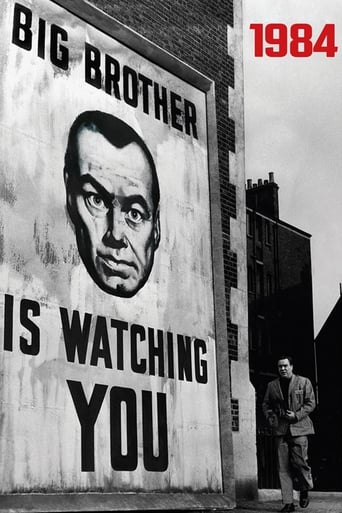
1984
1956 · Film · 90 min
Directed by Michael Anderson
In a totalitarian future society, a man whose daily work is rewriting history tries to rebel by falling in love.
2 positive1 negative25 neutralfrom 28 commenters
Where to watch
No streaming data for this title.


29 comments on Hacker News
Satire pokes fun at what is happening right now; it's not predicting anything. Just like 1984 warned of the dangers of totalitarianism that was already happening, Idiocracy was about current U.S. culture at the time. It wouldn't have been funny if our culture weren't already like that 20 years ago.
The premise is just a silly one so that there's a plot-based reason to show an exaggerated version of what was already happening culturally. It's not intended to be the point of the movie.
Sort of.
- I've often bought books with old/traditional covers which I like, but then a movie is made and the cover is "updated" to the movie tie-in version
- I've found at least one typo in pretty much every e-book I've ever read, and usually report them --- they rarely get fixed, which annoys me to no end (esp. if it's a copy were there cover has changed as noted above)
There's also the old news story about the kid who bought the pirated copy of _1984_ took class notes in it, and then had the copy deleted, which presumably is why when Microsoft took the ebook reader functionality out of Edge they issued checks to people who had used the note-taking functionality.
I think (armchair analysis) it's a combination of two things, one is that it's by choice - people enjoy using LLMs, they find it valuable and convenient. As for social media, companies and society itself successfully managed to gamify people sharing their personal lives on the internet, to voluntarily reduce their own privacy. Also because they still believe they have a choice in the matter, by e.g. not posting or sharing things.
The other thing is the boiling frog analogy, it wasn't a sudden "we're at war now so you get a camera in your house" moment (iirc 1984 skips over the transition to an authoritative state though), it's a slow, gradual progress. People got used to taking selfies, then applying a filter, then using facial scans for identification, then a cool app that puts your face on movie scenes and now the company behind faceapp and co has detailed facial scans of millions of people.
Europe tried to limit it via legislation, but that's a lot of after-the-fact policing and that's just Europe.
TFA:
> We’ve seen this movie before.
...which one? 1984? The Terminator? The Truman Show? The Matrix? Minority Report? The Social Network?
They film us on the street. They film us at traffic signals, from law enforcement vehicles, and drones, parks and even through our doorbell cameras. I don't mean this glibly, or in its entirety, but the big screen watching your every move in 1984 seems not too far off..
> Completely agree, but I also think there's value in re-watching within a short period of time. I find you retain enough memory from the previous viewing to be able to see subtle details and connect things that you maybe wouldn't have been able to in a first viewing.
Maybe it is ADHD speaking, but I find it very boring if it is too predictable. If I'm bored, very little goes in anyway.
> And also, you can just drop the analytic brain and immediately rewatch something because you find it to be a beautiful film moment-to-moment.
There are some things I rewatched shortly after because it was beautiful. I like to also re-read George Orwell's 1984 annually so that I can figure out what my UK government plan for me next.
I agree with the sentiment that "most people want entertainment, not art," or at least they do a lot of the time. I have a pretty wide definition of what is art, in that almost anything created by a human could be appreciated as art (whether that's a novel, a building, the swinging of a baseball bat, or even a boring sidewalk). But a lot of people, a lot of the time engage with movies and books and the like as merely "entertainment." There's art there, but art is a two-way interaction between the creator(s) and the audience. Even in the pulpiest, most corporate creations. I'm not engaging with cat food commercials as art, but one genuinely could. I agree that AI can generate stuff that is entertaining.
"The idea that only humans can make that kind of work has already been disproven." That I disagree with, and it ultimately is a matter of "what is art." I won't pretend to offer a full, complete definition of what is art, but at least one aspect of defining what is and is not art is, in my opinion, whether is was created by a human or not. There is at least some legal precedent that in order for a copyright to be granted, the work has to be created by a human being: https://en.wikipedia.org/wiki/Monkey_selfie_copyright_dispute
"I suspect future generations of AI will be better at creating compelling original art because the AI will have a more complete model of our emotional triggers - including novelty and surprise triggers - than we do ourselves."
Again, by my definition at least, AI cannot create "original art." But I'll concede that it is conceivable that AI will generate entertainment that is more popular and arousing than the entertainment of today. That is a rather bleak future to imagine, though, isn't it? It seems reminiscent of the "versificator" of 1984.
It's not necessary for a work of fiction to focus on diverse and realistic characters, particularly when its primary aim is to critique a specific aspect of technology. In such cases, characters often function as just means to highlight and amplify that central theme.
Take 1984. It reads like a thought experiment reflecting the author's deepest fears about the dangers of unchecked power structures. Allegedly, Orwell’s own son would have been around 40 years old in the year 1984 (I read so in Pynchon's introduction to this book in Penguin's edition. It was a great essay.)
But, 1984 also features a great protagonist and an absolutely haunting language. While many of the other characters mainly serve to convey the broader ideas, it’s him who grounds the story emotionally. His suffering, his moral collapse, and the eventual loss of his ability was so tough to read and will forever haunt me. When he breaks, it feels like a loss for all of humanity. But, what I mean is characters are not essential to make a great work. When Orwell wants to convey his ideas, the characters are sidelined and ideas take the front wheel.
I understand your perspective. I'm not a fan of many of the episodes either. I really liked the first season, but the ones that followed just didn’t live up to it. And it does not rise above a horror centered around some particular technology. But, it's them give it cultural relevance.
Here is the plan of our elected representatives:
- Erode what resistance to total surveillance remains.
- Practice total surveillance.
Here is my plan to oppose that plan:
- Rekindle Orwell's 1984 as a full literary/movie/video-game genre, where awful things happen to people when the government or an associated non-knocking variant of the Spanish Inquisition shows up because somebody committed wrong-think.
I'm a little afraid that if we don't succeed in bringing this problem to the general's public attention via their binging habits, as a sort of social vaccine, we will end up with the disease.
I think Orwell's fame is totally unrelated to these 6 rules — 5 rules, since the last one is just a warning that rules about style should not be absolute.
Why is 1984 so acclaimed? Its style is boring and unimaginative. The characters' psychology is exaggerated and totally unbelievable (I remember the scene in the cinema at the beginning at the book, and, at the end of the book, the absurd post-torture behaviour). A large part of the story was ripped off Zamyatin. Some parts of the story are okay, but other parts are ridiculous... When I read that the nice old librarian was in fact the young chief of the counter-intelligence service, disguised in order to catch dissidents, I burst out laughing: imagine Beria tailing dissidents in the street, or Edgar Hoover disguised as a plumber to install illegal wire-tapes!
Orwell's crude style and stories are perfectly fine for a grotesque parody like Animal Farm. But I can't think of 1984 as a good book, not even close. I suppose it was successful because propaganda likes crude style and stupid stories, and 1984 was largely seen as a propaganda tool.
Re [1] - ChatGPT can be The Versificator - the pulp generation device in 1984 - the versificator producing content for the proletariat such as tabloids (stories on sports, crime and astrology), films, low quality paperback novels, and lyrics. It seemed like an SF idea when I read the book, but now it is almost plausible, wow.
[2] See sidebar of https://ministryofversification.blogspot.com/2009/03/1984-bbc-1954.html
The US is a surveillance state entrepreneurial free for all. I suspect the surveillance databases we know about are only the tip of the iceberg.
"You could sit at home, and do like absolutely nothing, and your name goes through like 17 computers a day. 1984? Yeah right, man. That's a typo. Orwell is here now" - in a movie that was released over 25 years ago, and our society has been sleepwalking further into the panopticon ever since.
We desperately need a US version of the GDPR, one that doesn't get neutered by all of these surveillance industries interested in preserving the status quo of their anti-human businesses. In fact I'd say the US should just wholesale adopt the EU GDPR verbatim, and let the courts figure out the details arising from different legal systems. That couldn't be any more complex than interpreting all of the loopholes the corporate Parties would end up adding to newly-drafted privacy legislation.
>Don't excessive speeding tickets lead to a loss of license?
Usually.
>Perhaps a more sophisticated society will one day know our fears and punish us accordingly (cue film script).
That was a plot line in 1984 and IMO flies in the face of equality under law.
The classic dystopias in literature described a supposedly future time, in order to criticize the present. The classics: Clockwork Orange; Farenheit 451; Brave New World; 1984.
Now there's a new trend in this genre, where a supposedly possible future time is described in order to glorify the present, and defend it against all possible change, good or bad, because "it could become worst". Handmaid's Tale is a good example. It makes catholic religion look so good it's sad. The total absence of criticism towards a religion tied with the institutional rape of thousands of children[0], and hatred of women, for instance, is absurd. And the fact is the raping is still going on as you read this. Of course this is only a single point of failure and absurdity amongst many others. Whilst Huxley, Orwell and others were driven by passion and rebellion against injustice and misery and desire to change life, low quality scripts like the one on this TV series are clearly motivated by making money while surfing/exploiting current social media cultural "trends". Disgusting.
0: https://www.bbc.com/news/world-44209971
I strongly agree with you. Brave New World is a utopian novel desperately trying to appear dystopic. With just a few small changes, to account for the existence of automation/robots/computers, the darker aspects (e.g. the population of deltas) stop being plausible within the universe.
The TV show had to invent a lot of extra nonsense to introduce conflict. Perhaps the most troubling aspect of Brave New World is that things are so stable, human needs are met so consistently, that life ceases to be a struggle; without a struggle, life becomes meaningless. That interpretation is alluded to in the TV show, but I won't spoil it.
We should be working as hard as possible to move society closer to brave new world and further from 1984.
Movies with great impact on me:
1. Untouchable - must see
2. Gattaca - are we going there?
3. 1984 - must see
4. Idiocracy - initially looks like joke/stupid movie, but it's more real then we may want to agree
5. Life of others (made in Ge)
6. Amelie Poulain (made in Fr)
7. Turtles can fly (made in Ir)
8. Stalker - the russian original (3 parts) (made in Ru)
9. Metropolis
Other good movies:
Lost Horizon
The Bucket List
The Truman Show
Solaris 1972
Enemy at the Gates
The Hitchhiker’s Guide to the Galaxy
Tips for good movies in general: take countries one by one and search best ever movies from that country.
tl;dr: yes
First let me address the time investment angle. Not every hour is the same. There are active hours when I'm creating something, having conversations, actively learning. There are passive hours when I'm consuming content - watching movies or YouTube videos, listening to podcasts, reading books. An hour spent reading a book is not an hour not spent learning a new ML technique. It's an hour not spent watching TV. Once you realize that, you stop feeling guilty.
Now back to the main subject. Reading Cliff's notes and comments will give you some idea of what's in a book, but it will be by definition incomplete, and likely biased. A good example is George Orwell's 1984. You need to read the entire book to understand the very last sentence. It is very powerful, but if you skip the book and just read it out of context it won't have the same effect. You may think you understand what the book is about, but that understanding will be rather shallow.
The biggest problem with books is that, like everywhere else, 90+% is crap and it's not easy to tell which books you'll like. Recommendations don't work well because they depend on people. You won't necessarily like a book I liked. So effectively you're on your own as far as discovery goes.
I wrote and ran something like this but the sweet spot was 20 min not 10. The purpose for me was to discover how many 20 min chunks of time were actually productive. The efficiency of planned tasks declines when you assign more hours to it.
But that was not what I ended up measuring. The widget (it was) was like someone looking over my shoulder and modified my behavior. I became insanely productive for a few days then had a weird kind off burn out where I declined to enter anything or wrote "watching youtube videos" for days.
Eventually I replaced the widget with a careful cut out from the movie 1984 so that it looked like a telescreen with big brother looking at me. A factory bell would ring and I would be "forced" to take a break. I got bored with that before figuring out the ideal work/break ratio. (It didnt care what I was doing)
I considered automating self-inflicted activity monitoring but any amount alters your behavior... much like your gut told you it would.
That's definitely part of what I'm driving at. I didn't mean to blame individual teachers, and on re-reading that should have been clearer. If I were to distill this to a thesis, I'd go with:
"Education, particularly in literature, is seriously worsened by structural limitations teachers can't control."
Standardized tests are a big part of that, and I do think "analyze this book in detail without access to the text" is a singularly useless task that actively rewards shallow thought. Multiple choice analysis questions are another problem, especially "what did the author intend by this passage" questions which set people up to totally misunderstand 'death of the author' later. Less directly, test questions like "compare and contrast the handling of death in two novels" put teachers under pressure to cover laundry lists of themes so that their classes will have something relevant to write about - which gets in the way of any other kind of focused study, like reading theory or following one author across multiple works.
But standardized tests aren't the only structural pressures which crop up regularly. I mentioned consistent homework and daily class periods - discussing "yesterday's reading" for a book like 1984 is a ridiculous approach, but there's relatively little room for finishing and then discussing books, or choosing a few key check-ins mid-book. (And these problems all tie together: with more time for theory, you might do that in class while reading at night. With better cross-class organization, you might offer lots of reading some nights while shorting other classes, then no reading on other nights.) Short grading periods and always-visible Blackboard grades drive time-wasting assignments; I've heard plenty of teachers say that they gave out tasks just to have baseline grades for the first interim report. The lack of block scheduling means every class is effectively <35 minutes, making it hard to show films or discuss serious themes without numerous interruptions.
I could go on at enormous length, but that's the gist. For all that schools demand cutting-edge educational practices (which are often bunk), testing and organizational demands leave teachers with worse learning arrangements than your average book club.
1984 has zero celebrities - they don't and can't exist in that world.
The only figure with a face is big brother, and he didn't exist. I think Goldstein had no face?
If the proles (85% of the population) had celebrities, they would not be actual people : https://en.m.wikipedia.org/wiki/Prolefeed
"Below that come the dumb masses whom we habitually refer to as 'the proles', numbering perhaps 85 per cent of the population."
"What opinions the masses hold, or do not hold, is looked on as a matter of indifference. They can be granted intellectual liberty because they have no intellect."
"There was a whole chain of separate departments dealing with proletarian literature, music, drama, and entertainment generally. Here were produced rubbishy newspapers containing almost nothing except sport, crime and astrology, sensational five-cent novelettes, films oozing with sex, and sentimental songs which were composed entirely by mechanical means"
There is a line between censorship and a healthy culture in a project, I don't think asking for tools to moderate what people write into issues and being able to remove illegal content (like copyrighted movies or CP), is not censorship, especially because I'm not a government body nor do I have even remotely that power.
Giving me these tools empowers me to run the project how I like, not how someone who read the backcover of 1984 likes it (ie with no moderation tools at all).
There was a whole chain of separate departments dealing with proletarian literature, music, drama, and entertainment generally. Here were produced rubbishy newspapers containing almost nothing except sport, crime and astrology, sensational five-cent novelettes, films oozing with sex, and sentimental songs which were composed entirely by mechanical means on a special kind of kaleidoscope known as a versificator.
-- 1984, George Orwell
This is a pretty stupid McArdle column.
McArdle has decided, on behalf of the entirety of pop culture, than when critics refer to the message behind THT as "timely", they mean "THT is a warning about impending theocracy in North America". In fact, in sampling 3 reviews from the front page of Google that used the word "timely", all of them made the far more obvious connection: between THT and concerns about misogyny and sexism, a huge feature of the 2016 election.
Further, McArdle's attempt to knock back the idea that the overall story of THT is something out of 1992† is incoherent and actually pretty fatuous.
Consider: McArdle goes out of her way to observe that Orwell --- to her the only realistic dystopian fiction writer --- cribbed details from communist dictatorships in the USSR and China. That 1984 doesn't talk about (what she perceives to be) a credible future for the United States is excusable, because she can't write a takedown of George Orwell.
Now consider: Islamic State didn't exist in 1985, and in fact few people in the west appreciated the toll Islamic theocracy took on women in the middle east. But substitute Wahhabism for fundamentalist neo-Puritan Christianity, and a whole lot of THT seems uncannily predictive, right down to the public execution of gay people and members of other Islamic religions. Remember, Winston Smith's story took place in London, not Moscow.
If McArdle was just criticizing a TV show, I wouldn't care. But, by subtext, she's attempting to diminish the potency of the book (the book, by the way, is even more biting than the show, which strips away a lot of the systemic racism of the book's Gilead). McArdle isn't always full of it; sometimes she writes some interesting things. This isn't one of those times.
† Note to McArdle: Suzanne Vega is still recording albums; she didn't stop existing when you stopped listening.
Friends who are replying, my intent is not to stir up debate between Christians or about religion. The Books mentioned are relevant to this topic. They are good reading for anyone interested. Based on the down votes it seems HN would rather not include them while discussing this topic; which is all the more reason to go read them for yourself. They remain significant in our modern culture, e.g., music, books, movies and the lives of billions of people (worldwide.) While 1984 and many other dystopian novels are good for thought experiments...
These Books are relevant both historically and today.
[humorless]
Gilad Bracha describes the reference as to the Newspeak dictionary getting smaller with each edition in 1984:
http://www.se-radio.net/2009/07/episode-140-newspeak-and-pluggable-types-with-gilad-bracha/
The idea of making a language reducible instead of extensible is a rather interesting design motif.
I think that 1984 references, while apropos, are counterproductive. 1984 isn't documentary, and it's not prophecy; it's fiction used to make some political points. It is entirely reasonable for someone to not weight it very highly, in their assessment of likelihoods in the real world. Those not already sympathetic see comparisons to 1984 as hyperbole, those making them as out of touch with reality, and it doesn't help us seem less "tinfoil hat". Actual and potential abuses, with historical analogue, should be substantially more important - though precise reaction is hard to judge (can we get some polling done?)
You'd be surprised how willing most people are to just rewrite or delete history as it suits them.
I've heard of guys whose ex-girlfriends tore out and destroyed pages of their diaries related to the guy when they broke up.
People delete their half of conversations on forums, Facebook, etc. when they get proven wrong, so it looks like the other party was just talking to themselves.
Someone once asked me to help them remove someone from a photo (not a family photo, a documentary photo of a community activity). "Why?" "Because he was being annoying!" "But this photo could be printed in the paper. He was there. You can't just rewrite history like that!" "It's my photo! If you won't help me, I'll get someone else to do it."
Rewriting history is the norm. Most people haven't read 1984, and I suspect that many that do, don't get it.
What great movies, sadly such mainstream movies are getting rarer and rarer (I thought Inception was one, but, boy, what a disappointment).
The more you watch them the more new stuff you discover, e.g. it recently occurred to me that the Zion control mechanism is very similar in spirit to "the book" in 1984, called The Theory and Practice of Oligarchical Collectivism supposedly written by the anarchist mastermind Emmanuel Goldstein, leader of the Brotherhood. It is later revealed that this book was indeed written by O'Brien, the member of the thought police that eventually arrests Smith. I believe other sophisticated autocratic regimes, like China, have similar multilayered control mechanisms in place.
On carbon footprint she may have a point, although arguably every book is a little chunk of carbon sequestration. CO2 enters the atmosphere when things are burned, which books usually aren't; with less demand for paper, there may not be an economic incentive to plant as many fast-growing trees. It's true that their production and transport consumes a good deal of energy that e-books don't, however.
I don't think you're old. I rely heavily on the 'active reading' tools available via computer, such as searching, hyperlinks, and so forth. But that sort of reading is more at the research end, where you know roughly what information you want and any learning you do along the way is relatively shallow. If I'm reading passively and trying to gain a deep understanding of the characters or concepts being explained by the author, then I still very much prefer a book, even though I may flip back and forth frequently if it's technical in nature. I also find it more productive to write notes by hand in this mode, rather than type or cut and paste. Of course, this relies on a good author, whose narrative or didactic approach the reader can trust.
Arguably, this is irrational. I do like the smell of (well-kept) books, the texture of the paper and so forth; it pains me to see someone mistreat a book or snap the pages when they don't like what they're reading. Some of this is nostalgia (books were an avenue of escape from a difficult environment growing up), and some is a conditioned reflex. When I sit down to study a book, these sensory cues help to shift my brain into study mode and ignore distractions. This is partly because of the limitations involved. If I need to put down the book and walk back to the shelf or to the computer to check the meaning of a word, or answer some peripheral question it's a time-consuming interruption; I must decide between accepting the inconvenience, postponing it until the end of the reading session if possible (and then checking several things at once), or staying put and just thinking the problem through on my own. Proceeding without filling the gap in understanding is generally a bad idea; I'd rather re-read material from earlier than build knowledge that's structurally unsound. Working the problem through is obviously slower than looking something up, and the knottier the problem the more important it is to check the quality of one's solution later. On the other hand, one's own brain is ultimately portable, and solving a problem exercises both short- and long-term memory better than consulting an oracle. It's like eating; packaged or processed food is very convenient, but too much of it weakens the digestion. Although computers and ebooks have great unrealized potential for education, they should probably not be the primary reading medium for kids, any more than instant snacks or fast food should be considered the cornerstone of a healthy diet.
E-books have three problems from my point of view. Cosmetically, the pages are too small, the text is too large, and the reading surface is too grey. I like high-density text but so far only the iPad gets close. Functionally, I like the convenience of digital storage/retrieval, but would actually like the option of an 'exclusive' reading mode which locks me out of search, dictionary lookup etc. If there is no inconvenience to using such resources, then I have no economic incentive to puzzle over something and work it out myself, whether by mental effort or searching back through the text for something that was overlooked on a first reading.
And conceptually, there's a McLuhan problem: 'the medium is the message' in the sense that the reading device is the gateway to knowledge, and can be locked or restricted. Books become something less than independent works of creativity and scholarship, and more generic 'content' which must adapt to the reading device. Many subtleties of typesetting and reading order are lost along the way, along with the publishing income from older literary works, which to some extent subsidized the publication of newer writers. Books have less of an individual identity with which to attract readers or retain their affections. More importantly, as the market for reading devices matures they will necessarily compete on features; whereas a paper book's literary value is independent of the binding, the content or availability of e-books may become a function of the device on which they are read, with owners of fancy devices enjoying a much wider selection of reading material. Last but not least, digital technology can facilitate censorship as well as distribution. Although the ability to correct errors and update reference material in a digital text is a great advance in many ways, the ease with which newly-unpopular truths can be retroactively deleted should give pause. We've already seen one example of this on the Kindle, where copies of 1984 disappeared overnight due to a copyright issue; recent events involving Stuxnet and Wikileaks suggest a very near future in which malware targets not systems in general, but specific data or configurations incompatible with others' interests. In the literary context, deletion of any material suggesting that we have not 'always been at war with Eastasia' or that 2 + 2 = 4, for anyone who can not produce documentary proof of a 'need to know.'