 Hacker Cinema
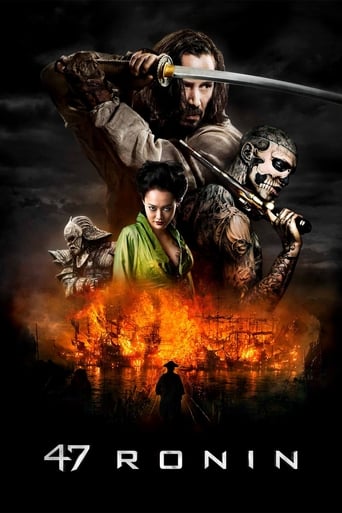
47 Ronin
2013 · Film · 119 min
Directed by Carl Rinsch
Kai—an outcast—joins Oishi, the leader of 47 outcast samurai. Together they seek vengeance upon the treacherous overlord who killed their master and banished their kind. To restore honour to their homeland, the warriors embark upon a quest that challenges them with a series of trials that would destroy ordinary warriors.
3 negative1 neutralfrom 4 commenters
Where to watch
No streaming data for this title.





4 comments on Hacker News
> [A] half-dozen studios and video platforms lined up to woo a little-known filmmaker named Carl Erik Rinsch. He had directed only one movie, “47 Ronin.” It was a commercial and critical dud, and Mr. Rinsch’s tussles with its producers had raised eyebrows, even in an industry where such conflicts are the norm.
> But memories in Hollywood are short, and the demand for new content was intense.
This right here feels like the kind of story that can enrage minorities in Hollywood. Typical story of a nobody that studios are eager to take a chance on, except it pretty much only happens to white dudes. Let the failures such as these an opportunity to highlight, when the bets eventually fail (which itself is not unreasonable given the risks taken), that while some people might complain about "minority hires", there are way more "majority hires" who are just as unproven as next guy but get a shot at the big productions nonetheless. And, as in this case, make a total mess out of it.
Reads like a hit piece on Rinsch. I guess he pissed off the wrong well connected people that want his career over. 47 Ronin is not a good movie but it’s often interesting. Netflix gave him a lot of money and he spent it? My heart bleeds.
Did laugh at the “caught hypothermia” - it’s contagious now?
Also laughed at “his wife is a model, here’s a picture of her in a dumpy coat.”
This is true of ALL arts and endeavours more generally: that it takes years of first hand experience to be able to appreciate the last stretch of 80/20 (i.e. the last 20% that takes 80% of the effort to achieve). On top of this, there are many things unique to Japanese (Kamakura period and later) philosophy that one should understand to gain contextual awareness.
For an example that will be close to the HN readership, to a freshly graduated Harvard MBA and former McKinsey consultant with a BA in Economics, a self-taught full stack web developer with a couple years experience is for all intents and purposes the same in skills as an MIT post-doc in computer science with a few papers published (I've also met some "business" folks who think the web dev is "superior" because he "gets things done" and his output is "prettier").
I personally think that one should achieve depth in at least one field to appreciate just how hard it is to get to the top of it. As a former classical musician, I can absolutely tell the difference between a good pianist such as you might find playing on a typical night at the Lincoln Centre in New York, and a "once in a generation" pianist such as Richter; this came at the cost of perhaps 2 decades of purposeful study and practicing the art. But my friends with little experience of classical music do not get quite as excited about Richter.
The Japanese are also unique due to the history of their country shaping their philosophy of art (which I will try to summarize based on my very limited understanding - I'd love to be corrected by more knowledgeable readers).
The Heian-period aristocrats, who looked up to the mainland Chinese civilisation, became so decadent and self-focused in their seeking of ever increasing sophistication that they completely lost interest in the running of their own country and the resulting chaos led to the rise of warlords (Daimyo) and a ruling military elite structure based in many parts on fighting ability (this is not unique to Japan: "may they eat cake!").
The Heian period marked spirits (exiling someone from court for having composed a distasteful poem or wearing a slightly mismatched ensemble being, generally, not a good governance principle). So when the Daimyo stopped fighting each other, united under the Tokugawa shogunate, thus having more time to do things other than get good at fighting [1], they sought to display status in other less flashy ways (this did happen later - cf the Rinpa school of painting), a form of counter-signalling based on taste rather than wealth, such as the very materially simple tea ceremony and teahouse. In other words, it's not about the tea, but about the way it is served and the contextual notes. This was helped by the idea that Spartans make better warriors than hedonists.
On top of this and perhaps linked ("dying a good warrior death young, is more honorable and valuable than dying old in your bed having not fought"), the philosophy of art tends towards valuing things like the "ephemeral nature of life" and making very subtle statements related to it. For example, there is a phenomenon in Japan of "the first tuna catch of the year" which is a very expensive and prized fish, almost a celebration. But for you, that's just a slice of tuna, and chemically, it might just be the very same composition as much of the tuna on offer the rest of the year. It would be missing the point - it is the act of catching the first tuna of the year (or it might be the first tuna caught after they come back from a migration where they get fat or something - it's seasonal, I can't remember the details), and the eating of that tuna at that particular time, that is valued by the consumer. Similarly, the rice is designed to be served at a specific temperature, and to "just" hold together at that temperature and with that mix and at that amount of time after being hand shaped for you, and an experienced consumer will appreciate the texture and cooking level of the rice and be satisfied to have had the experience of that precise moment in time and the ephemeral nature of it, much more than by any feeling of satiety.
Now personally I am happy eating the sushi at the standing sushi stand at Tokyo Station in B1 of the Yaesu exit (Uogashi?). That's as good as I can tell the difference and the cheapest I know (around $10-20 a go). So, I'll probably never fork out $400 for Jiro, because I know that's where my limit lies and I couldn't appreciate the conversation anyway (which is a great part of the experience, and why Jiro proper doesn't allow non-Japanese speakers to book). But that's also because I do not wish to invest time and effort into getting to a knowledge level where I could truly appreciate Jiro. I'm also avoiding attending any No theatre performances because, again, have no desire to spend years studying the art.
In other words, it's good to decide whether or not you want to gain depth in a field; if so, time to put in serious effort and do much reading; if not, one should (in my opinion) be aware of one's limits and unknown unknowns and not worry too much about not appreciating said field. But there is absolutely an objective level of difference between the top performers and the middling ones in all fields, even if outsiders cannot perceive it instinctively.
[1] As an example of the discussions of the transition period: 47 of a few hundred samurai that saw their master being betrayed and killed plotted revenge for two years, then executed it (google "47 Ronin", if you didn't see the Keanu movie). In the Hagakure, Tsunetomo criticizes the 47 Ronin for not having immediately committed seppuku, which even if not achieving revenge, would have been the honorable thing to do, instead of deciding to live. Tsunetomo was in turn criticized as being too much of a typical peacetime warrior, choosing honour and appearances over winning, in contrast to a Miyamoto Musashi whose methods were not always clean (such as arriving late to his duels to put the adversary off balance) allowing him a legendary record of victories. Or indeed Ieyasu Tokugawa himself.
Rotten Tomatoes does contain different information, and different statistics. For example, take Robin Hood: Prince of Thieves.
IMDb gives a 6.9/10 from 119,115 users. That's the only real statistic it gives us; there is no 'Metascore' for this movie. (Personally I think the Oscar nomination should be mentioned next to this score, but it's sort of buried further down the page)
Rotten Tomatoes, on the other hand, shows us several numbers. The Tomatometer is at 50% for "All Critics", with an average rating of 5.7/10 and 52 reviews. The "Top Critics" Tomatometer is at 36%, with an average rating of 5.9/10 and 14 reviews. The Audience rating, however, is 73%, with an average rating of 3.4/5 from 333,273 users.
--
The above example shows how you can sometimes use IMDb's stats of general ratings as a median reference between the audience numbers and critics numbers. But this doesn't always paint the best picture. Let's take another example: the recent (and generally accepted as a flop) 47 Ronin.
Here, IMDb gives us a 6.3/10 rating from 60,849 users. But it also gives a Metascore of 29/100. Yet the number in a gold star in bigger font is just the '6.3'. So even though this movie has a dramatically lower Metascore, they only feature the general user rating from IMDb.
The story is much more dramatic on Rotten Tomatoes. It has a 13% 'All Critics' Tomatometer rating from 72 reviews, with an average rating of 4.1/10. The 'Top Critics' Tomatometer shows 0% with 13 reviews and an average rating of 2.9/10; not one single top critic liked this film, out of 13 critics! Yet the audience rating shows 51% with an average of 3.3/5 with 53,921 ratings.
We can see how IMDb got its '6.3' rating here: both seem to show a middle-of-the-road rating from general audience ratings. But Rotten Tomatoes' critics stats show this movie isn't worth wasting two hours of your life on. The gamble of whether you may like the movie or not becomes more certainly less likely when you take the critics' reviews into consideration.
--
As we can see above, even within each website, sometimes they have not only greatly varying statistics, but sometimes missing or hidden information (Robin Hood not having a Metacritic rating and not prominently displaying the oscar nod). People weigh their options based on the data they have at hand, so the information you give people - along with its context - will change their minds greatly, regardless of the source.
This is why I think it's much more realistic to look at multiple different sites. You need as much information as you can get, and no one site gives you all the relevant data, as it varies from film to film and user community to user community. It would seem you can't just depend on 'the crowd' to give someone an accurate idea of whether they will like a film; a survey would probably be better, but nobody's going to survey every film they watch.