 Hacker Cinema
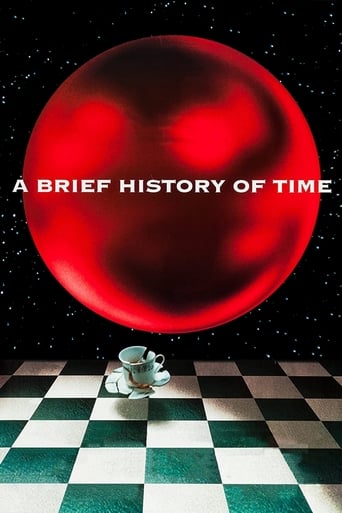
A Brief History of Time
1991 · Film · documentary · 80 min
Directed by Errol Morris
Partly adapted from cosmologist Stephen Hawking's popular book about his theories of the universe, this in-depth documentary also presents Hawking's daily life as he deals with the ALS that renders him virtually immobile and unable to speak without the use of a computer. Hawking's friends, family, former classmates and peers are interviewed about not only his theories but the man himself.
2 positive3 neutralfrom 5 commenters
Where to watch
No streaming data for this title.





5 comments on Hacker News
My parents had a hard time explaining my dad's job to me, so they just told me he was a scientist because he had a masters in physics (he was a diplomat). Like any little kid, my parents were my heroes, so of course this led me to becoming obsessed with scientists and reading up on science stuff, eg trying to read my sister's university textbooks.
I developed a hobby of reading up on and sharing factoids I found online, and found one about the 'god particle'. At first I thought it was cool because it seemed to basically talk about a particle that causes mass (of course, this was actually wrong, but that didn't really matter to a 10 year old), but reading about how it was predicted 40-50 years ago and the largest single machine humanity had built was being used to try to find it made it my favorite factoid and I'd excitedly start talking all about it the moment anyone showed even the slightest bit of interest.
In 2012 when the detection was announced, we were on a short 2-3 day vacation in Dubai and were having breakfast in the hotel. The TV was right next to us, and seeing the news I was trying (and failing) to explain to my parents how the Higgs boson had been predicted 50 years ago and it took that long for the technology to finally catch up to be able to verify it, and how this would represent one of the last remaining pieces of the standard model (although back then I didn't quite grasp that the standard model was not a full theory of everything). I was trying to explain to them the size of the LHC, how it was the biggest single machine we've built, how when they were turning it on for the first time, there were fears about it creating micro-black holes which might swallow the Earth.
I think that while we need scientists in the public eye, we don't need them as social media entertainers, a lot of well known science communicators on social media come off as attention-seeking charismatic fakes/frauds to me (eg NDT). Stuff like the interviews and documentaries Stephen Hawking had appeared in (or to a lesser extent, the ones Michio Kaku has appeared in) did much more for me in being inspired, even without having known what research they were known for.
I think we could also do with more books like Hawking's 'A Brief History of Time' and encouraging kids to read them. Also, instead of over-simplifying everything and passing off scientists as geniuses in the traditional sense, we should be more open in showing that the people who made these discoveries or predictions were not inherently born with it, the vast majority of them were completely normal people who worked very hard to build skills in the thing they enjoyed.
Another discovery I feel was somewhat similar is that of discrete time crystals, casually predicted in 2012, turned out to actually be possible in 2018 and has a similar 'cool' factor.
It also refers to work rules that are designed to make sure that workers doing a task are the ones who have been trained for it. Sometimes the rules seem to get in the way: Do you have to call in an electrician to plug in a PC? Or can the guy in the next cube, who saw Norm use a plug strip on PBS, plug it in? The movie version of "A brief history of time" has Dr. Hawking telling an anecdote about nailed down chairs on a set.
It isn't always about neighborly overtime.
If you have not seen it, the documentary “A Brief History of Time,” which is not an adaptation of the book but interviews with Hawking and his colleagues, and family, is excellent and worth your time.
I don't understand the physics but I do believe Stephen Hawking disproved this[1]; he said that after entertaining the idea that as the universe contracts time might reverse he concluded later this was wrong.
[1] A Brief History of Time (the documentary film)
This is a great story. I first recall when I first knew I was being misled by a teacher. I was in 9th grade earth science, and she had shown a documentary on the early history of the universe which had made reference to string theory. String theory posits perhaps 11 dimensions in some versions from what I gather. The teacher thought this was ridiculous and said something to the class to the effect of, well I can't even imagine having a fourth dimension, can you? Student Parrots: No! Teacher: Well then, of course string theory can't be right!
Now I was 14, and it would still be a few years before I first would read 'A Brief History of Time' and so I knew nothing of string theory, but, I somehow knew, on some basic instinctual level that I was being misled in that moment, that just because the teacher could not "imagine" higher dimensions did not in and of itself mean that there could not possibly be higher dimensions in theory. Looking back, that was the start of a distrust in me with regards to the academic "establishment" which has continued in varying degrees to this very day. It is one of those epistemological moments of clarity: once one realizes it is possible to be misled by a teacher, which one naturally is conditioned to trust, then really who else could possibly mislead one? What sources can after all be trusted? Once one realizes the inherent fallibility of everyone, including one's teachers, then things just are not quite the same ever again, there is a certain loss of innocence there which can never be gotten back.