 Hacker Cinema
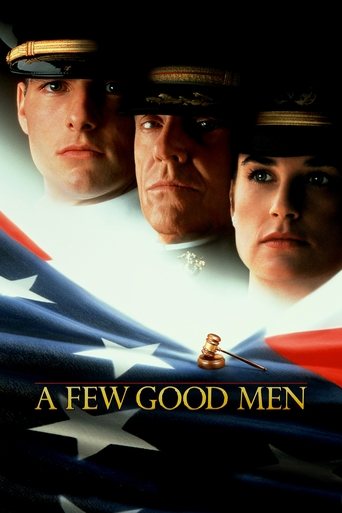
A Few Good Men
1992 · Film · 138 min
Directed by Rob Reiner
When cocky military lawyer Lt. Daniel Kaffee and his co-counsel, Lt. Cmdr. JoAnne Galloway, are assigned to a murder case, they uncover a hazing ritual that could implicate high-ranking officials such as shady Col. Nathan Jessep.
7 positive1 negative1 mixed7 neutralfrom 16 commenters
Where to watch
No streaming data for this title.
Videos commenters linked
From YouTube links in the comments below. Most are clips and trailers; “Full” means the uploader says so.




18 comments on Hacker News
Oh wow he did A Few Good Men, too? These comments are just crazy in how many influential movies he made to me, without me realizing they were by him. And how are you the first to mention AFGM? That's the best of the bunch!
A Few Good Men is also a great movie IMHO.
And he was quite excellent in The Wolf of Wall Street (playing I think Leonardo's father?)
Very sad development.
Can you believe that This is Spinal Tap, The Sure Thing, Stand by Me, Princess Bride, When Harry Met Sally, Misery, and A Few Good Men were all directed by the same man? What an eclectic set of masterpieces.
You should watch how movies are made sometime. How a script is developed. How changes to it are made. How storyboards are created. How actors are screened for roles. How locations are scouted, booked, and changed. How the gazillion of different departments end up affecting how a movie looks, is produced, made, and in which direction it goes (the wardrobe alone, and its availability and deadlines will have a huge impact on the movie).
What does "EXT. NIGHT" mean in a script? Is it cloudy? Rainy? Well lit? What are camera locations? Is the scene important for the context of the movie? What are characters wearing? What are they looking at?
What do actors actually do? How do they actually behave?
Here are a few examples of script vs. screen.
Here's a well described script of Whiplash. Tell me the one hundred million things happening on screen that are not in the script: https://www.youtube.com/watch?v=kunUvYIJtHM
Or here's Joker interrogation from The Dark Night Rises. Same million different things, including actors (or the director) ignoring instructions in the script: https://www.youtube.com/watch?v=rqQdEh0hUsc
Here's A Few Good Men: https://www.youtube.com/watch?v=6hv7U7XhDdI&list=PLxtbRuSKCCyu4oRuZFrsj1Jw8hlXFWAFL&index=10
and so on
---
Edit. Here's Annie Atkins on visual design in movies, including Grand Budapest Hotel: https://www.youtube.com/watch?v=SzGvEYSzHf4. And here's a small article summarizing some of it: https://www.itsnicethat.com/articles/annie-atkins-grand-budapest-hotel
Good luck finding any of these details in any of the scripts. See minute 14:16 where she goes through the script
Edit 2: do watch The Kerning chapter at 22:35 to see what it actually takes to create something :)
While there are only a few movies that I have seen in their entirety several times (5+); there are several scenes from certain movies that I have probably seen more than a dozen times.
1) Court scene from 'My Cousin Vinny' 2) Court scene from 'A Few Good Men' 3) Last 20 minutes from 'The Shining' 4) Escape sequence from 'Shawshank Redemption'
For a mainstream Hollywood film, "A Few Good Men" is quite nuanced. Colonel Jessup's actions are plainly illegal, and in the end he is arrested for them, but his point still has merit: society must be protected, and perhaps necessarily, it is protected by people who must do things that society would disapprove of. The actual courtroom proceedings of the movie are less interesting than the philosophical debate, and ultimately one can admire both viewpoints.
A Few Good Men is a great movie because, especially for 1992, it spoke directly to those gray areas.
About ten years later, after 9/11, the US established Guantanamo Bay detention camp, where in 2023 there are still people (32?) held outside of normal legal processes.
I would expect that the 32 remaining, out of almost 800 total, are a clear threat to the United States.
But is it right to keep them there? What are the moral implications of the rest of America looking away while ugly work is done with their authority and in their name?
Colonel Jessep isn't 100% wrong (Santiago's death may have saved lives, but his death shouldn't have happened), and Lt Kaffee isn't 100% right (Jessep broke the law, but people are not owed unvarnished truth without earning it).
Everyone's who's worked for a large corporation, even outside the IC, knows that many things are done in that grey area, with the expectation bosses would deny asking someone to do it. See the recent news about Union Pacific train wheel bearing inspections being pressured to pass.
To me, the balance of any system is accepting an optimal level of corruption/abuse, in order to permit efficient functioning. Grease lets things slip, yet also decreases friction.
It's ugly, sad, and terrible... but also necessary. A perfectly enforced code of laws would rapidly implode any country in the world, because it wouldn't leave room for interpretation and exceptions.
I think the '90s had a bit more variety than the '10s and (for now) '20s. E.g. we seem to have lost good legal procedurals, thrillers, weird fiction, and "small scale" sci-fi.
Fo example, what are the'10s equivalents of "A Few Good Men", "Seven", "Dark City" and "The 13th Floor"?
There is _some_ stuff, but less than before, replaced by a massive amount of super hero movies or long-running franchises.
As a support clue, I invite you to consider the winners of the MTV Movie Awards, which are more "popular" than other Awards:
92 Terminator 2: Judgment Day 93 A Few Good Men 94 Menace II Society 95 Pulp Fiction 96 Seven 97 Scream 98 Titanic 99 There's Something About Mary 00 The Matrix (bonus: not 90s)
compare with the 10s
10 The Twilight Saga: New Moon 11 The Twilight Saga: Eclipse 12 The Twilight Saga: Breaking Dawn – Part 1 13 Marvel's The Avengers 14 The Hunger Games: Catching Fire 15 The Fault In Our Stars 16 Star Wars: The Force Awakens 17 Beauty and the Beast 18 Black Panther 19 Avengers: Endgame
I have the feeling most "risky" movies, for lack of a better word, have moved to streaming services.
> NSO will continue its mission of saving lives
Sounds exactly like Lt. Col. Jessep from A Few Good Men. The film teaches to never trust that line or those who utter it.
The "A few good men" movie sequence is not really good. First I cannot understand Jack Nicholson's answer and could not rely on the lips movements to get it. It is supposed to be the "you can't handle the truth" translation, but I miss the verb "vous ne ... pas la vérité". Also the lips and mouth position to pronounce "la vérité" are not realistic, Jack seems to add a syllable at the very end.
When I was still a new dev, I had a "superboss" in another city (HQ) managing teams across the country including our little dev team. I was new and did not interact with "superboss"-es from HQ directly.
One day after a major release stuff broke in production. The company was losing customers daily. The "superboss"-es from HQ descended on our little dev team in a small midwestern city and ordered "Code Red".
What it meant to me as a new dev was that I can't go home and the whole team had to stay in the office until the problem was solved... A part of the team had to sleep in the office for a few weeks. (I still don't know if this is against OSHA.)
Many years later while I was watching the movie "A Few Good Men.", I learnt that "Code Red" was a military term. Suddenly, it dawned on me that my "superboss" was also an ex-military person.
Sleeping at work did not fix the issue, after many months of hiring help and bringing in more hands the outage was brought under control.
Did the ex-military "superboss" help the situation? I don't know...
Now I know that Military veterans in their enthusiasm to find work in civilian environments tout their ex-military skills as team building or leadership skills.
Skills learned in the military are for war, learned for conflict situations and applying them to civilian environments and bringing a war mentality or attitude to a workplace is toxic.
I don't have an answer to what makes a good technical leader but I know from experience that ex-military style leadership only adds to the toxicity of a workplace.
Also see the movie, A Few Good Men
Sometimes I feel like half of my HN comments are about this guy, but Aaron Sorkin (writer/creator of A Few Good Men, The West Wing, The Social Network, and recently The Newsroom) wrote this line in a not-very-successful TV show 15 years ago called Sports Night, which is the same phrase but slightly nicer, and has stuck with me.
Dan is a TV host who did a Variety Fair interview in which he was semi-pro drug legalisation.
> Dan: The validity of your read on what most of the country thinks notwithstanding, Stanley.... Actions are immoral. Opinions are not. And I won't apologize for mine. Discussion is good, and for those of us fortunate enough to be the subject of magazine articles, it may be our responsibility from time to time to try and raise the level of debate.
Full Metal Jacket.
• Three Kings.
• In The Valley of Elah.
Good Morning Vietnam.
A Few Good Men.
Platoon.
• Jarhead.
Casualties Of War.
• The Men Who Stare At Goats.
The Deer Hunter.
The Thin Red Line.
• Syriana.
• The Green Zone.
• Stop Loss.
Also, • HBO's "Generation Kill".
(•'d relatively recent movies)
I don't think "The Hurt Locker" was particularly critical of the military and didn't count it. Also not counting documentaries like "Restrepo".
I hereby dispute the idea that the DOD has made it impossible for big-budget Hollywood movies to criticize the US military, and suggest instead that the bias Hollywood in favor of the military is responding to customer preferences and not leading it. Given what I presume to be America's default position of "supporting our troops", I'm struck by how many films Hollywood produce that challenge that default.
Remember also that Hollywood confronts at least two vectors of consumer preference in marketing films: first, Americans (in the large) have a (typical) diffuse nationalistic home-team support for our overseas adventures, and, more importantly, there's a less-political less-issue-oriented reverence expected for the sacrifices made by the young people we send into combat which is especially intense during times when large numbers of people are serving in combat zones. In other words, it's especially tricky to criticize the military during active conflicts.
Also, Three Kings is a fantastic movie.
It seems that we need to have a conversation about truth, art, and the space between the two. Just because it happened doesn't mean it is worth telling. Just because it happened doesn't mean that it will sell. Just because it happened doesn't mean that it is art.
Benjamin Franklin probably didn't do anything with a key and a kite and a thunderstorm. Did you know? Do you care? It makes a good story so we tell it. We build the mythology of our heroes (and villains) through the best narratives that we can construct, not necessarily the most true. Aaron Sorkin is not a truth-teller; he is a storyteller. His entire purpose is to entertain and he has a knack for doing just that.[0] Hopefully he manages to do so with this film, because there are parts of Steve Jobs' life that would do incredibly well with the Sorkin treatment. Personally, I can't wait. The author of this piece is not so excited. I have some advice for him: don't watch it, particularly since you don't seem to know the difference between biography and story.
[0]: See: The West Wing, Social Network, A Few Good Men, Moneyball.
> Normally the writer's craft is so obvious that it buries the art. When the art buries the craft, you have something special.
This kind of formulation is upsetting because art and craft are the same thing (in many languages they're the same word, too). If you can't see the "art" "behind" the craft, then the craft is poor. The whole purpose of craft is to hide itself.
Now, the craft is usually so poor that we made a whole other concept for "good craft", and that is "art".
It wouldn't be a problem if "art" was just a shorthand for "good craft", but then it took a life of its own, and became associated with miracles, "gift of God".
- - -
That said, to me, "the best movie I've ever seen" is A Few Good Men, by the same Sorkin. I can't wait to see this one!
Here's how the next Arrington/McClure interview will pan out:
-
Arrington: Did you order the (code red) meeting?
McClure: I did the job I ...
Arrington: Did you order the (code red) meeting ? [shouting]
McClure: You're God damn right I did. [shouting]
-
A Few Good Men. http://www.imdb.com/title/tt0104257/quotes?qt0470412
http://www.youtube.com/watch?v=AOYGbM3nK9k#t=3m59s
Ironic he chose the quote from A Few Good Men since Nicholson in that movie was arguing in favor of the forces for security, not the forces for freedom. His character would have been on the opposite side of this debate.