 Hacker Cinema
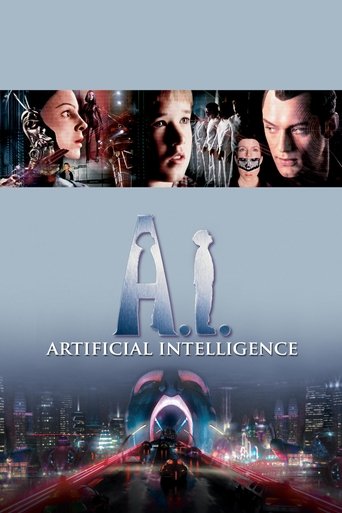
A.I. Artificial Intelligence
2001 · Film · 146 min
Directed by Steven Spielberg
David, a robotic boy—the first of his kind programmed to love—is adopted as a test case by a Cybertronics employee and his wife. Though he gradually becomes their child, a series of unexpected circumstances make this life impossible for David.
2 positive1 negative1 mixed7 neutralfrom 11 commenters
Where to watch
No streaming data for this title.
Videos commenters linked
From YouTube links in the comments below. Most are clips and trailers; “Full” means the uploader says so.




11 comments on Hacker News
If data integrity is assured, and thus there is no change in the data to store/transfer, then that's the opposite of computationally transforming the data?
How do we see robot and AI and helping interactions in film and tv and games?
A curated list of films for consideration:
Mary Shelley's "Frankenstein" or "The Modern Prometheus" (1818), Metropolis (1927), I\, Robot (1940-1950; Three Laws of Robotics, robopsychology), Macy Conferences (1941-1960; Cybernetics), Tobor the Great (1954), Here Comes Tobor (1956), Jetsons' maid's name: Rosie (1962), Lost in Space (1965), 2001: A Space Odyssey (1968), THX 1138 (1971), Star Wars (1977), Terminator (1984), Driving Miss Daisy (1989), Edward Scissorhands (1990), Flubber (1997, 1961), Futurama (TV, 1999-), Star Wars: Phantom Menace (1999), The Iron Giant (1999), Bicentennial Man (1999), A.I. Artificial Intelligence (2001), Minority Report (2003), I\, Robot (2004), Team America: World Police (2004), Wall-E (2008), Iron Man (2008), Eagle Eye (2008), Moon (2009), Surrogates (2009), Tron: Legacy (2010), Hugo (2011), Django Unchained (2012), Her (2013), Transcendence (2014), Chappie (2015), Tomorrowland (2015), The Wild Robot (2016, 2024), Ghost in the Shell (2017),
Giant f robots: Gundam (1979), Transformers (TV: 1984-1987, 2007-), Voltron (1984-1985), MechWarrior (1989), Matrix II: Revolutions (2003), Avatar (2009, 2022, 2025), Pacific Rim (2013-), RoboCop (1987, 2014), Edge of Tomorrow (2014),
~AI vehicle: Herbie, The Love Bug (1968-), Knight Rider (TV, 1982-1986), Thunder in Paradise (TV, 1993-95), Heat Vision and Jack (1999), Transformers (2007), Bumblebee (2018)
Games: Portal (2007), LEGO Bricktales (2022), While True: learn() (2018), "NPC" Non-Player Character
Category:Films_about_artificial_intelligence : https://en.wikipedia.org/wiki/Category:Films_about_artificial_intelligence
List of artificial intelligence films: https://en.wikipedia.org/wiki/List_of_artificial_intelligence_films
Category:Films_about_robots: https://en.wikipedia.org/wiki/Category:Films_about_robots
Category:American_robot_films: https://en.wikipedia.org/wiki/Category:American_robot_films
and partly https://en.wikipedia.org/wiki/Supertoys_Last_All_Summer_Long
Made into the film https://en.wikipedia.org/wiki/A.I._Artificial_Intelligence
First of, we are doing a bang-up job killing ourselves and the planet. Hard to see how they could outmatch us. Launch all the nukes?
In general the children are better than the parents. The replacement, if it's the case, will probably be more like in the 2001, A.I. Artificial Intelligence movie: some beings that are completely unrelatable to us would look with pity and slight amusement as a being disappears after only 100 or so years, just as we look at that poor ciliate.
> That movie was pretty good, but it would’ve been great if it had been thirty minutes shorter.
For me the canonical example of a movie that didn't know when to quit was A.I. Artificial Intelligence. There were at least four points in the movie when I firmly thought to myself, this would be a good point to end the movie. And then the movie just ... kept on going. On and on and on. I understand that Spielberg took it upon himself to remain faithful to the original Kubrick/Watson treatment, but you can just hear him screaming in the background "can't we just end here?" as well.
ChatGPT's list is interesting, the data must skew more heavily towards old internet where culture was more America centric. The Matrix, The Matrix Reloaded, The Matrix Revolutions, Avatar, A.I. Artificial Intelligence, Westworld, Ex Machina were all very directly or moderately inspired by Ghost in the Shell 1995. Ghost in the Shell was likely inspired by the original Blade Runner. There might be others, but I am not as familiar with them. There are at least 5 films that seem to confuse inorganic AI with organic AI, almost like the model associated a larger class of aliens to AI because of specific strong relationships between AI technology and alien technology. I wonder to what degree it treats the word AI as being both artificial intelligence and intelligence that developed in artificially created life.
I asked ChatGPT. It gave me bunch. I got some I've never heard of. I think I'll look into them.
<ChatGPT>
list 50 interesting movies that explore AI.
The Matrix
Ex Machina
Blade Runner
The Terminator
I, Robot
The War of the Worlds
A.I. Artificial Intelligence
Transcendence
The Fifth Element
2001: A Space Odyssey
WarGames
Westworld
The Machine
Her
The Iron Giant
Automata
The Truman Show
The Prestige
The Martian
The Fly
The Bicentennial Man
Surrogates
The Day the Earth Stood Still
Limitless
Robocop
Electric Dreams
The Island
The Time Machine
The Circle
The Arrival
The Host
The Stepford Wives
The Brain that Wouldn't Die
Frankenstein
The Invisible Man
Metropolis
The Thing
Jurassic Park
Independence Day
Gravity
Artificial Intelligence: AI
Avatar
The Hitchhiker's Guide to the Galaxy
The Matrix Reloaded
The Matrix Revolutions
Inception
Interstellar
The Time Traveler's Wife
The Butterfly Effect
The Future.
</ChatGPT>
A.I. Artificial Intelligence from 2001 (https://en.m.wikipedia.org/wiki/A.I._Artificial_Intelligence) that was developed by Kubrick wasn't bad for the first two thirds of the movie. The ending is pretty bad, and Wikipedia tells me my bias (that Spielberg made it lame) is probably wrong.
Thanks for sharing your opinion. Probably you could tell from the tone of my comment, but I don't like the movie the way it is. I agree with you that the movie and the book work well together but I wish the movie worked as a standalone piece of art.
I think Kubrick and Clarke could have perhaps found a compromise. For example, I remember liking the ending part of the movie "A.I. Artificial Intelligence" by Spielberg which had a similar situation to the last sequence in 2001. I don't recall if that movie had any explicit explanation of what the beings at the end were but it was pretty clear who they were and what they were doing from the way the movie handled things.
I loved Spielberg's "A.I. Artificial Intelligence". I know it's not everyone's favorite movie but I keep thinking about it "in a deep manner" (for lack of a better phrase) from time to time, it makes me question my essence as a human being: "Would I be able to love a robot child? Yes, I would, wouldn't I? Or would I? I know I should, robots like the ones presented in the movie are just like humans, I should love them the same, if not more" and stuff like that.
The article’s final paragraph: >”Every robot rebel has its benevolent counterpart, such as C-3PO in the Star Wars franchise or the android child David in Steven Spielberg’s 2001 film A.I. Artificial Intelligence. Both kinds of stories, the hopeful and the fearful, reveal to us our complex emotional responses to AI. Understanding these and their deep history is crucial to making the most of life with intelligent machines.”
The authors interchangeably use robots, automata, AI (meaning AGI, I am guessing) — that makes for a confusing read. If they mean AGI, then nothing about how humans dealt with robots will likely prepare us for how to deal with an exponentially fast learning, super smart, intelligence. I would argue that learning from history would be anchoring ourselves to wrong ideas (ideas of incrementalism). To prepare for AGI, we need to think quite differently and radically, in some sense.
Reminds me of "A.I. Artificial Intelligence" movie, it had the coolest talking bear.
https://www.youtube.com/watch?v=RDgecjYaCCA