 Hacker Cinema
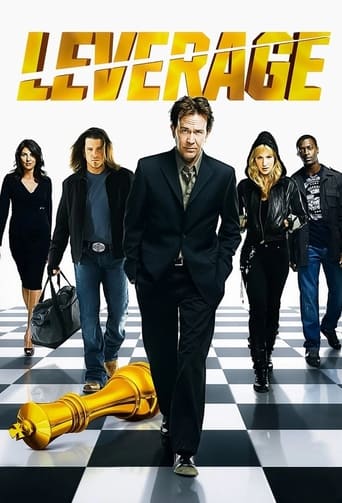
Leverage
2008 · TV series · 42 min episodes · 5 seasons
Created by John Rogers, Chris Downey
DramaComedyActionAdventureCrime
A five-person team comprised of a thief, a grifter, a hacker, and a retrieval specialist, led by former insurance investigator Nathan Ford, use their skills to fight corporate and governmental injustices inflicted on ordinary citizens.
2 positive1 negative9 neutralfrom 12 commenters
Where to watch
No streaming data for this title.
Videos commenters linked
From YouTube links in the comments below. Most are clips and trailers; “Full” means the uploader says so.




12 comments on Hacker News
The excellent TV show Leverage pointed this out incisively over a decade and a half ago. This clip [0] from the very second episode (excuse the potato quality; it's what I could find quickly) says basically what you do. It was aired in 2008.
[0] https://www.youtube.com/watch?v=CbE3q4oO2JQ
I started watching Leverage, the TV show, on Amazon, and the subtitles in the early series are clearly AI generated or just bad by default.
I use subtitles because I don’t want to micromanage the volume on my TV when adverts are forced on me and they are 100x louder than than what I was watching.
Reminds me of an episode of Leverage where they wanted to hack into Congress and change the text of a bill. In the show, it turned out everything was airgapped so they had to send a person to drop off a paper copy of the compromised bill. Hmm, that was also a plot line in Better Call Saul.
So there's a show called leverage in which the idea of generating fake news sites and fake discussion is an important plot element in many episodes for pulling a con on a mark.
I've even thought about spinning up a couple of fake news websites myself and populating them with news that I specifically want to push false events or create things that never existed.
The way I look at it is you need 2-4 fake news websites, 1-2 fake university websites, and then you can get yourself a Wikipedia article, then a facebook and Twitter account, then for all intents and purposes as far as most people know you've created an entire fake town. Then you can make up whatever fake.nwws or outrage you want for your fake town.
The only hard part up until now is producing enough other content to make it stand up to scrutiny, but now with GPT it will be trivial to do so.
How long before our news feeds will be filled with fake tragedies that never happened? I can even deepfake news reporters and footage of the event.
To illustrate my point how many people even knew east Palestine existed until the train got derailed.
What if next week a train gets derailed delivering nuclear waste causing widespread scarring and death in Sesquhoya Wisconsin, complete with news coverage by the local Sesquhoya news channel and victims testimonials. But Sesquhoya never existed, how will that influence discourse and the reliability of the internet?
If anyone is interested in discussing the idea more feel free to reach out to me.
Definitely. John Rogers, who wrote Leverage, a whole TV series about vigilantes striking back against the crooked, makes some excellent points here:
https://twitter.com/jonrog1/status/938450037276733440
It wouldn't matter. One particular episode of Leverage featured an Irish loan shark. Everybody complained that the attempted Irish accent of the actor was terrible and couldn't they get an actual Irishman to play the role? The twist: the actor is Irish and he wasn't doing an accent, that's how he normally talks.
If you enjoy Leverage, Hustle might also be up your alley: http://www.imdb.com/title/tt0379632/
That's where I got my fix after Leverages' somewhat premature demise.
RED is Hollywood-class, though towards the lower end. A lot of big-name movies that you've heard of include scenes shot on RED cameras: http://www.red.com/shot-on-red. The TV show Leverage was shot entirely on a pair of RED Xs.
RED's stuff is on the order of $25k. The main player for digital cinema is Arri ALEXA, on the order of $50k. It's not that far off.
I really like this article. There are a lot of good insights I will be mining over the next several weeks.
One interesting thing is how it connects with John Boyd's concept of OODA. Boyd talks about "stacking" the opposing force's OODA loop and injecting it with misinformation to get it going. It more or less describes, for example, the predatory loans. It's also interesting to see this kind of dynamic play out in the TV shows, Burn Notice and Leverage.
Do you watch Leverage too?
(Leverage is a TV show in its 4th season, and last week's episode included this very con http://www.tv.com/leverage/the-boiler-room-job/episode/1391981/summary.html)
Money Quote:
"That means licensing fees can keep climbing as Netflix moves more of its business to streaming and away from DVDs. Sending a disc round-trip can cost as much as $1, and Netflix mails about 2 million DVDs a day, whereas streaming a movie costs the company about a nickel. “We’re direct to the consumer, so we don’t give half our money to a cable company,” Sarandos says. “Our money goes directly to the content providers.”
Some content comes and goes, as in the case with the Timothy Hutton vehicle Leverage, to which Netflix obtained streaming rights through executive producer Dean Devlin. That didn’t sit well with TNT, so when the channel renewed the show for a third season, it made sure to secure digital rights, leaving Netflix with streaming rights to some seasons but not others.
“But TNT had to pay a lot more to secure the rights from Dean — it’s exactly why Netflix is exciting for networks and studios,” Sarandos says. “We’re an exciting new buyer in this space. We bid up the price of content.”"
Eg, Netflix is good for the creators, not so much for the old-economy gatekeepers.
Yeah, I've long thought it's a great idea that circumvents a lot of the weaknesses of tightly-constrained TV storytelling.
The problem is the economics. It seems people tend to respond negatively to production values below a certain standard. Cable productions run about $2M/episode, which translates to roughly $3M/hour or $50K/minute. Even if you can cut that by 20%, you still need to make a serious amount of money, and that's a lot of $2.10 iTunes purchases or $0.xy (I don't know what that number is, but it's got to be smaller than a dollar) Netflix streams that you've got to get in order to break even. And that's for the production values of "White Collar" or "Leverage", not "LOST" or "Rome"
On top of that, you have the business costs. You've got to pay the overhead costs, and you've got to pay development costs. Half the new shows that get a slot on TV fail, and getting one slot filled requires shooting 2-3 pilot episodes at a couple million a pop. In addition to expansion, you've got to replace your shows every few years, since (a) even the best shows get stale after a while and (b) costs go up every year.