 Hacker Cinema
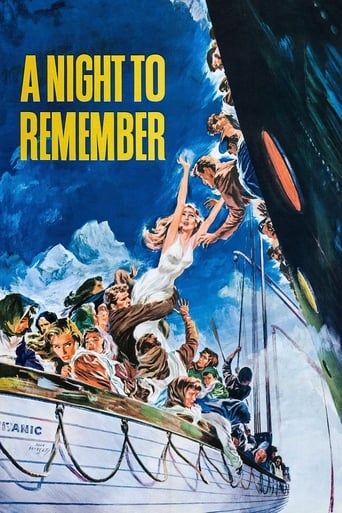
A Night to Remember
1958 · Film · 123 min
Directed by Roy Ward Baker
The sinking of the Titanic is presented in a highly realistic fashion in this tense British drama. The disaster is portrayed largely from the perspective of the ocean liner's second officer, Charles Lightoller. Despite numerous warnings about ice, the ship sails on, with Capt. Edward John Smith keeping it going at a steady clip. When the doomed vessel finally hits an iceberg, the crew and passengers discover that they lack enough lifeboats, and tragedy follows.
2 positivefrom 2 commenters
Where to watch
No streaming data for this title.






3 comments on Hacker News
> I'm 50 and hence rather older than several films on the subject. Titanic has always been held up as the ship wreck within my lifetime for several reasons.
I’m 49 and agree with all of this. My father is 76 and it’s always held a fascination for him too. He had me read A Night to Remember which he himself had read as a kid. I remember following the discovery of the Titanic by Ballard with great fascination.
There's a very strong similarity in the meanings and origins of the words "enlightenment", "catastrophe", "revelation", and "apocalypse". Most of them have a sense of an overturning or of a revealing. There's the similar terms and expressions "the scales fell from my eyes", "I saw clearly", "flash of insight". They're not unrelated to concepts of creativity, genius, or intelligence. And there's the sense of the world "prophet" as "one who receives a message" (usually with a connotation of divinity).
In almost all of these, you might substitute a modern psychological concept: that of a dramatically changed world-view. The things you once believed, they are no longer true.
I watched the 1950s version of the RMS Titanic story some months back (I've not seen Cameron's remake), A Night to Remember. One lens through which to view that film is of the gradual revealing, the enlightenment, if you will, or lack of same, of various characters to the plight and fate of the ship, including that of several of those not aboard (and ultimately the world via headlines and news reports).
The first to clearly grasp the situation (as portrayed in the film) was the ship's designer, aboard for final adjustments as a shake-down. Then the captain and members of the crew. The contrast between the observers on the Californian and Carpathia, remote to the Titanic, struck me particularly (the first being utterly ublivious, the latter understanding, and also understanding that despite their own best efforts, there was no way to reach the ship in time).
Some passengers responded with denial, some with anger, some with outrage, some, assessing the situation and recognising their fate, with equanimity.
It's quite the film.
Enlightenment can be devastating.
https://duckduckgo.com/?q=skyscraper+evacuation+systems&t=ftas&ia=web
https://www.technologyreview.com/s/425276/the-best-way-to-evacuate-a-skyscraper/
https://www.chamberofcommerce.com/herndon-va/33439780-skyscraper-evacuation-systems-inc
https://en.m.wikipedia.org/wiki/Emergency_evacuation
https://en.m.wikipedia.org/wiki/Fire_escape
https://sourceable.net/tablet/single/?name=high-rise-fires-rethinking-exit-strategies
http://emergency.cornell.edu/building-evacuation/
In short: there are systems, and they work, to varying extents, for existing structures. Very tall supertowers are a particular challenge, as every internal safety system competes for space with other interior uses, and external evacuation systems are difficult to specify and design. Many possible systems would have been compromised, internally or externally, on the twin towers, from the same extraordinary threats as were compromising the structure itself: gross physical damge to the structure, which closed off internal stairwells, and a raging, jet-fuel-fed inferno, which was weakening steel structural beams, and which would have compromised numerous possible esternal escape structures based on natural or synthetic fiber rope or tube systems.
Aerial evacuation was similarly hampered both by smoke and by lack of rooftop access (doors to the WTC roofs were locked against internal use).
The most effective protection was simply not to be in the towers when they fell. The decision of some survivors to leave WTC1 after witnessing WTC2's strike was key, and the in-building announcements to not evacuate contributed directly to the death toll. The inhabitants of WTC2 above the impact zone were doomed in all but the most optimistic scenarios, which is troubling -- the situation bears some resemblance to the disaster on the RMS Titanic in 1914, for which I strongly recommend the 1954 film A Night to Remember.
It's worth remembering that the daytime occupancy of the WTC complex could exceed 50,000, and estimates are that 17,400 people were in the towers at the time of the attacks. Over 84% of the occupants managed to escape successfully (the death total of 2,753 includes both the hijackers themselves and occupants of the two flights which struck the towers). That's a grim success under the circumstances.