 Hacker Cinema
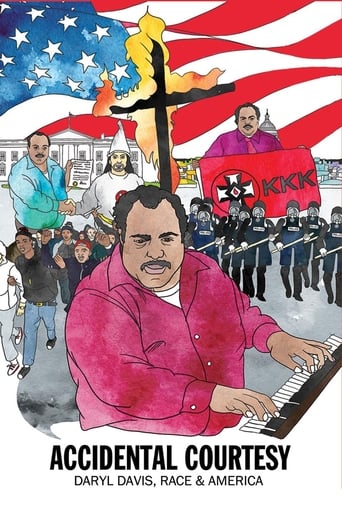
Accidental Courtesy: Daryl Davis, Race & America
2016 · Film · documentary · 95 min
Directed by Matthew Ornstein
Daryl Davis has an unusual hobby. As a musician he has played with legends like Chuck Berry and Little Richard, but in his spare time he likes to meet and befriend members of the Ku Klux Klan. Join Daryl on his personal quest to understand racism.
5 positive1 neutralfrom 6 commenters
Where to watch
No streaming data for this title.






6 comments on Hacker News
Great point. I agree.
For context: I grew up Mormon, which I consider "cult-lite mainstream" on the cult<->religion spectrum. Having gone through that and left the church, I've spent some time deconstructing what influenced me to think the way I did as a believing member.
The best advice I can give is (a) make friends with people who are inside information bubbles [1], (b) people are motivated primarily by feelings and needs [2] despite what they say, (c) people often cover what they're really feeling with political, philosophical, and ideological language, which is often very difficult to decrypt to outsiders, and leads to significant misunderstandings, which usually serves to further separate and prevent friendship from happening, which is what's needed in the first place.
[1] see Daryl Davis (https://www.huffpost.com/entry/black-man-daryl-davis-befriends-kkk-documentary-accidental-courtesy_n_585c250de4b0de3a08f495fc)
[2] see Nonviolent Communication, a book that I place in the "top 3" most influential books in my life (https://amazon.com/Nonviolent-Communication-Language-Life-Changing-Relationships/dp/189200528X)
Yes, but we're talking about neo-Nazis, not the original Nazis.
The neo-Nazis have apparently glossed over his indiscretions. It's not as if cognitive dissonance is anything new considering racists have always made do dealing with their out-group, labelling the ones they deal with as "the good ones."
If you watch Daryl Davis' documentary, Accidental Courtesy: Daryl Davis, Race & America you'll get to see this first hand as Davis, a black man, befriends numerous current and former Klansmen. They, of course, are able to compartmentalize their racism and their friendship with Davis.
While it's perhaps also true that it's easier now than ever to just remain in a bubble of like-minded people, I sometimes wonder if that maybe misses the point.
Perhaps the problem is not so much lack of access or exposure to new information, but rather that it's information, or 'self marketing' social interaction instead of real, sustained, connection/relation.
Kind of a 'medium is the message' type deal: technology enables/encourages us to relate in ways that involve promotion, lack of day-to-day interaction, increased compartmentalization of our social lives, etc.
For example, one argument against the 'bubble' theory is that a hugely popular site like reddit makes it easier than ever to be exposed to wildly different viewpoints. Not just through the 'all' section, but also by subscribing to various subreddits with a simple click.
But the fact that none of these pieces of text represent people that I know, that I grew up with, that are part of my daily life, that I talk to about my person non-partisan troubles, that I experienced things with, or touched/saw/heard, they're rather abstract.
In fact, they're so abstract that it's even difficult to 'link' their particular messages to each other and form a picture of a person who is more than the contents of that one message + the subreddit we're in.
I definitely feel that both online, and in 'real life', it's not so much the lack of information that is a problem, but rather the lack of real, ongoing relationships with others.
I've seen so many examples of people changing their minds on things simply because of their partner, or close friends, etc. I've seen far right individuals change their views after they sort of accidentally became friends with an immigrant. I've seen extremely conservative Christians change their views on, say, homosexuality because they had a wonderful colleague who was gay. And so on. I've seen much fewer examples of people who 'engaged' with information (books, articles, study, whatever) and made similar changes in their views.
Furthermore, I think we actively hide the effect of relationships on our views, because we want to think that our convictions are reasonable, and well-considered. So if our beliefs change through relationship (and of course information too), we are likely to de-emphasize that. Because it's not exactly 'rational'.
The documentary "Accidental Courtesy" highlights this well, I think. Some of Louis Theroux's stuff also shows this dynamic.
For those in this thread that think you can’t be friends with a racist, consider this story of a black guy who has convinced over 200 KKK members to give up their robes, simply by engaging them and being their friend: https://www.huffingtonpost.com/entry/black-man-daryl-davis-befriends-kkk-documentary-accidental-courtesy_us_585c250de4b0de3a08f495fc
I hope this doesn't come across as trivializing what you say (if so that's not my intent), for the AoEII players here it's basically the difference between a Monk-rush (where you convert enemies one-by-one and let them turn on each other) and a direct attack. Both are valid strategies - the choice, which to choose is more related to the in-game economics, so not really applicable here. But one shouldn't underestimate the effect it has on the wider 'KKK brotherhood' (or whatever they call themselves) when even a Grand Dragon gives his rope to a black man.
One thing though, I recommend everyone interested in this topic to watch the documentary about D. Davis on Netflix: Accidental Courtesy. It shows other (AFAIK failed) dialogs with other extremist groups, particularly a Neo-Nazi as well as rather extremist members of the BLM movement. Other examples, particularly Jews befriending Neo-Nazis, seem to show a pattern: You really have to be a member of the centrally hated target to be able to convince members of such extremist groups. Almost like how antidotes work - a black person can be the antidote to KKK while Jews can be that for Neo-Nazis. Maybe BLM members need to talk with white policemen and vice versa?
I'm thinking, as long as it's not someone whose group you really hate, there's always a central pillar left that keeps your belief system up. "Oh well, I guess black people can be pretty smart, but still, those Jews are what's the real danger to society, so I'd better stick to the plan."
When ever I think about issues regarding racism and tolerance, I like to think of Daryl Davis and Keshia Thomas.
http://www.huffingtonpost.com.au/entry/black-man-daryl-davis-befriends-kkk-documentary-accidental-courtesy_us_585c250de4b0de3a08f495fc http://www.nydailynews.com/news/national/black-woman-recalls-day-saved-alleged-kkk-member-mob-article-1.1501050