 Hacker Cinema
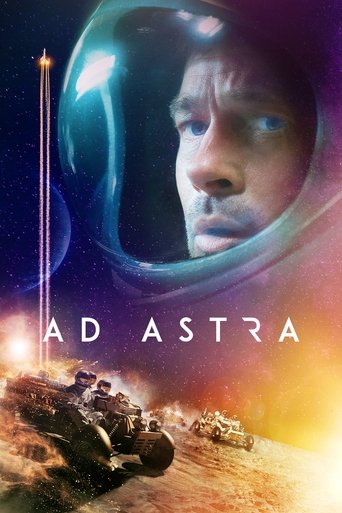
Ad Astra
2019 · Film · 123 min
Directed by James Gray
The near future, a time when both hope and hardships drive humanity to look to the stars and beyond. While a mysterious phenomenon menaces to destroy life on planet Earth, astronaut Roy McBride undertakes a mission across the immensity of space and its many perils to uncover the truth about a lost expedition that decades before boldly faced emptiness and silence in search of the unknown.
3 positive7 negative2 mixed5 neutralfrom 17 commenters
Where to watch
No streaming data for this title.





17 comments on Hacker News
Plenty of good sci-fi, but mostly on TV.
Still, you're also probably overlooking how common sci-fi films are. Like say, Ad Astra with Brad Pitt (2019). The Martian in 2015. Blade Runner 2049. And so on.
The 2010s in sci-fi gaves us:
- Dredd
- Melancholia (may not qualify for some sci-fi fans, I suppose, and I can understand why—it's so very allegorical)
- High Life
- Under the Skin
- Annihilation
- Ex Machina
- Edge of Tomorrow
- Looper
- Blade Runner 2049
- Sorry to Bother You
- Arrival
- Mad Max: Fury Road
- The Last Jedi (I know lots of people hated it—I think it's the only more-or-less good Star Wars movie since the original trilogy, and was shocked at the broadly-negative reaction, having come out of the theater thinking "finally, we got a good one, even if it did play the ending way too safe; everyone's going to be so happy!". We're not gonna change each other's minds in HN comments. Agree to disagree.)
And that's just the ones I've seen and thought were somewhere between good and great. And that I could remember or quickly find a reminder of with a quick search. I hear very good things about the new Planet of the Apes series (like, "each entry is better than the last" good) but have only seen the first one. Lots of people liked Rogue One, Snowpiercer, Ad Astra, and Interstellar (I didn't, or at least didn't think they were notably good, but hey, lots of people did). Godzilla, Pacific Rim, and Kong were OK romps. Heard good things about Upgrade and Attack the Block, but haven't seen them. The Martian was OK (some loved it). Inception was alright (again, lots of others like it way more than I do).
How many really good sci-fi movies did the 70s produce? The 80s? I think we're doing fine.
In the movie Ad Astra (2019) https://www.themoviedb.org/movie/419704-ad-astra they have the concept of "comfort rooms" the system is always sending humans to when they need to wait.
Brazil, The man from Earth, Moon, The fountain, Ad Astra, Donnie Darko, Ender's Game, Edge of tomorrow, Solaris (the old one), Westworld (70s), Metropolis (the japanese anime), Dark Star (trippy, 70s, great end), Firefly series and Serenity movie, Attack the block, Fifth Element, planet of the apes (the old one), ex machina, children of men
Ad Astra is "story" wrapped around visual effects to allow Brad Pitt be used as lead actor. And there could be so much to it: The emotional controls, done by I assume AI? Great plot for a dystopian society. A rogue scientist at the edge of explored space posing a big threat? The Heart of Darkness is great, regardless of version. Various powers battling of the few rocks in what is otherwise an empty solar system? The Expense shows us how great that can be.
All of that in one film? Not so much. And then there a the logic holes bigger than a smaller galaxy. Earth is facing severe energy issues, up to the point a habdfull of dudes are fighting over three luna rovers? Could be fun, ubtil one realizes that there is apparebtly enough energy to be had to kill civilisation by energy waves created somewhere around Saturn... Then Brad is sent on a secret missions, and instead of flying on a military vessel to the lunar station, he takes acivilian flight wearing uniform. Only to land travle across the moon. The inly reason for that seems to be show some fancy lunar battle scene... I could go on...
Space Cowboys so, that would fit. As would Alien and Aliens, everything after Prometeus... If I want Eric Daenicken, I go read one of his books.
I would say Ad Astra is filled to the brim with fantastic and implausible elements. The visual design is very realistic, and this contrast adds to the movie's sense of disconnect (which is great it you like it, and a movie killer if you don't).
Your experience, of course, may be different, but I personally was not a fan of Ad Astra. It’s one of the few movies I was really excited to see in theaters, and by the end I wished I had walked out early. I just didn’t like any of the characters and the crimes against the laws of physics were too great to suspend my disbelief.
The film Ad Astra may contain the most spectacular imagery of Neptune that is currently available. It’s done with reasonable verisimilitude (the planet, not what happened at the planet), based on what we know about it. Some liberties are taken with the thickness and relative velocity of the rings.
If your narrative was true, we would always see critics scores lower than the audience (assuming statistically significant number of critics reviewing a given movie). But we see so many counterexamples with radically different ratings: Spy kids, Ad Astra, Noah, King Kong (2005), Babe, The Blair Witch Project, Chicken Run, and thousands of others.
The tenfold categories are also a way to rescue a bad movie-watching experience, because you can at least debate whether (say) Ad Astra was a ROP or something else instead of just bitching about the science violations.
When 'Ad astra' came out (with IMHO ridiculous rating), I've used python's imdb_scraper to plot distribution based on votes from reviews, turns out that distribution completely opposite to distribution from votes, and now they arbitrarily ignore votes. I can not trust this movie page rating number anymore.
There was massive amount of in space infrastructure and lots of people. Even though they did space mining there is no way they would be able to put all that in place without RLVs. IIRC they even show them a couple times, basically big NASP like SSTO aerospaceplanes.
They also have regular transcontinental flights going through space, even though its IIRC not clear if its sub orbital ballistic trajectories or FOBS like partial orbit ones.
Still, many would-be hard SF films get this completely wrong - huge space stations and/or interplanetary spaceships yet they launch it all on rather dated looking expandable boosters!
Already The Martian it's pushing is pushing it with using basically improved EELVs (launched by ULA, none the less!) yet having hundreds if not thousands of tons of equipment and propelant in place.
Interstellar or Ad Astra is bad shit insane - dinky ELVs and multiple interplanetary colonization attempts and humongous space ship in the former and KFC & artillery fireballs on the Moon in the former. And Ad Astra even has booster stages being dropped when launching from Mars because hey, why not waste even more resources!
At least for me, that is not the case.
Most television and film content is just unbelievably boring, self-important, and undemanding of the viewer's attention. Frankly, content producers have become more and more disrespectful of the viewer's time.
In very rare cases, I suddenly notice I've lost track of the plot--if that happens a couple times, that's when I know I need to put away my phone/laptop and focus on the show.
It is not obvious which content is actually demanding. For example, the film The Martian was very dense and demanding of attention, while the more recent Ad Astra could be summarized with the single sentence "sad sack mopes around space." Dialog rich comedy is generally the most demanding.
Without getting too spoilery, Ad Astra depicts some handheld weapons in space. The movie is slllowww but visually wonderful.
That isn't all that far fetched, both the USSR and the United States looked at various options for space weapons. Traditional firearms like the TP-82 carried by the soviets and various options were looked at for new weapons by both sides like the 'Soviet laser pistol' https://en.wikipedia.org/wiki/Soviet_laser_pistol
There are some documents out there like "The Meanderings of a Weapon Oriented Mind When Applied in a Vacuum Such as the Moon" (just Google the title, click the link you trust) that show various other types that we know were looked at.
The Soviets even put an autocannon on the Salyut 3, and even fired 20 rounds on orbit https://en.wikipedia.org/wiki/Almaz#Defense_measures
What is really bad about MCU is that it displaced other movies from the big budget sci-fi niche. For every Ad Astra or Gravity we have 5 comic book films.
> if you are one of those people like me who stays to watch all a film’s credits
Sometimes I do, I almost left the cinema two times during Ad astra though, such a painful movie to watch.
I saw Ad Astra as a story told with a backdrop of a near-future humanity that has established permanent settlements on multiple terrestrial bodies. At the time of your comment, I had not yet seen the movie - I'd only seen the cover poster displaying a well-known space-suit-clad citizen chosen by society throughout the past couple of decades to demonstrate ideas and experiences (Brad Pitt, same with Matt McConaughey). Movie, television, music, and now algorithmic news feed themes are my preferred methods of gauging public sentiment (programmed or natural). The final detail of the end credits says that there were "15,000 jobs created by this film". This verifies the interest and subsequent investment channeled into a theory and demonstration of the interstellar human experience.
Now I am fresh out of the movie theater, and have consumed the media in it's entirety. The first person narration of Roy began the film with this line:
"I always wanted to be an astronaut... at least that's what I told myself."
This seemingly confirmed my theory of "propaganda meant to inspire current generations". But then the protagonist's ailments became apparent post-primate-attack when he is conducting his psychological evaluation. He describes how he is familiar with the rage of the primate. He understands their pain, but unlike them he is able to discard it and carry on, "remain calm" as he says at the beginning (debrief psych eval describing the fall from the antennae). This is the first instance of violence committed by a life-form confined to a metal tube in a vacuum for an undisclosed amount of time (the Norwegian craft was meant for biomedical research, and perhaps the primate aggression was exacerbated by human experimentation).
Then there are the comfort rooms - a solution meant to simulate conditions on Earth so as to soothe the distressed extra-terrestrial-human.
To paraphrase one of the final quotes of the movie, Roy describes the need to "rely on others and share their burdens as they share his". The pain of solitude was not worth the prospect of discovering "other life". He has no children to orphan in the name of relentless exploration ("yes, yes, yes"), as his father did - yet he realizes he is living out a similar life while underwater on Mars sneaking his way onto the Neptune-bound ship...