 Hacker Cinema
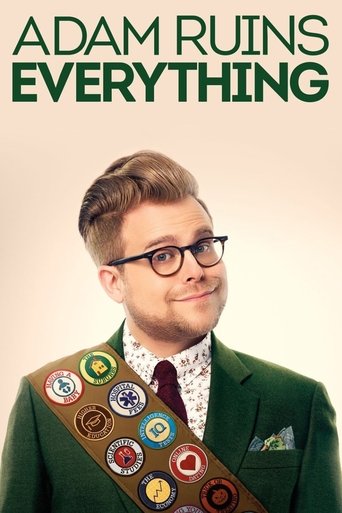
Adam Ruins Everything
2015 · TV series · documentary · 30 min episodes · 3 seasons
Created by Adam Conover
Host Adam Conover employs a combination of comedy, history and science to dispel widespread misconceptions about everything we take for granted.
6 positive2 negative4 neutralfrom 12 commenters
Where to watch
No streaming data for this title.
Videos commenters linked
From YouTube links in the comments below. Most are clips and trailers; “Full” means the uploader says so.






13 comments on Hacker News
"Adam Ruins Everything" is a really, really terrible source. I encourage you to take everything you've learned from it and throw it out entirely.
Every episode makes horrific errors, uses subpar sources if any, and frequently gets really basic facts wrong in an effort to "ruin everything" and weave a narrative.
There was an Adam Ruins Everything episode about car dealerships in the US, from what I remember US lawmakers have made it so it's not a free market compared to the EU. I think it's similar to how US ISPs maintain monopolies in certain areas.
His primary goal is to be a good interviewer. He acts as a blank slate so the guest can bounce whatever their thing is they have to talk about off him.
But even so, I wouldn't say he never challenges people, especially if it's something he actually does have a strong opinion on, like MMA and fitness stuff. There's a (in?)famous episode where he interviewed Adam Ruins Everything and they had a pretty big debate over some of Adam's assertions, like the idea that alpha males don't exist, or that men only seem to be better at sports because the sport was designed for them to be better at it.
This episode of "Adam ruins everything" covers healthcare insurance providers: https://www.youtube.com/watch?v=CeDOQpfaUc8
My takeaway is that the system is calibrated to aggresively punish people without insurance.
I hope the won’t-pay-$100-for-a-painting (or $100 per installment) crowd is large enough to make your business worthwhile. It’d be amazing to simultaneously fund new artists, bring regular Joes/Janes into the art world, and have a sustainable business at the same time.
But that little MBA demon on my shoulder is whispering that targeting low willingness-to-spend consumers will result in, at best, strongly limiting growth and, at worst, a perpetually money losing business. I’m just speculating since I don’t know your financials, so if you’re already in the black, my apologies. If you’re both in the black and don’t care about growth, apologies again.
But assuming you want to grow and/or aspire to be profitable, you’ll either need to grow the size of the art market (hard) or sell to wealthier (or at least, people who spend more of their money on art) consumers (less hard). Social proof is a huge factor for buyers of substantial art, to the point that a handful of people/galleries/etc get to define what constitutes great - and therefore very expensive - art (there was a great Adam Ruins Everything episode on this https://youtube.com/watch?v=Dw5kme5Q_Yo). My mom is very involved with the main art museum in my city, going on trips with other benefactors to buy art for the museum. She also buys art herself - not crazy expensive super known pieces like Damien Hurst’s shark, but still high-end pieces from up-and-coming artists (to put it another way, she buys pieces that aren’t in the $1 million+ range). She uses her own sensibilities primarily, but to find the art itself and ensure the price she’s paying isn’t for a dumpster, she relies on people in the art world.
So, I’m just suggesting you consider two characters of art consumers: (1) social proof drives their decisions and (2) there are often wealthier. Your creative juices might find something really innovative for the social proof component; I don’t have any specific suggestions at the moment. But on (2), consider targeting people in between Steven A Cohen (bought Hurst’s shark for $8-$12 million) and the <$100 art buyer. Given the success (until recently) of Restoration Hardware, I believe you could find people willing to pay $1,000-$10,000 for art. People pay thousands of dollars for a sofa, why not the art that’s on display in their homes? You could imagine quite a few professional, internet savvy DINCs (dual income no children) in their 30s or 40s being interested in having a substantial art piece. They may be intimidated by galleries and not know what to select. Just something to think about to boost your margins.
Great "Adam Ruins Everything" episode about this: https://www.youtube.com/watch?v=CAeHuDcy_bY
> There was an episode of "Adam Ruins Everything" about this. Basically, during prohibition, restaurants couldn't sell alcohol (which was their biggest profit center), so in order to stay afloat, they cut staff wages and introduced the concept of tipping to cover the gap.
So, I guess its time for an episode of “Dragonwriter Ruins Adam Ruins Everything”.
Americans imported the practice of tipping from Europe just after the civil war (some accounts say as an excuse for restaurant owners not to pay newly-freed blacks working as servers, but that's less than clear, though where such workers were common, it was certainly leveraged for that purpose), and there was criticism of the new but rapidly-spreading practice as unamerican and pro-aristocratic in the late 19th Century, before prohibition.
Heck, here's a pre-Prohibition (1916) book about the practice of tipping in America, which even recounts past legislative efforts to stop it:
http://www.gutenberg.org/files/33170/33170-h/33170-h.htm
So, no, it didn't start in response to Prohibition.
There was an episode of "Adam Ruins Everything" about this. Basically, during prohibition, restaurants couldn't sell alcohol (which was their biggest profit center), so in order to stay afloat, they cut staff wages and introduced the concept of tipping to cover the gap. It kind of stuck since then.
There is an awesome Adam ruins everything episode on Tax returns. It seems that rent seeking is pretty much the only thing keeping the current system in place.
This was covered in a very entertaining show called Adam Ruins Everything. Each episode has footnotes for the sources:
http://www.trutv.com/shows/adam-ruins-everything/blog/adams-sources/adam-ruins-cars.html
Interestingly enough, their source was an article from Vox from 2007: https://cdn1.vox-cdn.com/uploads/chorus_asset/file/2934608/Norton_Street_Rivals.0.pdf
EDIT: the article references the original author's work and the book (also cited as a source by the show) http://www.amazon.com/Fighting-Traffic-American-Inside-Technology/dp/0262516128
"Why Tipping Should Be Banned", by Adam Ruins Everything is worth watching if you are of the school of thought that tipping is bad: https://www.youtube.com/watch?v=q_vivC7c_1k
The gist of the video is that if you're tipping, then a waiter/waitress for example is not being paid enough, and tips are deliberately designed to bolster their unfair income.
The idea that we need 8 glasses of water a day comes from water company marketing departments, not science. Same for nearly everything in the popular common knowledge about sports drinks and electrolytes for athletes and others exercising.
Unless you have some medical condition that throws off your normal body systems, you only need to drink when you feel thirsty. For some people that will happen several times a day, and for others it might happen only a handful of times or fewer depending on how much water they get from their food.
There was an excellent episode of "Adam Ruins Everything" a few weeks ago on this topic. It is well worth watching.
I'm not sure you can really tell much about women's color preferences from bridesmaids dresses. A lot of women seem to think that brides tend to pick ugly dresses for their bridesmaids.
Some claim this is because they do not want the bridesmaids to outshine the bride. Others say it is because they need a design that works well for a group that may consist of people with different skin tones, sizes, and shapes, and that is not too expensive for the bridesmaids to buy, and this limits choices. Whatever the reason, it seems that a lot of these dresses are ones that the bridesmaids would not be choosing if they got to pick their own dresses.
That said, yes, pink = girls, blue = boys is a fairly modern convention. This was covered on the "Adam Ruins Summer Fun" episode of the excellent new show "Adam Ruins Everything" on TruTV [1].
Here is the reference cited on that episode for their discussion of boy/girl blue/pink [2].
[1] https://en.wikipedia.org/wiki/Adam_Ruins_Everything
[2] http://www.smithsonianmag.com/arts-culture/when-did-girls-start-wearing-pink-1370097/?no-ist