 Hacker Cinema
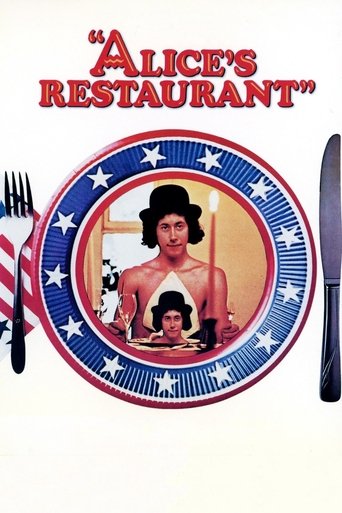
Alice's Restaurant
1969 · Film · 111 min
Directed by Arthur Penn
After getting kicked out of college, Arlo decides to visit his friend Alice for Thanksgiving dinner. After dinner is over, Arlo volunteers to take the trash to the dump but finds it closed for the holiday, so he dumps the trash in the bottom of a ravine. This act of littering gets him arrested and sends him on a bizarre journey.
1 neutralfrom 1 commenter
Where to watch
No streaming data for this title.
Videos commenters linked
From YouTube links in the comments below. Most are clips and trailers; “Full” means the uploader says so.







2 comments on Hacker News
This 2012 article starts off with a claim:
> The old-fashioned custom known as “dating” (as in: guy calls up girl and asks her out next Friday, takes her to a movie and a meal, picks up the cheque, takes her home, kisses her goodnight and, if he’s lucky, gets to third base) is something their grandparents did. Today, people just hook up.
Did the author get this from watching old TV shows? Because if you read, say, the Feynman stories about picking up women in the 1950s, you don't get the same opinion.
> “Today’s young man faces a sex life that probably would have exceeded the most optimistic imagination of most men throughout history,” Roy Baumeister says in his book Is There Anything Good About Men?
It's like the 1960s sexual revolution, and the era between The Pill and AIDS, when most VDs could easily be treated, didn't even happen.
Consider this scene from the 1969 "Alice's Restaurant" movie - https://youtu.be/sP05C_agI3k?t=1316 (note: shows a topless and purportedly underage woman), where the self-described 'teenybopper' lists the number of people she's had sex with, and how she want to sleep with Arlo - someone she's just met.
And I think there's a discussion in Heinlein's "To Sail Beyond the Sunset" describing how the people of some era (1960s?-1980s?) feel as comfortable giving a blowjob as previous generations might have shaken hands. Heinlein was a proponent of sexual liberation and free love, but surely his writings give an indication of what what's underneath the sanitized sexual history of the US.
It's hard to say if something is a valid prediction without establishing a baseline comparison. It could also be that he's predicting things wouldn't change from the 1960s.
> (1) Random acts of violence by crazy individuals, often taking place at schools, plague society in Stand on Zanzibar.
In 1966 Charles Joseph Whitman went to a tower on the campus of the University of Texas at Austin and murdered 16 people and wounded 32 others.
http://en.wikipedia.org/wiki/List_of_school_shootings_in_the_United_States#1960s lists many acts of violence that took place at schools in the 1960s.
In terms of a prediction, the amount of 'random' violence has gone down since the 1960s.
> (7) Although some people still get married, many in the younger generation now prefer short-term hookups without long-term commitment.
The book was written in the 1960s, in the free love era between effective treatments for VD and AIDS. Compare with the movie "Alice's Restaurant", from the same year as "Stand on Zanzibar", Arlo Guthrie (played by himself) is asked by a teenybopper he just met if he want to have sex with her. He turns her down, ostensibly because he doesn't want to catch her cold. https://www.youtube.com/watch?feature=player_detailpage&v=c0jfwlWDgto#t=1271 .
In terms of a prediction, has the amount of short-term hookups increased since the 1960s? Or stayed the same or decreased? I don't know.
But I'm willing to assert that the author of this piece (which was repeated on many sites) doesn't know either.
> (10) Motor vehicles increasingly run on electric fuel cells.
Really? I thought they increasingly run on batteries, not fuel cells. Wikipedia says:
> As of early 2014, there is limited hydrogen infrastructure, with 10 hydrogen fueling stations for automobiles publicly available in the U.S.,
I haven't read Stand on Zanzibar for a long time and it's not in my collection, so I can't investigate the other claims in any detail.