 Hacker Cinema
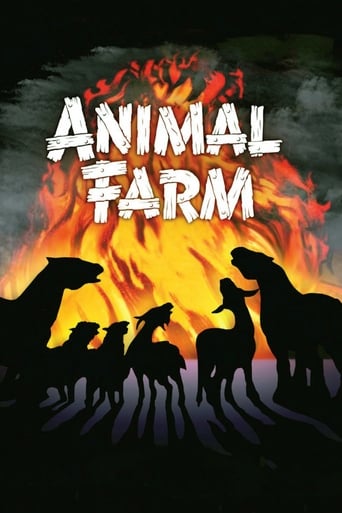
Animal Farm
1954 · Film · 73 min
Directed by Joy Batchelor, John Halas
Animals on a farm lead a revolution against the farmers to put their destiny in their own hands. However this revolution eats their own children and they cannot avoid corruption.
2 positive3 negative12 neutralfrom 17 commenters
Where to watch
No streaming data for this title.


18 comments on Hacker News
I have no understanding of your viewpoint. I wish I did, it sounds interesting. I do like a Crafting Interpreters or Mythical Man Month...
But I don't understand how those could not only be held to the same level as The Hobbit, but that you seem incapable of even reading Animal Farm.
Do you enjoy any fictional media? TV, movies, plays, interactive murder mystery dinners, tabletop games (d&d, etc)?
> If you consume “mainstream” American news, TV, movies, etc. you are being propagandized way more powerfully than anything a Sputnik, RT, AJ, DW, BBC, etc. could ever hope to achieve.
https://en.wikipedia.org/wiki/Military–entertainment_complex
War films are the most overt examples but far from the only ones:
> Four decades after the release of the 1954 adult animated film Animal Farm, Cold War historian Tony Shaw discovered, through looking at archives of the film, that the CIA had secretly purchased the rights to the film. The CIA also altered the ending of the film so that the pigs, who represent communists, were overthrown by the other animals on the farm.
https://en.wikipedia.org/wiki/Operation_Mockingbird
Said to an American news anchor (who later dismissed the speaker as a "brilliant conspiracist" for this line): "I’m sure you believe everything you say. But what I’m saying is if you believed something different you wouldn’t be sitting where you’re sitting."
> No conspiracy necessary. The CIA bought the rights to the 1954 film Animal Farm, modified the ending to fit propagandist ends,
yea, I remember reading the book and then watching the movie and it had differences iirc, its available on youtube for free and I remember some comments talking about the different ending.
IIRC, in the movie, the animals finally kick the pigs out and everything. It was a good ending.
but in the book, there was not a good ending, the humans and the pigs were celebrating together and then ended up fighting in between each other
> Twelve voices were shouting in anger, and they were all alike. No question, now, what had happened to the faces of the pigs. The creatures outside looked from pig to man, and from man to pig, and from pig to man again; but already it was impossible to say which was which.
This is the last paragraph I found from the book (had to download it via archive.org to find the last para)
So am I correct or is there more to the story?
No conspiracy necessary. The CIA bought the rights to the 1954 film Animal Farm, modified the ending to fit propagandist ends, and it went undiscovered for four decades. The original Top Gun was intended to recover the image of the US Navy after the Vietnam War. Etc etc etc.
https://en.wikipedia.org/wiki/Military%E2%80%93entertainment_complex
> _Animal Farm_ was taught to me by my capitalist and authoritarian teachers as an anti-communist screed
And then you find out:
Animal Farm (1954 UK animated film) was funded in part by the Central Intelligence Agency (CIA), who also made changes to the original script. Sometimes there is a "conspiracy" and the truth is weird. The animated movie has a entirely different resolution at the end than the book does. Presumably teacher's materials in the USA were similarly biased?
As an outsider, occasionally I am surprised by the similarities between the USA and the USSR even if the precise details are very different.
We do proper apocalyptic books and films in the UK! If you survive "Threads" and "When the wind blows", why not wash it down with some dystopia! 1984, Animal Farm, Children of men.
Other apocalypses and dystopias are available. The UK is not the sole source of them. 451F, Brave New World ...
To the "Oh, but consider the art, not the artist!" crowd:
Asimov on 1984:
>In his despair (or anger), Orwell forgets the virtues human beings have. All his characters are, in one way or another, weak or sadistic, or sleazy, or stupid, or repellent. This may be how most people are, or how Orwell wants to indicate they will all be under tyranny, but it seems to me that under even the worst tyrannies, so far, there have been brave men and women who have withstood the tyrants to the death and whose personal histories are luminous flames in the surrounding darkness. If only because there is no hint of this in 1984, it does not resemble the real world of the 1980s.
Nor did he foresee any difference in the role of women or any weakening of the feminine stereotype of 1949. There are only two female characters of importance. One is a strong, brainless ‘prole’ woman who is an endless washerwoman, endlessly singing a popular song with words of the type familiar in the 1930s and 1940s (at which Orwell shudders fastidiously as ‘trashy’, in blissful non-anticipation of hard rock).
The other is the heroine, Julia, who is sexually promiscuous (but is at least driven to courage by her interest in sex) and is otherwise brainless. When the hero, Winston, reads to her the book within a book that explains the nature of the Orwellian world, she responds by falling asleep — but then since the treatise Winston reads is stupefyingly soporific, this may be an indication of Julia’s good sense rather than the reverse.
In short, if 1984 must be considered science fiction, then it is very bad science fiction.
https://redsails.org/asimov-on-1984/
Jones Manoel on Animal Farm:
>Orwell spends the entire book describing generations of animals as easily confused, dumb, stupid, illiterate, amnesiac… the entire book! The main target of this book’s critique aren’t the revolutionaries or communism: it’s the working class. George Orwell writes from an aristocratic ethos. “Elite theory” posits the people as incapable of self-governance, without the capacity to constitute themselves as a political subject, and therefore always the object of dispute and manipulation by vying elites. The people lack the capacity for political self-determination, cannot build a political program or engage in autonomous political action. This is George Orwell’s theory, borne out by his choice of metaphors. […] Animal Farm isn’t a critique of revolutionaries; it’s a critique of workers. It’s an aristocratic manifesto against the working class.
https://redsails.org/jones-on-animal-farm/
Dolan on Shooting an Elephant:
>[“Shooting an Elephant”] is a vivid, simple story about how the young Orwell was forced by the pressure of an expectant Burmese crowd to shoot a harmless elephant. Orwell’s surface thesis, laid out in the concluding paragraphs, is that Imperialism turns the Imperialist into a puppet in the hands of the natives. Here’s the first paragraph:
In Moulmein, in lower Burma, I was hated by large numbers of people — the only time in my life that I have been important enough for this to happen to me. I was sub-divisional police officer of the town, and in an aimless, petty kind of way anti-European feeling was very bitter. No one had the guts to raise a riot, but if a European woman went through the bazaars alone somebody would probably spit betel juice over her dress. As a police officer I was an obvious target and was baited whenever it seemed safe to do so. When a nimble Burman tripped me up on the football field and the referee (another Burman) looked the other way, the crowd yelled with hideous laughter. This happened more than once. In the end the sneering yellow faces of young men that met me everywhere, the insults hooted after me when I was at a safe distance, got badly on my nerves. The young Buddhist priests were the worst of all. There were several thousands of them in the town and none of them seemed to have anything to do except stand on street corners and jeer at Europeans.
I did worry about that description of the Burmese. I mean, it was sort of racist. But reading on, I saw it was just part of a strategy, a double twist where first Orwell zaps you with his anti-Burmese descriptions, then balances them with a paragraph about his loathing for “the Empire [he] served.” It was such a risky, raw strategy I felt proud to have spotted it. Moving up through the ranks, I taught “Shooting an Elephant” for years as a classic of rhetorical structure.
Now I think I read it wrong, rejecting the “obvious” in favor of cooptation by the author. In fact, I was exactly the sort of sucker Orwell had in mind, a half-bright provincial trained to miss the obvious and cleave unto the far-fetched. By teasing this sort of reader with that shock intro, then reassuring him (“Don’t worry, I’m anti-Imperialist”), Orwell got me to ignore the biggest and most important feature of the essay: Orwell’s sheer simple hate for the Burmese. It stuns me to realize that I helped a generation of students overcome their simple, correct instinct (some poor honest kid would always ask, “Isn’t this kinda racist?” and be talked into seeing the Emperor’s glorious wardrobe by me).
http://exiledonline.com/big-brothers-george-orwell-and-christopher-hitchens-exposed/
He also stole the plot for both Animal Farm (https://www.radnorshire-fine-arts.co.uk/brand/elias-gertrude-1913-1988/) and 1984 (https://www.theguardian.com/books/booksblog/2009/jun/08/george-orwell-1984-zamyatin-we). In the case of Animal Farm he turned it from an anti-Nazi tale to an anti-Soviet one in which there's no Nazis to speak of.
He was a lousy hack of a writer who was elevated to prestige for political purposes.
Perhaps the most blatant case of "political correctness" in literary history.
>Between 1952 and 1957, from three sites in West Germany, a CIA operation codenamed ‘Aedinosaur’ launched millions of ten-foot balloons carrying copies of George Orwell’s Animal Farm, and dropped them over Poland, Hungary and Czechoslovakia — whose airforces were ordered to shoot the balloons down.
https://www.spectator.co.uk/article/novel-explosives-of-the-cold-war
>The movie adaptation of Animal Farm was the UK’s first animated feature film, and it was entirely funded by the CIA. This fact was kept secret for 20 years, and only revealed in 1974, to no cultural impact.
https://www.telegraph.co.uk/books/authors/how-cia-brought-animal-farm-to-the-screen/
> Communism was taken seriously by many in the West, and was quite popular.
It is easier to understand the popularity if you imagine the support was for Marxism, since plenty of the intelligencia (mostly in humanities?) still publicly support Marxism.
The word "communism" has changed its meaning over time - especially in the USA.
Eric Blair (George Orwell) was not a supporter of communism - he used the word "socialist" for his beliefs and he fought with the "anarchists" in Spain. Both of those political words have changed their meaning too.
Animal Farm was written by him and his wife[1] as a satire of communism because a direct criticism was not palatable at the time. Eric also experienced the Soviet Union undermining a revolution - he wrote about this in Homage to Catalonia https://news.ycombinator.com/item?id=35606380
The most bizarre story is the CIA funding[2] the UK animated version of Animal Farm so that they could change the script for propoganda purposes: "To meet the CIA's objectives, the ending was changed to show that only the pigs had become totally corrupt. The film ends with other animals mounting a successful revolt against their rulers. There is no mention of the humans in the film's conclusion."
[1] https://www.abc.net.au/news/2023-08-12/anna-funder-new-book-wifedom-george-orwell-eileen-blair/102711852
[2] https://www.theguardian.com/culture/2003/mar/07/artsfeatures.georgeorwell
I think Orwell's fame is totally unrelated to these 6 rules — 5 rules, since the last one is just a warning that rules about style should not be absolute.
Why is 1984 so acclaimed? Its style is boring and unimaginative. The characters' psychology is exaggerated and totally unbelievable (I remember the scene in the cinema at the beginning at the book, and, at the end of the book, the absurd post-torture behaviour). A large part of the story was ripped off Zamyatin. Some parts of the story are okay, but other parts are ridiculous... When I read that the nice old librarian was in fact the young chief of the counter-intelligence service, disguised in order to catch dissidents, I burst out laughing: imagine Beria tailing dissidents in the street, or Edgar Hoover disguised as a plumber to install illegal wire-tapes!
Orwell's crude style and stories are perfectly fine for a grotesque parody like Animal Farm. But I can't think of 1984 as a good book, not even close. I suppose it was successful because propaganda likes crude style and stupid stories, and 1984 was largely seen as a propaganda tool.
"The Freedom of the Press". It was meant to be a preface to the "Animal Farm", but ended up getting effectively censored (by publishers, not by the government) for decades.
https://www.orwellfoundation.com/the-orwell-foundation/orwell/essays-and-other-works/the-freedom-of-the-press/
What I found striking is how much of the landscape described there is familiar aside from the names.
"One of the peculiar phenomena of our time is the renegade Liberal. Over and above the familiar Marxist claim that ‘bourgeois liberty’ is an illusion, there is now a widespread tendency to argue that one can only defend democracy by totalitarian methods. If one loves democracy, the argument runs, one must crush its enemies by no matter what means. And who are its enemies? It always appears that they are not only those who attack it openly and consciously, but those who ‘objectively’ endanger it by spreading mistaken doctrines. In other words, defending democracy involves destroying all independence of thought."
"But freedom, as Rosa Luxembourg said, is ‘freedom for the other fellow’. The same principle is contained in the famous words of Voltaire: ‘I detest what you say; I will defend to the death your right to say it.’ If the intellectual liberty which without a doubt has been one of the distinguishing marks of western civilisation means anything at all, it means that everyone shall have the right to say and to print what he believes to be the truth, provided only that it does not harm the rest of the community in some quite unmistakable way. Both capitalist democracy and the western versions of Socialism have till recently taken that principle for granted. Our Government, as I have already pointed out, still makes some show of respecting it. The ordinary people in the street – partly, perhaps, because they are not sufficiently interested in ideas to be intolerant about them – still vaguely hold that ‘I suppose everyone’s got a right to their own opinion.’ It is only, or at any rate it is chiefly, the literary and scientific intelligentsia, the very people who ought to be the guardians of liberty, who are beginning to despise it, in theory as well as in practice."
"The sinister fact about literary censorship in England is that it is largely voluntary. Unpopular ideas can be silenced, and inconvenient facts kept dark, without the need for any official ban. Anyone who has lived long in a foreign country will know of instances of sensational items of news—things which on their own merits would get the big headlines—being kept right out of the British press, not because the Government intervened but because of a general tacit agreement that ‘it wouldn’t do’ to mention that particular fact. So far as the daily newspapers go, this is easy to understand. The British press is extremely centralised, and most of it is owned by wealthy men who have every motive to be dishonest on certain important topics. But the same kind of veiled censorship also operates in books and periodicals, as well as in plays, films and radio. At any given moment there is an orthodoxy, a body of ideas which it is assumed that all right-thinking people will accept without question. It is not exactly forbidden to say this, that or the other, but it is ‘not done’ to say it, just as in mid-Victorian times it was ‘not done’ to mention trousers in the presence of a lady. Anyone who challenges the prevailing orthodoxy finds himself silenced with surprising effectiveness. A genuinely unfashionable opinion is almost never given a fair hearing, either in the popular press or in the highbrow periodicals."
What's even more striking is that it's a socialist writing this. I'm far left myself and I'm with Orwell on this subject, but I see very few fellow lefties who are; as a whole, they're far more interested in deriding "freeze peach". Indeed, the quotes above would likely be quite sufficient by themselves to "cancel" Orwell if he were alive today - and I didn't even bring up the meatier parts where he e.g. defends Moseley's due process rights.
Wow, learning something new (and troubling) about Snowball (or rather, one portrayal of Snowball) in that article:
> When the novel Animal Farm was adapted for the screen in the 1950s, the CIA investors were initially greatly concerned that Snowball was presented too sympathetically in early script treatments and that Batchelor's script implied Snowball was "intelligent, dynamic, courageous". A memo declared that Snowball must be presented as a "fanatic intellectual whose plans if carried through would have led to disaster no less complete than under Napoleon." De Rochemont subsequently implemented these changes.
> .Orwell Subverted: The CIA and the Filming of animal Farm, pp. 75–79
Scary. I had no idea CIA had anything to do with movie production in the US. Wonder if that's still the case.
This is only true if the young ones in question are in a psychologically safe and emotionally supportive environment.
I read things as a young child, without having the support to talk and parse them out, and additionally on top of the chaotic environment I was already in, where reading things like Animal Farm, or, specifically in my case, being introduced to the concept of destructive extinction events in books, movies, and magazines caused much trauma. I had a year where I didn't sleep well, until I could finally convince myself that aliens weren't going to get me in the shower, and that a giant meteor wasn't going to collide with earth any time soon (yet, at least).
Interesting the difference a few years can make. In this preface Orwell claims the Ministry of Information attempted to suppress its publication around 1944; by 1950 the CIA had purchased the film rights. They eventually funded a feature-length animated film adaptation that was released in 1954[0]
[0] https://web.archive.org/web/20161026174651/http://www.telegraph.co.uk/books/authors/how-cia-brought-animal-farm-to-the-screen/
For more about his experience in the Spanish Civil War and its influence on his writing, I suggest the In Our Time episode on Animal Farm: http://www.bbc.co.uk/programmes/b07wgkz4
Reminiscent of how the CIA backed the production [1] of an Animal Farm cartoon as PSYOPS against the USSR.
Shutterbug is more fightning considering the content is conditioning for ubiquitous surveillance drones flying everywhere.
[1] http://www.telegraph.co.uk/culture/film/11209390/How-the-CIA-brought-Animal-Farm-to-the-screen.html
> It's sick if Orwell knew this and yet agreed to his anti-Communist political writings being disguised in a story and used to destabilize the farms on other states.
Orwell was not anti-communist, he was anti-Stalinist. Orwell himself was a democratic socialist.
Before he died in 1950, Orwell enjoyed a dramatization of Animal Farm broadcast on the BBC. I'm not sure he would have been upset, or found it hypocritical, to have a film version made in 1954.
> His book may have become a Squealer
Perhaps writing anti-Stalinist propaganda condemning Stalin's use of propaganda is hypocritical. But one would have to ignore the content of the message and focus only on the means of delivery to call Orwell a hypocrite. And why would he not want to see wider dissemination of his message?
This was likely part of Operation Mockingbird [1]: A large scale effort by the CIA to use media outlets and literature for propaganda purposes.
In a sick twist of irony Operation Mockingbird funded and arranged for the Hollywood production of the book "Animal Farm". It is believed they siphoned funds meant for the Marshall Plan.
Russians also struck back with propaganda efforts of their own. Operation INFEKTION [2] was a KGB operation to further the idea that AIDS was a man-made invention first produced in a U.S. laboratory.
Likely this hasn't ended. The U.S. military will provide access to their facilities and equipment, provided they get a cut on the movie script. Propaganda efforts to further the conspiracy that 9/11 was an inside job still prosper in Middle-eastern countries.
Current groups like "Anonymous" or the "Privacy-conscious" may very well be the target of propaganda attacks. Next time the media vilifies TOR as a network for criminals, it may pay to double-check the source.
[1] http://en.wikipedia.org/wiki/Operation_Mockingbird [2] http://en.wikipedia.org/wiki/Operation_INFEKTION
LoganCale, get them to watch the movie Brazil and then read 1984, and for good measure hit them with a copy of Animal Farm just for the heck of it.
"All animals are equal, but some animals are more equal than others."