 Hacker Cinema
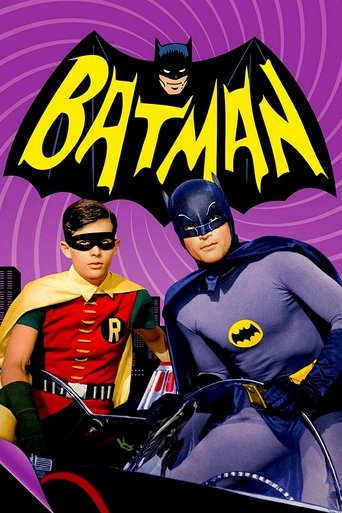
Batman
1966 · TV series · 25 min episodes · 3 seasons
Created by William Dozier, Lorenzo Semple Jr.
Science FictionFantasyComedyActionAdventure
Wealthy entrepreneur Bruce Wayne and his ward Dick Grayson lead a double life: they are actually crime fighting duo Batman and Robin. A secret Batpole in the Wayne mansion leads to the Batcave, where Police Commissioner Gordon often calls with the latest emergency threatening Gotham City. Racing to the scene of the crime in the Batmobile, Batman and Robin must (with the help of their trusty Bat-utility-belt) thwart the efforts of a variety of master criminals, including The Riddler, The Joker, Catwoman, and The Penguin.
4 positive1 negative15 neutralfrom 20 commenters
Where to watch
No streaming data for this title.
Videos commenters linked
From YouTube links in the comments below. Most are clips and trailers; “Full” means the uploader says so.

20 comments on Hacker News
Batman was a parody of cop shows, and his utility belt was part of the joke. Get Smart did similar things to lampoon spy movies.
The Munsters had a running gag where Herman would look into a mirror and it would shatter. I'd still laugh every time.
Another way: the Batmobile's Anti-Theft Activator [1] from the 1966-1968 Batman TV series.
[1] https://batlabels.tumblr.com/post/158029360040/anti-theft-activator-start-button
I’m really not sure if he should be given all the credit.
Comics thrived in other countries, so even if American comics were seen as right behind porn, it was only a matter of time until they eventually made their way into mainstream popularity in the US. Which, as far as I know, comics were already popular—they were just a kids’ thing. Same as how video games were just kids’ things for a solid 2-3 decades until kids who grew up on games became adults and the industry started pivoting towards their adult tastes.
Kind of like how kids who grew up on 1940s and 50s comics and their mainstream media influence started to grow a couple decades after they grew up. Batman was a pretty popular TV show roughly 25 years after being a notably popular comic book. Then 25 years after that, we started getting popular movies and more mature cartoons based on the series.
> It wasn't a genderbent Wolverine or Iron Man
But Huntress (Helena Bertinelli) was a genderbent Batman. Supergirl is gender-bent Superman.
In fact, every male superhero has a female counterpart. Captain Marvel / Shazam has Mary Marvel. Superman has Supergirl. Batman has Batgirl, actually 3 different batgirls.
---------
The only question for "longtime DC Fans" for Batgirl is: are they doing Cassandra Cain or are they doing Barbara Gordon? There's like 3+ long-running batgirl stories that go back decades.
Besides, both Cassandra Cain and Barbara Gordon are both unique characters who take up the "Batgirl" costume to the disdain of Batman. Its not like the "obvious" genderswap version (Huntress / Helena Bertinelli) who was kind of "obviously" written to be a female-version of Batman.
Cassandra Cain is League of Assassins originally. She never learned proper language / speaking skills and is overcoming illiteracy. She's unsocialized, extremely awkward, etc. etc.
Barbara Gordon is Commissioner Gordon's daughter, and is often a bit campier as a result. (The Police Chief certainly doesn't want his daughter in danger, but she goes out and helps Batman anyway). She's more of a fangirl of Batman and arguably connects with female fans in a more natural way.
Neither Cassandra Cain nor Barbara Gordon are rich, nor powerful, nor CEOs. Cassandra Cain was "League of Assassin" trained before Batman was (it was an interesting twist to have them train him in the 2000s era films, but that's really Cassandra / Damian's story)
---------
The first "Batgirl" was in the 1960s, and "Barbara Gordon" version of Batgirl was all over the original 1960s campy "Batman" live action TV show.
There's literally 60+ years of Batgirl history here. Its suddenly weird to complain of wokeism when the character has such a long history in comics and TV.
-----------
The only criticism I have, is that they didn't do Batgirl sooner. After all, there was the "Birds of Prey" movie, and Batgirl should have "graduated" into Oracle (her full-time superhero gig) for the Birds of Prey to get together. Batgirl is kind of the "awkward fangirl" thing she does as a kid. In my groups where I talk about comic books, everyone was wondering where the hell Oracle was in the Birds of Prey movie.
I agree with some other commenters; this is a lot of cherry picking. You could just as easily compare Nosferatu (1922) with Blade (1998) with Twilight (2008) and ask why culture gets happier and less serious as time goes on, “aren’t we all becoming like Brave New World???” Comparing Adam West’s Batman with today’s Batman is just lazy. They’re apples and oranges at this point: different genres, different climates (today the more “fun” stuff is Marvel), different film technology. And if we want to get into it, it’s not “depression” that’s trendy; it’s realism. 60’s Batman dealt with all the same “dark” themes as current Batman: mafia, crime, trauma and grief, etc. But the visual portrayal was different because it was a “comic book” before comic books adaptations were commonplace blockbusters. That doesn’t mean all of 1960s cinema is somehow a comic book movie. Hello: Psycho (1960), Dr. Strangelove (1964), The Good, The Bad, and the Ugly (1966).
Rainbow-colored spinning loading wheel; jumping menu bar icons, trying to grab your precious attention for whatever reason; minimize button triggering "sucking" animation; app installation where you have to needlessly drag an icon onto Applications folder; pop-up windows which appear, then momentarily shrink and expand again. Sometimes it gives certain 1960's Batman TV series vibes.
You wonder if that Batman episode about people not being able to read in their dreams holds up
Tangentially, last night I half-listened to an interesting YouTube video that used the history of Robin Hood movies to describe this trend.
https://www.youtube.com/watch?v=428ZxrW6jhk
It's a slowly escalating 45-minute rant, but I think that this quote from toward the end summarizes it fairly well: "I'm admittedly a little tired of seeing heroes always surrounded by worlds of gray, because, if they're there long enough, they start to feel kind of gray, too."
I haven't ever seen the Errol Flynn version of Robin Hood, but I suppose my equivalent is that, as far as I'm concerned, Batman peaked with the TV show in the 1960s. It wasn't just colorful, it was legitimately fun. To the point where even the bad episodes were good. The Tim Burton movies were also a bit like that. They were visually dark, sure, but that was Tim Burton's aesthetics, and it was a package deal that came together with at least a few glimmerings of that same twisted sense of humor that got him fired from Disney for making Frankenweenie.
Since then, though? It's a bunch of increasingly sad movies by apparently sad people whose creative drive seems to primarily come from the desire to demonstrate to themselves and everyone else that they are Grown Ups, and who are too busy Taking Their Jobs Seriously to have any fun at work. And so they're working so hard that, even though what they're producing is technically classified as entertainment, the end result is so joyless that watching it ends up feeling, at least to me, like work.
The MCU movies are not considered campy by most standards since they take themselves and their internal universe completely seriously.
Batman of the 1960s was campy. The Flash TV show is campy. The MCU may have some humorous moments but the tone, overall, is serious and thought-provoking. Civil War, Black Panther, Winter Soldier, and Iron have all been mentioned here already but you can go on and on with those films.
Originality? Hah! Even remaking Frankenstein every 20 years or so brought a new take to it, whether Boris Karloff, Bela Lugosi or Robert de Nero, they all brought something new.
More than any point I can remember before Hollywood now turn every movie and remake into the exact same movie. There was always some degree of fashion, but there's no contrast any more - it's all highlight, so it drags and drags by being boring and samey (but loud). Highlight is now just the dull background. The loudness wars, movie edition.
Doesn't matter what it is, a current film (or Netflix high budget, Game of Thrones etc) will have:
+ An absurdly overblown inspirational speech inspiring the troops (or children, or escapees, or office colleagues)! This will take 5-10 ear-bleeding, cringing minutes. If unlucky, you'll get two or three of these in one show!
+ An absurdly artificial, but highly 3D friendly chase scene with no production value other than hype. This will take 5-15 minutes. It stopped being interesting after Blues Brothers' piss take of chase scenes!
+ Ditto, ditto fight scene. Super slow motion. I always think of Adam West's TV Batman, complete with music - Zap! Pow! OWWW! Biff! 300 enemies die, town levelled, 342,000 rounds of ammunition spent, hero hasn't broken sweat. Just about the only recent exceptions I can think of are Deadpool and Sin City. Damn, the sequels were disappointing.
+ Ditto, ditto villain's death or capture.
I wait for them to land on Netflix, then go make tea, tidy the kitchen or watch some paint dry in all those "highlights". Independents with next to no budget can still do original though.
- Confusion between the window receiving mouse events and the window receiving keyboard events. I'm a programmer, I know exactly how this works, and it STILL startles me on a daily basis when I've been reading text in one window for a minute or two, scrolling around, and then when I start typing, I realize my keystrokes aren't going to the program that I've been interacting with for the last few minutes. What was the last window I actually clicked on? Did I just type random garbage into a code file? An email? A chat window? I have to go find it and fix it before I continue what I'm doing.
- Awkward switching between screens. Waiting for the animation reminds me of those spinning scene transitions in the old Batman TV show [0]. At one point I learned to set the screen animation to be almost instant — there was still an annoying flicker — but the hack stopped working, I looked up another hack, then I got a new Macbook Pro and the notes I had didn't work, and realized I should just stop fighting it. I guess the thing about a "snappy" transition is that you don't see what's happening and could get confused. Makes sense, but very frustrating if you know what you're doing. Now I just amuse myself by mentally playing the Batman transition sound when I switch between workspaces.
Funny thing: early film editors initially thought that cuts needed to be extremely gentle, with explicit cues to help viewers understand that one scene had ended and a new scene was starting. They didn't stick with those techniques for long; it turns out that people are smarter than they anticipated, and they get bored with filler that doesn't move the movie forward! Even a fraction of a second of boilerplate filler to show that a cut has happened (as opposed to moments that serve an artistic purpose) decreases engagement.
- Awkward switching between program windows. If a program has multiple windows, and there's one I really don't care about right now, like an email or document I was working on a few days ago, I don't want to see it randomly popping to the foreground just because I switched to an email or document that I've been working on today. OS X occasionally gets really pushy with me like OH YOU SHOULD REALLY FINISH THIS EMAIL TO YOUR MOM or I HAVEN'T SEEN YOU WORKING ON THIS APP LATELY. Shut up, OS X, I know what window I asked for, and that wasn't it.
- No way to avoid collisions between my keyboard shortcuts and application shortcuts. It's really easy in Linux, thanks somewhat ironically to that Windows key that I cursed when it first appeared. Turns out it's perfect: it's a key that you can bind to window manager shortcuts in full confidence that it will never collide with application keyboard shortcuts. It's a logical division that worked really well with my brain: my window operations and system-level shortcuts all used the same modifier key, and application shortcuts used different modifier keys. You'd think Apple would have something equally elegant, but they don't. You set up key bindings, get attached to them, and then the next program you learn might require you to redo them (or customize application shortcuts to something that makes less sense than the defaults.)
- Menu bar at the top of the screen. I admit this is cliche and somewhat arbitrary, but I was a years-long Apple user, using Apple GUI operating systems all the way back to the Mac Plus and Apple IIgs days, and the instant I saw that Windows programs had menu bars attached to their windows, I realized that's the way it should be. I'm sure other people have the opposite reaction, but I'm an Apple "native speaker" who used Apple GUIs for many years before I saw a Windows machine, and who has used Apple on the desktop almost exclusively for the last six years, yet the menu bar thing still seems weird to me. Why is the menu bar for my program so far away? From a productivity standpoint, on Windows or Linux, if I can see program window, I can visually target the menu. On a Mac, first I have to click the program window, then I can visually target the menu and click on it. It's a small annoyance, but the small annoyances add up.
I'm sure I could go on, but I shouldn't invest more of my morning in complaining :-(
[0] https://www.youtube.com/watch?v=ksuPdtwHCE4
Hmm, Wikipedia says there was no Batman episode broadcast that night [0]. I don't believe it! [edit:] Well, maybe it was "Time Tunnel" -- my other favorite show of that era. It was on that night [1].
[0] https://en.wikipedia.org/wiki/List_of_Batman_(TV_series)_episodes
[1] http://www.imdb.com/title/tt0723777/
>This "stop doing something because I personally don't like it!" mentality is what should be done away with.
Couldn't agree more.
It's the same mentality that makes people declare that "[arbitrary tv show] should've been cancelled long ago!"; or what a travesty it is that [arbitrary beloved IP] is getting a sequel/remake/reboot.
If the Simpsons runs for fifty seasons, it doesn't undo the first ten.
If they reboot Batman a dozen more times, it doesn't keep you from thinking that Adam West was the best Batman.
And to categorize 3D movies as simply a fad totally disregards works for which 3D was an integral part of the creative vision, e.g. Avatar, Gravity, Love.
There's simply no good reason to discourage anyone from contributing anything creative to the culture, even if you question their motives.
One of the episodes of the 1960s Batman series involved the UN, and seeing that episode playing in bar a couple of months ago made me think of how no TV show today would feature a UN plotline; the most likely plotline indeed would only be about diplomatic immunity - ie how some people get to be above the law. My point here is that in the late 1960s, international diplomacy was respected enough to be part of the pop culture conversation. Fifty years later, teh pop culture conversation centres around popular violence (mass shootings) and terrorism, like ISIS. It seems to me that in the past, people had hopes for the future and believed the politicians were working to make a better world. Today, they don't believe that and see how politicians have created a world were some people are above the law and the rest of us are considered irrelevant and to be placated with realty-tv entertainment.
When inequality leads to hopelessness, what are we to honestly expect?
There's a long history of calling a secure phone a red phone, like the connection between Moscow and Washington during the Cold War.
In the cheesy TV show from the 60s, Batman and the police commissioner had literal red phones that they used to talk to each other.
| For example, "The Thief of Bagdad" (1940) features scenes with a flying carpet suspended by wires. In the theatrical prints, the grain size was large enough to hide their presence. However, standard definition DVD transfers from the internegative made them show up easily.
one place where this comes out to comic effect is the fairly recent release of the Batman television series in high definition. just when you're about to laugh at a tragedy, you start to laugh at the wires and ropes that made it all come together.
it is quite amazing to see something that didn't intend to be noticed become so amazing.
the sadness is how much of the 80's and 90's television was recorded on tape and not film, which is so much lower quality that we won't be able to restore to the high levels of the 50's and the 60's.
Dissenters: yes, there are exceptions. I might absolutely insist on particular formats, spending more to hire an assistant to transfer discs to DRM-free despite the package including iTunes/Windows-Media/UltraViolet downloads providing clean transfers in convenient formats. I might have a sudden compulsion to watch 120 episodes of a half-century-old TV show right now (overnight delivery for $4 intolerable!), crappy amateur transfers from pre-VHS videotape being entirely tolerable on my HDTV.
But nigh unto all customers aren't so pedantic and technical. Most don't even know what "torrents" are. Most have a library of DVD/BD discs & multiple players and few qualms about expanding it. Most of those wanting digital versions are capable of following simple directions to download the included high-quality digital transfers, and find little value in DRM-free versions when the provided formats work just fine on what most people have. And most viewers won't be squeamish about shelling out a buck-fifty per episode.
Yeah, I used to share such pedantic geeky views. Then I discovered I had other things to do and get wound up about, having been burned too often by technical difficulties and crappy rips. For a few taps and a few hours' pay, I'll get the complete collection - in convenient & pristine form - in time for a mind-searing weekend of '60s campy superheros.
ETA: ok, it releases 11/11. We're talking '60s Batman, I can wait a couple weeks. For those vanishingly small number of people who can't, well, there's always torrents of crummy transfers from ancient videotape recorders.
"what objects/things don't exist today that _could_ with widespread and affordable 3D printing"
"Get this batman figure based on todays episode printed at home RIGHT NOW. Just ask your parent to go to acme-cartoon-figures.com/batman05"
1.) Twitter is also asymmetric
2.) I'm pretty sure that what seemed like a good third of the sixties Batman TV show episodes involved Batman showing up to the Bat Signal only to have it have been a trap. (and yes, I consider the TV show to be the canonical Batman).
I don't have TV, but I let my son watch TV. It's just stuff I've checked out, like "Curious George" on Netflix, or the 1960s "Batman" TV show that I have on Plex.
Sure, he's heard about Mighty Morphin Power Rangers from his friends at pre-school, but his mother and I think it's too intense for him right now.
I don't let my life be ruled by what other people think is popular, I'm certainly not going to let my child be raised according to that standard.