 Hacker Cinema
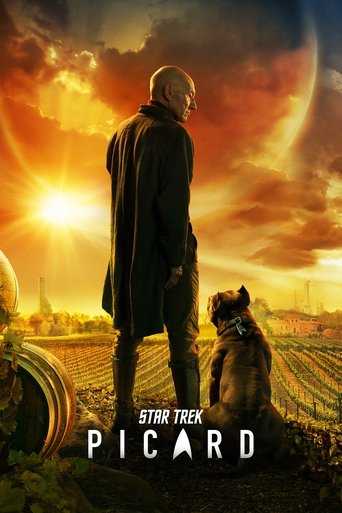
Star Trek: Picard
2020 · TV series · 3 seasons
Created by Alex Kurtzman, Kirsten Beyer, Akiva Goldsman, Michael Chabon
Science FictionFantasyActionAdventureDrama
Set twenty years after the events of Star Trek Nemesis, we follow the now-retired Admiral Picard into the next chapter of his life.
6 positive3 negative8 neutralfrom 17 commenters
Where to watch
No streaming data for this title.
Videos commenters linked
From YouTube links in the comments below. Most are clips and trailers; “Full” means the uploader says so.



18 comments on Hacker News
Yup, I am a fan and watched that concept video when it came out. I'm hoping he makes some sort of return, perhaps involving the Star Trek Picard Season 3 reveal that Kirk's body is being kept on ice at Section 31, on Daystrom Station. I would imagine that there are many ways that Kirk could be brought back, perhaps Kirk's body could have ended up being stored in a transporter's buffer similar to how the episode "Relics" from Star Trek: The Next Generation, Captain Montgomery Scott (Scotty) is discovered alive in a transporter buffer after being trapped for 75 years on a Dyson sphere. The transporter has been rigged to sustain two life signals, allowing Scott to survive by maintaining a diagnostic cycle. His pattern remains intact, allowing him to be rematerialized after being rescued by the USS Enterprise. Another possibility is being back due to meddling from the Q or an evolved V'Ger. There's been published a comic where some of the old crew from multiple TV projects have been brought back to help solve the killings of some of Star Trek's Gods by an unknown figure. Emperor Kahless is eventually revealed to be Star Trek’s god-killer. Among the many cameos in the series are Benjamin Sisko, Jake Sisko, Kira Nerys, Odo, Worf, Alexander Rozhenko, Spock, Scotty, Uhura, B'Elanna Torres, Tom Paris, Ro Laren, and others like Q, Kahless (clone/Emperor), and crossovers with Picard-era or TOS characters. It does not have to be a TV series but could be a limited TV mini-series. The Star Trek financial gods wasted big money on a badly done Section 31 movie. I don't see why they don't do something more similar to Star Trek comic and Television canon.
>> having a big catalog from Disney at X/month is more worth more for Disney than sublicensing to Netflix at Y/month.
But sometimes that leads to really stupid things. At one time all Star Trek TV shows were on Paramount while all the movies were only on Max. I believe they're all owned by Paramount, but apparently the shoes are the big draw (the new series "Picard" was exclusively on Paramount) and they could get more profit by putting the movies elsewhere and collecting a bit more than if it were all on their service. GAK!
Right. For a long time I wondered what's going on, and eventually started believing it's my fault - that maybe I'm just a rare HDR-poor person watching TV shows on SDR computer displays, maybe I've hit an unusual corner case in the video decoding path, or something. I kept believing that until Star Trek: Picard, Season 3, which made it clear it's not me, it's them.
The whole show, like everything in the past decade or so, was dark and washed out (except for some space FX parts, where at least some colors were saturated, sometimes). This lasted up until the last two episodes, where for plot reasons[0], some protagonists found themselves onboard a ship from TNG-era shows (1980s - 2000s), pulled straight from a museum, which means the set was recreated as it was on old shows, complete with the lighting. From that scene onwards through the final episode, as it jumped between that one special set and every other dark and gray scene, I had proof in front of me that scenes in modern shows can be properly lit, they just aren't, and it's an active choice[1].
Importantly, this scene wasn't a one-off gimmick that risked coming out too bright on normal people's HDR-enabled TV screens. The set involved was, per the showrunner, pretty much the whole raison d'etre for the entire season, and they burned most of the season's budget on perfecting it[2]. Them being able to light it well (and have it coexist with every other badly-lit scene) only proves there's no technical obstacle involved - that dark and washed out TV is just a choice everyone's making for... unclear reasons.
--
[0] - Hard to navigate around a major spoiler and highlight of the era in the franchise.
[1] - Actually, I can't give this scene enough justice. But given how massive moment that was for people following the franchise, I'll just provide a link to the video (SPOILER WARNING): https://youtu.be/t-mY4Xbjyn8?t=42 -- watch in max quality; compare okay-ish exterior CG early on, observe how dark and washed out scenes with people are - and this is literally how the entire season (and really, entire show) was until that point... or just scroll to 2:27, and then on a perfect cue - "computer, lights!" - observe how next 30 seconds reveal that everything could've been properly lit from the start, but for some non-tech reason, it wasn't.
[2] - Most of that was eaten up by casting very specific people, but the set itself was damn expensive too.
I mean, I can always use pause and hope that my podcast player will remember where I stopped to be able to continue from that point later on. That's true. But why did I need to think about it in the first place? By running 4 episodes back to back I actually binge-played it without even realising. And, for me personally, no matter how good a show is (from Futurama to Black Mirror), once they start running consecutively, I start recognizing patterns and repetitions and it makes it feel stale a bit. Maybe I'm just old school where TV/Radio broadcast would force me to wait for the next episode, for at least 24 hours (or longer), which would make it feel fresh and make me really looking forward to continue.
Few months ago I watched Star Trek Picard season 3, and I remembered this principle and I paced it so I would watch one episode daily and I enjoyed it tremendously.
It's not that I didn't enjoy 29 minutes of episode 1 of The Multiverse Employee Handbook - I did. But, when the first 7 minute episode ended, I was thinking to myself "wow, this is great!", and I was expecting the podcast playback to stop leaving me wanting to look for more. But it kept going, and, 22 minutes later I was thinking " ah, cool, will definitely continue tomorrow". The wow factor was gone. That's like me giving you a delicious slice of cake, and, as you are still full of impressions about how good it was, I shove three more slices onto your plate. :) Now you're feeling like you're about to explode.
Anyway, looking forward to enjoying more episodes. Keep up the good work!
TNG has several species like the Q that have evolved to godlike abilities and there are episodes where a humanoid undergoes the final stage of physical evolution and then ascends to a higher plane of existence (becomes something like the Q). Star Trek Picard (relatively new show) had a lot about exploring internal conflict and I think even in TNG one of the final episodes has Q tell Picard that the final frontier is internal and doesn't involve mapping out stellar nebulae.
Other shows like Stargate also have the concept of "ascension" as a pivotal plot point of many episodes. Farscape covers this as well in several episodes. Things like mind melds and mind reading are pretty common in these shows once someone ascends.
There is a lot of "woo" in science fiction as it is kind of hard to still believe in gross limitations for us over a cosmic scale of thousands of millions of years. Assuming we don't die out, I'd believe our ultimate potential is unfathomable to us now.
Recent "Star Trek Picard" episode...
Data: We are going to die.
Geordi La Forge: Data...You are being negative again. Say something positive!
Data: I hope we die quickly!
I think we only got new Trek due to Paramount trying to sell Paramount Plus.
Star Trek: Strange New Worlds is terrific and has the spirit of the original series.
Star Trek: Lower Decks is also amazing in a very different way. It's like the writers made an adult cartoon show for all the super fans that references every meme, while still being very endearing and true to trek.
Star Trek: Picard, is also supposedly really good, but I have only seen one episode so far.
Incidentally, part of why I've been in no rush to watch Star Trek: Picard past season 1. At the end of that season, Jean-Luc Picard dies, period and end of story. But I'm guessing the following seasons carry on like the android that now thinks it's Picard actually is Picard.
I recently graduated to the next step beyond closed captions: I've started enabling audio descriptions for TV shows too.
It's SO interesting.
They are generally really well put together. And they often highlight things that I would have missed - mentioning the name of a character who joins a scene who I don't instantly recognize, for example.
Even more fun: audio descriptions of the title sequences for a TV show. Three that I particularly enjoyed were Severance, Moon Night and Star Trek: Picard - in all three cases the titles are rich with visual metaphors relating to the show, which the audio description then carefully spells out for you!
> how much Netflix content just reflect whatever crap is a fad in California politics
You’re right, it’s infuriating but not limited to Netflix unfortunately. Look at Picard… a total cringe-fest. That said, I did randomly watch an Israeli TV series about the lives of ultra-orthodox Jews, Shtisel, and despite the lack of CGI and all that, I found it an interesting watch.
> I don't understand why they insist on calling it Star Trek when it's nothing like the show.
Here are some of the elements off the top of my head
1. Takes place in the same universe
2. The characters belong to Starfleet
3. Spock
4. Based on Star Trek created by Gene Roddenberry
5. *spoiler* Cardassian Federation President in Season 4
6. Trills
7. Warp drives
8. Replicators
9. Romulans merging with Vulcans to reunify
10. Synthetic humanoid modeled after Data, Lore, etc.
11. New stuff like Tardigrades
12. Mirror universe
13. Unified earth
14. Klingons
15. Ferengi
I mean, I get it, original Star Trek is super campy, but like all the ST since ST:TOS, ST:D is inclusive, prioritizes working together to solve monumental challenges, and breaks cultural barriers many people don't even realize exist unless they are marginalized.
And damn, they got amazing Tardigrades. Such a cool run at the concept. I really enjoy the show for what it is, not to satisfy some deep longing for legacy Star Trek. Picard satisfies the legacy urges nicely.
I look at what happened and see a lot of good. I like Picard, Discovery, Lower Decks, and the reboot movies. Discovery found a way to reuse a lot of existing canon and essentially reboot it. I think it worked well. It took some time to get things moving in the right direction as all Star Trek series do, and the showrunner changes didn't help, but I look forward to what's next.
What is "you", then?
Let's say that in addition to the technology described in the story, we can create a completely simulated world, with all the people in it simulated as well. You get your brain scanned an instant before you die (from a non-neurological disease), and then "boot up" the copy in the simulated world. Are "you" alive or dead? Your body is certainly dead, but your mind goes on, presumably with the ability to have the same (albeit simulated) experiences, thoughts, and emotions your old body could. Get enough people to do this, and over time your simulated world could be populated entirely by people whose bodies have died, with no "computer AIs" in there at all. Eventually this simulated world maybe even has more people in it than the physical world. Is this simulated world less of a world than the physical one? Are the people in it any less alive than those in the physical world?
Let's dispense with the simulated world, and say we also have the technology to clone (and arbitrarily age) human bodies, and the ability to "write" a brain copy into a clone (obliterating anything that might originally have been there, though with clones we expect them to be blank slates). You go to sleep, they make a copy, copy it into your clone, and then wake you both up simultaneously. Which is "you"?
How about at the instant they wake up the clone, they destroy your "original" body. Did "you" die? Is the clone you, or not-you? Should the you that remains have the same rights and responsibilities as the old you? I would hope so; I would think that this might become a common way to extend your life if we somehow find that cloning and brain-copying is easier than curing all terminal disease or reversing the aging process.
Think about Star-Trek-style transporters, which -- if you dig into the science of the sci-fi -- must destroy your body (after recording the quantum state of every particle in it), and then recreate it at the destination. Is the transported person "you"? Star Trek seems to think so. How is that materially different from scanning your brain and constructing an identical brain from that scan, and putting it in an identical (cloned) body?
While I'm thinking about Star Trek, the last few episodes of season one of Star Trek Picard deal with the idea of transferring your "consciousness" to an android body before/as you die. They clearly seem to still believe that the "you"-ness of themselves will survive after the transfer. At the same time, there is also the question of death being possibly an essential part of the human condition; that is, can you really consider yourself human if you are immortal in an android body? (A TNG episode also dealt with consciousness transfer, and also the added issue of commandeering Data's body for the purpose, without his consent.)
One more Star Trek: in a TNG episode we find that, some years prior, a transporter accident had created a duplicate of Riker and left him on a planet that became inaccessible for years afterward, until a transport window re-opened. Riker went on with his life off the planet, earning promotions, later becoming first officer of the Enterprise, while another Riker managed to survive as the sole occupant of a deteriorating outpost on the planet. After the Riker on the planet is found, obviously we're going to think of the Riker that we've known and followed for several years of TV-show-time as the "real" Riker, and the one on the planet as the "copy". But in (TV) reality there is no way to distinguish them (as they explain in the episode); neither Riker is any more "original" than the other. One of them just got unluckily stuck on a planet, alone, for many years, while the other didn't.
Going back to simulated worlds for a second, if we get to the point where we can prove that it's possible to create simulated worlds with the ability to fool a human into believing the simulation is real, then it becomes vastly more probable that our reality actually is a simulated world than a physical one. If we somehow were to learn that is true, would we suddenly believe that we aren't truly alive or that our lives are pointless?
These are some (IMO) pretty deep philosophical questions about the nature of consciousness and reality, and people will certainly differ in their feelings and conclusions about this. For my part, every instance above where there's a "copy" involved, I see that "copy" as no less "you" than the original.
Hints? Only hints?
I would recommend you to watch Star Trek Picard then =)
But that standard is too strict. I mean, this specific book isn't a replacement for Dr. Seuss. No one is going to buy this for their kids (or new graduates) who don't already know the Seuss book. And obviously no one is going to consume this instead of Picard season 2.
It's definitely not competing with the original. But it's trading on the originals, which is clearly sort of unfair. So the court wants to find against them. But the only tools in the box are these clumsy arguments about "transformation" that would seem to apply equally to this thing if it wasn't commercial. But if it wasn't a commercial product, it wouldn't have seemed unfair!
Basically, the law just needs a clearer standard here for what it clearly wants to do.
I was particulary offended by this in the recent Star Trek: Picard.
In previous shows the Federation has demonstrated the ability to create totally flawless and interactable holograms.
Yet somehow in this show everyone has switched over to glowly flickering interfaces hovering over your desk.
In the headquarters of Star Fleet, a giant hologram of a star ship is in the atrium, and it glitches out for a moment as the camera looks at it just to let the viewer know it's a hologram.
Not only is there no reason for holograms to glitch out all the time assuming that the technology could be created, but this TV series has already demonstrated their ability to do this much better!
There’s a couple Dune themed usernames getting around.
Have you seen the latest episode of Star Trek: Picard?
Ironically, CBS literally posted the entire first episode for free on YouTube: https://www.theverge.com/2020/1/30/21115348/star-trek-picard-cbs-all-access-first-episode-free-watch-pilot