 Hacker Cinema
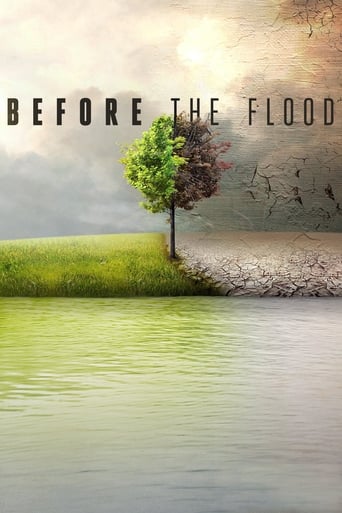
Before the Flood
2016 · Film · documentary · 93 min
Directed by Fisher Stevens
A look at how climate change affects our environment and what society can do to prevent the demise of endangered species, ecosystems, and native communities across the planet.
3 positive1 negative5 neutralfrom 9 commenters
Where to watch
No streaming data for this title.
Videos commenters linked
From YouTube links in the comments below. Most are clips and trailers; “Full” means the uploader says so.





11 comments on Hacker News
"The countries responsible for the largest carbon emissions from planned fossil fuel production are India (coal) ..."
In the film Before The Flood[0] it's made pretty clear that India has both a massive coal reserve to tap into, and a population the size of the entire United States still living without electricity (at the time) about to become electrified - likely via said coal.
That was in 2016, has anything changed in India to actually prevent this outcome? It's not like we didn't see it coming.
Big populations, big problems.
[0] https://en.wikipedia.org/wiki/Before_the_Flood_(film)
> third world countries
I'll stop you right there because the major producers of greenhouse gasses aren't third world countries. Historically, the majority of greenhouse gasses emitted comes from industrialized nations.
> can be switched to gas cheaply and easily
I highly doubt that. Gas distribution requires a fine grained pipeline infrastructure which needs constant maintenance. That's a massive upfront cost in developing countries and new economies like India where the domestic market lacks such infrastructure in many places. Not to mention challenges regarding security and geography.
Given the respective individual income level in those countries, it's far cheaper to source energy locally from wood, manure and - above all - coal.
Moreover, the big issue isn't what new economies like India aren't emitting today. But what they are very much willing to emit in the near future in order to raise overall living standards to a level comparable with the West.
At this point, wagging fingers what they should or shouldn't do is a non-sequitur since Western nations carry a historical responsibility for their own industrial pasts.
In the documentary "Before the Flood", this dillemma is being made abundantly clear: https://www.youtube.com/watch?v=Ia5fMomBXbE
> The same regions have the lowest per-capita carbon output.
Largely irrelevant. Every country aspires to increase their quality of life, burgeoning populations still living in the mud are just carbon time bombs. So, relevant in the negative sense of their per-capita output has nowhere to go but up, with a huge multiplier.
It helps to view "third-world" as simply arriving in third place at the finish line of modern living; on a long enough timeline, there are no more mud huts.
In the film Before the Flood, there's a part focused on India which states they have ~300M people living without electricity. A population roughly the size of the USA. In the same part, representatives from India's government make clear that India has vast coal reserves and no intention of leaving those 300M people without electricity. You're looking at an overnight arrival of the US population from the dark to using lights and refrigerators.
It's not like populations with low carbon output have all mastered some kind of low impact living. They're just poor and lagging behind the more wealthy nations, don't mistake it for a lack of intention to join the first-world.
Feels like "our" ancestors must have felt in the 30's? The storm is gathering... I'd suggest finding a community of like minded people, (most of the western world remains oblivious) looking into growing insects, mushrooms and stuff with led lights.. also according to "Before the flood" (great film btw) the Gulf stream risks moving too and Europe entering a new ice age..so moving south seems like a good idea, which is great as they are more affordable countries with people generally being more...helpful?
Pfaf.org ic.org
Last night, I watched NGC's "Before the flood". At one point, a director for a local climate action institute in India was interviewed by Leo DiCaprio.
She pretty much pointed out that climate change is a social issue in no uncertain terms:
https://www.youtube.com/watch?v=Ia5fMomBXbE
As an EU citizen, I applaud the ambitions, but I feel apprehensive at the same time. Regardless how you spin this, affordability is an absolute requirement.
For instance, on the consumer side of things, you see this concern expressed by the 'gilets jaunes' movement who were initially road users (commuters, truckers,...) protesting rising fuel prices as those add to the cost of living (whether real or perceived). Low income households can't afford to buy a new fuel efficient or electric car; or renovate their home to be more energy efficient (solar, isolation,...); or even buy groceries with a minimal carbon footprint (cheap food prices translate into externalized costs e.g. meat industry + availability / convenience).
Like, over the past few years, several cities have enacted a localized carbon levy for anyone who wants to drive into their city centers. While I'm a proponent of the idea, the net result is that visiting family by car has now become an expensive proposition. Public transport is a partial alternative, but it just doesn't offer the same availability / convenience as a personal vehicle.
A concern here is that this levy targets vehicle classes whose emissions are above an established norm. Turns out that a sizable proportion of low income class families living in those cities who find themselves owning a car they can't afford to drive anymore. This was explicitly raised as a policy concern in a parliamentary hearing in late 2020.
That's just one concrete example of why climate change is a social issue.
The problem raised by the Indian director in the documentary is rooted in the exact same challenge: finding balance between enabling 8 billion people to attain a sustainable, modern living standard while at the same time reducing humanity's reliance on fossil fuels.
One also has to understand that in order to attain Western living standards, "the rest of the world" is very much on a trajectory on par with historic social and economic dynamics and changes seen in America and Europe from the late 19th century hence. India and China together constitute about 35% of the global population. As the Indian director rightly questions: How can the West hold a moral high ground at this point in time while not having taken any notable affirmative action over the past 40 years to curb the impact of its own way of living profoundly?
Barring any finger pointing towards who does what, the filmmakers also interview the then-mayor of Miami Beach who first-hand faces the consequences of rising sea levels whilst being confronted with party politics. All he can do is install 400 million dollars worth of pumps just to keep his constituency's feet dry for the next 40 to 50 years.
He simply ends up stolidly remarking: "The ocean isn't Democratic or Republican. It just keeps rising."
The National Geographic film Before the Flood [0] did a reasonably good job of covering this topic. If you haven't seen it, it's worth a watch.
[0] https://en.wikipedia.org/wiki/Before_the_Flood_(film)
It is a token gesture because there is little chance of it being done by enough people to make a difference. I base this off the documentary Before the Flood, in which DiCaprio says that in the early 2000s the big tactic was to promote home energy conservation but it amounts to very little and it has been realized that other more involved strategies are needed. This is stated explicitly early on, and it seems very plausible to me
You reminded me of an interview with a woman from India, in the film "Before the Flood". She mentions:
India has 300 million people without electricity, and they're doing exactly what the US and other nations did years ago: focus on improving their quality of life, using inexpensive coal and fuels.
Just finished watching the film Before The Flood and the representative from India's Centre For Science and Environment really frustrated and upset me. She was blaming US consumption as the source of the problem and how we don't practice what we preach. Our air is not poisonous, we don't have 300 million citizens without power living in poverty. The US has some of the best and greatest companies working on energy (see Tesla) and it is time India stop blaming the US and start putting in the work on their own.
See the following short clip from the film: https://youtu.be/90CkXVF-Q8M?t=36m2s
Relevant to watch. Before the Flood - Full Movie | National Geographic [1] https://www.youtube.com/watch?v=90CkXVF-Q8M
Before the Flood - Full Movie | National Geographic - YouTube https://www.youtube.com/watch?v=90CkXVF-Q8M