 Hacker Cinema
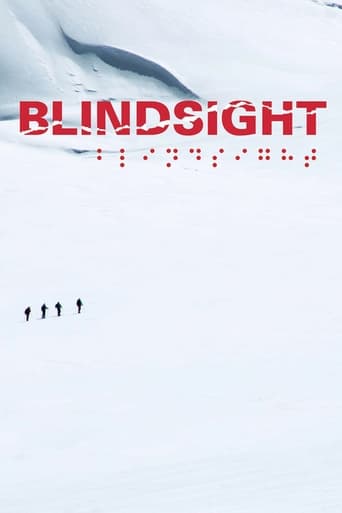
Blindsight
2006 · Film · documentary · 104 min
Directed by Lucy Walker
Six blind Tibetan teenagers climb the Lhakpa-Ri peak of Mount Everest, led by seven-summit blind mountain-climber Erik Weihenmayer.
1 positive4 neutralfrom 5 commenters
Where to watch
No streaming data for this title.
Videos commenters linked
From YouTube links in the comments below. Most are clips and trailers; “Full” means the uploader says so.





5 comments on Hacker News
There's a fan-made short film/trailer for Blindsight:
https://www.youtube.com/watch?v=VkR2hnXR0SM
Also, "just an AI probe" and "It would be amazing" in the context of Blindsight... <insert mad laughter>.
Sorry, my mistake: the title is Permanence. Author is Karl Schroeder. If I remember correctly (and clearly my memory isn't to be trusted), Watts says in the afterword of Blindsight that he violently disagrees with Schroeder, or the perspective Schroeder offers, in that book, but I believe he recommends it as a rich exploration of many of the issue Blindsight explores.
Thanks for the write up. I'm completely sold on Sunflower series, and will probably read it next. It sounds very promising -- and probably short enough that I can slip it in between books 1 and 2 of the Culture series.
Thanks also for the encouragement to stick with Banks, too. I'll try. I'm not sure I'll be able to last for six full books though. The storytelling in Consider Phlebas -- which I'd call action-adventure sci-fi maximalism -- isn't working all that well for me. There's so much technobabble. There are so many lasers. So much ink is spilled filling out the world just for the sake of it. It's a massive overload and baroque overdose of sci-fi tropes. So far the most interesting episode has been, I think, the main character's interaction with the shuttle on the island.
We're all going to become philosophers of "Chinese Rooms"[0] at this rate.
The plain fact is, ChatGPT is demonstrating a major step forward towards artificial general intelligence. It can't perfectly explain jokes, especially puns, but it's pretty darned close.
What happens next is what always happens next with AI. When it can identify and explain something, someone puts it in reverse and asks it to make jokes instead. HumourDiffusion v0.1, coming next week, and it will make you laugh more than half the comedians on TV. Version 7 will write sitcoms that are actually funny. Version 21 will win a Pulitzer.
Perhaps ChatGPT is what Peter Watts predicted in "Blindsight"[1] - intelligence without consciousness.
[0]https://en.wikipedia.org/wiki/Chinese_room
[1]https://en.wikipedia.org/wiki/Blindsight_(Watts_novel)
It sure looks like prey animals (so, most of them) live every day of their lives in a slasher movie. If not something worse. But maybe a constant, very real possibility of being attacked then eaten alive is actually not horrible? IDK. Best case all the "lower" animals have no consciousness whatsoever so at least they don't observe their own experience of the horror they live—but then that's creepy in its own, more cosmic-horror, right (think Watts' Blindsight).
But yes I am absolutely capable of ignoring that and going "wow aren't those flowers pretty" and do it all the time.
> Science fiction almost universally assumes the speed of light is not a hard limit.
Not at all, you need to look at other sub-genres. The social, economic and military structures that form around slower than light travel are a mainstay of hard science fiction. "A Deepness in the Sky" is a great example. So is the first half of "Neptune's Brood" or the second half of "Accelerando". Any story that uses a generation ship as the setting, like "Hull Zero Three", also assumes sub-light travel. Or what would happen if present-day society discovered an alien race next door, like in "The Sparrow". Or maybe we need to make ourselves slightly less human to survive sub-light space travel. "Blindsight" and "Echopraxia" explore the philospohical ramifications of that. Even "Ender's Game" doesn't have FTL travel.
Now space opera almost universally assumes that FTL is possible. Though there are exceptions, Ian Banks "The Algebraist" is my favorite sub-light space opera.
edit: Some hard sci-fi will still use wormholes, either as a normal thing or a macguffin. FTL communication is also common. Though FTL comms are getting less common in modern hard sci fi. Us readers like this and it makes for convenient plot devices as comm lag leads to misunderstandings.
TV and movies are almost always space opera, with "The Expanse" being the only sub-light TV production that comes to mind, and "2001" for film. But I don't know as much about film as books.