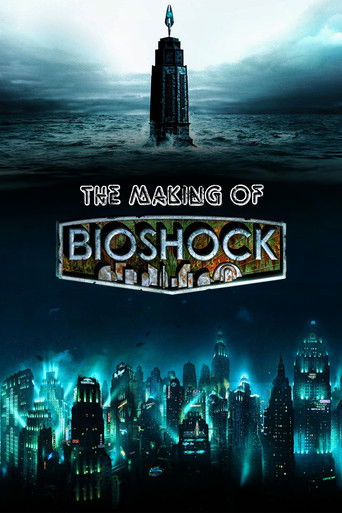
The Making of Bioshock
2007 · Film · documentary · 41 min
A series of interviews with the key developers of the groundbreaking video game, Bioshock.
3 positive2 negative1 neutralfrom 6 commenters
Where to watch
No streaming data for this title.
 Hacker Cinema
2007 · Film · documentary · 41 min
A series of interviews with the key developers of the groundbreaking video game, Bioshock.
3 positive2 negative1 neutralfrom 6 commenters
No streaming data for this title.


6 comments on Hacker News
Agreed. I bin this with other “rules lawyering,” which usually feels unfair, uninteresting, and unsatisfying.
It’s why puzzlemaking a truly challenging and impressive skill. It must be fair, a challenge, and obvious in retrospect.
I think it’s why the twist in Bioshock worked so well for me: it was right there in plain sight numerous times, while other twists in mystery games/films elicit a groan.
I'm not sure I would agree with TLOU, but I completely agree with Portal and Bioshock.
Portal is a puzzle game with a bit of a silly story to move the puzzles along. I didn't care about the protagonist, in the same way that I don't care about the art work in a chess game. It's lovely but I'm not emotionally invested in it in the same way I'm not emotionally invested in Fast and Furious.
Bioshock 1/2/Infinite was similar. The world had been lovingly crafted, the antagonists and enemies had backstories but the main character was not anyone I cared about. Having a backstory is completely different to having a relatable protagonist that I want to see succeed.
For every Logan there are 6(?) X-Men films that are just explosions.
I don't even try to play multiplayer games anymore, as within moments I get the feeling of time wasted. I do however, from time to time, play single-player games (like Portal, or Modern Warfare series, or more recently, Bioshock) for their artistic / story value. The best games have stories much better and deeper than most of the movies, so I find them important intellectually and artisticly.
Okay, first, I just want to thank you for your excellent response.
I'll admit, I don't think art must necessarily illustrate the human condition. I think good art often does, but it can also just be something that evokes an emotion. Of course, lots of things evoke emotions, so that's obviously necessary but not sufficient. I agree that the expert exercise of craft can be quite enjoyable, but that too is not sufficient to be artistically interesting or else all skilled workers would be artists (and if you feel that way, we really aren't talking about the same thing when we use the word "art"). This is already a debatably overly-limited definition of art, but my point was to unpack the idea that art does have various motives, goals, and effects on the viewer, as well as many ways to achieve them, and that is a fine thing.
However, I wasn't trying to debate what is artistic and what I not. I was saying that for those of us interested in games as art, Bioshock is an exciting game, and it's exciting because it does something new and it does it well.
I don't understand how you can get out of what I said that I think Bioshock's story is what makes it art. To say "ahh yes, but it's not a movie!" is to miss the entire point, (which may very well be the fault of my writing). The point is that it controlled me and I enjoyed it. The point is that it told me I was a slave AND IT WAS RIGHT. Because of things I DID. And it did it in a way that only a game could, not a movie or a book or a song.
I said Bioshock was interesting and I stand by that because it did something that none of the games you've cited do: the rules of the simulation and the rules of narrative played together to make meaning that as key to the game that couldn't be made in strictly simulation or narrative forms alone.
You say the "gameplay doesn't distinguish itself much," and if you mean the combat and other kinetic elements don't particularly stand out, I don't entirely disagree, but that's missing the point. When you say that Bioshock's story isn't well told, however, that's something I disagree with strongly.
I wish I had time to discuss each of the games you listed, because we agree on some points and disagree on others, but I don't, so I'll try to address some of the themes I saw.
You defend some Nintendo games for being something other than literary, and you and I are in agreement that that's not required to be interesting. Too many people think that a game has artistic merit if and only if it has a good story. There are a whole lot of good games without a story, or with a terrible story that they tell well (e.g. Half-Life 1). This isn't the point.
However, story and how it's told is important stuff in a lot of these games. But how do games tell stories? Like literature and movies, games have character development and pacing, but there are also aspects unique to each medium. Literature has the craft of writing, movies have framing and mise en scene. Games have other means of telling stories, and we're still figuring some of them out. Bioshock tells its story and evokes something in the player in a way I haven't seen before. That's why I said initially that it's one of the most exciting games out there. It's exciting because it's trail-blazing. It's exciting because it uses this to be an indictment of its own genre conventions.
Finally, you write, "I think art means making fun games above everything," a statement that honestly makes me rather sad. There are plenty of great things to do in terms of making fun games and finding new ways to make fun games. However, you make the analogy of games to film: do you think Citizen Kane was a fun movie? Should Kubrick have worried more about making Paths of Glory more fun? I don't think fun is bad, but to limit our definition of a good game to what is fun is to put on blinders.
tl;dr - Good literature isn't about plot and neither is BioShock. Good literature and BioShock, however, both use their medium well, and BioShock is exciting because it shows us a new way of doing things.
Hopefully nobody here will tell you to get a life. We're on a site called Hacker News, discussing artistic merit in video games. So it's good.
I have a different view of art than you do. I don't think that art must necessarily illustrate the human condition. Do Bach's cello suites make any sort of commentary whatsoever? Not to the untrained eye. They're just expertly crafted pieces of music. That, to me, is the core of art: not necessarily a statement about humanity but the practice of honing your ability with a craft. You can have the best idea imaginable but if you can't tell it well then it's not art.
I'm certain that BioShock DOES mean to do what you think it does. It absolutely attempts those route literary devices and it does a pretty good job of that. However, I would not for an instant call BioShock art, because it is not a movie. Its purpose is not primarily to tell a story. Its main role is to be a good game. And at that, it fails. It's fairly monotonous and while it has great ambience, the gameplay doesn't distinguish itself much. The story doesn't tell itself WELL. There were a few interesting moments from what I've played but that was it.
In my mind, the primary method of art in a game is that of the game itself. The best artists are the ones making the most fun games. That doesn't necessarily mean greater themes: Zelda is very black-and-white, for instance, in terms of story. However, a game doesn't require a story if it does its job well. Zelda doesn't, and yet THAT is what I consider to be the highest art. It's a beautiful, memorable game.
Portal? That's as close to sublime as you get. It DOES have a story, and it has a good one. And no, it doesn't have themes, any more than A Midsummer Night's Dream does. Which is to say, you can see themes in it, because they're there in both of them, but the main thing about each one is that they're enjoyable without focusing on the themes. Shakespeare isn't great because he told themes: he's great because every line he wrote was beautiful and absolutely fit whatever he was writing. The components have to fit together. That's what makes a good game.
Half-Life 2 has a story, and it tells the story well. The story is incredibly well-written, too, and it's told in the game brilliantly. The gameplay is surprisingly emotional: you get very involved in the gunfighting because of how slowly it develops. You feel extremely in the game. That's art. That's what gaming is all about.
Final Fantasy? It always tries to tell a story. And the stories are usually very thematic. I think it's slightly going downhill, but the one I mentioned (II/IV) was sublime. The graphics, music, gameplay was all very simple, but it was beautiful. It was evocative. The soundtrack in particular is stunning. The story was not particularly complex, but it was emotional and told itself well. That's art at its best. When I played it at 8 or 9, it changed my life. It made me want to become a game designer.
You're in the mindset that all mechanics have been done, and so art is just doing an old thing in a new way. That's silly! We're at the phase in video games where NOTHING has been done. We're like cinematographers in the 20s. We can do ANYTHING and it's new, and so we don't have to worry about exhausting old ground. Portal is art because it created a new game mechanic! It's something that was never done before. And not only does it MAKE the mechanic, but it polishes it considerably. It's tight, it's exciting for the entire game, and it's new. Art.
And Nintendo? They're making the greatest art of them ALL. I look at them like I look at the early silent films: they don't use an involved story, because they're busy focusing on technique, style. Every Mario game adds new ideas. It keeps on redefining the platform genre, adding new things to do. That's art. Nintendo takes the craft that Miyamoto started as a boy and continues to refine and perfect it. It's why I'd argue that of my favorite games, Nintendo's made about half. A handful of Zeldas, a few Marios, even Animal Crossing, Wii Sports, and every Super Smash Bros. They're not "literary" but they don't have to be. They don't need symbols. They're all about incredibly fun and radical new game ideas, and they're all the highest form of art.
tl;dr - BioShock's story isn't good enough to be considered literature, and it has mediocre gameplay. I think art means making fun games above everything, and BioShock is a big fail for that, even if it is pretty.
I think we need to distinguish between two aspects of good storytelling: having a good story, and telling it well. In a game, I think the latter matters a lot more than the former.
People don't play games just because they want to see a story -- if they wanted that they'd just watch a movie and get a lot more story in a lot less time. In a game the main function of the story is to provide a reward for beating the last part of the game, and a motivation to beat the next part. Games can have quite simple, even cliched storylines (e.g. Prince of Persia Sands of Time, or the original Half Life) and still seem compelling.
On the other hand, a lot of games fall down in the quality of the storytelling. Bad dialogue, bargain-basement voice-acting, or just plain dull scenes can spoil a game pretty quickly. ("I fought a seven-headed monster for this?")
Bioshock may have a well-developed story for an interesting novel, but I'm not sure about the quality of the storytelling. I've only played the first couple of levels before getting bored, but so far most of the story has been pumped directly into my ear by some guy with a sepia-toned icon and a largely-incomprehensible monotonic brogue. Combine that with the fact that the levels and enemies so far have all looked pretty much the same, and I couldn't summon up the motivation to keep playing.