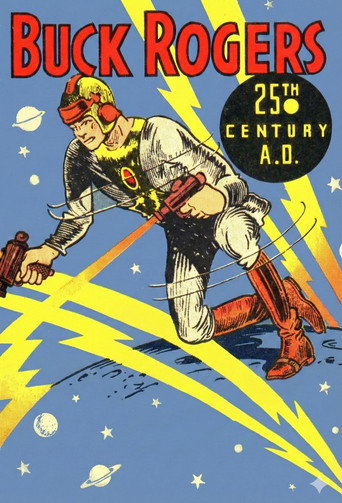
Buck Rogers
1950 · TV series · 1 season
In the year 2430 in a secret lab in a cave behind Niagara Falls, Buck Rogers battles intergalactic troublemakers.
2 positive1 mixed2 neutralfrom 5 commenters
Where to watch
No streaming data for this title.
 Hacker Cinema
1950 · TV series · 1 season
In the year 2430 in a secret lab in a cave behind Niagara Falls, Buck Rogers battles intergalactic troublemakers.
2 positive1 mixed2 neutralfrom 5 commenters
No streaming data for this title.



5 comments on Hacker News
Science fiction (novels, short stories, or by the 1950s films, and 1960s telvision) doesn't have a primary goal of predicting the future but rather of selling entertainment. To the extent it is speculative, it's almost always discussing contemporary circumstances sufficiently distant setting (in time and space) to be able to comment on it in a way which both minimises social censure and reaction and gives a potential for a fresh perspective (in the best cases). Of course, much of it is simply, or at least largely, escapist space opera / space westerns (Buck Rogers, Star Wars, Battlestar Galactica (original series). And yes, some of the escapist content does have real science or predictive value.
But in balance it's an exceedingly poor prospecting ground for hard-nosed, realistic, and/or accurate predictions. For much the same reason that most space ships are laid our horizontally, with gravity working on the frontal rather than coronal plane is that sets built on Earth are far more easily built and filmed that way, SF addresses its creations, narrative, and audience-appeal needs over any putative scientific or prophetic accuracy.
And sure, there are notable counterexamples.
E.M. Forster's The Machine Stops is frighteningly accurate in a world much like that of the 2010s / 2020s.
Arthur C. Clark in some works hits on some remarkably accurate depictions of at least parts of a future world. Imperial Earth envisions both handheld computers and a culture obsessed with recording every passing moment in a way that's nearly selfie-culture (though he seems to have missed influencers). 2001: A Space Odyssey predicts tablet computers and video telephony with reasonable accuracy (though all but completely ignores their social implications).
Orson Scott Card's Ender's Game presages blogging to some degree (though generally overstating its influence, as Randall Munroe spoofed: <https://www.xkcd.com/635/>).
And there's a whole slew of dystopian SF which has materialised in some form or another, from Ray Bradbury ("The Veldt"), Philip K. Dick (too many to mention), William Gibson, Neal Stephenson, etc., etc., etc. I and others suspect that's to some extent less prophetic than direct stimulus, with contemporary techbros aping their favourite adolescent sci-fi universes without asking "are we the baddies?" or whether they should.
But if you want hard predictions about the future, it's probably better to look to the literature which specifically and seriously attempts to do this, outside of a fictional context.
One such book is Alvin Toffler's Future Shock, now 54 years old.[1]
I'd read that, for the first time, on its 50th anniversary. I was struck by much, and found it on balance to have stood the test of time quite well, and much better than is typical for the genre. As to accuracy, there seem to be three general cases:
- Specific proponents of specific technologies virtually always overestimated the acceptance and impact of those technologies. The notable exception is, of course, information technology, though even for it the specific ways in which it has and hasn't advanced is worth close study.
- Virtually all of the social dynamic predictions seem laughably modest today --- developments in racial, gender, and sexual equality and acceptance, amongst others. Though on reflection this isn't so much that the predictions were bold, but that they've come to pass. We are on the far side of the singularity for these changes, for the most part. What was written in the context of a world in which these changes lay in the future reads much differently now that the inflection points are in the past. At the same time, it's also clear that such changes need not be permanent, and that perhaps such dynamics tend more towards cyclical patterns or pendulum swings, with greater and lesser liberalisation at different points in time.
- Much of the psychological and sociological concerns over advancing technology, faster paces of change, and an ever-growing onslaught of information seem to me to have been extraordinarily prescient, and largely born out. The disruptive effects, both on a personal psychological level and on a collective sociological one, appear to be profound, and we're still in the midst of discovering just how much so.
In thinking about how technological change manifests, I've come up with an ontology of the types of technological mechanisms which operate: fuels, materials, information (receipt, processing, storage, transmission), networks, systems, process knowledge, causal knowledge, power transmission and transformation, and hygiene (dealing with unintended consequences).[2]
Much of the Industrial Revolution (~1800 -- 1950 or so) was fundamentally grounded in new fuels (coal, petroleum, natural gas) and power transmission and transformation (particularly electricity and magnetism), with strong secondary effects through improved and expanded materials (Bessemer steel, aluminium, plastics), communications (telegraph, telephone, radio, television) and recording (rapid print advancements, photography, phonography, film). Since 1950, it's been information technology which seems to have been in the forefront, making some profound advances (overall processing and storage capacities) whilst remaining stubbornly stagnant in others (forecasting, meaningful automation and controls). Networks and systems have been primary secondary effects.
Hygiene is the ninth factor I'd come upon, and falls out of the recognition that all technologies have both intended and unintended effects. As technologies increase in complexity, I strongly suspect the latter dominate, exacting something of a drag on overall progress.
The element that's missing from my typology is the interaction between technology and society as a whole. I don't have much to say on that at the moment, though I feel it's quite significant. I'm noting that lapse for the moment.
________________________________
Notes:
1. <https://en.wikipedia.org/wiki/Future_Shock> <https://archive.org/details/isbn_0553132644>
2. I've written on this a few times at HN and elsewhere, searching Algolia for "tech ontology" or "technological ontology" should turn up some references. I'm increasingly feeling that the idea probably needs a book-length treatment discussing each mechanism, how it applies (some of the mappings I make may strike some as obscure, e.g., that knowledge is in some ways a network function, as expressed in the phrase "web of knowledge"), and what the capacities and limitations of each mechanism are.
BSG was always "Mormons in space." With recycled props from Buck Rogers back in the 80s.
Buck Rogers was not religious. It was pure episodic adventure. The TV series has nothing on the (or any) Buster Crabbe serial from the 30s.
Day the Earth Stood Still and Forbidden Planet are ‘required’. Haha. Robinson Crusoe on Mars is great.
The Black Hole is a Disney movie.
How about some TV?
Classic: Battlestar Galactica, Buck Rogers, need I mention, Star Trek?
Current: Lost in Space, …
(Yikes. If 2001 is slow and boring, Solaris (1972) is watching paint dry. Sheesh)
… age appropriate is difficult, ahaha. You could also try your local library, the might have DVDs of TV shows and staff usually have kids section, and classics separate.
It was even more exciting two lifetimes ago.
In short order people got electric light (magic! just flick a switch), phonographs (on hearing one, people apparently went looking for the soprano behind the curtain), moving pictures (there are stories of audiences being panicked by a film--black and white, 16 fps, grainy, silent, and all--of a train coming toward the camera), radio (plays, orchestras, and other entertainment from hundreds of miles away), and all sorts of wonderful houshold appliances like refrigerators, vacuum cleaners and electric heaters and stoves which saved tens of hours per week. And glow-in-the-dark radium watches, and telephones.
Having lived through these (in a rural area, things came a bit later than in the big cities) my mother-in-law was unimpressed by the movies about Buck Rogers rocketing around the solar system and Dick Tracy's video wristwatch, taking them as just things that hadn't made it to her town yet.
I used to watch the old black and white Flash Gordon and Buck Rogers TV serials from the 30s when I was a kid in the 70s. The black and white, the scrolling plot summary, the dinky bullet shaped spaceships and firework rocket engines, flying around saving space princesses were a bit naff, but we lapped it up anyway.
That opening scroll, but in full colour on a 'modern' cinema screen, with the latest sound systems of the day was stunning. I immediately got the reference, it was obvious to anyone of the time. But the way it was used with full colour and up to date projection technology, having the text recede into the distance yet still remain readable due to the high resolution film stock, the opening scene of the staggering huge battle cruiser seemingly taking forever to fill the screen was just awe inspiring.
George Lucas was speaking directly into your subconcious saying "You know those old TV shows you love? I love them too. So I made this".
My children love Star Wars, but not the way I do, and they can never have quite the same relationship to it. You just had to be there at that time and have those formative experiences to prepare you for it.
The one thing I made absolutely sure of - I made certain my girls didn't know Vader was Luke's father and let them see it on the screen. That was really important to me.