 Hacker Cinema
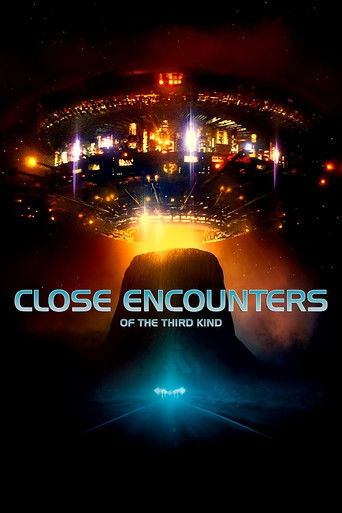
Close Encounters of the Third Kind
1977 · Film · 137 min
Directed by Steven Spielberg
After an encounter with UFOs, an electricity linesman feels undeniably drawn to an isolated area in the wilderness where something spectacular is about to happen.
5 positive1 negative9 neutralfrom 15 commenters
Where to watch
No streaming data for this title.
16 comments on Hacker News
Close Encounters of the Third Kind was indeed when I first noticed this effect. It was dramatic and cool and all that, but pretty obviously an effect. Coupling it with Raiders of the Lost Ark and the effect almost pigeon-holes a film to be of that era.
I'm unsurprised Douglas Trumbull was behind the Close Encounters effect since his work on 2001: A Space Odyssey captured his earliest experiments filming tanks of liquids with fluids added. They were fairly effective in Kubrick's film when they appeared to resemble fantastic nebulae, globular clusters…
(And never mind the mind-bending cleverness of how the slit-scan shots were created for 2001.)
Close Encounters of the Third Kind (best of the grandiose classics imo)
Deep Impact (the only good asteroid movie?)
Jurassic Park + Independence Day (peak Goldblum)
Total Recall + A Scanner Darkly (best Philip K Dick adaptation)
Gravity (great visuals / perseverance story)
I bought a Sub Mini just last week and it took me about 3.5 hours to get it working.
First, I plugged it in via ethernet and my entire network went down. The second I unplugged it, it worked again. Unifi have a dedicated help link in their UI that's displayed next to any Sonos products. I followed the instructions on Unifi's website, made a few ethernet cables for my wireless speakers, disabled WiFi on everything, and it no longer broke. Progress.
Then I tried to adopt it to my system with my Google Pixel and the app hung. I repeatedly tried, both ethernet and WiFi, no joy. Called the helpline and was walked through factory resetting and tried many more times. It just hung at "Adding Sub Mini...".
After a long slog I gave up. I borrowed my dad's iPad the following day and it worked first time.
The entire process was opaque,I had no idea why it failed. Had I not already invested I wouldn't buy any more - and definitely won't recommend.
But I watched Close Encounters of the Third Kind last night and it sounded pretty amazing.
Thanks for your thoughtful reply.
I follow your thoughts towards ET, and offer that Spielberg has already realized an epic treatment of the theme: Close Encounters of the Third Kind, in which he develops the idea of corporate society and daytime TV being indistinguishable from an extraterrestrial incursion. That he invited the founder of Auteur Theory and savant of the French New Wave, Francios Truffaut to emcee projects the high awareness Spielberg had of his conceits. To my mind ET merely revisited the scenario of CE3K as something that could be cross-marketed in Happy Meals, exploiting the success of Lucas' Star Wars licensing.
Ridley Scott's Alien is also trenchant commentary on the corporate/TV zeitgeist with an attack by an unstoppable libidinal force of life (Zizek referred to this idea as "lamella") that lives beneath all the levitating signifiers of the "capitalist real" (Mark Fisher).
All of these movies are first and foremost entertainment products, which so happen to code a surprising amount of reflection on the part of their auteur creators on US/UK corporatism and existential angst.
Recognizing the power of the movies on the collective mind, I'll repeat my thesis that the central consideration for PKD is "why do you think you're human?", not "how do humans distinguish androids from themselves?"
PKD created his works un-beholden to the idioms of popular culture, and I regard his oeuvre as profoundly more intellectually free than any Hollywood adaptation can be. The arrow of artist progress goes from books to movies, not the other way around, so beware of reading the movie's themes into the books. He helped carve out a place for science fiction in literature, and the popularity of cinematic adaptations of his work reveals the resonance of his themes, so read the story then look for how the movies hew to the writing.
There's a strange reversal of books adapted from movies, but even in the case of Arthur Clarke's 2001 (vs. The Sentinel) these read as fan fiction.
Every single film you mentioned came out after Star Wars. The closest, Close Encounters of the Third Kind, came out only 6 months later, so hard to argue that its derivative. Even so, its inarguable that Star Wars was the first of its kind to reach the kind of mass appeal that it did.
Likewise (to the parent), references to D&D or Kurosawa are red herrings, because those were sort of niche at that point. Flash Gordon is/was debatably niche, but even then, Flash Gordon wasn't made into a movie until 1980 (after Lucas gave up on pursuing the rights, and instead made Star Wars).
I'm not here to defend Star Wars as great art, but I am here to say that its place in the cultural canon is 100% earned, and trying to dismiss it as cliche, formulaic, or derivative is to wildly misunderstand the cultural impact of its forebears, and anachronistically criticize it for its similarities to the things it inspired.
>Arguably, the original trilogy was simply dungeons and dragons in space. Wizards, rogues, and knights in space.
It was basically Flash Gordon plus WW2 movies plus samurai movies plus fairy tales and Arthurian fantasy in space.
I think one of the reasons why The Force Awakens is not good is that it tries to copy previous Star Wars movies, but Star Wars has always been best when it copies stuff from other genres and mixes them together into a new thing, not when it tries to copy from its own previous films.
>it's pretty much the only widely known sci-fi films from the last 70s early 80s
Close Encounters of the Third Kind, Alien, Blade Runner, and The Terminator are all widely known late 70s / early 80s sci-fi films.
Probably not as well known but still pretty widely known are Star Trek: The Motion Picture, The Thing, and 2010: The Year We Make Contact.
This was an inspiration for a plot device in the 1977 movie Close Encounters of the Third Kind, in which helicopters spread a nerve agent which kills (or at least immobilizes) sheep and the cover is "anthrax"
For folks who don't want to click, the argument is Indiana Jones didn't have an impact on the outcome of the story; the Nazis still would have found the arc and died in the end.
It's an amusing idea, but I've always thought it was weird to call it a problem with the movie, as it would apply to the protagonist in a bunch of movies (spoilers abound in this extremely random assortment of movies off the top of my head):
* If Kurt Russel's character hadn't been in The Thing, everything that happened still would have happened
* If Harry and Sally hadn't been in When Harry Met Sally, New York would still be Yorking
* If Florence Pugh's character hadn't gone to Sweden in Midsommar, the tourists still would have died
* If Richard Dreyfuss's character hadn't been in Close Encounters of the Third Kind, the aliens still would have made contact, dropped off their old passengers, and picked up new passengers
* If Scott Pilgrim hadn't been in Scott Pilgrim, everyone would probably still just be hanging out more or less the same
* If Matt Damon's character hadn't been in The Martian, they would have all still ended up back on Earth
* If Rocky Balboa hadn't been in Rocky, probably two other people would have boxed and one of them would have won
To each their own, but for my money good stories are about character journeys, not about... I dunno, like, an accounting of what changed during the movie.
There is a line in the movie "Close Encounters of the Third Kind" about traffic accidents. One character says "we don't have any footage of real car crashes, but we know they happen." At the time of the story, no serious car crash had been captured on film. Now, because there are so many more cameras, we have plenty of such footage. A real phenomena should scale with the availability of potential witnesses, not shrink and disappear as more and better cameras come online.
I agree with you, but then I think the same can be said of movies such as "Close Encounters of the Third Kind", wherein the pacing was awesome back in the day, when you had to actually be somewhere to watch a movie, but now when everyone can stream to their own private space, 'tis a bigger challenge. I watch a lot of 70's movies with this slow, boring pace ..
"In 1970s you would just create plastic models of spaceships and film them with normal camera"
Are you sure? For example, from the ILM history at https://en.wikipedia.org/wiki/Industrial_Light_%26_Magic we see:
1975: Resurrected the use of VistaVision; first use of a motion control camera (Star Wars Episode IV: A New Hope)
Following the link to https://en.wikipedia.org/wiki/Motion_control_photography gives us:
> The first large-scale application of motion control was in Star Wars (1977), where a digitally controlled camera known as the Dykstraflex performed complex and repeatable motions around stationary spaceship models. This enabled a greater complexity in the spaceship-battle sequences, as separately filmed elements (spaceships, backgrounds, etc.) could be better coordinated with one another with greatly reduced error.
That doesn't sound like a normal camera.
The text immediately before that quote is:
> The 1968 film 2001: A Space Odyssey pioneered motion control in two respects. The film's model photography was conducted with large mechanical rigs that enabled precise and repeatable camera and model motion. The film's finale was created with mechanically controlled slit-scan photography, which required precise camera motion control during the exposure of single frames.
And in Close Encounters of the Third Kind, the mothership was made of wood, plastic and metal, and wasn't cheap.
Now, to be sure these are high budget movies, but your broad description makes it sound like it was true for all movies in the 1970s.
I think a better comparison would be to look at the model-based special effects in Star Trek: Deep Space Nine with the CGI effects in Babylon 5; both produced at about the same time. Quoting https://en.wikipedia.org/wiki/Star_Trek:_Deep_Space_Nine :
> DS9 was the first TV show in the Star Trek franchise to use computer-generated imagery (CGI) for exterior space shots. Although a few other television series, like Babylon 5, were using CGI exclusively to avoid the high expense of model photography, the Star Trek franchise had continued to use primarily physical models for exterior space shots because producers felt models provided more realism.
Having grown up in the 80s, I caught a ton of the pop culture nods in the series. I was the exact same age as these kids during the time the show was taking place.
I like how you broke it down by age group vs movies/tropes, something I hadn't considered.
To add to your list, the adults' situations were mirroring much from Jaws (the iconic typewriter scene, the Chief's plodding hunt for the thing), Poltergeist (the mom talking to the room, addressing her child as "Baby"), and Close Encounters of the Third Kind (the mom's obsessive behavior w/ the lights).
Though I'm not a huge fan, I thought Winona Rider's performance was incredible. She had that perfect balance of almost-over-the-top motherly worry about her son, yet cognizant and brave enough to not quite hit the level of crazy hysterics.
I really hope there's a 2nd season.
I think the cultural fascination started with UFOs started with the first sighting on June 24, 1947: https://en.wikipedia.org/wiki/Kenneth_Arnold_UFO_sighting
After that, it was picked up in movies and TV, with the first movie being the 1950 film: https://en.wikipedia.org/wiki/The_Flying_Saucer Movies and TV continued to imprint the human psyche with the image of flying saucers for many years.
Flying saucers also had the benefit of being much easier to hoax in pictures and video than cylinders or other shapes, for obvious reasons (an old hubcap or pie pan could be a UFO, and spinning them like a frisbee provides gyroscopic stabilization).
The only thing close to flying saucers in terms of mass recognition and capturing the world's imagination would be greys. The movie https://en.wikipedia.org/wiki/Close_Encounters_of_the_Third_Kind in 1977 popularized this image of aliens, even though aliens in fiction have included grey skinned beings since at least 1893: https://en.wikipedia.org/wiki/Grey_alien
Prior to greys, the most common cultural alien in popular culture, or at least in English language, were https://en.wikipedia.org/wiki/Little_green_men or anything with antennae, sometimes with helmets. Following these, https://en.wikipedia.org/wiki/Reptilians were popular, probably most popularized in the V series in the early 80s: https://en.wikipedia.org/wiki/V_%281983_miniseries%29
But, nothing beats the flying saucer.
Repasting something I coped in previously ( https://news.ycombinator.com/item?id=7844295 ) , an excerpt from Bob Johnstone's /We Were Burning/ http://www.amazon.com/We-Were-Burning-Entrepreneurs-Electronic/dp/0465091180/ , pp. 230-231 http://www.amazon.com/We-Were-Burning-Entrepreneurs-Electronic/dp/0465091180/ref=sr_1_1?ie=UTF8&qid=1401863926&sr=8-1&keywords=we+were+burning (or Search Inside for "Keith Emerson"):
> For about ten years, from roughly the mid-sixties to the mid-seventies, the small but rapidly growing market for synthesizers was dominated by tiny U.S. start-ups, most notably Moog and ARP (a Massachusetts-based firm best remembered as the maker of the synthesizer used to communicate with the aliens in the movie /Close Encounters of the Third Kind/). People were going apeshit over these funny electronic sounds," Moog recalled.
> "I heard Walter Carlos doing /Switched-On Bach/," rock keyboardist Keith Emerson said, "and on the cover of the album was this thing that looked like a telephone exchange."[11] Fascinated, Emerson made enquiries, and managed to borrow a Moog synthesizer for a live rendition of the theme music from the movie 2001: A Space Odyssey.
> The extraordinary noises the synthesizer made baffled the audience to such an extent that Emerson decided he had to have a Moog synthesizer of his own to play on stage. So the rock star called the inventor and told him what he wanted to do. Moog replied that he would not recommend it—his synthesizers were only meant to be studio equipment. Nonetheless, Emerson insisted, eventually shelling out £30,000—a princely sum—for a massive, modular system. He was very proud of his new acquisition. "Trouble was it arrived with no instruction book—three oscillators, a reverb unit, trigger controls, filters, mixers, and a load of strange wires and plugs, and I couldn't even switch the damn thing on. You needed to be a rocket scientist."
> Such problems were typical of products made by early U.S. synthesiszer firms, all of which suffered from bad management and chronic underfinancing. "We were always in the red," Moog lamented, "we had no capital. None. Zero." They would stumble along from one National Association of Music Manufacturers show (where instrument dealers gather to place orders) to the next. If you didn't have a hit at one year's show, then you had better have one at the next, or you were dead."
> A second problem was quality. According to Moog, "In the late sixties and early seventies, you could put five pounds of shit in a box, and if it made a sound you could sell it." In addition to poor manufacturing, another recurrent vexation was the inherently unstable nature of these early, analog synthesizers.
> The oscillators that generated the sound were controlled by electrical voltages. To boost an oscillator's pitch up an octave took a corresponding increase in voltage. The trouble was that the damn things wouldn't stay in tune—their pitch was notorious for drifting. A ripple in the power supply, a change in temperature as the hall heated up or as the components themselves became warmer, almost anything was enough to set them adrift, necessitating a retune.
> "The tuning was a nightmare," Emerson recalled, "I had a frequency counter built into my system which I had to keep an eye on, plus I was playing the Hammond and two other instruments. When I look back now, I don't know how I got through it, I really don't."
> An expanding market, undercapitalized firms, poor manufacturing, and unreliable components—this was a scenario that was virtually tailor-made for the Japanese, with their deep pockets, superb production skills, and long-term commitment. Japanese firms began to make their presence felt in the synthesiser market from the mid-seventies on.
The history of the synthesiser market seems relevant here. From Bob Johnstone's /We Were Burning/ http://www.amazon.com/We-Were-Burning-Entrepreneurs-Electronic/dp/0465091180/ , pp. 230-231 http://www.amazon.com/We-Were-Burning-Entrepreneurs-Electronic/dp/0465091180/ref=sr_1_1?ie=UTF8&qid=1401863926&sr=8-1&keywords=we+were+burning (or Search Inside for "Keith Emerson"):
> For about ten years, from roughly the mid-sixties to the mid-seventies, the small but rapidly growing market for synthesizers was dominated by tiny U.S. start-ups, most notably Moog and ARP (a Massachusetts-based firm best remembered as the maker of the synthesizer used to communicate with the aliens in the movie /Close Encounters of the Third Kind/). People were going apeshit over these funny electronic sounds," Moog recalled.
> "I heard Walter Carlos doing /Switched-On Bach/," rock keyboardist Keith Emerson said, "and on the cover of the album was this thing that looked like a telephone exchange."[11] Fascinated, Emerson made enquiries, and managed to borrow a Moog synthesizer for a live rendition of the theme music from the movie 2001: A Space Odyssey.
> The extraordinary noises the synthesizer made baffled the audience to such an extent that Emerson decided he had to have a Moog synthesizer of his own to play on stage. So the rock star called the inventor and told him what he wanted to do. Moog replied that he would not recommend it—his synthesizers were only meant to be audio equipment.
Nonetheless, Emerson insisted, eventually shelling out £30,000—a princely sum—for a massive, modular system. He was very proud of his new acquisition. "Trouble was it arrived with no instruction book—three oscillators, a reverb unit, trigger controls, filters, mixers, and a load of strange wires and plugs, and I couldn't even switch the damn thing on. You needed to be a rocket scientist."
> Such problems were typical of products made by early U.S. synthesiszer firms, all of which suffered from bad management and chronic underfinancing. "We were always in the red," Moog lamented, "we had no capital. None. Zero." They would stumble along from one National Association of Music Manufacturers show (where instrument dealers gather to place orders) to the next. If you didn't have a hit at one year's show, then you had better have one at the next, or you were dead."
> A second problem was quality. According to Moog, "In the late sixties and early seventies, you could put five pounds of shit in a box, and if it made a sound you could sell it." In addition to poor manufacturing, another recurrent vexation was the inherently unstable nature of these early, analog synthesizers.
> The oscillators that generated the sound were controlled by electrical voltages. To boost an oscillator's pitch up an octave took a corresponding increase in voltage. The trouble was that the damn things wouldn't stay in tune—their pitch was notorious for drifting. A ripple in the power supply, a change in temperature as the hall heated up or as the components themselves became warmer, almost anything was enough to set them adrift, necessitating a retune.
> "The tuning was a nightmare," Emerson recalled, "I had a frequency counter built into my system which I had to keep an eye on, plus I was playing the Hammond and two other instruments. When I look back now, I don't know how I got through it, I really don't."
> An expanding market, undercapitalized firms, poor manufacturing, and unreliable components—this was a scenario that was virtually tailor-made for the Japanese, with their deep pockets, superb production skills, and long-term commitment. Japanese firms began to make their presence felt in the synthesiser market from the mid-seventies on.
I don't have much first-hand experience with Blu-rays, but I wonder if this kind of bad compression is a common thing?
Fortunately it's not too common, but it's more common than one would like. This isn't unique to Blu-rays either; it happened a lot with DVDs. Various problems that I've seen are:
1. Improperly done telecine (e.g. telecining two different parts of the frame at different rates, more common in animation).
2. Badly done framerate-changing (Robot Chicken DVDs).
3. Completely borked interlacing (Family Guy first season DVDs).
4. Bad encoders that can't deal with massive bitrate peaks well (Suzumiya Haruhi no Yuutsu R1 DVDs, see http://i43.tinypic.com/105b8rk.png).
The primary problem with Blu-rays is a lack of source quality, not these kinds of mistakes: a lot of Blu-rays simply don't have any detail beyond SD because their source material is horrible (examples: Cowboy Bebop: The Movie, Close Encounters of the Third Kind).