 Hacker Cinema
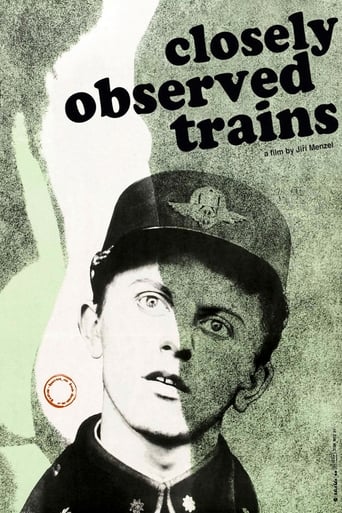
Closely Watched Trains
Ostře sledované vlaky
1966 · Film · 93 min
Directed by Jiří Menzel
At a village railway station in occupied Czechoslovakia, a bumbling dispatcher’s apprentice longs to liberate himself from his virginity. Oblivious to the war and the resistance that surrounds him, this young man embarks on a journey of sexual awakening and self-discovery, encountering a universe of frustration, eroticism, and adventure within his sleepy backwater depot.
3 positive2 neutralfrom 5 commenters
Where to watch
No streaming data for this title.

5 comments on Hacker News
>(Obchod na korze, Sedmikrásky, Ostře sledované vlaky, Hoří, má panenko, Marketa Lazarová, Ucho) and Polish (Popiól I Diament, The Saragossa Manuscript, Człowiek z marmuru, Człowiek z żelaza)
Excellent! You've watched some brilliant Slavic films already then, especially Marketa Lazarova and The Saragossa Manuscript. I have these two in my favourite films of all time list. I hope you enjoyed them as much as I did.
Here are some of my favs: Ziemia obiecana (1975), Sanatorium pod klepsydrą (1973), Pociąg (1959), Kanal (1957), Holubice (1960), Slnko v sieti (1962), Zlaté kapradí (1963), Údolí včel (1968), Csillagosok, katonák (1967), A Pál utcai fiúk (1968), A tanú (1969), Kárhozat (1988), Két félidő a pokolban (1961), Szindbád (1971), Szürkület (1990), Dacii (1967), Danton (1983), O slavnosti a hostech (1966), Pădurea spînzuraților (1965), Reconstituirea (1968), and Добро пожаловать, или Посторонним вход воспрещён (1964).
Sure, please list.
FWIW, the "1001" has introduced me to a number of Czech (Obchod na korze, Sedmikrásky, Ostře sledované vlaky, Hoří, má panenko, Marketa Lazarová, Ucho) and Polish (Popiól I Diament, The Saragossa Manuscript, Człowiek z marmuru, Człowiek z żelaza) films.
I'm only up to the 1980's though, there may be a few more.
I'm not aware of having seen any Hungarian films (yet).
I think you're onto something. I don't speak Czech but I've been there a number of times and I know people who live there.
When Hašek wrote Švejk the Czechs were surrounded and influenced by vastly different nations—the crumbling remnants of the Austro-Hungarian Empire—which they were part of—the Russian Empire and Germany—both of which were in chaos after WWI. Even today they're still surrounded but at least now they're an independent nation with their own language so perhaps it's not surprising what comes out of them is quite unique.
It's quite some years since I saw Closely Watched Trains with English subtitles and it had a huge impact on me. It's one of those films that one cannot get out of one's mind for days. In its own understated way it's a great film and it's not surprising that it was a Czech production. Its ending upset me greatly because whilst its story was fiction, it reminded me of similar tragic scenarios that were played out for real many times during WWII (it seems to me one of the purposes of the film was to remind us of the fact).
BTW, when I first went to Czechoslovakia it was still under communist rule and the only practical (easiest) way to get from Vienna to Prague was by train from Franz-Josefs-Bahnhof and Emperor Franz Joseph Railway line. For some reason seeming known to the communists we had to use this single track line instead of the more modern dual track line via Brüno. I mention it because the Franz Joseph Railway was a once-in-a-lifetime experience to travel on, the track was in such terrible condition that one thought the train would derail any moment and the train only did about 30km/h max. After Communism fell the track via Brüno was opened up and although a much longer route the trip only took half as long.
There is a movie called closely watched trains which is humorous but not relevant.
Any particular recommendations what to read for someone unfamiliar with Bohumil Hrabal? I just realized I've seen a film based on one of his novels of the same title, 'Closely Watched Trains' (a great film, by the way.)
Interested in any suggestions whatsoever.