 Hacker Cinema
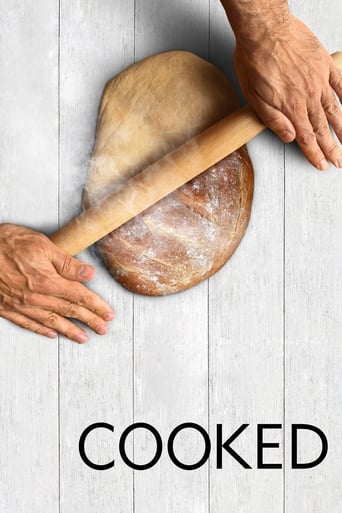
Cooked
2016 · TV series · documentary · 240 min episodes · 1 season
Created by Michael Pollan, Alex Gibney
Explored through the lenses of the four natural elements – fire, water, air and earth – COOKED is an enlightening and compelling look at the evolution of what food means to us through the history of food preparation and its universal ability to connect us. Highlighting our primal human need to cook, the series urges a return to the kitchen to reclaim our lost traditions and to forge a deeper, more meaningful connection to the ingredients and cooking techniques that we use to nourish ourselves.
7 positivefrom 7 commenters
Where to watch
No streaming data for this title.
Videos commenters linked
From YouTube links in the comments below. Most are clips and trailers; “Full” means the uploader says so.


7 comments on Hacker News
The answer to this question is that we don't make bread like we used to. There's a wonderful documentary on Netflix about this, called "Cooked" (the episode entitled "Air" is about bread). Short answer: bread used to be fermented, and consisted of three ingredients. Today's regular supermarket bread is bad for you, unless you take the time to go to your local bakery and buy their sourdough. My wife couldn't eat bread without falling asleep on the couch a couple of hours afterwards. But she can eat sourdough - which costs about the same as the gluten-free variety we used to buy. Also, it's beyond delicious.
It's not unique to Persian cooking, but there is wisdom in most cultural foods. I have been cooking a lot during the pandemic and every month I discover a new fermented food that has "recently" been found to be a superfood - kombucha, kefir, kimchi, soy sauce, mole sauce, sourdough etc. That is not to talk about other ingredients like turmeric, chiles, lentils and other stuff that add nutritional value.
EDIT: I wanted to add something I just remembered from the Netflix docuseries "Cooked" - "If you were to eat grains and nothing but grains, you will die sooner rather than later from lack of one nutrient or another. But if you were to eat real fermented bread made from the same grains, you will live much longer". Something about fermentation is truly nourishing.
You're touching indirectly on a hugely fundamental thing here: the price of production and the price consumers pay for food.
Why does agriculture produce an excess that doesn't get sold? Because the less is produced, the more prohibitively expensive production becomes per unit due to power laws. Hence why it's far more cost effective to cultivate a large volume of livestock compared to sustenance farming.
Meat is a great example. As the demand for cheap meat is high, agricultural enterprises have optimized their production of livestock in order to attain an optimum profit margin per individual unit. For instance, the financial upkeep of infrastructure remains the same whether you have one 1 cow or 10 cows. If you raise and sell 10 cows, the production cost per individual cow goes down. Then there's market demand and supply. The cheaper the price per unit, the more an enterprise needs to produce if it wants to stay competitive. Hence why mega-farms exist.
While the financial cost or production per unit of food has dropped exponentially in the 20th century, the carbon cost for that same unit has increased tremendously.
Harking back to your original statement about plastic. It's true that wrapping food in plastic allows for longer conservation per unit. But then this effect is largely negated because:
Producers will keep on producing excess volumes in order to drive financial production costs down and meet market prices. Retail chains will keep buying large bulk quantities to drive costs down and throw the unsold excess away. What you conserve in your fridge gets wasted elsewhere along the entire chain from cradle to consumer. The carbon costs, however, pretty much remain the same.
Production and processing of disposable plastic wrapping just adds to the carbon cost of excess production.
One conclusion you could draw from all of this is that we simply shifted the cost of food consumption from a financial to an ecological cost. If we want to reduce emissions created by industrialized farming, then there are few options ahead of us.
There's the technological road in which we look for ways of capturing excess emissions, but this might prove extremely hard and raises all kinds of ethical questions re: GMO's or how we treat animals. How much wiggle room do we have to implement solutions that keep the consumer price of food as they are?
The other road is... produce less, reduce production an order of magnitueds in order to reduce carbon emissions and pay the actual cost of food as a consumer. That is, increase the price of meat and other produce so it reflects the true cost of the impact on the environment.
When you start thinking about the true cost of food, then you may look at the past and at how we approach food. Our culinary culture around the world. With the advent of globalization and mass-consumption, something else happened: the gradual replacement of local cuisine - based on local produce and associated habits - by western diets which contains ingredients with a high carbon cost.
I recommend watching Michael Pollan's Cooked series on Netflix in order to get the idea of what cooking really means across the world and the impact of this evolution on our dietary choices. (https://www.youtube.com/watch?v=epMAq5WYJk4).
Our habits and behaviour as consumers really is one of the big keys to this problem.
When you come to think of it, there's little reason why millions of people in Europe or America should be able to buy tiger prawns on a daily basis produced in the Mekong delta at discount prices worth pennies. If there is a high demand for tiger prawns, then that's likely a demand created because of their mere availability and low price in supermarket chains.
I recently watched the documentary "Cooked" on Netflix. In it, Michael Pollan makes some interesting observations about "real food" vs "industrial food", and the benefits of long cooking times, sourdough bread vs. yeast bread and so on. It echoes many of the same observations as this article.
That's not to say that he's 100% right about everything, but I think there is a very good point to be made that we ought to eat more home-cooked food, instead of fast food and processed food products optimized for production costs and shelf life.
So many Ken Burns documentaries come to mind but I think the National Parks one is my favorite. The Vietnam War, his latest work, was excellent too.
"Lo and Behold" by Herzog depressed the hell out of me. It gives me the impression that society is being torn apart by the independence that technology enables.
Farenheit 9/11.
Michal Pollan's Cooked series.
Highly recommend watching Michael Pollan's documentary series "Cooked," especially episode 4 where he delves into fermentation.
He visits a convent where the sisters are making raw milk cheese. It's fascinating.
https://www.netflix.com/nl-en/title/80022456
If you are interested in the link between human evolution and food, I highly recommend the documentary 'Cooked', by Michael Pollan: http://www.imdb.com/title/tt5347906/