 Hacker Cinema
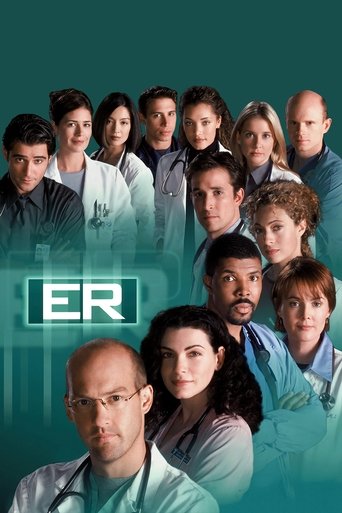
ER
1994 · TV series · 45 min episodes · 15 seasons
Created by Michael Crichton
ER explores the inner workings of an urban teaching hospital and the critical issues faced by the dedicated physicians and staff of its overburdened emergency room.
6 positive2 negative18 neutralfrom 26 commenters
Where to watch
No streaming data for this title.





28 comments on Hacker News
I kind of have this, and part of this I think is just cognitive load. When something first comes out. There’s this like added mental pressure to like it, to think about how everyone else responds to it. I watched the Pitt because I already had language for it. I loved ER, and it’s basically a spiritual sequel to the 90’s show. I tried Severance, I don’t know if I would like it a few years from now but I think it would be easier to like without the feeling I was supposed to.
This is a bit overstated but I’m analyzing something mildly subconscious, not like a conscious anxiety - it just feels like a lot of work to engage. A few years later the pressure is off, there’s no expectations. You can choose what to engage with in peace.
There’s also in some cases the obvious - if you don’t like Sinners society implies you’re probably close minded and maybe even a little bit racist. And even if I don’t 100% reject that sentiment, I don’t want to consume art in that context, and I doubt the artist would want me to either(I mean aside from wanting the ticket sales) Better to wait a few years and consume it on your own terms. Have some space to look at the landscape and determine what you might really enjoy in the strength of the idea itself. Most of my favorite shows and movies I consumed in that context.
> I cant think of how slapping a union on top of an already unstable foundation is going to solve anything
You mean like the entire television and film industry? Any production over a certain (small) size is completely unionized. It's so massively successful the American cultural exports dominate in almost every corner of the world.
I'm not sure where the idea that unions can't work for the games industry comes from since it's almost identical to the film and TV industry. Unions exist so workers don't get exploited and to provide stability.
What about Nintendo? They famously have very limited layoffs. They see value in providing stability and maintaing culture and institutional memory.
If anything, it's short-term profit-seeking that destroys industries. You see this in the world of original content production for streamers. They cut the size of writers rooms. They tried to no longer have writers on set. There's a push for "mini writing rooms". Why? Because it cuts costs on a very short term basis.
In doing so, Netflix (etc) are intentionally throwing away the model that created billion dollar properties like Friends, Seinfeld, ER, MASH, Cheers, etc that, to this day, generate massive profits. Seinfeld was known for getting over a million viewers when it was running in syndication.
Long-term it creates problems. Future products and showrunners are writers who need to get experience on set. Shortsighted cost-reudction is literally killing the future of the industry.
As for the price of video games, there are several aspects to this:
1. AAA publishers like to complain that games still cost $60 after years. That's true but also the distribution is significantly higher than it was 20 years ago. You're selling way more games;
2. The marginal cost of producing a game via download is essentially zero; and
3. Games eventaully get much cheaper on Steam. That's a good thing. Early experiments with this showed that selling a game cheap on Steam could generate significantly more revenue than the original release. And because the marginal cost is zero, it's all profit.
There are also TV series with very little title sequences.
OK it is dating a bit (last season ended in 2009) but we are about to finish rewatching ER and the title sequence is just a black screen with the title name.
I'd have to check but I would guess there are still some series with a short title sequence.
> Isn't ER from the 90s? Most TV at that time was shot on videotape, not film, so there's no way to get an HD version of it, so if this is the case, you're seeing it in the best possible rendition already. Going through a projector probably helps actually, by making things smoother than they would be with upscaling on a 4k-res TV.
That is exactly what I am trying to say. While I have an overall lower max res, my viewing experience is much more consistent across all kind of contents. And it never feels as crappy as upscaled content.
>If you want to see what a modern 4K TV can really do, you have to watch it with something new, shot in 4K, perhaps in HDR if the TV can render that (this works best if the TV is OLED; LCD TVs don't have the brightness to really show HDR properly). Watching the same media on your 1080p projector should look noticeably worse than your friend's 75" OLED set.
I know I've seen it at friends place. But what I mean is I don't really feel it unless I compare both side by side thus it doesn't make my viewing experience less enjoyable. Ignorance is bliss I guess. And I much prefer the immersion of having an albeit lower res projected in the full size of my living room wall than 4K res in a smaller screen. It would maybe be different if I was watching ice hockey games and trying to follow the puck but I am not.
YMMV of course.
Isn't ER from the 90s? Most TV at that time was shot on videotape, not film, so there's no way to get an HD version of it, so if this is the case, you're seeing it in the best possible rendition already. Going through a projector probably helps actually, by making things smoother than they would be with upscaling on a 4k-res TV.
If you want to see what a modern 4K TV can really do, you have to watch it with something new, shot in 4K, perhaps in HDR if the TV can render that (this works best if the TV is OLED; LCD TVs don't have the brightness to really show HDR properly). Watching the same media on your 1080p projector should look noticeably worse than your friend's 75" OLED set.
Possibly, I think I have seen both terms used.
Mine is a 1080p model. I have seen 4K TVs at friends houses but I can't say I miss it. Somehow the when you watch some old non HD it still looks good when projected on a wall. Sure it is not highres but the image seems smoothen the image instead of having a pixelated or badly upscaled result. For example these last few months I have been watching a lot the ER TV show and I wasn't the least annoyed by the lower res.
If you like those sitcoms then you would probably like stuff on Hulu: Animal Control, Abbot Elementary, Superstore, Only Murders, etc. You can also rewatch Always Sunny, ER, and a bunch more. (Oh and "Dave" which is new and brilliant).
HBO's entire catalog is full of bangers, many of which I still haven't seen yet.
I watched all of ER a few years back. There was only one episode where a doctor killed Simone by mistake because they were stuck there way longer than they should have been due to a staffing issue. However basically from the opening of the first episode, how exhausted all these doctors are is hammered home.
Huh? Doctors don't base their decisions on House episodes. Not even ER episodes.
> Utterly unthinkable, isn't it?
No. Ignaz Semmelweis faced it in the 1800s for daring to suggest (what we know know as germs) made people sick and hand washing could drastically reduce medical complications. He was able to prove it too.
By the end was locked up in an asylum for his ‘crimes’.
Want more recent?
How many stories have you heard of instruments or gauze or whatever left in surgical patients? Of operating on the wrong part or person?
People are fallible. But checklists help a ton. We know that for sure. Why is aviation obsessed with following them? Because they work to increase safety.
Surgeons have resisted them. I don’t know the current state of it, but they were making that exact “good surgeons don’t need it” argument. I remember it being a plot point on an episode of a medical drama (ER? Or maybe Grey’s Anatomy).
There are probably tons of other examples in other fields.
Back when ER was a hit show, there was survey among medical professionals and hospital staff asking for their favorite medical drama series and the reasons for it. Grey's Anatomy, and similar series, constantly beat ER. The reason was that medical staff considered ER way too realistic. Makes sense, why would I entertain myself during my off hours with what is basically a documentary about my on-duty hours.
I remember watching a terminally ill patient in ER writing letters to his children to open when they reached milestones or after his death. Knowing my father had done the same for me and that connection was brutal, like it floored me.
I'd not skip that episode or something like it for having emotional punch though, even knowing I'm probably still just as likely to react strongly.
There has never been more competition for attention than now. What used to be good numbers will not be in the future but I think what matters more for a sport is the dollars spent by the fans that they have.
Consider: In 1980 the TV show Dallas had an estimated household viewership of nearly 28 million.[1]
By 1990 Cheers was getting 19.8 million in the number one spot, while the number of TVs in households jumped by 20 million people to an estimated 93.1 million.[2]
In 1998 ER was getting 17.8 million in the first position, with a further 6 million new TVs.[3]
Coincidentally, in 1999 they changed the metrics to go by estimated viewers (which then raised them back to approximately 30 million for some shows).
The trend has been pretty clear, more competition means no one thing is going to capture the attention of as high a percentage of people as before. Baseball isn't up against just stuff broadcast in its own regional markets anymore; it's competing against everything from cooking shows from Norway, a streamer from Japan, one of a dozen on-demand services, and an endless supply of social media.
Just because it's different though doesn't mean there's not money to be made and calls to nationalize a sport where the owners can make hundreds of millions even off bad franchises seems to make zero sense to me.
[1]: https://www.classictvhits.com/tvratings/1980.htm
[2]: https://www.classictvhits.com/tvratings/1990.htm
[3]: https://www.classictvhits.com/tvratings/1998.htm
You gave me two beautiful examples, the best examples, thank you very much.
Medicine (healthcare's real name) and driving.
Right so, that ties in to what I was saying, you do need more people for the menial jobs, 20% more bus drivers hired. It doesn't increase COSTS, it increases WAGES, not the same thing! Throwing away half the good food just for the sake of wasting it increases costs, hiring 20% more bus drivers increases wages, the money goes to a person, not to the garbage. And then, too, you have fewer people out of work as a percentage of society, so in fact they're much more productive because instead of resorting to theft and drug deals and borrowing money from good people to pay it back to usurers, and all the costs in uncertainty of being unemployed long term, the bus drivers share a job and are never unemployed.
And they're never depleting their body while unemployed, have you ever thought of the costs of poverty if they were actually charged? An employee can have his back broken in three minutes to make the employer thirty cents in additional profit and complain nothing for fear of being fired (happened to me in Mare Island at a brewery, I had to do all these defensive maneuvers to avoid work that would have caused spinal injury in hours). Like yeah there's the lawsuit, supposedly, tons of lawyers handy to give the employee the run-around, so fine there's a settlement, but does the boss ever completely repair the harm to the worker whose body he considered his like he rented it, good-as-new? He could right! So that's more than what the boss pays, a back injury Amazon-Warehouse style, I figure the suit goes for $300,000. But that's not what it costs to get it good-as-new, that would cost like $15,000,000 for a spine, if that, I think they can never fix a spine for real. Medicine cannot fix that. By having two drivers share the wage, none is ever unemployed and therefore desperate, so they never sacrifice their backs to the boss for a millionth of what it costs to repair them, what's the ROI on that, -99.9999%. So splitting a $70,000 job in half saves millions of dollars, I think that might just cover the "costs" you're talking about.
So that takes us to healthcare in America. As a matter of fact, doctors pretend they work crazy hours, and that's what you see in the felatory TV series like Dr. House and ER, Gray's Anatomy, but many just don't. Surgeons--it depends. I think old doctors in their extreme hazing of young doctors make them work fucked up hours but after the hazing they don't do shit. Don't work shit. Like don't work Fridays a lot of them, and even when you go see them, they are always fucking late. So that's time too, they're not working during those thirteen minutes they keep you waiting, then they take breaks between patients, their hours are mostly empty. They generally cut you short on minutes, like if you want to ask them three things they get pissy, they get pissy for all kinds of stuff, they're actually a boss, doctors are bosses, they boss around the nurse and the pseudo-nurse staff. They even boss around the patient, give you "doctor's orders" as they put it which are not orders in a legal sense. They nag you. They extort you. They judge you. Ask you super personal irrelevant questions. Few put themselves at the patient's service.
Sure some doctors are fine, but if half the waiters put flies in your soup deliberately you're not going to praise the other half for not putting flies in your soup, that's just what a waiter is supposed to do, does he want a 50% tip and praise for not putting a fly in my soup? No, instead it is legitimate to focus on the half that do put flies in your soup, don't correct me for not being fair and balanced. Like why do the other half of waiters tolerate the fly inserters?[1]
In fact 32 hour work-weeks, making doctors actually FUCKING WORK 32 FULL HOURS, and do their job for real, and answer questions for real, not play dumb so they don't do icky work they don't like, not try to shunt you into shitty treatments, not lie about side effects, not misdiagnose, no sadism like that's asking so much, basically not commit what is morally (and much more often than they realize, legally and provably) malpractice and negligence day in and day out would improve healthcare enormously. But it would reduce costs, unfortunately, and they want the opposite. Doctors are a union, they are always on strike, they've been on strike for a century. They make United Auto Workers look like sweatshop workers, Milton Friedman said so.
So thanks so much for those two examples, healthcare and transportation, in both of those the ROI for 32 hour work weeks is gigantic. I would have never realized how strong my arguments secretly were without your comment.
[1] In fact, the fly-inserting waiters are in charge and tolerate the normal waiters to deflect accusations, make those felatory TV series easier to be deceived by, do marketing calling themselves heroes, and release the pressure from the public hating them. They don't want that hatred. And to pin the blame on them when there's a scandal. And the fly-inserters hate them for doing their job properly.
Tossing a huge range of different properties in a blender is fine, ripping off a single property is just lazy. Which sounds more original pure Harry Potter fan fiction or ER the TV show + Harry Potter + Cheers the TV show.
Draw evenly from M*A*S*H + Dresden Files + Mass Effect + Dexter and your going to end up in some strange and interesting places. Play through Starcraft 1+2 on the other hand and the story is fine if a bit bland.
WW was still quite formulaic. ER, NYPD Blue, etc were all shows that maybe pushed for more consistent storylines but they were still boxed in by old school network expectations, and they got their starts in the mid-90s.
Sopranos was a very clear break in writing style. People like to slot in The Wire next to it, but The Wire was more episodic/restricted and honestly felt like an R-rated network tv show to me.
A sociologist I met described it as the "generation effect" which is that people live in a cohort of other people about their same age +/-10 years. Throughout one's life the composition of the cohort changes as you begin to specialize starting with college/first job and continuing if you focus on a particular area (for me it has been systems analysis).
This effect can drive people to over-pay to go to "good schools" or work for less than they think they should be paid at the "good places to work" because it lets them join a cohort with members who are statistically more likely to be "successful" (for some arbitrary definition of success). I personally never paid much attention to it but thought about it when talking with this person.
I know from experience that it happens in Silicon Valley that someone will say, "Oh I know someone at some previous company who is really good at that, let me see if they would be willing to change jobs." That is why companies pay people bonuses for "referrals."
I suspect it happens in LA in the entertainment industry as well. If you watch the old American television series "ER"[1]. Produced by Steven Spielberg's Amblin Entertainment production company, it is amazing to see people who were on that show first as guest actors and then show up later in series.
[1] https://www.imdb.com/title/tt0108757/
I believe that this is a common trope in medical dramas. While I'm unaware of how often it is actually done, I know that I have seen it done in multiple episodes of House, or ER, etc, etc.
The show was careful to never show someone getting killed due to sheer incompetence. But to be fair even "realistic" shows like ER would tread lightly when they went there, it's nearly always depicted as a systemic failure due to poor communication or some other unforseen circumstance.
But since the overall topic is the nature of elitism, I would volunteer that when I've had a friend or relative at a hospital with an "elite" reputation, that was no guarantee against episodes of incompetence. But that's a completely different topic.
Maybe the traditional networks would make a decent comeback if they started producing view-worthy shows again. There was so much content actually worth watching and getting excited for one or two decades ago, now at most I’m looking forward to the next episode of Bob’s Burgers as far as domestic network shows are concerned. Anything else worth watching to me comes from Netflix or Amazon, or premium networks that are already preparing for the death of cable like HBO.
There just isn’t a modern day equivalent to ER, and THAT is why TV is dying (along with absurd price hikes).
https://en.wikipedia.org/wiki/Top-rated_United_States_television_programs_by_season
Going all the way back to 2000, it's pretty clear that the top rated tv shows have always skewed towards older demographics. ER, CSI whatever, Lawyer drama #25.
That level of concern is a bit ridiculous for a 10 year old. I was riding my bike all over by myself at that point. Crossing the street with indirect supervision is something I'd trust a 6 year old with.
Now maybe I had a charmed childhood, but I'm in my mid twenties, so it's not like I'm talking about growing up in the 50's here. My parents are older though, they did grow up in the 50s, and I I know they view independence as an important individual trait. I'm sure overprotective parents are not a recent phenomenon. One of my (younger) brother's friends was accompanied to and from school by his mother well in to High School. Walk, drive, riding a bike, you name it, she was there.
My mom asked her about this once, and she was like "Oh, [Declanomous's Mother], you have [Declanomous] and [Son #2]. I just have [her son]. I don't know what I'd do if anything happened to him." My mom thought this point was kind of ridiculous, because it's not as if one child is a backup for another child. She just let my brother and I run around because she wanted us to learn to do things on our own.
Personally I think the current environment vis-a-vis child rearing reflects a larger trend towards fear in overall society. Part of this is a result of a larger focus on danger in childhood development, but I feel like a whole culture around existential fear really developed after 9/11. It seems like we started viewing the entire world as dangerous, rather than being ripe for exploration. I feel like this is really noticeable when watching media from different eras. Popular TV shows before 9/11 were Seinfeld, Friends, and Fraiser. After 9/11 shows like CSI, 24, etc. became very popular.
I could be completely wrong. I know shows like Law and Order and ER were very popular before 9/11. I recall them being less existentially terrifying though. This could just be because I was very young at the time though.
Firefly is great, albeit short.
I was forced to watch Buffy, but while the first season makes you cringe, it is pretty good. Not as stellar as people claim, but really good. I think Joss Whedans masterpiece wasn't Buffy, it was Toy Story. But do watch the musical episode "Once More, With Feeling"!
Babylon 5, of course, if you can tolerate the (even for the time) bad CGI.
I've just watched DS9 from beginning to end, something I had wanted to do for 15 years now. Hasn't aged well, and I hadn't seen it in English before. Avery Brooks' overpronunciation is painful, but it is the best Star Trek series by far.
Friends was something I've enjoyed as a teen, and later as an adult. It was a totally different experience as an adult. I think that's worth a lot, to have a depth that appeals differently to you in different stages of your life.
Modern Family was way better than expected.
ALF is a bit painful to watch nowadays, it also hasn't aged well.
Golden Girls are probably still great, The Cosby Show definitely is!
Boston Legal is fun, fun, fun! Hey, why shouldn't Nantucket be allowed to habe its own nuclear weapons? But do watch all the newer Star Trek series before BL, so you can appreciate the ST heavy cast.
Dallas! Oh my. Incredible how old Victoria Principal is today.
ER was great, but I haven't seen much of the last seasons. I also liked Chicago Hope, but it clearly lost.
The 2004 Battlestar Galactica. Probably the most modern TV series of its time, great themes and issues, pretty current, fantastic buildup to the big finale and then... disappointment.
Game of Thrones, if only for the shock value ;-)
And at last, the Tv series I've probably enjoyed most in the last few years: the first two seasons of Veronica Mars. But make sure you can stomach it, the season finales are sickeningly evil (especially season 2).
"To my knowledge, no child grows up “playing doctor” and still believes as a teenager (or even as a college student) that an actual medical practice resembles that activity. Likewise, no one has a fully functional toy legal system to play with as a child, and as a result goes into law. On the other hand, “adult” programming, seen from afar, is enough like child-programming to set the computer-enthusiast child up for just this kind of exceptionally cruel bait-and-switch."
No, but they do see things like "House MD", "ER","The practice" etc... , which resembles the actual medical or legal profession as much as movie "hacking" resembles computer programming.
Besides, I've never known a child to actually see "adult" programming - unless one of your parents is working from home, most "adult" programming happens in a corporate setting. In the same way I've never known a child to see "adult" psychology, or other professions which are practiced in closed environments.
"Virtually every profession has a concept of professional equipment"
True, but so do programmers. The idea that professional equipment has to be hardware (or for that matter a keyboard) is rather false.
Professional writers use the same hardware as amateur writers - pen, paper, computer . But they might have better word processing software.
And I'm not sure about others, but the hardware I use for programming is much different then what an amateur computer user might have- a lot more memory (to run those IDEs, databases, memory cache etc...) , two or more screens , and software that are unlikely to be used by non professionals (Jetbrains IDE, Beyond compare, virtual machines) etc..
Also - there are keyboards designed for faster typing, from my experience they just not very useful (programming rarely requires fast typing in my experience, better googling would be a thousand times more useful).
some tech has short run; and some entertainment has long runs (like ER TV show), but these are exceptions to the rule. Your search engine, Google has enjoyed a 14 year run, and is going strong. Windows OS has enjoyed a nearly 30 years run so far. Kardashians on the other hand, enjoyed only a couple of years of popularity. This is what I mean.
I'm not so sure about that.
Firstly, making the service I am describing available to customers like me doesn't mean that everyone is going to abandon the traditional delivery methods. Such a service would likely require some level of technical sophistication (i.e. plugging in an ethernet cable) where most TV users just want to turn on the TV. Traditional delivery methods, and revenue streams, would not be immediately damaged by such a solution.
Secondly, using your example of ER, there is marginal revenue per viewer. For every viewer that the new service draws from the old service, it becomes necessary to make a certain amount of money per viewer. ER's lowest rating was about 9 million viewers. At 13 million an episode, the marginal revenue per viewer (again, on the low end) would need to be around $3/viewer/episode to earn $14 million in net income per episode (that's 9M viewers x $3.00 = $27mm - $13mm cost per ep = $14mm). At 22 episodes a season, that's $66/yr for each viewer. Compare that to a digital cable service that can cost you well over $1200 dollars a year. You could buy 18 shows on the magnitude of ER for that price, and who could possibly have the emotional fortitude for that? Let alone the free time.
http://en.wikipedia.org/wiki/ER_%28TV_series%29#Ratings http://money.cnn.com/2010/01/06/news/companies/cable_bill_cost_increase/index.htm
The cable television business model is a value suck. Albeit, a value suck that's not going anywhere, but I sure as heck am not going to pay for it. I'll stick to free TV, Netflix, and my BD player.
The numbers work for the sort of service I want, and I would bet that Reed Hastings would love to give it to me for $30.00/mo if he could get around the content providers who are clinging to their 20th century business model.
Yea, and I also learned how to become a doctor by watching House and ER, fish for Alaskan crab by watching Deadliest Catch, and learned all about how to have relationships by closely studying Friends and Entourage!
So no, that episode of Top Gear does not bring up any "good points" to draw legitimate conclusions about the American South. All it shows is that if you insult the average person enough, they'll get pissed off enough to deliver a few minutes of good footage. Meanwhile, back here in reality (not in TV land) -- if you visited down South you'd find that, given a broad sampling, Southerners are far kinder and warmer than us from New England. (p.s. I'm not from the South).
It gives me great concern that we as Americans assume so much truth from our 30 minute highlight reels.
It seems that broadcast TV and the newspapers have the same problem: their business models were based on the once natural coupling of the generation, aggregation, and syndication of content. While the economies of scale of printing and delivery naturally coupled these roles, the 'net allowed for their disbanding.
When I have a spare hour, I want to take a couple of copies of my "local" paper, the Cleveland Plain Dealer and cut out each individual non-advertising piece of content. Then, I want to separate them into piles: (1) locally-generated content with a local perspective, (2) non-local content with local interest, and (3) non-local content.
#1 = Story on some local crime that doesn't affect people who aren't Clevelanders
#2 = Stories about KeyBank. Although they might be written by the AP, they are of special interest to Clevelanders. This probably doesn't include the local movie reviewer unless the film was shot in Cleveland or something like that.
#3 = The AP article about what Obama ate for breakfast today.
I'm pretty sure that the portion of the paper that falls into pile #1 and #2 is pretty small. I skip over #3 because I've already read a better article in The Times. The PD, like almost all local papers, relies on the artificial coupling of generation, aggregation, and syndication to justify its business model. Interestingly, the PD has a terrible internet presence (cleveland.com), but it at least seems to filter out the unique, local content.
How are the broadcast networks different? Youtube has proven that consumers prefer to consume the good content from the broadcast networks at their leisure even if the video quality is sub-standard. So, the big networks' broadcast/syndication capabilities are no longer the value they once were. The NetFlix Roku has proven that the internet is good enough to publish high-quality content cheaply, and it costs only slightly more than a digital TV converter box!
The network's role as aggregator of content has never been seen as a significant benefit -- Who chooses which shows to watch based on the network showing them?
So, what value is left for the networks? They are better than just about anyone else at identifying and producing top-tier content. No one has done an internet-based ER or Friends (yet). Is it the network's ability to use its large audience to market new shows that provides its remaining value? By knowing that they can get people interested in the next ER, they can afford to throw $5M at a pilot. Can alternative methods of producing and marketing high-quality content compete? In the short-term, perhaps. But, when mainstream, entertainment-related content providers (sites about TV, magazines about entertainment and celebrities, etc.) start to talk about the last episode of the new internet-only show right along with a summary of last night's Grey's Anatomy, the networks' last remaining source of power may decompose.
I was surprised that the NYTimes article didn't make a better comparison of the networks' fate with that of the newspapers as their plights are not so different.
Questions I have:
1. How can a business be made of local news production? I'd be willing to pay for it, but I'm not sure that enough people would be.
2. It seems that iTunes, etc. provide a good means of charging consumers for video content. How can the funding/publicity model be changed to allow an internet-only ER to happen? Am I wrong to presume that consumers want top production quality?
I almost pitched this post because I wasn't sure that I'd said anything that hasn't been said over the past few years, but I decided to keep in hopes of sparking some discussion.