 Hacker Cinema
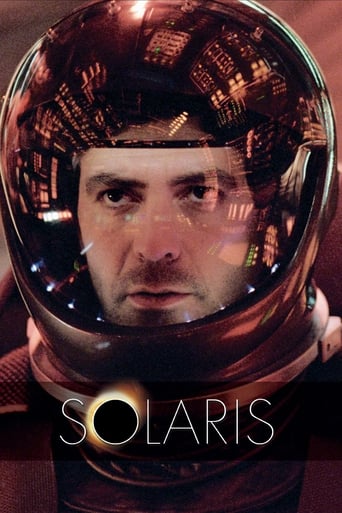
Solaris
2002 · Film · 99 min
Directed by Steven Soderbergh
A troubled psychologist is sent to investigate the crew of an isolated research station orbiting a bizarre planet.
12 positive7 negative4 mixed4 neutralfrom 27 commenters
Where to watch
No streaming data for this title.



30 comments on Hacker News
Interesting. I read this book over the summer (and also discovered in the process that my library also has a collection of Lem in Polish too! Too bad I don’t know Polish). I suppose as long as they are focusing on an “atmospheric retelling” of the story, it doesn’t really matter that none of Lem’s stories ever end in human triumph. This one ends mostly in confusion and failure.
I also recently learned that there was a new English translation of Solaris. This version is much-hyped for being closer to the original, but as I read it, I am finding that I preferred the original translation (even though Lem himself reportedly did not like it). Anyway, huge Lem fan. Maybe an immersive game-like experience will better serve Lem’s visions. I was sorely disappointed in Soderbergh’s awful film version of Solaris. It just didn’t capture the terror of the story at all.
Solaris (2002), Soderbergh's love story in space, is one of my favs. (I watched the Russian adaption and didn't have the same reactions) The plot of human inner life juxtaposed with non-Terran nature flips the script for antagonist--the enemy is within us and humans did not evolve to be in space. Cliff Martinez's soundtrack is, for me, right up there with Vangelis or Tangerine Dream.
There are a number of movie directors who really deliver a cinematic experience and mess with your head: David Cronenberg, Terry Gilliam, David Lynch, Quentin Tarantino, to name a few contemporaries. I return to a handful of their films again and again. Many very re-watchable.
I think it's worth adding here a few playwrights who have made films scripts: Stephen Poliakoff and David Mamet.
I want to shout out to a classic director: Michelangelo Antonioni. He flipped my lid. He really captures something for me with his cinematography and the quiet emotional tension he gets from his actors. Blow Up (1966), LaAvventura (1960) are my favs.
I have only read Lem's "Solaris", and I have also watched the Soderbergh movie. But I don't think I've ever read/seen a more profound meditation on the human experience PLUS the possibilities of an encounter with an alien intelligence. Just wonderful, soul-provoking stuff.
I would recommend Stanislaw Lem. He is Polish and Jewish. Solaris is great start. There has been two movie adaptions of his book, Soviet and Hollywood, and both fail to express the main point of the book that is possible incomprehensible strangeness of alien intelligence. I would compare his book to Peter Watts Blindsight in this regard.
I just bookmarked three of these. I have watched Tarkovsky's version of Solaris at least 3 times (and the American version with George Clooney and Natascha McElhone 5 or 6 times) - I love that story and both movies are so very good!
Lem is one of the most interesting sci fi authors. He is deep and philosophical, but can also be very funny. Solaris is definitely not one of the funny ones.
I also love both the film versions of Solaris. The Tartovsky one is the best IMHO but very long, but I also really like the more recebt Soderbergh one with George Clooney.
For funny, try The Cyberiad. A collection of short stories of two robot inventors who try to outcompete one another.
I recommend Solaris. I think it's a wonderful book focused on our inability to communicate with other forma of intelligent life. It's a pity that the US movie was such a disaster.
For me, the first part of HMV was quite tiring and difficult to get through. It's a long essay written in a first person perspective, but it gets much easier later on. And it's rewarding, I think it's his best book on the problem of understanding other civilizations. Furthermore, it's a bit satirical and critical of military, government, and scientists.
> Don’t quite understand your point. The actors in the supporting roles are also a pleasure to watch.
They’re not nearly as good as the actors in the film, and they’re used to a much lesser extent. (Seems a little mean but you did force me to spell it out.)
The positive comments make me feel I do need to give the series another watch someday soon to understand where the fans are coming from. I think I had a much more positive view of Smiley’s People than some, which I’m curious about too...
> Lol I very strongly feel that the miniseries kicks the movies ass :).
I can clear a room by going on about how Soderbergh’s Solaris is superior to Tarkovsky’s, so I guess I’m not a stranger to your plight.
> Consider that Gary Oldman re-uses the glasses prop for George Smiley which Guinness originated.
He used Guinness’s voice. It’s astonishing, really.
> it’s the definitive performance, and thus the definitive filmic version :)
You’ve got me wishing it was filmic - unless I’m mistaken it’s 576i :(
There’s a series with Helen Mirren called Prime Suspect that was shown intermittently in England over twenty five years. One thing I took away from it was that the evolving aspect ratios of broadcast TV (the show used three different ones over time, inviting some comparison) really have expanded what’s possible on the screen.
The Soderbergh movie is pretty good. Not quite the same story as the book but I attribute that to the difficulty of making a planet a character in a movie.
Every realization of the Solaris story demands patience and thought from its audience, and I expect that's the root of the problem with its lack of popularity.
I strongly recommend the book version (the films by Tarkovsky and Soderbergh are okay but the book is better) of Solaris. It explores this idea of an alien life form that is decidedly un-humanoid.
[Lem, the author]... wrote that he deliberately chose the ocean as a sentient alien to avoid any personification and the pitfalls of anthropomorphism in depicting first contact.
https://en.wikipedia.org/wiki/Solaris_(novel)
Funny coincidence, I just watched both the original Solaris and the remake this weekend. They've been on my list to watch for years. I enjoyed both. The original requires a lot of patience, and it's somewhat less accessible I think to non-Russian speakers who have to read subtitles.
Ebert's reviews are pretty spot on.
https://www.rogerebert.com/reviews/great-movie-solaris-1972
https://www.rogerebert.com/reviews/solaris-2002
If you like anything by PKD, or you enjoy 2001, you'll probably like Solaris.
Lem's Solaris is (among other things) a literary take on Wittgenstein's lion, might be an easier and more fun read. (I hear the George Clooney vehicle movie is actually good too, but different from the book.)
Regarding your Chinese Midwesterner lit, we do have the huge genre of Serge Leone and the Italian "spaghetti westerns" (and spaghetti was invented in China!)
Anyway, I don't want an AI remixing literary to make derivative literature. I want AI remixing news and culture to find subtle patterns and generating literature about that, which is what many great human writers too.
Hm, I still don't see Solaris that way - satiric, I mean. Quite aware of the limits of our knowledge, definitely. A dash of transcendental, a la The Kid by the Strugatsky's (the English version of the title, 'Space Mowgli', is an abomination), or Childhood's End by A.C. Clarke. I feel he says, look at all this flood of mind stuff, and what do we get for it? Finally he's standing on the shore, at the end of knowledge, and he's touching the vast unknown ocean in front of him - very symbolic.
The love story is definitely not the main thread, but I felt it was very personal. Not sure why. Kelvin is Lem, no doubt about it, and he poured into the book some measure of his soul. I didn't catch that when I was 16, but I felt it quite powerfully a few months ago when I re-read it.
The contemplative atmosphere of the movie by Soderbergh seemed to capture some of the spirit of the book, but it would take a heck of a lot of text to explain why. But that was it, it didn't capture much else.
I didn't read much else by Lem - the Cyberiad and some Pirx stuff, but that's about it and it was long ago and I don't remember much. Nothing felt as meaningful as Solaris to me.
I didn't read many books by the Strugatskys, but those I've read are awesome.
Solaris is somewhat satiric, but it's subtle. After that long, encyclopedic summary of solarisist research that spans decades (or is it a whole century? I forget), the protagonist tells us everyone has developed their own theory about Solaris, and every single theory is wrong, because it ultimately reflects the mind of the theorizer. Then, ironically, the protagonist tells us his theory. Lem is deeply cynical here about humankind's ability to understand anything outside themselves. It's a pretty overt critique of modern academia, perhaps especially the soft sciences like psychology and psychiatry. It's not meant to be a very emotional novel, I think. Lem hated the movies, which misinterpreted his intentions and honed in on the love story aspect.
Did you read Lem's His Master's Voice? It goes even beyond Solaris in that way. It's about the infighting, political maneuvering etc. that surround an attempt to decipher what may or may not be an extraterrestrial signal. It's perhaps a bit drier than Solaris, being written as a memoir by one of the scientists involved.
I'd say Lem had two modes of writing. He wrote comic adventure stories like the Pirx stories and The Cyberiad. And he wrote ironic, somewhat cynical or pessimistic criticisms of science, such as Solaris, HMV and The Futurological Congress. The latter is great -- during a scientific conference on the future of human civilization, the drinking water is poisoned with psychedelics drugs, and the main character a future dystopia. It's a short, fun book. Cynical, but fun.
His other novels, such as Eden and Fiasco, reflect this view. He's never struck me as a fan of humankind.
I'm not sure I see much of a Borges connection, other than the fictitious history of Solaris.
Have you read any of the Strugatskys' books? They're like anti-Lem's -- lot more optimistic and unabashedly humanist, I think. Roadside Picnic is a great start, but they wrote a bunch of great novels. Beetle in the Anthill is one of my favorites.
It really was. Lem made a good point about how most scifi treats aliens either as humanoid versions of ourselves, or creatures from our nightmares. After Star Trek Next Generation introduced the Borg, they found they needed to humanize them by having a Borg Queen individual.
The 2002 movie version had Gibarian's recording say that our enthusiasm for exploration is a sham. We're looking for mirrors. The point of Solaris was that the alien was not at all like us, and therefore humans couldn't understand it, because we're too busy projecting onto it. And Solaris used that to create disturbing human analogs, because it didn't understand either.
I actually rate Solaris last among the Lem works I've read. Below things like Hospital of the Transfiguration, which are pretty far off the beaten track for Lem. I actually stayed away from Lem for years because the (2002) Solaris movie made me think he's just waffling and hasn't any SF ideas worth looking at. Hardly could have been more misleading.
A Perfect Vacuum is I think the pinnacle of Lem's achievement. Why write a book and leave others to criticise what you did, when you can imagine the finished book and write a critique of _that_ yourself? Imaginary Magnitude is a similar idea, and I like that too, but I think Vacuum ends up the cleverer of the two even though Golem XIV (from Magnitude) is better than most Singularitarian fiction you'll see today.
The book is superb.
But to appreciate the book have to understand that Lem, in his serious mode (he also wrote comedies and light-hearted adventures, which are quite different), is not very concerned about plot, nor about most things American sci-fi has always been about: There are no heroics, no politics, no space wars, no McGuffins, and there's only minimal world-building.
Lem is an engaging writer, but also a somewhat dry one, and Solaris is a sort of essay on science, camouflaged as a novel: Like his other masterpiece, His Master's Voice, it is a critique of science. Whereas HMV attacks the scientific field pretty broadly, Solaris is more of an investigation into the limitations of the human mind: A scientist visits a far-away research station and comes to realize that all previous research (by decades of so-called "Solarisists") isn't even wrong, it's irrelevant. About a third of the book is spent on a wry summary of all the scholarly research that Solarisists have been performing and collecting in journals. Even after many decades, Solaris has funded many scientists, and yielded endless observations, but also zero insight. (At the time the book is set, most scientists have simply given up, and the station is largely abandoned.) Solaris is an inscrutable alien organism that the human mind can simply not understand. Ironically, even the main character comes to think, towards the end, that he has understood Solaris, when it's obvious to the reader that his conclusions are just more of the same, a reflection of our human-ness.
Of course, both movie adaptations got this wrong, or chose to ignore that aspect of the book. They think it's about people reincarnated from memories, and that it's about love. In the book, the "ghosts" are actually dealt with rather simply and matter-of-factly; the scientists find themselves being tormented by them, and quickly move to destroy them. Lem, however, doesn't bother with the emotional melodrama you find in both movies.
I don't remember what Soderbergh's version aimed for exactly (other than being a sort of Last Tango in Paris in space), but Tarkovsky's is very much inward-looking and concerned with the nature of artifice and truth (the "ghosts" are not real, and neither is Solaris, in a way). Tarkovsky didn't really want to create a sci-fi movie, and so you get something which is not entirely convincing.
The book is better than both films, though I liked the films, too. And, yes, the films diverged from the book in significant ways. Lem is a fantastic writer, and Solaris is one of his best. I definitely recommend it, if you like cerebral sci-fi.
Tarkovsky's works are generally demanding works of art. They are definitely slow paced and almost boring, but I've always found myself in a much more thoughtful frame of mind after watching his films.
As for Solaris, it is worth reading the book as well as watching both versions of the film -- they ask and explore different questions. The book is about the nature of intelligence and life whereas the films are more about the human part of the equation -- what does it mean to be a human as opposed to be a "replicant"? Tarkovsky is slower paced, but IMHO encourages deep reflection. Soderbergh's version is definitely more watchable and is actually quite thoughtful by Hollywood standards.
The original soundtrack by Kenji Kawai, like Vangelis' Blade Runner soundtrack, is what helped make the film a timeless classic. I really hope the music in this clip was to merely engage people who aren't familiar with the original film by Mamoru Oshii. An excellent soundtrack can make a passable film a really enjoyable experience - case in point: Solaris (2002).
I have watched the USA version of Solaris 6 or 7 times, the Russian verion 3 or 4 times, and enjoyed the book.
Facinating story and movies. It was cool to see behind the scenes of making the Russian version.
And the book is, more than anything, a bleak critique of cargo cult science.
In the novel, endless volumes of books and papers are written about the planet Solaris, but the literature has produced not a single scientific insight that goes beyond merely anthropomorphizing; the protagonist himself satirically describes the many, futile attempts at analyzing Solaris, deciding that all the theories are incorrect, then, ironically, proceeds to formulate another anthropomorphic theory himself, which he decides is the correct one.
The movies (Tarkovsky's and Soderbergh's) both retain the basic plot, but go for a somewhat literal, romantic interpretation that Lem never intended. For example, the subplot in the book about the "ghosts" that Solaris manifests is comparatively unimportant in the novel, but takes up most of the screen time in both movies.
Lem touches on this theme in many of his books, especially His Master's Voice, which is also about scientists trying to understand an alien intelligence.
Re: Stanislaw Lem. You're right, he definitely feels like he belongs in the Soviet writers context. You can tell the difference in culture, context, commercial preoccupations, etc. when you compare Soderbergh's film version of Solaris with Tarkovsky's version. Both films were enjoyable, of course, but Tarkovsky was much closer to the depth of the book.
Watching Stalker may forever alter your taste in cinematography, it's so beautiful. Solaris is also good (watching it back to back with the Clooney remake is an interesting experience); Lem pretty much hated all three adaptations (http://en.wikipedia.org/wiki/Solaris_(novel)), an adaptation that reflects the alienness that he wanted to underline would be an interesting movie. You might want to think about what repressed personification would confront you if you had traveled to Solaris.
The page reminds me of when my wife and I watched Solaris (2002) without realizing our DVD player was on shuffle. We both enjoyed the nonlinear narrative for a good 45m before we realized what was wrong.
Fixing the problem seemed to make the movie worse for us.
That's just it though while Doctor Strange Love (1964) was #32 and Up (2009) was #924 there both vary good movies. There was plenty of recent and fun movies vary low on the list, consider:
Bowfinger (1999), Solaris (2002), Honey, I Shrunk the Kids (1989), From the Village to the City (1974), Going Postal (2010), Legally Blonde (2001) that's that's 4913 to 4918.
PS: Granted, rating movies is a huge multi dimensional problem, just ask Netflix, but you don't need a lot of accuracy to find a good movie.
Stanislaw Lem is probably my most favorite sci-fi author. He's very popular in Europe, but not so much in the US it seems. His works are hilariously funny, philosophical and have a certain magic to them. When I saw the robot I was almost certain that it had to be about him.
I don't know about the quality of the English translations of his books, but in German, they are fabulous. There are a lot of word plays that are hard to translate.
By the way, many will recommend Solaris in here because there were two films based on it, one by Tarkovsky and one by Soderbergh. While it's not a bad book it's probably not his best and not entirely exemplary of his other books.
This is a good introduction to his work: http://world.std.com/~mmcirvin/vitrifaxintro.html
Yeah, keep in mind Soderburgh had a budget; Tarkovsky did his on a shoestring budget, and some of the wtfs (like the driving sequence) result from budgetary issues.
Soderburgh certainly improved a lot on the cinematography, no argument.
For people with a lot vested in their critical opinions I'm sure criticism of solaris is a no-go; for a lot of others, though, it's one of those films where you can see how it could be so much better if remade with less budgetary constraints (we don't need a cgi planet, really, but just a second-draft to get it right)...and Soderburgh being Soderburgh he got his chance.
One thing that's worth remembering is just how narrow Tarkovsky cut the book: the book goes on at great length, but Tarkovsky cut everything down to the core human drama:
- you're sent to investigate the mental health of people out on this space station investigating this incomprehensible object, b/c they've basically stopped communicating
- you get there and instead of anything you expect to find, you find your long-dead wife
- that's a pretty incomprehensible thing, no? It's something Lem included as a pretty smart move, but you could -- literally -- write a whole novel or make a whole film just trying to work through the psychological reactions that'd produce
By restricting that attention it humanizes the encounter with the incomprehensible:
- you get to 'cheat'; a cgi orange planet is obviously a cgi orange planet, and thus not really 'mysterious'; using interpersonal relationships for your mystery lets you tap into very primal emotional hooks
- but at the end it's still left deliberately opaque enough to remain an encounter with the incomprehensible
If you have read more by Lem you'll see his pet peeve is comprehensible mysteries -- just about every story he's written can be interpreted in some way as a kind of parable of how even 'explorers' are mostly uninterested in or incapable of encountering or appreciating anything they didn't already know or understand.
Fiasco fits the bill, as does 'Return from the Stars' (though it's harder to pick out, there). Lem was pretty prolific.
Oh, BTW, the movies are good too.
The one by Tarkowski is a classic and has an almost cult following (almost impossible to criticize it in certain circles). It is a remarkable movie, but I've found it a bit bombastic at times.
The other one, by Soderbergh, is the movie that opened my eyes to the art of cinema - or rather, to telling stories with the image, framing, and camera motion. It's hard to explain, it was like a revelation. I used to be very much focused on music, sound and words, and was almost blind to visual arts. Seeing Soderbergh's "Solaris" was a turning point to me, along with other major changes in my life at that point. I guess I was just getting ready and seeing the movie was probably the catalyst. Now I can actually take pictures in a conscious way and am able to "say" something by just framing the image in a certain way.
I read the book decades ago, when I was a high-school kid. It had a major impact on my thinking. It's a lot more philosophical than what you would expect from a sci-fi novel. Reminding of Borges in a way.
The being with the fully-cryptic (or almost fully cryptic) consciousness is described in the novel "Solaris" by Stanislav Lem - two movies were made after it, one by Andrei Tarkowski, the other by Steven Soderbergh.
It's a great book anyway, regardless of your interest in the issue of consciousness.