 Hacker Cinema
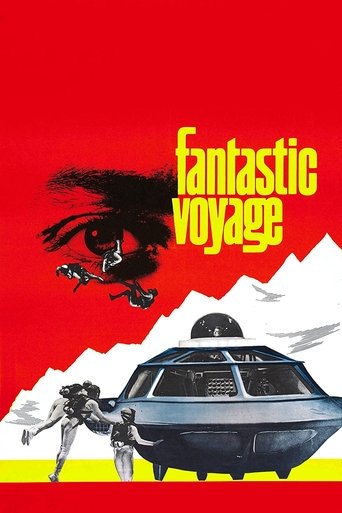
Fantastic Voyage
1966 · Film · 101 min
Directed by Richard Fleischer
In order to save an assassinated scientist, a submarine and its crew are shrunk to microscopic size and injected into his bloodstream.
1 positive1 negative6 neutralfrom 8 commenters
Where to watch
No streaming data for this title.



8 comments on Hacker News
Well, you have a point, but the separation is hardly as stark as all that. Both film and television have works that definitely qualify as Science Fiction, and some are even original rather than adaptations from books.
A few examples: 2001: A Space Odyssey, Fantastic Voyage, Moon, much of Twilight Zone and Outer Limits, Prospect, etc.
And for that matter there is plenty of SciFi in print as well, and it isn't all novelizations of movies and TV shows.
There is certainly more room for exposition in a novel (a fact which plenty of authors have abused over the decades, and plenty of directors have abdicated responsibility for by tacking on lengthy voiceover or on-screen text introductions), which often allows for more complete worldbuilding to explore whatever contrafactual premise the story is built around, but it is possible on-screen as well, as long as you don't rely solely on the dialog to convey it. For that matter, books shouldn't rely solely on the dialog for that purpose either.
Of course, on-screen dramatic works aren't the only ones that face the problem of conveying a setting in few words. Novellas, novelettes, and short stories have similar constraints to various degrees.
Another funny anecdote in that category I didn't see in the article is Isaac Asimov's novelization for Fantastic Voyage. Because of filming delays the book was published 6 months before the film release, leading many people to believe the film was an adaptation of the book.
That novelization differs significantly from the movie, but mostly because Asimov thought the screenplay was filled with bad sci-fi plot-holes and was given permission to change whatever he liked.
Funny the story completely missed "Fantastic Voyage" movie (https://en.wikipedia.org/wiki/Fantastic_Voyage) which had a research submarine called "Proteus".
I've spent days playing with Mandelbulb 3D and other fractal programs. I was really into the projection of 4D strange attractors onto a 2D plane or printout (my current screensaver). I would burn weeks in FPS mode navigating these Lovecraftian and Fantastic Voyage [1] worlds.
[1] I refer to the original 1966 movie, since the remakes didn't quite make it my opinion! And Raquel Welch.
My first reaction is that Venus is awful no one would go there, but I really love that Asimov would never say no to a premise.
Fantastic Voyage for example, he was like, ok, this is crazy, but here's what would happen at those scales. And he proceeded to patch logical flaws from the movie in his novelization, which turned out far better.
> In the 1966 science fiction film Fantastic Voyage, a submarine is shrunken down and injected into a scientist's body to repair a blood clot in his brain. While the movie may be still be fiction, researchers at Caltech are making strides in this direction: they have, for the first time, created bacterial cells with the ability to reflect sound waves from inside bodies, reminiscent of how submarines reflect sonar to reveal their locations.
I think this wins the Biggest Reach To Connect Science News With Pop-Cultural Touchstones prize.
I distinctly remember reading about synthetic biology ~10 years ago, when it was just emerging as a concept, and thinking "this sounds like a fun toy, but it's not practical or useful- cells are too complex to engineer with such simple 'modules,' and what can you do with a bunch of switches to control fluorescent protein, anyway?" But the concept still exists, and advances like this one march steadily on...
In a way, this kind of medical-synthetic-microbe could be thought of as a "soft genetic therapy." You could reprogram your own cells to manufacture some missing enzyme, or eat cancer cells, or whatever, but as yet (even with CRISPR and co.) we don't have a really safe way to do that in humans. But if you can find some bacteria which would get along fine in your body anyway, and modify them to fulfil your whims, that's much easier- and if things turn sour, you can just take some antibiotics.
I feel like a lot of the replies here are missing what's actually a quite subtle, thoughtful argument:
The German philosopher Gottfried Wilhelm Leibniz made the point vividly in 1714. Perception or consciousness, he wrote, is “inexplicable on mechanical principles, i.e. by shapes and movements. If we imagine a machine whose structure makes it think, sense, and be conscious, we can conceive of it being enlarged in such a way that we can go inside it like a mill” — think of the 1966 movie “Fantastic Voyage,” or imagine the ultimate brain scanner. Leibniz continued, “Suppose we do: visiting its insides, we will never find anything but parts pushing each other — never anything that could explain a conscious state.”
...
Many make the same mistake today — the Very Large Mistake (as Winnie-the-Pooh might put it) of thinking that we know enough about the nature of physical stuff to know that conscious experience can’t be physical. We don’t. We don’t know the intrinsic nature of physical stuff..
We find this idea extremely difficult because we’re so very deeply committed to the belief that we know more about the physical than we do, and (in particular) know enough to know that consciousness can’t be physical. We don’t see that the hard problem is not what consciousness is, it’s what matter is — what the physical is.
People making computer analogies below are engaging in the exact fallacy the piece is arguing against. A turing machine is a mathematical model for symbolic manipulation, and yet it's assumed one could somehow "map" consciousness 1-to-1 onto such a machine. The fact we can't simulate a single protein fold on a supercomputer gives me real pause in believing we've begun to grasp or have the ability to digitally emulate the kind of tricks life used to bootstrap consciousness out of matter.
I know the "no real evidence" / "too warm & wet & macro" arguments against quantum consciousness, but that to me looks like by far the most fruitful path to investigate to break out of dualist/"eliminativist" dilemma we find ourselves in. Recent research on quantum biology already makes clear life makes is far more quantum than I think almost anyone would have believed possible a decade or two ago. Considering just photosynthesis, arguably no life as we know it on earth would be possible without clever non-classical hacks by nature.
Reminds me of the movie Fantastic Voyage [1966] http://www.imdb.com/title/tt0060397/