 Hacker Cinema
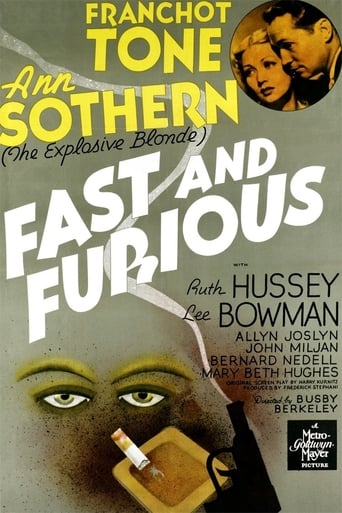
Fast and Furious
1939 · Film · 73 min
Directed by Busby Berkeley
Joel & Garda Sloan, a husband and wife detective team, who also sell rare books in New York, take a vacation to Seaside City. At Seaside, Joel's pal, Mike Stevens is managing and preparing for their beauty pageant. Joel is made one of the judges plus he has invested $5,000 in it, to Garda's dismay. Eric Bartell, promoter, arrives to dupe Stevens. When Ed Connors, New York racketeer arrives, Bartell is mysteriously murdered. Joel and Garda set out to investigate the murder.
6 negative5 neutralfrom 11 commenters
Where to watch
No streaming data for this title.

12 comments on Hacker News
It's a case of the biggest blockbusters, with the biggest budgets, like the MCU movies or Fast and Furious and such, looking like crap vfx wise. Same for movies at every level.
VFX can be more subtle (e.g. how Fincher uses it), but it's rare. The industry (which is separate from the technology) didn't mature, it enabled crappy effects to dominate.
The Fugitive was a good movie but I think the Transformers and Fast and Furious series are trash. I really liked Wolf Warrior 2 on the other hand and I'd add that that movies is not about nurturing resentments or seeking conflict with the west in the slightest unlike some Chinese movements that have come out since them. I only wish Ne Zha had not been packed with fart jokes but that's what you get when you are cribbing from Dreamworks movies.
My mileage varies, I feel independent cinema is practically non-existent while Marvel, Fast and Furious, Star Wars and other franchise properties are sucking the oxygen out out theaters and streamers.
It's interesting to even fathom that someone would put cultural domain issues entirely within a capitalist context.
There are two fundamental reasons that content everywhere is subsidized and protected. They are of course related.
First, more obviously is the cultural aspect. The things we believe, the stories we tell, are part of our identities. With critical mass and investment those stories some will take root.
It's a little bit of a myth to suggest that a small creative team just 'makes something' and it goes big. This does happen, but generally speaking, it takes a machine. Many layers. 'Taylor Swift' should be thought of as a 'Brand and Production Company' - as opposed to a person.
You'll find that almost all truly creative endeavours are at least partly communitarian. The ballet exists only because Louis XIV, the most powerful man in the Western Hemisphere, personally created it.
Almost all such endeavours have a purely creative component, it's actually more rare than not that those works are purely commercial. The creative world is in constant tension between 'art and money'. You often hear famous movie stars say 'One for Me, One for the Studio' hinting at that.
Some cultures are stronger than others (aka European), and some have more of a critical mass in terms of audience (aka Indonesia), some have both (aka Japan). Some have contiguous histories of relative sovereignty (aka Thailand), some the opposite (aka Laos, Tibet) and so varying levels of support and protection are needed otherwise a lot of it would just evaporate.
Most countries provide fairly significant tax advantages etc. for creative works.
Second, is the fact that creative works on the commercial side, like anything, are an industry with similar kinds of underlying components and critical masses.
In that context it's a little bit glib to say to a group of people in a little region for example to 'compete' with a massive established industrial base. Whatever the industry.
Hollywood is big enough, has several very institutionalized layers of production, incredible degree of hyper-specialization (i.e. you will find more 'kinds of trades' and people who are really good at it there, than anywhere in that field). That includes access to capital, legal frameworks, specialized talent, workers guild specialization, harmonization with government (i.e. getting locations), talent agencies, distribution channels and relationships with Netflix etc..
This extends to the rest of the 'support' aspects of the industry like bookings on talk shows, morning shows, cover placements in magazines, media dockets etc.. It's all professionalized and mostly corporate.
Marvel films, in particular are a really good example of this - they are not particularly good films, but the production quality of them is basically '1st rate' at every turn, from writing, production design, direction, story narrative, the immense production support, post-production / effects, marketing.
Once you add in language and cultural barriers, i.e. the fact that a movie about 'Captain America' will have a strong enough audience domestically, with some acceptance abroad, and you have insurmountable competitive advantage. (Nobody is going to watch a film about 'Captain France', or 'Captain Japan' - or rather, many fewer).
The only other place that can compete really is the UK, which has many of those same foundational advantages, plus a long history of 'popular theatre' and especially the BBC which exists in part as a systematic support / lynch-pin under the auspices relevant to Point #1.
Canada, pound for pound, actually punches above it's weight relative to the US in a lot of production aspects. The new Dune film is Denis Villneuve, and his 'posse' of creatives are from Montreal. In some ways, it's a 'Canadian-led' film, but that just happens to be talent, it's not really part of the industrial base. Villneuve exists because Quebec strongly supports creative endeavours (and FYI for every Villneuve, there are 10 you've not heard of, 50 who never really had support or a shot, and 1000 who tried and failed).
FYI there is actually a lot of film production in Toronto/Van/Montreal, but mostly the 'labour' bits of production, not the choice roles.
The raw economics of entertainment, in the short run, optimize like anything else. Take a 'Large Open Economy' and put it next to 'Small Open Economies' and you'll see consolidation hugely disproportionately in the 'Large' economy, which is where all the talent, surplus, and good jobs end up.
Entertainment happens to be at least one sector, where due to 'Point #1' (i.e. culture), there's wide recognition of the need to support it via non-market forces, so at least there's that. But really the same applies to any sector.
If we really think that we should just all enjoy Marvel and Netflix - and that's that - well then all of that is fine - but it's such a hugely narrow aspect of creative output.
Finally, the true globalization of the industry has seen the biggest budgets move towards ever dumber films. Fast and Furious, Transformers ... they have to appeal not not just to 'working class Americans', but to 'the global working class' which is barely literate, and of course they're from diverse cultures so there's a lot less to draw upon for cultural reference. 'Transformers' , 'Godzilla' etc. are basically giant action sequences and that's it. Of course that's totally fine - but they suck up the budget and attention of other potential works, which don't get made. So ironically, this problem has manifested itself even for the 'Large Open Economy'.
For your reference, here are quotes from a few dozen industry luminaries on that subject [1]. It's a good read.
[1] https://www.nytimes.com/interactive/2019/06/20/movies/movie-industry-future.html
Fast and Furious Marvel
So what other movies are there ???.
The sci-fi author David Weber said something in an interview I read ages ago that stuck with me. It was something to the effect of: "don't spend paragraphs describing how a light switch works in the future." There's a place for true hard sci-fi, but it is niche. The bulk of sci-fi is quite justifiably going to be more or less accurate in places in relation to how well it services the overall combined goals fo the film.
It also somewhat bugs me that pretty invariably the folks that crap all over these movies are huge Trek or Babylon 5 fans, shows that have endless literal magic in them, and they're just fine with it. It's hard not to see this as another form of nerd sniping (note: not directed at you personally, just talking about a dynamic I've seen with many friends).
I'll agree about pretentiousness, but I do think Intersteller should be given credit for working to get more right than the vast majority of flims, but more importantly for doing an original concept where in many ways, GR itself is a main character. That was a bold bet in a world where we have 9 Fast and Furious movies.
No, 'Robin Hood' was never about that.
Robin Hood long predates any kind of even basic economics.
Even those concepts you site a little tricky in 2029.
It's about as complex as a Tranformers or Fast and Furious film: ugly authoritarian tax guy takes money from people and treats them like crap, Robin Hood fights back. That's it. It's the ultimate in populism.
> I drive a red Model S and people attempt to race all the time
I saw a documentary about this once called 'Fast and Furious'. You just need to find the fastest guys and beat them.
If only the same programs could be used to block searches for Justin Bieber, Dancing with the Stars, Fast and Furious movies, anything Kardashian, etc.
This doesn't come off as particularly convincing. Is the argument that Fast and Furious movies are "challenging, emotional journeys" while Iron Man isn't?
What I do find a bit concerning is the avalanche of super hero movies. While I've been raised on a diet of French and US comics, and like a good braindead super hero movie (or even less braindead, like Watchmen), monocultures are not a good thing. More variety would be nice. But thinking they are more silly than generic Hollywood blockbusters is a weird complaint.
I'm embarrassed to say I know it features in the latest Fast and Furious movie.
You can't expect to understand a broad shift if you're only looking at the top grossing movies. That's like predicting the US economy by only looking at Bill G and Warren Buffet's asset sheets.
The Crank movies are a good example of something you couldn't really do 10 years ago. They were filmed on budgets with 10mm to 20mm. Typically a movie involving so many stunts would be far more expensive. Compare to say the Fast and Furious movies which have budgets in the 100mm range.
And while the current financial picture for the studios is hit driven, that's largely because of the high minimum cost to get a production done. As production costs fall films don't have to sell as well to be profitable, creating more of a long tail to the market.