 Hacker Cinema
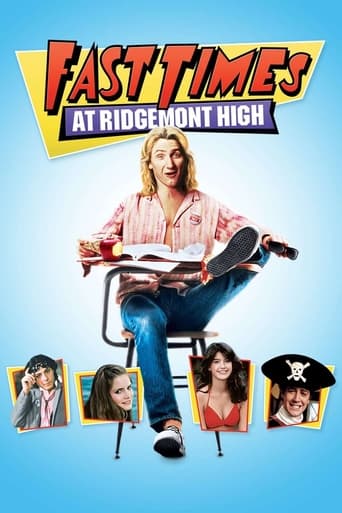
Fast Times at Ridgemont High
1982 · Film · 90 min
Directed by Amy Heckerling
A group of Southern-California high school students ignore their studies in favor of indulging in their teenage distractions.
2 positive1 negative8 neutralfrom 11 commenters
Where to watch
No streaming data for this title.
Videos commenters linked
From YouTube links in the comments below. Most are clips and trailers; “Full” means the uploader says so.



13 comments on Hacker News
The classic nostalgia version of this is the opening of "Fast Times at Ridgemont High" (1982). Ridgemont Mall in the movie is the Sherman Oaks Galleria, which has appeared in at least 12 movies, and is still operating as a mall.
[1] https://www.youtube.com/watch?v=weKrwubPbeI
Let’s be real, the overwhelming majority of those 500 are straight up terrible. Netflix alone has produced well over 100 movies, and IMO at best some of them are worth finishing not that I can think of any off the top of my head.
Now I’m sure you’ve looked forward to many movies but off the top of your head list stuff you’ve either seen more than once and or actually recommend to someone that came our in the last 10 years vs…
(78) The Deer Hunter, Superman, National Lampoon's Animal House, Invasion of the Body Snatchers (79) Apocalypse Now, Alien, Life of Brian, Mad Max, Escape from Alcatraz (80) The Shining, Star Wars: Episode V, Airplane!, The Blues Brothers, Caddyshack, The Elephant Man (81) Raiders of the Lost Ark, Das Boot, The Evil Dead, Mad Max 2, Escape from New York, Time Bandits (82) Blade Runner, The Thing, E.T. the Extra-Terrestrial, Poltergeist, Conan the Barbarian, Fast Times at Ridgemont High, Tron (83) Scarface, WarGames, Star Wars: Episode VI, Trading Places, The Evil Dead
Obviously not all great movies but that’s ~30 classic movies in just 6 years and I’m sure I’ve missed a few as kids movies are largely missing from that list.
The cultural bifurcation however is increasingly pronounced. Ironically, all the more so as communications technologies improve, because those improvements are concentrated increasingly in dense metropolitian areas. Not necessarily city centres, but the urban metro areas net of suburbs around wealthy regions --- many along the coasts, but also urban areas within otherwise rural states (e.g., the blue-red division within the South and West between cities in those regions and urban areas).
The height of homogenisation probably came about with general availability of rail-based package deliver, direct postal mail delivery, rural electrification and telephone service, major broadcast television and radio networks, and the US Interstate Highway System buildout.
At some point between the mid-1940s and mid-1970s, there wasn't a whole lot of difference between what general culture was available within a broader metro region and a rural area. Broadcast and print culture (e.g., magazines) were fairly uniform (there weren't enough networks to support hugely divergent micro-targeting), goods and communications could spread well. Yes, major cultural hubs such as New York, Los Angeles, and San Francisco had their own specific cultures, and there was information for which you'd probably have to physically visit a major university campus or library to access. But overall, cultural diversity was hitting a low point. Flyover regions might wait a few weeks or months longer for first-run films (distributed as actual film prints), or see less coverage by major performing acts, but that was largely it.
That's been walked back with increases in direct-cabled broadband communications infrastructure, probably starting with cable TV (the fact that cable TV wasn't yet available was a laugh line in Fast Times at Ridgemont High, 1982, with the book it was based on published in 1981).
Now, the distinction between broadband in the tens of Mbit (or lower) vs. 100 Mbit to Gigabit ethernet, 5G vs. 3- or 4-G mobile networks, and general reliability of network infrastructure, as well as installation and maintenance costs, is a major distinguishing feature between first-tier and tertiary markets. In a world where work is performed remotely, being able to participate in full-video conferencing or download or upload content matters.
Maybe those differences will get ironed out. But as with postal mail, intercity rail and bus service, interstate highways, telecoms, and electricity, it all but certainly won't be market mechanisms on their own which do so. All of the listed services I've just named were brought to rural regions through government programs, projects, organisations, and/or subsidies.
>How many reviews of movies have you seen from a senior, experienced reviewer got a film really totally wrong?
Tons. Even legendary critics like Ebert got movies wrong. He gave thumbs down to Full Metal Jacket, Blue Velvet, The Thing, Fast Times at Ridgemont High, The Usual Suspects, Ace Ventura, Tommy Boy, and many more.
a lot of us who were 80s kids who can practically recite Star Wars got that way cause we had a very small collection of movies
Yup. For me it was Risky Business, Fast Times at Ridgemont High, and probably a few others.
Freshman year of college my roommate had a VCR. We learned that if we hooked up the VCR's RF output not to the TV input, but to the antenna, we could broadcast movies to the couple of neighboring rooms in the dorm.
you think that's high? I usually binge at least 2-3 seasons of a new-to-me show a month on netflix, prime, hulu, if I'm really busy -- my wife makes up for the time I miss watching new-to-her shows, or the kids watch new-to-them shows or disney launches a new movie... I mean.. Wandavision, Falcon+Winter Soldier, Mandalorian, New Mighty Ducks are top notch and that's just disney...
Netflix has the Witcher which I still need to watch, just finished two different ones on figure skating Zero Chill (Hockey+Figure skating) and Spinning out. Both really good shows that weren't on my radar. Recently finished Queen's gambit too--also great and not on radar...
Lots of back-burner shows too (waiting for the next season).
7-11pm is usually dinner, tv with family put kids to bed, watch 1-2 shows with wife, then go to bed. Sometimes I watch old movies that are new to me just cause I heard they're good but haven't seen them yet. Grew up in 80's and just recently finished Fast Times at Ridgemont High for example.
120 hours of screen time's easy... weekends are probably a lot more.. maybe 8 hour sessions, definitely enough to watch 1 whole new-to-us series... esp. with lockdowns and covid.
I can't speak to cultural DNA. But I guess we could test it by looking at kids who at a young age moved to a different country and whether that cultural DNA sticks.
As I mentioned elsewhere, I think the media and entertainment have a hand in this and the establishment does not care --they want cheap labor. So on the one hand it's Fast Times at Ridgemont High, on the other we big tech and others want American kids to be dedicated to study like Chinese or Indian kids.
Movies and Media pretty much indoctrinate kids to be carefree and do what you want without consequences. (If media had no influence on people, people would not call for diversity in role models, etc)
And most kids aren't trying to be like the kids in Fast Times at Ridgemont High.
Maybe we already experienced peak "stoner-high" movies.
That said, I hope this and alcohol usage by teens exhibit a downtrend. Too many kids with decent potential never realized it due to detouring into stoner life and alcoholism --kids from middle income fams.
Another movie I'd love to see something like this for is Fast Times at Ridgemont High. There exists a TV-friendly cut that removes all nudity, and inserts a couple of extra scenes (like Spicoli in the boys' room bragging to his stoner buds about what he's going to do to Mr. Hand). I'd love an edit that starts with the R-rated release, and adds in the extra TV-friendly footage.
You are in for a treat. This excerpt from Fast Times at Ridgemont High (worth watching in its entirety) tells you what you need to know: https://www.youtube.com/watch?v=NLTTugZ4BIw
No, it is clear that it did not. The usage of 'man' referenced upthread was, probably somewhat earlier than that time, transitioning from 'generic term of address for a male person' to 'means of communicating emphasis when addressing someone (not necessarily male)'. It wasn't used as a labeling term for 'type of man'; rather 'man' was, of course, as it still is, the generic label for 'adult male person'. I still hear vocative and emphatic usages of 'man' though the vocative usage seems somewhat old-fashioned to me.
My assumption has been that the vocative usage of 'man' was originally associated particularly with urban African-American speech and got picked up by youth culture during the 1950s and 1960s, much as was happening with other urban African-American slang and dialect usages.
The trajectory of 'dude' in the 1980s (possibly given a significant push by the film Fast Times at Ridgemont High) was somewhat similar to that of 'vocative->emphasis man', though 'dude' of course had been a term that had earlier on been used as a label for certain categories of men (e.g. the 'surfer dude' and the much earlier usages that go back to the 19th century).
The peculiar nouns "-osity" thing was not originally a hacker thing. Discounting other unnecessary word endings being introduced to the public at large by the Fonz in Happy Days when he continually added the "-omundo" to the end of things, the "-osity" type of adjective -> noun mutilation may have been picked up from surfer/Cali talk, introduced into the mainstream by movies such as Fast Times at Ridgemont High (Spicoli) and later by Bill and Ted's Excellent Adventure and Pauli Shore (on MTV and then in really bad movies).
By the same token terms like "barf" and "bogus" were just popular terms in the very early 80s because of all of the California influence.
Of all of these, the ones that look most familiar for the time that really have little to do with popular culture of the time were: BITBLT (just because I remember seeing it and thought "what the hell"), crash (mid to later 80s when used the first Macs), and down (which wasn't really used much until the 90s, because when you couldn't connect to a BBS or Compuserve, etc. - which almost was never the case to my memory - you just couldn't connect, and prior to modems there was no connection- just cassette tapes and eventually floppies - and no I did not have a card machine :) and I didn't see a minicomputer with a huge-ass 8 inch floppy until my first network admin job in the 90s).
Basically, the majority of this is "bogus". ;)
Funny, I think my first program did exactly the same on the same hardware, back in, oh, 1969 at Claremont High in San Diego (the campus used for the movie Fast Times at Ridgemont High). Had entirely forgotten that episode...