 Hacker Cinema
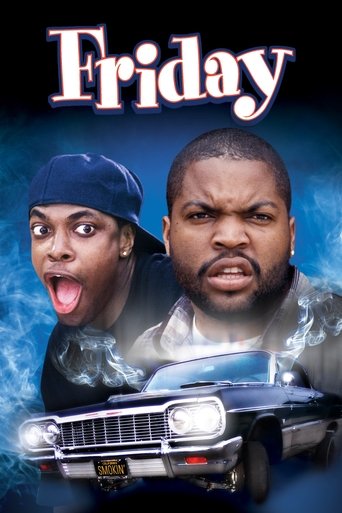
Friday
1995 · Film · 91 min
Directed by F. Gary Gray
Craig and Smokey are two guys in Los Angeles hanging out on their porch on a Friday afternoon, smoking and drinking, looking for something to do.
2 positive1 negative7 neutralfrom 10 commenters
Where to watch
No streaming data for this title.


10 comments on Hacker News
That’s not true in colloquial American English. Movies like “Friday” or “Madea Goes to Jail” are just referred to as “Comedy”.
It's quite recent that that would have been possible.
And GOT is pretty tame, sexually, compared to what Heinlein stories got up to.
Incest is a little spicy, but those are the villans so it's a bit more accepted, and the rest of GOT is mostly just a flash of tit or dick now and then, right? More titilating than conceptually boundary pushing.
Heinlein had, off the top of my head: a main character forgiving and falling in love with her rapist, mother/son incest including protagonist, big ol' family incest (more complicated and varied than I can remember the details of) including "the good guys", a transexual protagonist (including many, many sexual descriptions), many varieties of open relationships, more forms of group marriage than I've ever heard anywhere else, and a sex cult (started by the protagonist).
Most of those you could probably leave out of whatever story without too much trouble, but they're not exactly small parts of their respective stories either.
Still, I'd think someone could make a really good movie/show out of at least: Friday, Double Star, The Moon is a Harsh Mistress, probably a few others.
>>>do you mind if there were simply no big budget movies or TV shows to ever be centered around black American characters, or portray black American culture in any way?
I think those are strange questions, because they aren't the situation we have in America. We have plenty of entertainment content focused on the black experience. Friday franchise, Shaft franchise, Undercover Brother, Black Dynamite, all those terrible Tyler Perry movies, even some of the classic blaxploitation films such as Coffy (Pam Grier in her prime, 1973) are solid entertainment. So I wouldn't prefer that this stuff not exist.
>>>Do you feel it's okay to have a large ethnic population and continue to exclusively produce content with only white people and historically white culture in them?
Why deprive all the non-white people of their agency? If a non-white culture wants content that better communicates their lived experience, they should produce it themselves. Japan does it. India does it. Those cultures rightly recognize that they don't need some goofy Americans with gender studies degrees to write their stories for them. Stop outsourcing your culture to people who hate you ( https://www.youtube.com/watch?v=rt9MKUsKqHk ).
The amazing thing we are seeing lately is the decentralization of content production; people are realizing that they don't have to rely on the weirdos in Hollywood to produce culture for them.
This means the content created by independents needs to stand on its own merits though, it can't coast to success on established star power or well-refined CGI content mills: it needs genuinely good storytelling, compelling characters, innovative but affordable visuals, etc.... And this is where a TON of the current-generation BIPOC/LGBT/whatever content falls flat on its face: it fucking sucks. You have mediocre creators trying to separate the buying public from their money by brow-beating people with "if you don't buy my product you're a racist!". The backlash to such tactics was predictable and IMO well-deserved.
We might be better off looking at African storytellers to write uniquely-"black" scifi: http://theblerdgurl.com/comics/the-rise-of-african-comics/
https://en.wikipedia.org/wiki/Afrofuturism
It's easy to fudge numbers if we all disagree on terms.
Sure you are right if you included the thousands of Asian hookers being coerced by some int'l trafficking org. Sure if you include the small number of Somali gangs doing kidnaps and sales.. some of the more hardcore gangs in the inner cities that actually use all sorts of methods for the overall syndicate -
sure - those people may be technically 'pimping' (at least some) - but I do not think that those types of people come to mind when someone is casually discussing 'pimps' - I believe people are more likely to conjure up someone in their mind more like snoop dogg or 'I'm gonna get you sucka' type of character. Or like 'money mike' the pimp in the next Friday movie by Kat Willaims.
I have come to learn that a majority of those types of people don't want underage or beat-down girls and they generally frown upon, and try to reduce drug use as well.
Like I said in original comment there are those out there that are using force or other coercion (we have your passport, and have your family in regime place X - do this or else jail and loss of family) - and they should be stopped.
It gets more fuzzy when you run into people who are voluntarily sex working for things like debts to flee a place - however it's easy to lump in those numbers.
My point was not to try to throw hard numbers at X amount of sex workers are not being forced, that too depends on how certain terms are defined of course as well.
My point was that many orgs included news orgs are happy to paint all sorts of things as 'trafficking' that are nothing more than people looking for sex or people who are looking for ways to trade it - without violence, and it's not accurate to think 'pimps' or 'pimping' is:
"the distinction of a pimp is due to using violence, drugs, or other coercion on vulnerable subjects such as runaways, underage, or trafficked/kidnapped persons."
as is the comment I was replying to, and trying to shed additional light on.
I've had an eye on that part of the industry for some years now (since '95).
My first full time club gig including finding and ejecting hoes and pimps (some are quite sneaky / hard to define) - you could say we hated pimps and despised hoes (it was believed they hurt our business and took clients from our business permanently)- for the first several years of that part of my past club/djing career.
It wasn't until hbo's pimps up series came out that I started looking deeper into all that and learned that many / most are there to help each other not trying to hurt each other - it's pretty complicated.
People have different definitions in their mind on many of the terms used in describing these things, so defining the terms instead of stereo typing is better - which was my point in the first place.
edited to add Kat W / Money Mike reference.
When was it not an option to pay for the content people are trying to sell you?
The problem was UX friction. You had to go to a video store, rent a movie, get ready to be raped with fees, or go to a library and hope they have it, or go to a second hand store and browse the selection. You had to have a special piece of hardware or ten, and if a movie you wanted to watch was on a format you didn't have, too bad. That's why people used to watch the same movies every so often. Watch a movie? Doesn't matter if we had seen it already. Let's watch it again anyway. This is how movies like The Big Lebowsky and Friday got their followings, people watching them repeatedly. Like music. This touches on the social impacts of the paid subscription model that is off topic so I won't delve into that.
And then Netflix changed everything. And then everyone else got in on the game, and now you've got worse UX friction than before. You've got to determine which service has the movie you want to watch. You've got to pay for that service, now it looks like per person, for just that movie. And if you want to watch 4 or 5 movies? You might have to have as many as 4 or 5 monthly subscriptions. Or you can rent it for 1.99. But buy it? No, you cannot buy it. I mean, you can, but who has a DVD player and space for a bunch of DVDs?
But tpb has all the movies. And you can own them. And they're all in one place. And as a bonus, they're free if you don't include your VPN service.
Side note, how is tpb different from a library exactly? Besides scale and efficiency, in principle, what's the difference between tpb and a library?
Ray, Ali, Color Purple, Glory, Django, Cotton Club, Boyz in the Hood, Friday, Malcolm X, Bad Boys, Barbershop, and of course, New Jack City.
Each of these movies did great and reached a wide demographic. As did Black Panther. The only difference is that Black Panther's marketing propogated this ridiculous myth that it was the first black superhero movie. (Sorry, Wesley Snipes, Will Smith, and Halle Berre... you're down the memory hole.) Or, even more absurd, that it is the first all-black cast that has done well at the box office.
Just shows how powerful marketing is.
More power to them... I've lived through several iterations of "'brand-new' microfiber technology that make cleaning up spills a snap!" I suppose I can live through endless repetitions of "the very first movie with a real-live black person in it!" Whatever....
When they killed Mark Zuckerberg was also interesting. Reality is GTA is a parody of American Culture. The developers aren't even American, at least not originally. They were all from Europe, that's why Vice City is basically a Scarface spoof. Then you got San Andreas which looked and felt like I was watching Boyz N Da Hood / Friday, and other movies.
I read just about every Heinlein story I could get my hands on as a teenager. The funny thing is that the one's I thought were sort of stupid - e.g. Have Space Suit Will Travel and The Moon is a Harsh Mistress - because they were only about the solar system, I've found to be among my favorites as an adult.
Then again, I couldn't get through Friday back then, but found the description of the role that big data would play in the future prescient a few years ago. Likewise, understanding Stranger in a Strange Land in the context of Heinlien's relationship with Hubbard was beyond me in high-school [Hubbard's BattleField Earth is worth a read or at least a try, even if the movie isn't. He was a talented writer among other things].
This is so not true when comes to the biggest AAA video-games, and fan-boys never happy with them :) - like boycotting them months before the game is released, even making their avatar with a picture of the Boycott, and then later seeing them buying it with the avatar unchanged...
Or maybe even movies - well it might work - for Friday bad movie night :)
This article is, sadly, typical of the anti-RIAA brigade. The modus operandi is essentially to portray small, irrelevant details ("tut, tut, no adjustment for inflation!") or imprecise or non-legalistic terminology ("It's not theft, it's copyright infringement!") as evidence variously of a sinister RIAA conspiracy, or, as is the case here, simply of their utter stupidity. Next, hands are waved, big claims are made, and untested and economically implausible business models are bandied about with the abandon of someone who doesn't have a dime invested in the enterprise (well, except for the 50 dollars or so they save themselves annually by torrenting the music they want). This is usually accompanied by a healthy dollop of macho posturing: "don't make me steal this!".
Now, I know that no good can possibly come of trying to refute these "arguments", but... to paraphrase the hero in the film "Friday": it's Saturday, and I ain't got sh$t to do! So:
1) "The numbers are not adjusted for inflation."
Adjusting for inflation actually makes the collapse in turnover more pronounced, not less. Ditto adjusting for population or median income. Doh! The fact that he doesn't see this in his own exquisitely crafted inflation-adjusted graph is evidence, were it needed, that there is none so blind as he who will not see.
2) "These are stats from the RIAA. America only."
I should start by saying that this "argument" is slightly less asinine than the previous. It's important, though, to be clear about how this fact presents a problem. If we're arguing that this graph is evidence of the death of the music industry, then we probably should be looking at global sales (on the other hand, the US is the largest and most important music market and thus is significant in its own right). If we're, however, arguing (as most sensible, informed observers are) that filesharing/etc has a deleterious effect on music sales, then it is sufficient for the graph to display like-for-like data (which it does). After all, the effects of piracy are going to be similar irrespective of geographical location. If anything, one would expect more piracy in e.g. emerging markets.
3) "The type of graph specifically masks and trivializes the growth of digital, enhancing the sob story."
Right, so the author whinges in point 1 about data not being adjusted for inflation. "We need correct absolute figures!" screamed the author. But now that we're at point 3, the problem is now that the data is showing absolute rather than rate of growth figures. "We need percentage growth figures!", screams the author. This is just silly. He admits as much by conceding "Ok, ok, that’s kind of cheating because pre-2004 there were virtually no digital sales, but hey, the point is digital has been growing quickly". Sorry, but no, the point is not that digital has been "growing quickly", the point is that the music industry, as a result of the pirates' activities, have been hemorrhaging cash. If digital is growing so quickly and everything is fine and dandy save for a few greedy lawyers/execs/etc at the RIAA/choose your bogeyman, then why is EMI so dead?
Here's another turkey:
"Here’s the actual situation, properly adjusted for inflation, and using a normal line chart instead of a complicated stacked area chart."
So whereas a few sentences ago the author was whinging about the data not being aggregated globally, he now wants the data _disaggregated_ on distribution format. If the question is "does piracy negatively impact music?" or "is the music industry in trouble as a result of piracy?" then cumulative values are exactly what we need to look at, which means we have to look at those pesky, "complicated" stacked area charts.
The only upshot to this fellows little "analysis" was that as a result of it, the RIAA is $25 richer. Well done!