 Hacker Cinema
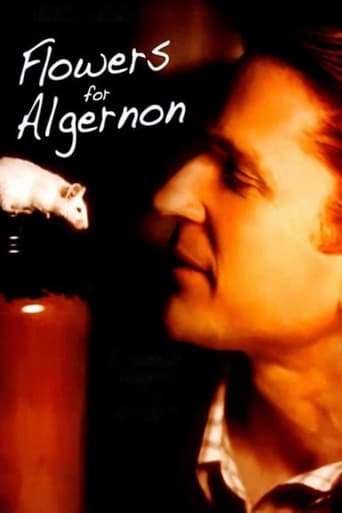
Flowers for Algernon
2000 · Film · 91 min
Directed by Jeff Bleckner
Charlie Gordon is mentally handicapped and all he wants in life is to be a genius. When he gets picked for experimental surgery it looks like his dream may finally come true. But the surgery has side effects that could could kill Charlie. Can Charlie survive being just plain old "Charlie Gordon" and will his newfound romance survive this test of character?
1 mixed3 neutralfrom 4 commenters
Where to watch
No streaming data for this title.


4 comments on Hacker News
Two very different movies were made about this book: "Charly" starring Cliff Robertson and "Flowers for Algernon" starring Matthew Modine. The movies were made years apart and have very different vibes for the way that Charlie Gordon was portrayed reflecting different philosophies of acting at the times they were made. Cliff Robertson won an Oscar for his portrayal of Charlie Gordon.
Limitless the book was much better than Limitless the movie. And, yes, it doesn't have a Hollywood-style happy ending at all.
I just finished reading "Flowers for Algernon" the short story and I never read the novel. It also immediately reminded me of "Limitless". (The book, I wouldn't compare it to the movie, again, at least because of that silly "happy end", which seems to be obligatory in the Hollywood.) If you want somebody's (i.e. mine) take on it: well, "Limitless" was much, much better of a read. I was a lot younger when I read it, so I don't how I would react now, but I remember it to be pleasantly realistic, unlike the vast majority of [English] sci-fi. Unlike in the movie, though, there was a lot less "magic" to MDT. There was no silly stuff like being suddenly able to multiply 10-digit numbers in the head and similar Hollywood representations of "being incredibly intelligent" which are just annoyingly stupid, if you ask me. In the book it felt very real, it was very easy to "feel" what is that effect. It's basically just an exceptionally potent nootropic drug, think "amphetamine, but better". And, yes, that was motivational. This is the main reason I remembered it, actually: there I very much felt how the protagonist was "improved". In the "Flowers for Argernon", on the other hand, it just feels like author is trying to explore some idea he isn't mentally equipped to explore. I.e., he has no idea what he is trying to describe. It's childish and unrealistic.
All I can say about "Flowers for Algernon" the short story — I was thinking that the novel must be much better for this to be considered worthwhile. But then there is an addendum at the end of this:
> The novel, published as a mainstream work by Harcourt Brace Jovanovich, is not as effective as the story version, which is much tighter and written from a very successfully executed first-person point of view.
Soo… yeah. I'm not gonna try it right now. But then, again, I must admit that anybody who mostly likes sci-fi shouldn't even listen to me, because I can say only bad things about vast majority of famous sci-fi books, with only just a couple exceptions. Mostly it's literally just pulp fiction, comic books without pictures. Not what I expect when somebody talks about "literature".
"Best part to predict the future is to live it." There's great deal of science fiction about enhancement, but usually it discusses nanotechnology or compute-based augmentation; there's less out there that would cover the impact of actually understanding how the brain works ("the brain genome project") and developing more "natural" solutions.
Re: movies. Charles Stross ('cstross' on here) mentioned how television has effectively replaced the short story as commercial medium -- so youtube shorts could effectively have the same impact short stories (e.g., Flowers for Algernon -- the original story about enhancement) once had.
tl;dr Please write a modernized "Flowers for Algernon", perhaps as a film short.
I can't see much of a downside for this potential drug
Amazing that the author of a sci-fi blog would say this; such a drug could feed the premises of a dozen short stories or Twilight Zone episodes -- and many would have dark endings. (Perhaps this was really her intent, to trigger fun scare stories in comment threads.) Examples:
You could remember a good experience so well you spend your whole life trying in vain to reproduce it.
You could remember a bad experience so well it paralyzes you.
Your initial advantage could go through phases of benefit and detriment, ultimately be so isolating you're completely alone, and then be reversed (a little like 'Flowers for Algernon').
There could be an ironic turn (blinded just after gaining perfect visual memory; 'Time Enough at Last').
You could, imperceptibly at first, lose other valuable skills in proportion to the memory gain. Social abilities; judgement; empathy. The irony would be you can't even remember the dimensions of life you've lost -- they're no longer perceptible compared to the eidetic perfection.
Etc, etc...