 Hacker Cinema
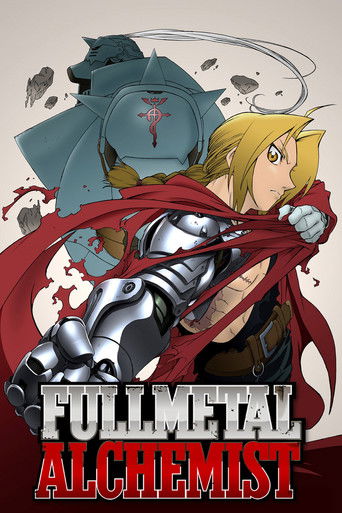
Fullmetal Alchemist
鋼の錬金術師
2003 · TV series · 24 min episodes · 1 season
AnimationActionAdventureScience FictionFantasy
Two young brothers are raised as alchemists, but when they are severely injured trying to perform a forbidden act, they begin searching for the one thing that can save them; the fabled philosopher's stone.
2 positive1 negative3 neutralfrom 6 commenters
Where to watch
No streaming data for this title.
6 comments on Hacker News
Excellent, you reached the point that Edward Elric, from the first Fullmetal Alchemist anime, arrived at in the final episode(s): The illusion of balance, when everything in that world revolved around the Law of Equivalent Exchange.
Sometimes the rewards do not match the sacrifice/effort, but that doesn't mean you won't pick that same choice when given the chance, or that it was a "bad choice". If you accept what may come from your choices, you can more objectively act upon them.
Fullmetal Alchemist and its movie are both excellent, though, even though they it's vastly different from the source (and of course, the more faithful adaption in Fullmetal Alchemist: Brotherhood).
I think the Lord of the Rings trilogy is also quite good, even though it does stray quite a bit from the books, omissions aside.
It's really hard to make good media and I haven't found any reliable indicators hinting at whether an adaptation will be good or not. I found The Hobbit trilogy to be laborious despite having Peter Jackson at the helm of it as well. Though in that case, maybe the source material itself is the issue.
Anime has had no shortage of adaptations disrespectful of the original. Most of the time it's due to not having enough source material like HBO GoT, which somehow sent Fullmetal Alchemist to 1920s Germany in the first adaptation's movie. But sometimes you get people like Bokurano's director who straight up said he hated the manga.
Content! Find video (movies, series), audio (-books, radio, podcasts).
The best way is to get exposed to the language as much as possible (some people prefer humans for this, some people prefer multimedia), and then you can use Anki on the side.
For example, I'm recently watching Fullmetal Alchemist in Japanese. I don't speak Japanese, but I've picked up 50 or so phrases. Sometimes I get a phrase stuck in my head without knowing what it means, or I'll wonder how to say something (that I know I've heard but forgot), and later that day my brain will dig up the answer from the depths (essentially a much longer version of the 'active recall' that Anki uses).
I'm a big fan of the Input Hypothesis (Stephen Krashen) which says the best way to learn a language is "input before output", in other words, immerse yourself in the language for a long period (say, 6-12 months) before trying to produce output (writing or speaking).
In this way, by the time you speak or write, you will know what it sounds like, how the grammar works, and will be able to self-correct, rather than forming bad habits.
We all know people who've lived in a country for decades and their grammar & pronunciation is awful despite constant use. The argument here is that they were forced to produce output (speak) before they were ready (got enough input to develop a workable model of the language), and were not corrected, typically out of politeness.
The key point is that the brain does this modeling on its own, given the input. Explicit learning (eg. Anki) is unnecessary, but it does "cement" knowledge and accelerates things.
If you'd like to read more on this, AJATT (All Japanese All the Time) is a great blog (a bit rambly though) on this method and also goes into spaced repetition quite a bit.
"You don't learn a language, you get used to it."
http://www.alljapaneseallthetime.com/blog/
On the other end of the spectrum you have the exact opposite approach, traveling and going out to pubs and speaking the language from day 1: Benny Lewis, Fluent in 3 Months
https://www.fluentin3months.com/
It's basically introvert versus extrovert.
They disagree on whether output comes first or last, but they agree that you want to get as much input as possible.
Happy hacking :)
Depends on what sort of literature or history floats your boat. I don't recall if I'd had exposure to the term in formal schooling, but certainly ran across it in such as Neal Stephenson's Baroque Cycle (https://en.wikipedia.org/wiki/The_Baroque_Cycle), Fullmetal Alchemist (http://www.imdb.com/title/tt0421357/), and a variety of historical fiction (most of which it's been well over 15y since I've read, and as such I've long forgotten what it was).
Funny thing about anime: fan subs/dubs are why most anime publishers line up a translation during production now. They realized they were missing a big market. It's why the original Fullmetal Alchemist ('03-'04) was a fansub for a long time before an official NA release, while the recent remake came out in English[1] on Hulu days after airing in Japan.
A whole new import market sprung up because of what was technically piracy.
[1]With subtitles, but dubbed episodes started popping up on the Hulu page near the end of the show's run.