 Hacker Cinema
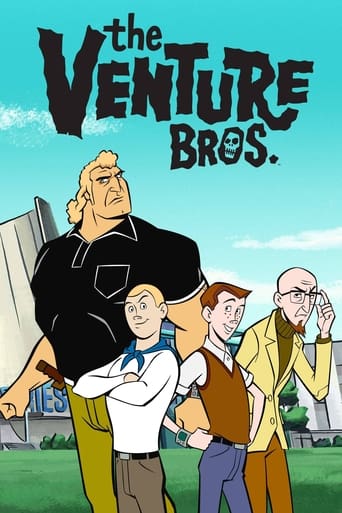
The Venture Bros.
2004 · TV series · 22 min episodes · 7 seasons
Created by Doc Hammer, Christopher McCulloch
AnimationComedyActionAdventureScience FictionFantasy
Hank and Dean Venture, with their father Doctor Venture and faithful bodyguard Brock Samson, go on wild adventures facing megalomaniacs, zombies, and suspicious ninjas, all for the glory of adventure. Or something like that.
2 positive1 negative1 neutralfrom 4 commenters
Where to watch
No streaming data for this title.



5 comments on Hacker News
Bruh, we're getting a Venture Bros. movie _AND_ a Metalocalypse movie, too! It's a good year for movies.
Used to do this until I stopped needing to. A consistent bed time plus Rick and Morty/Venture Bros./Archer, just going from season 1 episode 1 on down the list, and then restarting once I got to the last episode at some point.
Worked very well, but I think if I tried it now, I would have a more difficult time sleeping with television playing in the background now that I no longer sleep this way.
I'm not sure it's an unsolvable problem, given enough data. Sure, a lot of people would recommend me Venture Bros (including my wife) since I enjoy both Archer and Bob's Burgers. But I have tried multiple times to get into it without success. Maybe it's just that those two data points aren't enough to pin down what it is I like about those shows that Venture Bros don't give me (at least in the first few episodes).
But you are right, I've scrobbled 100s of thousands of songs to last.fm, and those recommendations hit at best 50% of the time. I'm hoping machine learning could help here, as I'd always like a good recommendation, seeing as I seem to be picky.
This is one subject I find eternally fascinating.
There is an American cartoon show called The Venture Bros, of which the main theme is actually American science and Cargo Cults.
Here's a quote on the subject I made formerly, it is more about technology than science but there are parallel themes.
The cartoon series The Venture Bros symbolizes the Stagnation Hypothesis. If you don't want to watch the entire series to understand the point, just take a look at the episode: Season 3 Episode 2: The Doctor Is Sin (the intro even features Dr T. Venture offering jobs to migrant laborers for which they are absurdly under qualified and very low wages. This, in light of the frequent complaints of worker scarcity in the midst of stagnant wages is quite poignant).
In the series the grandfather (deceased) was able to do all kinds of amazing innovations, space stations, underwater laboratories, biospheres, rolling walkways, new fabrics, all kinds of new machines. The next generation symbolized by Dr T. Venture was unable to compete with all this amazing success and began to act as a hanger-on, a me-too, acting as if he knew what was going on but in actuality understanding nearly none of it and therefore became reliant on sexing up what is really ancient technology to make himself look good to investors and his own self image. His sons, the next iteration of Ventures are permanent children, living in a technology wonderland they effectively treat as magical surroundings. Not only do they not understand the technology of their grandfather, but they don't understand there is anything to understand, despite the fact that as clones they are actually technological artifacts themselves.
Unfortunately this supposed comedy show is a reasonable interpretation of the last few generations.
If you exclude computation (electronics/robots/AI/internet) then there just aren't very many parts of the economy that are genuinely growing. This has been going on since the early 70s.
This has been obfuscated by the accounting of the economy.
The government and central banks have an incentive to produce numbers that sound rosy because they noticed long ago that if the people in the economy felt like things were going well, that they were more likely to spend, invest and work. There is a self fulfilling prophesy nature to it all.
The source of wealth or 'more stuff' is the ability to produce more stuff for less cost. Lower the inputs, up the outputs. Technology is a key element in making that happen.
The problem is that (ex-computation) new innovations are far less likely to affect the average person. Name a single invention outside computers of the last several decades. I do not mean a hypothetical abstraction in a laboratory somewhere.
When people find themselves coming up with close to nothing they resort to saying: well, maybe new innovation is bound up inside classical things we have but cannot see inside of (we are at the Dr T. Venture stage here).
It is certainly true that minor improvements accumulate into a quality of their own over time. That is Toyota's business model. The insides of the cars experience consistent iterative improvement. There are similar analogs in other industries.
But. And this is the key point. That utterly fails to explain why new innovations aren't reaching the common person. If we really were experiencing a boom in innovation and invention we would expect to see thousands of new fields and sub-fields opening up. What new materials technology do you have inside your home that did not exist in 1970? What forms of transport? There are literally dozens of major areas that have not seen any major innovation and they have stopped being labeled 'technology' as a result.
The Stagnation Hypothesis basically explains all of this.
I would like to remind you that earnings, prices in general are phenomenon which relate back to the real world in some way. That is to say they must be side affects of something else.
The cartoon series The Venture Bros symbolizes the Stagnation Hypothesis. If you don't want to watch the entire series to understand the point, just take a look at the episode: Season 3 Episode 2: The Doctor Is Sin (the intro even features Dr T. Venture offering jobs to migrant laborers for which they are absurdly under qualified and very low wages. This, in light of the frequent complaints of worker scarcity in the midst of stagnant wages is quite poignant).
In the series the grandfather (deceased) was able to do all kinds of amazing innovations, space stations, underwater laboratories, biospheres, rolling walkways, new fabrics, all kinds of new machines. The next generation symbolized by Dr T. Venture was unable to compete with all this amazing success and began to act as a hanger-on, a me-too, acting as if he knew what was going on but in actuality understanding nearly none of it and therefore became reliant on sexing up what is really ancient technology to make himself look good to investors and his own self image. His sons, the next iteration of Ventures are permanent children, living in a technology wonderland they effectively treat as magical surroundings. Not only do they not understand the technology of their grandfather, but they don't understand there is anything to understand, despite the fact that as clones they are actually technological artifacts themselves.
Unfortunately this supposed comedy show is a reasonable interpretation of the last few generations.
If you exclude computation (electronics/robots/AI/internet) then there just aren't very many parts of the economy that are genuinely growing. This has been going on since the early 70s.
This has been obfuscated by the accounting of the economy.
The government and central banks have an incentive to produce numbers that sound rosy because they noticed long ago that if the people in the economy felt like things were going well, that they were more likely to spend, invest and work. There is a self fulfilling prophesy nature to it all.
The source of wealth or 'more stuff' is the ability to produce more stuff for less cost. Lower the inputs, up the outputs. Technology is a key element in making that happen.
The problem is that (ex-computation) new innovations are far less likely to affect the average person. Name a single invention outside computers of the last several decades. I do not mean a hypothetical abstraction in a laboratory somewhere.
When people find themselves coming up with close to nothing they resort to saying: well, maybe new innovation is bound up inside classical things we have but cannot see inside of (we are at the Dr T. Venture stage here).
It is certainly true that minor improvements accumulate into a quality of their own over time. That is Toyota's business model. The insides of the cars experience consistent iterative improvement. There are similar analogs in other industries.
But. And this is the key point. That utterly fails to explain why new innovations aren't reaching the common person. If we really were experiencing a boom in innovation and invention we would expect to see thousands of new fields and sub-fields opening up. What new materials technology do you have inside your home that did not exist in 1970? What forms of transport? There are literally dozens of major areas that have not seen any major innovation and they have stopped being labeled 'technology' as a result.
With any technology there exists diminishing returns. Even in computation as Moore's Law attests to.
The real mark of true innovation and invention is the new thing associated with the typical household. For example; suppose the manufacture of aerogel could be brought down by 2 orders of magnitude.
This would be a leap that would revolutionize everything insulation related. Household energy bills could probably be 1/10 of what they are today. And due to the thinness of the fabric and the money it would save, it would get rolled out very quickly indeed.