 Hacker Cinema
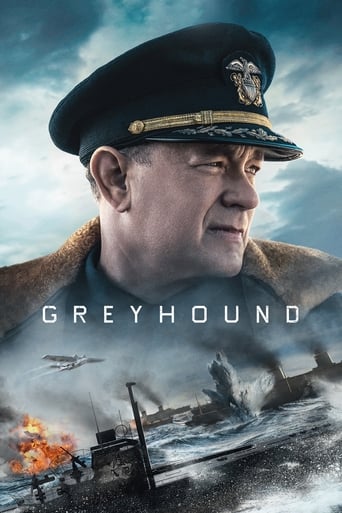
Greyhound
2020 · Film · 92 min
Directed by Aaron Schneider
A first-time captain leads a convoy of allied ships carrying thousands of soldiers across the treacherous waters of the "Black Pit" to the front lines of WWII. With no air cover protection for 5 days, the captain and his convoy must battle the surrounding enemy Nazi U-boats in order to give the allies a chance to win the war.
5 positive1 negative1 mixed7 neutralfrom 14 commenters
Where to watch
No streaming data for this title.

14 comments on Hacker News
This is such a fascinating piece of history.
I've always been very interested in the developments that occurred in WW2. I think The "Battle of the Beams" is one development that gave us the basis for what we use so much now in general aviation.
The BBC series "The Secret War" is a fantastic series that pulls apart how these discoveries were made. It has a lovely 1970s vibe to it and is very well narrated.
https://www.youtube.com/watch?v=fkCW4g8It_A&list=PLV7OedKrXDcCWzlrNR9hf8pm-NS1lOw49
Interesting to realise that the cavity magnetron, providing higher resolution radar, was invented by the British and gifted to the United States. I believe the Germans researched it, but decided it was impossible. Please correct me if I'm wrong on this though.
If you watch "Greyhound", the tools that sunk the U-boats were British inventions, hedgehog and ASDIC. HuffDuff (High Frequency Direction Finding) is mentioned I think in the movie? It was made by a Polish engineer working for the British. Amazing that the Kriegsmarine didn't work out that their mandatory reporting schedule was sinking their U boats. With such a collection of defenses combined with doctrine changes for attacking U boat swarms, no wonder the U-Boat losses became so huge.
WW2 changed the world and brought us forward so much in terms of technology. Fascinating stuff.
It's a great place to explore the physics of it all, since the tools used were sometimes elementary (X-Ray machines to baffle direction beams).
Reginald Jones changed the world. Thanks hi_hi for the links.
This includes movies, but browsing their "originals" list, so far I (or my wife) have enjoyed (in no particular order):
Slow Horses Lessons in Chemistry Severance Ted Lasso Shrinking Mythic Quest Roar CODA The Problem with John Stewart And we are looking forward to checking out, in no particular order:
Palm Royale For All Mankind Criminal Record Killers of the Flower Moon Foundation Strange Planet The Morning Show Greyhound They're not all knockout hits. Overall we just feel safer trying something new there. If we don't like it, it's usually just because it's not for us, and less because it feels like an algorithmic, soulless cash grab.
> Of the U.S. services, the U.S. Merchant Marine had the highest casualty rate in WWII of 4%
There was a Tom Hanks movie on Apple TV a couple years ago called "Greyhound", about a destroyer captain leading a convoy across the Atlantic in WWII.
Just the very beginning, the banter about what they were about to encounter was pretty chilling.
Hunt for Red October
The Outpost
Master and Commander
The Martian
All four Matrix movies
The Godfather Trilogy, best in a single sitting (Connie’s arc is awesome, the cinematography of the third epic; the only problem is how much more of the outside world each of the sequels needs).
Greyhound
A Bridge Too Far (which has changed dramatically as I have learned over the last almost fifty years; I now see it as so subtlety tongue in cheek and cynical).
Draft Day. Possibly the best constructed movie.
> I get a kick out of it when it's done this way in TV shows and movies.
Greyhound is a nice example. And it was a very noisy environment
A rare early cube farm science fiction story by the author of the Horatio Hornblower series, The African Queen (1935), The Good Shepherd / Greyhound, and The Ship (1943) https://en.m.wikipedia.org/wiki/Horatio_Hornblower -- https://en.m.wikipedia.org/wiki/Greyhound_(film) -- https://en.m.wikipedia.org/wiki/The_Ship_(novel)
Netflix is screwed.
It used to be that if you wanted to watch a movie, you could find it on Netflix, put it in your DVD queue and in a few days receive the DVD in the mail. Their inventory was really good, (with some exceptions) and the service had pretty fast turnaround. Phase 1.
Then broadband started becoming more available, so streaming became a natural extension. Here's where Netflix faced bigger challenges. Initially, IP owners were happy to sell streaming rights for pennies since they didn't have any idea of the real value. Netflix leveraged this to build up an even bigger catalog that wasn't constrained by the number of DVDs in their inventory.
Netflix started to dabble in producing (and buying) content for their streaming. Good stuff like Stranger Things. The Crown. Dark. Babylon Berlin. And IP owners started raising the prices for renewals for movies and series in their catalogs. Netflix decided to cheap out on the quality of their shows. And they started to cut down on their DVD catalog as well.
Now you have all of the IP owners with their own streaming services, so Netflix will find it really hard to stream anything but the crappiest stuff. And they've shown little ability to consistently produce quality series or movies.
Contrast this with ATV+. Apple knew that it had a huge potential customer base, but that licensing IP wasn't going to be sustainable; whatever they streamed had to be exclusive. So they started slow, trying to replace HBO for high quality content. And they had some meh shows like "See." Not bad, but not HBO. Then "The Morning Show," followed by "Ted Lasso." Now they're starting to get some traction. Having an infinite amount of money always helps, but they became pretty good at saying no. "For All Mankind" grabbed a chunk of sci-fi viewers. Greyhound captured the war nerds. Slowly, carefully, they've been building up a pretty solid catalog. Now you have shows like "Servant," "Slow Horses," "The Mosquito Coast," "Foundation."
Cap it off with a series and a movie that have set ATV+ on par with any streaming service: Severance and Coda.
Now ATV+ will never have the catalog that Disney+ has. They might be fine with that. But where does this leave Netflix? Netflix has no serious movies that could compete for an Oscar. They don't seem to have the ability to create must see TV anymore. Perhaps they're too driven by algorithms to give the viewer what Netflix "thinks" they want? I just can't see a path forward for Netflix as other than crappy shows. Even with their foreign content, they face increased price pressure and competition from the other SVODs.
" more strategic your role -should- be. "
"The problem is too many upper managers think their role should be tactical. "
So this is a little bit mythologizing and there's a couple problems with this perception:
1) Everything is operational, and operations require material leadership at every level, there is no escaping it. Meaning, that there's a very material 'hands-on' component to even in higher level leadership.
The constancy of major decisions can have greater consequences and there are many more moving pieces, so it's hard.
Putting out fires and dealing with these grinding can easily overwhelm leaders but that's the reality of it, always.
Execs should usually have a much broader perspective that can help and guide decisions making.
Obviously, too much micro detail can be a problem, but that should be addressed by leadership that is willing to just listen and react accordingly.
I've been overridden by 'bad executive fiat' o occasion ... but also made forays where I shouldn't have because I didn't have the bigger picture.
2) Strategy is the most overused concept in all of business. While it's an important function it's usually a collective pursuit, involves input from various places - and most importantly, depends on details, i.e. downward facing.
Was Steve Jobs a relaxed, high level person setting strategy? Letting the details be worked out?
Musk?
Ford?
Bezos?
Not really.
There's a thoughtless comment floating here that points to 'Executives Asking Bad Questions To Seem Important' which is mostly wrong. They're asking questions to become informed. Some details matter, some don't but informing execs with a material understanding of the situation is a fundamental aspect of organizational communication.
The Tom Hanks film Greyhound is a neat study in that (He's the captain of a US ship leading a convoy in the Atlantic in WW2 getting hunted by German UBoats) - it's fully real time, you see a commander in the hot seat, and tons of activity around him. It's kind of interesting to see how information is propagated up and down and at what details. Obviously they're not building products.
Strategy, in the end, if it's done well should seem fairly obvious, even boring.
We have such lofty expectations of the term, that we expect 'enlightened divination' out of it, but more often than not, the result of good strategy should be a product roadmap that takes into rational consideration the aspects of market dynamics.
I think that having some creative analysts in a staff position to help the CEO maintain a broad perspective and take into consideration the more interesting market trends we often associate with the word 'strategy' is probably enough.
In my experience, I believe that in any company ... there is probably enough collective insight in the organization to set an appropriate strategy, it could only communications could work effectively.
That said, good execs are rare, and employees that are able to wrap their heads around the challenges that upper management faces are just as rare.
Finally ... the over/under managing issue is a really hard one, there are so many factors there.
Greyhound was such a disappointment for me (a huge Das Boot fan, submarine sim player). The subs in the movie acted like a bunch of horny teenagers in a girls' dormitory, surfacing at the stupidest moments, firing at everything that moves, taking a fucking destroyer head-on for some reason. Stopped taking the movie seriously halfway through, skipped through the second half for some cool shots that didn't look violently CGI. If it wasn't for Tom Hanks, it would've been a 35 % movie.
I was thinking in the context of Greyhound, one of the nice things about streaming is that you don't need to worry nearly so much if people will think they got their money's worth. People go to a theatre, see a 90 minute film, and some will leave thinking "Jeez, $10 for an hour-and-a-half film. Yeah it was good but..." On streaming, it really doesn't matter. See also The Queen's Gambit miniseries (although there are of course largely historical examples of TV in this format).
Here's the best practical demonstration I've found; it's about as well as can be accomplished considering we're talking about looking at pictures of HDR on non-HDR displays.
https://prolost.com/blog/edr
It's decidedly not a gimmick. However, it not exactly magic either, and to extent it really relies on the effectiveness of your display's local dimming and maximum brightness.
If you're running your display at 50% brightness, then yeah... it's got "more brightness to spare" when it's time to render those extra brighter-than-bright areas.
If you're running your display at max 100% brightness already then... well, there's nowhere to go from there.
I briefly played around with my 2018 iPad Pro, which has an EDR display. I watched the Apple TV movie "Greyhound" with Tom Hanks. That movie appears to have been shot as something of a demo for HDR rendering. Lots of shots inside the dark, cramped ships, with INTENSELY bright light coming in thru the windows.
Watching it on the iPad, the windows were WAY brighter than the rest of the ship interior. But, I could still see everything in the ship interior. It wasn't lost in the shadows. Watching it on my nice Dell IPS monitor, it looked totally different. The portholes were brighter than the ship interior, but not by much. It just looked like a normal movie.
It was a very convincing demo. However, perhaps hilariously, I thought it looked better in non-HDR on my Dell. Nonetheless, it was an impressive tech demo.
Tom Hanks wrote the film as well. He has done a lot of good in terms of WWII history. Greyhound was one of those movies that really brought to life just what combat looks like on the water. To an outsider, naval combat seems rather benign and “far away” compared to Infantry, but the reality is that naval combat is terrifying and up close. It was an incredible film in capturing the horrors of naval warfare. Just seeing how hard it was to be a captain (or even a sonar man,) gives me redoubled respect for those that serve on the seas.
I personally haven't seen Greyhound, but if you found this article interesting, the 2019 French film Le Chant du Loup is entirely about sonar crews on modern submarines. It's definitely a fun movie that seems (to an uninitiated) pretty technically accurate.
https://www.imdb.com/title/tt7458762/
I'm not normally one to promote Hollywood but the film Greyhound (2020) with Tom Hanks does an _excellent_ portrayal of this technology (albeit slightly more primitive) in fighting German U-Boats in WW2. Well worth a watch if this interests you.