 Hacker Cinema
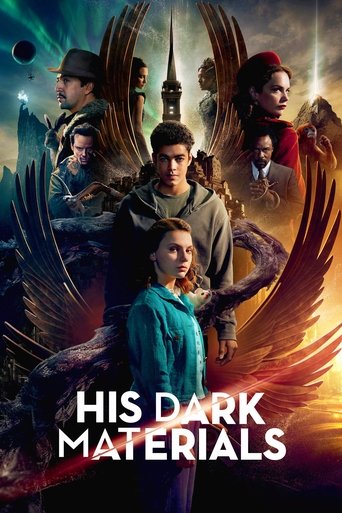
His Dark Materials
2019 · TV series · 3 seasons
Created by Jack Thorne
Science FictionFantasyDramaActionAdventure
Lyra is an orphan who lives in a parallel universe in which science, theology and magic are entwined. Her search for a kidnapped friend uncovers a sinister plot involving stolen children and turns into a quest to understand a mysterious phenomenon called Dust. She is later joined on her journey by Will, a boy who possesses a knife that can cut windows between worlds. As she learns the truth about her parents and her prophesied destiny, the two young people are caught up in a war against celestial powers that ranges across many worlds.
4 positive2 negative3 neutralfrom 9 commenters
Where to watch
No streaming data for this title.
9 comments on Hacker News
> Notable also is that a lot of resources go into series rather than just movies,
As a great example of this, is the His Dark Materials series. Where every episode is shot like a big-budget movie, and is pretty amazing compared to anything filmed in the 90s. Its subject matter skews toward the adolescent, but I enjoyed watching with the kids.
I’m 41 and I’m utterly baffled by my 24 year-old SO’s interest in binging an apparently infinite litany of TV shows from streaming services. I’ve watched the first six seasons of Game Of Thrones, the first season of Dark, all of The Expanse (reading the last book of the final trilogy now), His Dark Materials (because I read the book) and Andor. That’s it. I watched some Star Trek TNG & DS9 as a kid and was horrified by what snippets of Discovery and Picard I came across. I find the bulk of modern entertainment to be an utter insult to viewers.
I have generally found that the best children's content all holds up amazingly well when viewed from an adult perspective. Think most Pixar films, Harry Potter, Avatar: The Last Airbender, The Little Prince, His Dark Materials, Roald Dahl and so much more. Great authors simplify complex adult themes for children, but never forgo them.
His Dark Materials has a highly rated (and ongoing) TV series from HBO & the BBC: https://www.imdb.com/title/tt5607976/
Lord of the Rings is great for many reasons, but when it comes to story His Dark Materials is better. It's a real shame they messed up the movie for that one.
His dark materials seems like it was supposed to be a sort of atheist narnia, but Philip Pullman is just not as good a writer or storyteller as cs lewis was. The tv show might improve upon the books though.
The Earthsea cycle is very, very different from Tolkien and GRRM.
The first three books are a classic "bildungsroman"--a coming of age story--both as a whole and individually. The point of view character in each novel is a young person, passing through late adolescence and into adulthood. In this respect it is more comparable to Harry Potter or The Dark Is Rising or perhaps His Dark Materials fantasy series.
The world LeGuin builds for the story is incredibly rich and unique, like Middle Earth and the world of ASOIAF, but the structure of the stories are considerably simpler.
However, the "inner life" of the stories are richer. Like the Dune series, the novels of Earthsea spend a lot of time deep in the perspective of a few key characters. I think it is one reason these novels are so hard to film in a satisfying way.
That said, where Earthsea really distinguishes itself from almost any other fantasy series, is the fact that LeGuin came back to the series much later in her life and added two more books. These are set in the same world but regard it with different perspectives of age and gender.
The original trilogy is classic fantasy about Our Heroes who are uniquely gifted and ultimately save the day and pass into legend. The final two books are about what happens to those people when they face the complicated and unsatisfying future: their personal gifts are no longer powerful, and their beliefs and assumptions are challenged by a new generation... and ultimately found to be not only flawed, but awful. Some of the things they defended were not absolutely good after all, but the lasting artifacts of earlier selfishness, bias, and bigotry.
I resisted reading these later two novels for a long time because I enjoyed the purity of the stories in the original trilogy. But now having read them all, I find I can enjoy them in related but still somewhat separate ways.
If the later two novels don't sound like your kind of thing, you could read the first three now, and then visit the last two books a decade or two (or three) later. That would align your perspective with LeGuin's when she wrote them.
I am currently reading Dune and I promised myself to never watch the movie so I can keep the images alive in my head. Did the same with His Dark Materials. And even though the movies were good epic movies, I miss my own Lord of the Rings.
* If you've already read Cryptonomicon (see more here: http://jseliger.com/2006/11/29/cryptonomicon ), you're going in the right direction, but you should skip the Baroque cycle and Anathem.
* David Leavitt's The Indian Clerk deals extensively with math (http://jseliger.wordpress.com/2007/12/14/the-indian-clerk).
* Joel Spolsky's The Best Software Writing isn't fiction but is worth reading.
* I'll reiterate Tom Wolf's The Bonfire of the Vanities and A Man in Full.
* Philip Pullman's His Dark Materials trilogy is nominally aimed at adolescents, but people of any age can enjoy it.
* Michael Tolkin's The Player is partially about the business of film, as is its sequel, The Return of the Player.
If you're curious about more, send me an e-mail; I write a book blog at http://jseliger.com , and a lot of the reviews/commentaries would probably be of interest to hackerish types.