 Hacker Cinema
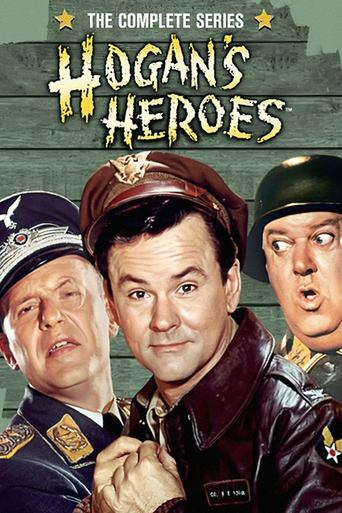
Hogan's Heroes
1965 · TV series · 25 min episodes · 6 seasons
Created by Bernard Fein, Albert S. Ruddy
From a German prisoner of war camp during World War II, Colonel Robert E. Hogan coordinates an international crew of Allied prisoners running a Special Operations group.
2 positive1 negative9 neutralfrom 12 commenters
Where to watch
No streaming data for this title.
Videos commenters linked
From YouTube links in the comments below. Most are clips and trailers; “Full” means the uploader says so.

12 comments on Hacker News
>I look back at period pieces - films showcasing the 40s, 50s, etc., and it seems like mental institutions would be a wonderful way to house these folks and keep them fed and warm
I'm reading this comment as if you had written:
"The TV show Hogan's Heroes makes being a prisoner of war sound like a jolly good time."
Just convince your manager that it was their idea, and it will benefit them and save the company money to let you escape and work for the client, like how Colonel Hogan manipulated Colonel Klink on Hogan's Heros. Maybe your manager will even follow you to the client's safe house!
Klink Encourages Stalag 13's POWs to Escape - Hogan's Heroes - 1970:
https://www.youtube.com/watch?v=WMh8fjO2R50
Convinced he's on the trail of a big-prisoner escape operation, the Kommandant tries to make Stalag 13's POWs feel comfortable escaping so he and Schultz can follow them to the operation's safe house. A witty episode.
> At the beginning of the pandemic, people theorized that public health will influence future media for a generation, much like WW2 did. For decades, we got war TV shows, war movies, war comics, etc. Hogan's Heroes ran into the '70s, Sgt. Rock was published until the late '80s, and so on. And I think we're about to see the same with media based on public health efforts.
but we actually won that war, which precipitated a rise to global hegemon status. covid has been a pathetic, fumbling showing, one that clearly reflects institutional decay and foreshadows future decline -- the reverse of the first situation
At the beginning of the pandemic, people theorized that public health will influence future media for a generation, much like WW2 did. For decades, we got war TV shows, war movies, war comics, etc. Hogan's Heroes ran into the '70s, Sgt. Rock was published until the late '80s, and so on. And I think we're about to see the same with media based on public health efforts.
One of the things that'll come out of this is that mRNA vaccines as miracle wonder drugs that cure everything are going to get huge amounts of attention, and media will reflect that. Especially if the Lyme, Malaria, and HIV vaccines prove successful. We are going to see mRNA vaccines as plot devices and MacGuffins in media for decades to come. It's going to get the same treatment radiation got in the '60s and '70s and genetic engineering got in the '90s and '00s. For example, it wouldn't surprise me if, the next time Marvel decides to make a new adaptation of Spider-Man, the spider will have been treated with mRNA instead of radiation (the original story) or gene therapy ('90s cartoon, '00s movies, maybe others).
> The concept would never fly today
I mean I don't know if I would go that far; things like Hipster Hitler got a fair amount of traction, at least for a bit [0]. Hardly indicative of the entirety of human culture, and obviously it's not a major network sitcom like Hogan's Heroes (or Seinfeld).
Also, a staple of the Call of Duty franchise is a tongue-and-cheek mode of running around killing zombie Nazis, isn't it? (I admittedly haven't played it), and it's not like "Iron Sky"[1] was meant to be taken super seriously.
I think it's unnecessarily reductive to say "one generation is ok with subject X and another generation isn't." I don't think humans really form big, homogeneous groups completely based around the year they were born.
[0] http://www.hipsterhitler.com/ [1] https://en.wikipedia.org/wiki/Iron_Sky
There is a long history of lampooning nazis for comedic effect, very often performed by Jewish comedians. Hogan's Heroes is a sitcom about POWs sticking it to the foolish krauts. The concept would never fly today but it was standard fare for post war comedy. The children who grew up with that culture continued using it into the 90's.
That's really amazing that human taste buds are such sensitive chemical detectors. We still can't build anything as good at anything near that size.
Off-topic: Is anyone else reminded of that episode of Hogan's Heroes where the Germans store heavy water in the POW camp to protect it from allied bombers, and Hogan tricks Colonol Klink into drinking the heavy water by telling him it had some kind of health benefit? https://www.pinterest.ca/pin/584201382887878852/
Did anybody else immediately think of the episode in Hogan's Heroes where Hogan convinces Col. Klink to drink heavy water? https://www.imdb.com/title/tt0602322/
> Sometimes it feels like we're drowning in media, and I'm not sure the trade-off of being able to watch Hogan's Heroes or whatever at a moment's notice rather than waiting for a rerun is entirely worth centering our lives on screens and speakers so completely.
Yeah, this is part of the driving force behind the resurgence of vinyl, cassettes, VHS, etc. Scarcity and physical presence are great ways to imbue a sense of meaning into media. This is something I have difficulty expressing to my older colleagues (I'm in my early 20s, many I work with are in their 40s or older).
"We" millennials no longer see a vinyl record as a means to the end of producing audio, the medium itself supposes to provide intrinsic value: the idea of "fidelity" has disappeared (remember "Hi-Fi"?) and has instead been replaced with some idea of "maximizing the experience" of engaging with the media.
The concept of "fidelity," is, in a sense, nonsensical in the world of fully electronic music (in the realm of movies, most audiences already have some sense that movies are inauthentic/there is no comparable "live" experience, so perhaps this discussion does not extend into that domain. That said, old VHS tapes are a fun source of obscure video footage, and digital video can still be somewhat hard to track down!). The word "fidelity" itself means (in my own words) "qualitative closeness of a reproduction to some original source" and what is the "source" for something produced completely in a studio, often without any acoustic instruments present whatsoever?
In the world of DJs and FL Studio or Ableton, many instead deal with some idea of "emotional fidelity" rather than "acoustic fidelity": how closely and intensely can we personally experience the (intended?) aesthetic/artistic qualities of a work? It is a meaningfully different experience to listening to one of my favorite disco records on vinyl (a record that, for all I know, buying secondhand in NYC, may have been played at the Paradise Garage) vs on YouTube.
This reminds me of the idea of "Hyperreality" in Baudrillard's "Simulacra and Simulation" -- music with its own internal aesthetic and emotional world, its own language, its own norms. Almost no relationship to some sort of physical reality (guitars, drums, etc) other than the fact that we must experience sound via acoustic waves.
> We've gained a lot, but more than a little's been lost
True. After a while you wonder what's the point of all these intense emotional experiences, does it really satisfy any of our needs as human beings? Does it bring us any closer together? Just because something feels more meaningful, does that actually make it more meaningful? There will be some interesting reflections on this period of digital abundance in about 20 years.
Something lost on second-half-of-millenial-generation and up will be just how inaccessible media was, even well into the 90s. Movies took years to be released on video. What you could buy was mostly whatever the local stores chose to stock. You'd probably not even know about all kinds of media because it never showed up anywhere you could see it, unless you read lots of industry/medium specific magazines or something. Music? Hope your record/CD store has it or will order it. TV show? Didn't record it when it aired? Gone. You can watch TV Guide and try to catch a rerun. In a few years maybe it'll be one of a handful of episodes released on VHS (full seasons? LOL no, or incredibly expensive in the unlikely event that they are released). Want to see some family photos from someone across the country? Call them, oh they're out, leave a message on their answering machine that you'd like them to go get prints made and mail them to you. You may see them in a month. You'll have no idea what you're getting until they show up, unless you've seen them in person before.
And shortly before that, it was even worse. Home releases of movies? Haha, what's that? Maybe a super-expensive 16mm print will be available at some point for home projectors.
A short while ago mass media was far more ephemeral and inaccessible than it is now. Before that it didn't really exist, outside print. Want to hear music? Know anyone who can play it? No? You're out of luck. Better learn an instrument. Film? What's that? Maybe you can catch a stage show at the local harvest festival. Maybe your kids will stage something in the living room. That'd be nice.
We're not that far removed from those times. This has been a huge shift in people's relations to one another (to paraphrase Vonnegut, people's small artistic talents used to be very valuable to their friends, family, and community, but they're now in competition with the best in the world, rendering any expression of those talents low-value and eccentric) and to media itself. We've gained a lot, but more than a little's been lost. Sometimes it feels like we're drowning in media, and I'm not sure the trade-off of being able to watch Hogan's Heroes or whatever at a moment's notice rather than waiting for a rerun is entirely worth centering our lives on screens and speakers so completely.
"A good idea for a movie doesn't mean it's a good movie. A bad idea for a movie doesn't mean it's a bad idea."
This is exactly what I meant when I said that the quality of an idea is a marginal factor in the success of an endeavor. I fully agree that execution should be the main focus.
What I was trying to say is that not all ideas are equal. You can always make a worse movie with a better idea, or vice versa, but some ideas are easier to pull off than others. Given the exact same level of execution, "Batman fights the Joker" will beat "Random nobody in Nebraska sits in the dark eating cereal" every single time.
If all ideas are of equal quality, why would Hogan's Heroes be an excellent example? Wouldn't all examples then be equally good or bad?
Hogan's Heroes is an excellent example precisely because the idea is harder to pull off than other ideas. If you gave Hogan's Heroes and American Idol each to 100 teams to turn into a show, I believe American Idol would become a hit with greater frequency than Hogan's Heroes.
"Does he honestly believe that a movie about Batman eating a bowl of shredded wheat in a dimly lit room has the same probability of succeeding as a movie about me?"
You're confusing execution with the idea. The idea of you sitting around eating a bowl of cereal might seem boring, until you look at other ideas.
An author sitting around a hotel in the middle of winter. (The Shining) A mother and son sitting in a car. (Cujo) Office workers dealing with life. (Office Space) A man trying to get a rug. (The Big Lebowski)
The idea (A Dilbert movie) isn't the execution. It's merely the idea. A movie about you doesn't have to be boring. But the execution of it could result in a boring movie.
The problem with ideas is people always refer to the idea as bad, yet point to perceived execution as the reason. Just because an idea is good doesn't mean it's going to be a good movie.
A good idea for a movie doesn't mean it's a good movie. A bad idea for a movie doesn't mean it's a bad idea.
I think Hogan's Heroes is an excellent example. Really, a comedy about POWs in WW2? Really?