 Hacker Cinema
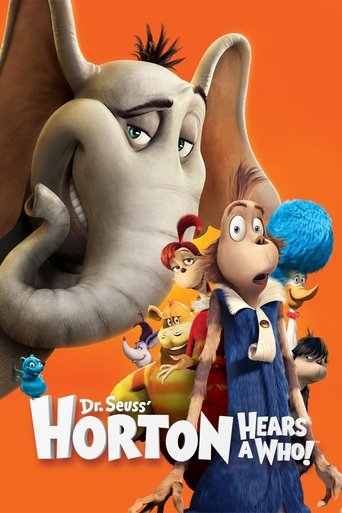
Horton Hears a Who!
2008 · Film · 86 min
Directed by Jimmy Hayward, Steve Martino
AnimationComedyFamilyAdventureFantasy
An imaginative elephant named Horton hears a faint cry for help coming from a tiny speck of dust floating through the air. Horton suspects there may be life on that speck and despite a surrounding community, who thinks he has lost his mind, he is determined to save the tiny particle.
2 positive2 negative1 neutralfrom 5 commenters
Where to watch
No streaming data for this title.



5 comments on Hacker News
I never understood how it was possible for little girls to watch the same movie literally hundreds of times, sometimes twice in one day. Some day science will get around to the real mysteries like this. I think I've tried to erase the memories of torture I survived, hearing Horton Hears a Who played most days for almost a year.
That cat in the hat movie was an abomination. I mean, the source material isn't much to work with, however they just took the character and plopped him into some nonsense storyline with naught but suggestive glances towards the book.
Horton hears a who was pretty good though, and I think that was because the book had a plot that you could work with. The lorax had that possibility, but they just mucked it up.
If you're wondering how bad The Lorax feature film really was, put succinctly it felt like it was embarrassed about its source material. Few of Seuss' words remain in the dialogue; on the one rare exception, the words were spoken by a character not found in the book and then immediately dismissed as weird.
If The Lorax had Seuss rolling in his grave, The Cat in the Hat with Mike Myers had Seuss spinning hard.
Horton Hears a Who on the other hand is quite good; an honorable example of how Seuss' material can be adapted to a feature film.
Hi, ex-visual effects guy here. You didn't really convince me that these are "myths", and get a few things wrong in the process. I'll hit on a few highlights.
"Ray Tracing, which has major issues with memory and cache"
Memory is impossible to make generalizations about with rendering but there are situations where ray tracing can use far less memory than scanline.
Consider if you have a NURBS surface you'd like to render. With a raytracer, you can solve the ray to surface directly. With a scanline renderer, you must tesselate that surface. Or consider a simple sphere. The memory used to define a sphere can be 4 floats -- xyz position and radius. Solving a ray-sphere intersection is as simple as it gets. With a scanline renderer...it's a lot more. And say you have a velocity and want to motion blur it. Raytracer: 7 floats, stochastic sample the rays in time. Scanline render... it's even more RAM.
Renderman is not a pure scanline renderer anymore. It has had raytracing for a long time.
"Almost all animated movies are rendered using RenderMan"
No, all of Pixars are. That's not "almost all". Dreamworks uses a proprietary renderer. Blue Sky uses a pure raytracer for their movies (Ice Age 1,2,3, Robots, Horton Hears a Who). I'm sure others use Mental Ray.
"Without going into the technical details..."
If you're interested in the graphics space, you should really learn a lot more about how and when raytracing is useful and efficient. I've used pure raytracers and pure scanline renderers in production, I by far preferred the pure raytracer. A compromise between the two is best in general.
I think that can be said about most stories with a non-tragic hero.
Except that it's relatively unique to the animation field.
The thing is, Pixar's process is more story focussed than other studios, A typical Pixar film usually has a 4 year production cycle in which the first two of those are spent primarily on writing and rewriting the story to get the "feel" right. Even then, they have no problem with changing the story at the 11th hour.
Case in point - WALL-E's ending was originally very different with WALL-E originally saving EVE from the trash compactors (essentially larger versions of WALL-E for irony). After the film was complete and was screened in Portland, Andrew Stanton changed the ending to what it is today. The story flows better.
Compare that to something like Dreamworks or Blue Sky Studios. Dreamworks focusses on making films which are more technically proficient and aimed at children (Kung Fu Panda was astounding from a technical standpoint) and something like Horton Hears a Who or Ice Age are heavily stylised films.
Dreamworks are more focussed on the business side, rather than the entertainment side of the process.
I first saw Toy Story as a child. Looking back on it as an adult, I remembered that I had a pretty good grasp on the plot and characters as a kid, so I was assuming it had been a simplistic film. When I watched it again, I saw lots of things I didn't notice as a kid.
That's Lasseter's influence as one of the Pixar co-founders. This style has permeated throughout the whole studio. Creativity comes first at Pixar. Ironically, he was actually fired from Disney in the 80's for trying to introduce 3D to their production pipeline and Disney ended up buying Pixar for billions...
They've built up a pretty solid momentum now, and it would take a series of bombs (like Disney after the mid-90s) to shake it.
Funnily enough that's a result of Katzenberg leaving Disney after a disagreement with Michael Eisner (then CEO of Disney) and he ended up co-founding Dreamworks.
(Though I'm kind of on the fence about Cars.)
Yeah, each of the studios has those little outliers. Monsters vs Aliens has very many adult jokes in it that children just wont get. If you haven't yet seen it, go see it.
For example: This is a quote from one of the US Military Advisors says to the President in a secret strategic meeting to deal with a giant alien robot.
"We need our top scientific minds on this project... Get India on the phone!"
I absolutely laughed my ass off at that joke and I'm sure most people didn't "get it".