 Hacker Cinema
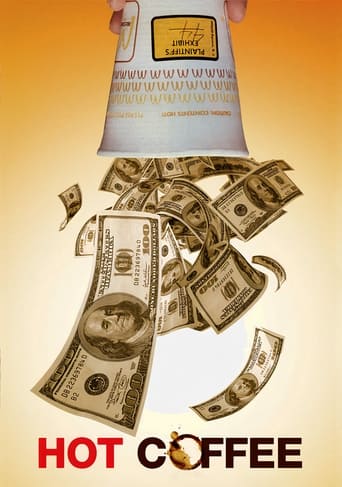
Hot Coffee
2011 · Film · documentary · 85 min
Directed by Susan Saladoff
Most people think they know the "McDonald's coffee case," but what they don't know is that corporations have spent millions distorting the case to promote tort reform. HOT COFFEE reveals how big business, aided by the media, brewed a dangerous concoction of manipulation and lies to protect corporate interests. By following four people whose lives were devastated by the attacks on our courts, the film challenges the assumptions Americans hold about "jackpot justice."
13 positive3 negative5 neutralfrom 21 commenters
Where to watch
No streaming data for this title.





25 comments on Hacker News
Well thanks to tort reform likely not:
https://en.wikipedia.org/wiki/Hot_Coffee_(film)
Arbitration seems just another way for big corp to weasel their way out of their obligations and responsibilities to consumers. See Hot Coffee Documentary [1]
1. https://en.wikipedia.org/wiki/Hot_Coffee_(film)
>Then, the case was rediscovered by a popular podcast ("You're Wrong About") so a lot of people now have the opposite perspective and anger at how it all played out
I'd say online communities have been having this reaction for at least a decade. In 2011 a documentary came out partially about the case, Hot Coffee, and since then most mentions of the McDonalds case I've seen have turned into a version of this conversation.
Actually, it probably even predates that film. The first Wikipedia entry for the case in 2003 says
>Based on this summary, the case has become emblematic of frivolous and outrageous lawsuits for many people, and is often used as an example of the need for tort reform in the United States legal system. The summary, however, omits a large amount of relevant information.
Plenty of people have given you the details on the McDonald’s case, but I’d like to point folks to the documentary “Hot Coffee”, which covers cases similar to the McDs case where the blame is unjustly pushed onto consumers.
Just be warned that you will be come out of it angry.
Weaseling around consumer protections indeed. Seems like something corporation do often. Check out this documentary it is quite insightful (e.g. The U.S. Chamber of Commerce (not a United States government agency, but a lobbying group for businesses)
https://en.wikipedia.org/wiki/Hot_Coffee_(film)
To add context, the original awarded amount was calculated to be the revenue of a single day of coffee sales for McDonald's. Stella Liebeck had originally sued for ~$50,000, to cover the cost of her medical bills, which McDonald's refused to do. Additionally, the award was calculated at that amount as a punitive measure, because McDonald's had received hundreds of complaints from customers of the coffee being too hot, which it summarily ignored. The coffee had been a problem; McDonald's just didn't care.
Unfortunately, the lawsuit, and the seemingly 'ridiculous-at-first-glance' nature of the headlines surrounding it, was used by several companies to push for specific tort reforms, which were mostly to the detriment of the average public.
There's more to this than "Dumbass sues company because hot coffee was hot".
Hot Coffee https://www.imdb.com/title/tt1445203/
> The lady burned by the McDonalds coffee was really hurt, and was only one of many many people burned by McDonalds coffee, who refused to serve it less hot.
What the documentary left out, was that it happened over a 10 year period where 700 out of 171 BILLION customers got burned from mcdonald's coffee. This is statistically nothing.
> Tort reform is largely a concept pushed by big business trying to avoid getting sued when they do wrong.
While I do not know who created the youtube video you posted, the "Hot Coffee" documentary that is frequently mentioned about the liebeck case is actually created by a special interest group, "Association of Trial Lawyers of America". If you think this movie doesn't have an agenda as well, I have a bridge to sell you. A video that does a better job of clearing up the misconceptions of the case is here: http://www.hotcoffeetruth.com/ .
> The number of frivolous lawsuits in the US is actually pretty low.
I have a hard time believing this. Frivilous lawsuits are easy to do in america and my friends (annoyingly) do them all the time. In fact, they brag about the ease of doing it. My personal estimate is around 70% of "I was injured" lawsuits from my friends were just made up to cash out.
Finally, "hot coffee" lawsuits happen all the time in america at temperatues as hot or hotter than what was given in liebeck case. And the cases almost always get thrown out by judges and juries because they are regarded as "frivilous". Source: https://en.wikipedia.org/wiki/Liebeck_v._McDonald%27s_Restaurants#Similar_lawsuits
The liebeck case was the exception, not the rule.
HBO produced a documentary [0] on that case a few years ago. I would recommend not watching it, only because they show the hospital photos of Stella Liebeck (the plaintiff in the case), and they are absolutely horrible.
[0] http://www.hbo.com/documentaries/hot-coffee/synopsis.html
The WHOIS for the domain proves him right:
https://whoislookup.ninja/whois/hotcoffeetruth.com
Registry Registrant ID: Registrant Name: Domain Administrator Registrant Organization: Chamber of Commerce of the United States of America Registrant Street: 1615 H Street NW, Registrant City: Washington Registrant State/Province: DC Registrant Postal Code: 20062 Registrant Country: US Registrant Phone: +1.2026596000 Registrant Phone Ext: Registrant Fax: Registrant Fax Ext: Registrant Email: @uschamber.com
Edited to add: The piece makes the point that the film "Hot Coffee" is propaganda. I believe that gives me leeway to do the same here.
See also: the 2011 documentary film "Hot Coffee" about the case and so called tort reform in the US legal system. http://www.hotcoffeethemovie.com/
If you haven't seen the documentary Hot Coffee, I highly recommend it. Very interesting look at that case.
> Over the past few days, news has trickled out that liberal billionaire George Soros has poured millions of dollars into local election campaigns against "tough on crime"
Because of lack of education, awareness, care and time, along with the easy with each elections (especially local and state) can be manipulated, we are left at the discretion of benevolent billionaires to fight for us.
I remember first becoming aware of this issues after watching Hot Coffee documentary. There is a large part there around how corporate interests can easily manipulate state Judicial branches -- by sponsoring judges which are more favorable to them (in that case it was capping maximum damages people could win during corporate settlements on appeal, and yes, lawyers knew to always appeal).
> But that's not the case in much of the country, where prosecutors don't file records that would explain why, for example, they pursued prison time instead of probation for a defendant. "We don't really know why prosecutors do what they do," Pfaff said.
I think aside from padding the stats and pleasing voters with "tough on crime", there is a very good reason for prosecutors to prosecute more. It helps prison guard unions (keeps them employed), private prisons, state prisons (cheap labor). Each one of those interests can spare a good amount of cash to sponsor the "right" prosecutor. It is like a long term investment. In fact, they'd be stupid not to do it.
On the topic of tort reform, I'd suggest the documentary Hot Coffee. It obviously has a bias but it really made an impact on how I view these large settlements.
These huge sums are required to set an example and not just be a fine. If he only won $500,000, then then next time a similar situation arises it just becomes a math question. Can they can earn more than $500,000 by releasing and paying the "fine".
https://en.wikipedia.org/wiki/Hot_Coffee_(film)
> our country is becoming a dictatorship.
Our country will never become a dictatorship, and our country is already a dictatorship. To be more precise it is an oligarchy or what was that word... plutocracy? Anyone has a link to that paper?
It is basically ruled by the very few powerful interests.
There are multiple methods of how it is done:
One of the most effective is regulatory capture -- look at heads of FCC, FDA, USDA, Military and corresponding industries: communications, pharma, military industrial complex companies. There is a giant revolving door between them.
Senators and legislature in general (state and federal) can be easily bought as well.
Judicial can be subverted as well. This happens easier on the state level were judges are elected. I found "Hot Coffee" movie pretty interesting and accessible in understanding how the process works: http://www.imdb.com/title/tt1445203/
Election campaigns are basically a big theater where future political favors are sold for campaign funds.
And finally the PR involved in polarizing the population and manipulating their opinions. On paper the country will never be a dictatorship so this just means spending extra on manipulating public opinion. Bush did a good job mobilizing Evangelical voters. Obama capitalized on liberal votes and sold a story of hope, change, plus added the racial card in there as well. It really was a very well run campaign, not unlike what Coke or Pepsi would have. This is not just a random internet person talking, AdAge -- one of the main marketing interest groups gave Obama an award in 2008 http://adage.com/article/moy-2008/obama-wins-ad-age-s-marketer-year/131810/ for the best marketing campaign. Other usual winners are Coke, Nike, Apple.
The other thing that helps out is that various segments of the population, which would benefit from having a unified voice and position, are divided. It happens naturally in society, but it is of course helped a bit by media: Fox News vs liberal news etc. The division lines are multiple: conservative vs liberal; racial: Whites, Blacks, Hispanics, immigrants; regional: North, South, East vs West; by religion: non-religious, vs Christians vs whatever. It is a bit like the sports fans, the hate the other fans, but in fact they are closer to the other fans in terms of interests, income status, and general life outlook, than they are they with the players they are rooting for, who could be all driving sports cars, and hang out in exclusive expensive downtown bars together.
So minus some PR juggling and the need for some extra rhetoric about "Freedom, democracy, and exceptionalism, mixed with a bit of God and manifest destiny" you are not too far off treating the country like a well run dictatorship.
Yes, reminds me of that movie "Hot Coffee". Basically negated by "Enigma Cheers" on amazon.com:
http://www.tripperjones.com/stuff/hot_coffee_critique.txt
I highly recommend watching a documentary called Hot Coffee (http://www.hotcoffeethemovie.com/Default.asp). It goes into details about how corporate lobbying eroded consumer rights.
Hot Coffee is an important documentary for all Americans, but parts of it are especially relevant to those of us who work in tech. The movie shows how arbitration clauses, enforced by many telecomm and software companies, threaten our constitutional rights to bring civil charges against the firms. As one expert in the film puts it, we'd be better off to adopt the term tort deform.
If you are interested and have time watch the "Hot Coffee" documentary.
It explores this very case and issues related to it.
http://dvd.netflix.com/Movie/Hot-Coffee/70167106?trkid=222336
It was interesting to me because I had heard about it, or rather was told about it this lawsuit and what I was told and believed about that case was wrong for the longest time. This film explores how that PR effort started and how successful it was.
1) In this case the cruise company was at fault, so that is why they went into "don't get sued" mode. No need rely on a stereotype here.
2) I'm not an American but I think your legal system is very good and many objective people do too: http://www.quora.com/Litigation-and-Lawsuits/Why-are-Americans-so-litigious
3) I'd recommend anyone to watch Hot Coffee [1] which documents the lobbying and spin that encourages American citizens to think there is a problem with "frivolous lawsuits"
[1] http://www.imdb.com/title/tt1445203/
It won't help much. Judge elections and appointments will then just be the focus of lobby groups. Watch the movie Hot Coffee to see how state supreme court judge elections are manipulated by business interests to install "friendly" judges.
Why not just make a law to cap the profits. Home must be sold at fair market price and the rest must be given to the owner.
While frivolous lawsuits are certainly a problem, I think everyone citing the McDonald's coffee example should watch the documentary Hot Coffee. It puts that incident in a new perspective.
According to the HBO documentary "Hot Coffee," which is excellent, by the way, even after she sued she didn't request damages beyond medical costs, rather they were awarded by the jury.
The MacDonalds hot coffee case should rightly be viewed as a textbook example of a frivolous lawsuit, and it baffles me that it has been used to actually argue against tort reform.
The Hot Coffee film was produced by a plaintiffs lawyer, and presents little more than emotional appeals. As a group, plaintiffs lawyers hated the publicity originally given to the MacDonalds suit, so perhaps it makes sense that some of them try so desperately to revise the standard interpretation.
Because it discourages people with a valid case and little money from filing the suit in the first place. So now if you think you've been wronged not only do you have to worry about winning you also have to worry about losing.
Nothing is stopping the defending counsel from getting a team of high priced lawyers, verses the 1 you could afford, and stuffing you with the bill of not only your lawyer, but all of theirs.
There is nothing fundamentally wrong with the US civil court system.[1] Just like there isn't a knifing epidemic in the UK. People see these cases in the media and get the idea this is common when it really isn't. This is what people that want to reform the tort system are trying to convince you. It's not the small businesses that have a problem with the current system. It's Macdonalds and ATT that believe they shouldn't have to pay millions in class action suits.
[1]http://en.wikipedia.org/wiki/Hot_Coffee_(film)
Here's a good recent documentary that goes into detail about the famous hot coffee case. It was eye-opening for sure. I never thought that I would going in, but I came away thinking McDonald's was woefully negligent in that case.
http://hotcoffeethemovie.com/