 Hacker Cinema
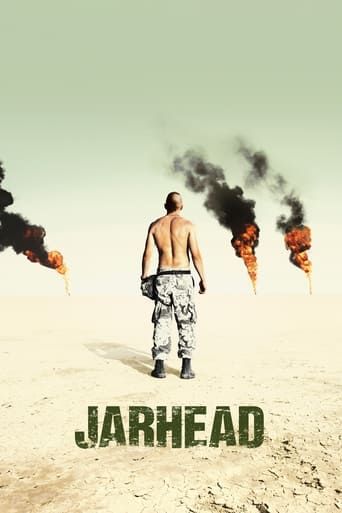
Jarhead
2005 · Film · 123 min
Directed by Sam Mendes
Jarhead is a film about a US Marine Anthony Swofford’s experience in the Gulf War. After putting up with an arduous boot camp, Swofford and his unit are sent to the Persian Gulf where they are eager to fight, but are forced to stay back from the action. Swofford struggles with the possibility of his girlfriend cheating on him, and as his mental state deteriorates, his desire to kill increases.
6 positive1 negative9 neutralfrom 16 commenters
Where to watch
No streaming data for this title.
16 comments on Hacker News
Staff Sgt. Sykes: [Sgt. Sykes is directing the recruits on how to judge distances] You take what you know, and then you multiply. Please don't use your dicks. They're too small, and I can't count that high. I don't wanna hear, "400,000 inches."
-Jarhead
https://www.imdb.com/title/tt0418763/
What you're describing is literally Netflix. I can go on Netflix and watch unlimited shows with completely unknown actors from across the globe.
When I was 19, I decided to make my way through the entirety of the imdb top 250 (which actually meant something at the time) as well as a few other big movie lists. To this day, I can remember many of those films and they influence how I see the world. I'm not convinced the Netflix shows I've watched carry such clout.
The cult of personality emerges when the rare talent warrants it. The face may be the same but the character transformation sure isn't. If they haven't got it then the cult soon flounders with all but the Kool-Aid drinkers which seems to be what we're witnessing with the current crop of actors. Try telling me Christian Bale's Batman is the same as his Machinist performance or Jake Gyllenhaal's Nightcrawler is the same as his Jarhead. These two are literally next level at their craft, and watching a top performer in any craft is immensely satisfying. If we lose that to CGI it will be a massive shame.
My top top pick is actually a youtube channel that does movie essays: https://www.youtube.com/@filmjoy
They are terrifically well researched with a bunch of easter eggs and production backstory and are put together in a high production value, thoughtful way.
They really made me love and appreciate film much more.
I think it's the same way as musicians appreciating music, right?
Non-musicians might say learning more about music theory, makes some music seem less magical in a 'knowing how it was done' sort of way.
But like a musician actively listening, watching film from a more critical viewpoint/lens is really fantastic. You start to think about things like 'who was the cinematographer?', 'Who did the music and score?' and enjoying finding things like how a certain director has a certain motif.
As for the film list:
- The lord of the rings trilogy, is I assume mandatory watching for all at this point.
- The Matrix trilogy, supplemented by the movie essay here: https://www.youtube.com/watch?v=M0VnYcMHuDc
- Whiplash (2014) A J.K simmons masterpiece
- Sicario (2015) Cinematographer Roger Deakins doing some amazing work alongside Denis Villeneuve.
- Blade Runner 2049 sort of an obvious choice but beautifully made, better than the original in all ways except maybe soundtrack. The original Vangelis Blade Runner music is sort of genre defining.
- Black Hawk Down (2001) Absolutely stellar cast some of whom in their first role or wouldn't have their breakout role until several movies later. Possibly one of the most well paced movies, it's extremely clear and coherent throughout. It's also tidy self and self contained, no one said lets make 10 sequels and a cinematic universe. Dealt with the morals and psychology of war that would be further touched on in Jarhead (2005) another great movie.
- The Hurt Locker (2008) If Jarhead is a claustrophobic look at how useless and powerless an average infantry soldier can feel during war, The Hurt Locker is a study of a soldier addicted to it. Through a lens of up close nihilism.
- The silence of the lambs (1991) Hannibal Lecter / Anthony Hopkins with a bunch of scenes that are so good they are studied in film schools. Genre best horror-thriller.
> ordered the ground forces in
as i recall, the air war was so devastating there wasn't much of a purpose for ground troops and when it came time to "order the ground forces in" most of the work was just walking across Kuwait. They even made a movie about how much of a let down the ground war was to the Marines https://en.wikipedia.org/wiki/Jarhead_(film)
> in the end the american has a good heart and conscience and should be forgiven.
Nothing about Apocalypse Now or Full Metal Jacket says that at all. Have you even watched them? They’re both about how war and the military machine are devastating and dehumanizing to the soldier, and to the enemy. All words seem like egregious understatements for them so I recommend seeing them (or seeing them again).
To my horror I did find out that the first half of Full Metal Jacket was attractive to enough teenage boys in the late 80s to eventually cause Jarhead to be produced [1]. I guess they stopped watching after the first half, or the idea of murdering teenage girls was attractive to them? Either way it is anything but propaganda.
As for the other movies that do involve righting a wrong or at least exposing them, that’s not state propaganda. Primarily because the state is the villain in them and they encourage suspicion of the state, neither of which promotes state power. A movie which gives the feels about being an American doesn’t make something propaganda it makes it a movie that wants to sell to Americans.
1: https://www.nytimes.com/2018/04/18/magazine/full-metal-jacket-ermey-marine-corps.html
I have a hard time naming any series that doesn’t make the CIA seem morally questionable. Even offhandedly, e.g in the recent James Bond films.
What are your examples of it being portrayed as heroically good?
If you had said the military, maybe you’d have a point, but even then we’ve got films like Apocalypse Now, Jarhead, and so on that are clearly critical.
Snipers go through quite extensive “desensitization” training as they are guaranteed to see the immediate outcome of their actions and they also tend to operate in a conditions when its not a clear “them or me” scenario.
Shooting someone who’s shooting at you or your friends is easy, taking a shot form 100’s of meters at an unsuspecting target isn’t.
Their entire training is based around you are the weapon and you must do your job, Jarhead was quite a good movie about just how much emotional toll this mindset takes even or even especially in cases when they are actually denied fulfilling their role.
From day one when snipers appeared on the battlefield things like kill counts and leader boards amongst snipers appeared as a coping mechanism.
- Jarhead: showing the boredom and uselessness of war
- Hurt Locker: showing the lack of clear morality (good guy/bad guy) in war
- American Sniper: showing the lasting psychological damage that war can inflict on the individual soldier.
Even though some of these movies depict individual heroism in war, none of them would be allowed in China (without heavy editing) because they are at their heart, critical of the entire endevour.
Agree with your general point, but I think you're generalizing a bit too much. There's plenty of movies that aren't Top Gun-level propaganda. The Hurt Locker, Jarhead, all the ones commented below.
For those that don't know, the author is Anthony Swofford, who wrote the book Jarhead, which was turned into a movie of the same name.
It's a classic piece written by a Vietnam War veteran: Why Men Love War (1984) By William Broyles, Jr. https://www.esquire.com/news-politics/news/a28718/why-men-love-war/
Boyles is a screenwriter who was involved in writing in the movies like Apollo 13, Cast Away, Jarhead, and Saving Private Ryan.
I can't speak for its overall veracity, but if nothing else Jarhead (the movie) did show the life of deployed Marines as endless, frustrating waiting.
As well as Three Kings and Hurt Locker mentioned elsewhere, there's also Jarhead. All great movies.
There was also Green Zone, which was OK.
Full Metal Jacket.
• Three Kings.
• In The Valley of Elah.
Good Morning Vietnam.
A Few Good Men.
Platoon.
• Jarhead.
Casualties Of War.
• The Men Who Stare At Goats.
The Deer Hunter.
The Thin Red Line.
• Syriana.
• The Green Zone.
• Stop Loss.
Also, • HBO's "Generation Kill".
(•'d relatively recent movies)
I don't think "The Hurt Locker" was particularly critical of the military and didn't count it. Also not counting documentaries like "Restrepo".
I hereby dispute the idea that the DOD has made it impossible for big-budget Hollywood movies to criticize the US military, and suggest instead that the bias Hollywood in favor of the military is responding to customer preferences and not leading it. Given what I presume to be America's default position of "supporting our troops", I'm struck by how many films Hollywood produce that challenge that default.
Remember also that Hollywood confronts at least two vectors of consumer preference in marketing films: first, Americans (in the large) have a (typical) diffuse nationalistic home-team support for our overseas adventures, and, more importantly, there's a less-political less-issue-oriented reverence expected for the sacrifices made by the young people we send into combat which is especially intense during times when large numbers of people are serving in combat zones. In other words, it's especially tricky to criticize the military during active conflicts.
Also, Three Kings is a fantastic movie.
> Black Hawk Down
Yeah, that was a good movie, but Ridley Scott is so much better than most Hollywood directors that it's not a fair comparison. (Never saw Jarhead)
> And here’s something no one has stopped to consider: Maybe making movies is too damn expensive. Or rather, far more expensive than it needs to be.
Hmm. I went to the theatre (first time since a long time as the experience feels antiquated and overpriced) with friends to see Sherlock Holmes, and the opening scene perfectly exemplifies the point: for about ten second you see a shot of the cathedral of Strasbourg. Half of it consists of a CGI explosion. I live there, and to produce this shot, they locked this part of the city for one week.
Ten seconds. One week. A whole team plus equipment. To the other side of the world. Seriously.
When seeing the scene I found that downright shocking, especially given the 10€ hole burning my pocket.
By comparison it takes Turn10 Studios three days[0] locally to gather enough information on a track to subsequently work on for one year. That's a full-length, five kilometer track.
I know this is not the same, and various other things come into play, but I just can't help but have an alarm bell ringing when I see movie production costs. See for yourself (budget in $):
- 2001 and Star Wars: 10 million each - Independence Day: 75 million - Transformers: 150 million - Kill Bill 1+2: 50 million - Jurassic Park: 65 million - King Kong: 200 million - Blues Brothers: 30 million - Fast & Furious: 90 million - The Fellowship of the Ring: 100 million - Harry Potter: ~150 million each - Full Metal Jacket: 15 million - Jarhead: 72 million - Apocalypse Now: 30 million - Black Hawk Down: 90 million - Terminator: 6 million - The Matrix: 60 million - Terminator 2: 100 million - Casino Royale: 100 million - Quantum of Solace: 230 million - Sherlock Holmes: 125 million - The Godfather: 6.5 million
I know those $ do not mean the same across time, but still, you can see going from simple to double produces crap (CS vs QoS), or produces twice the length at arguably the same 'quality' (whatever that means) for a significantly smaller cost (LotR vs HP). I don't see either why F&F costs thrice as much as BB, and almost twice as much as KB.
Bottom line: MAFIAA, please produce non-crap and control your costs instead of blaming piracy.
[0] http://forzamotorsport.net/en-us/underthehood4/