 Hacker Cinema
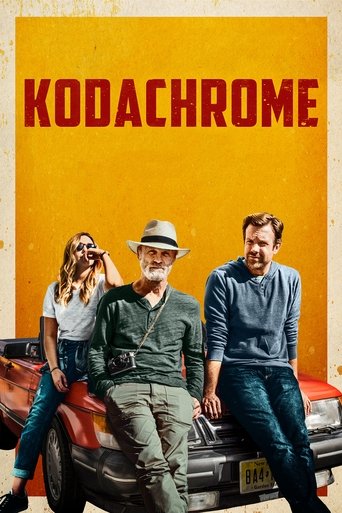
Kodachrome
2017 · Film · 105 min
Directed by Mark Raso
Matt Ryder is convinced to drive his estranged and dying father Benjamin Ryder cross country to deliver four old rolls of Kodachrome film to the last lab in the world that can develop them before it shuts down for good. Along with Ben's nurse Zooey, the three navigate a world changing from analogue to digital while trying to put the past behind them.
1 positive1 negative2 neutralfrom 4 commenters
Where to watch
No streaming data for this title.


4 comments on Hacker News
What a find!
As for Kodachrome's legacy, there's a 2017 movie of the eponymous title starring Ed Harris. While not a documentary, it's still worth seeing.
https://www.imdb.com/title/tt1880399/
I currently have a roll of ISO 25 loaded in my camera right now (Rollei RPX 25) :-) I grew up shooting on film and preferred 400 over 800 speed film because of the film grain at 800 ~ the fact that my mirrorless can go up to 25600 and still look okay just blows my mind.
Kodachrome. They give us those nice bright colors. They give us the greens of summers. Makes you think all the world's a sunny day. I got a Nikon camera. I love to take a photograph. Too bad mama took my Kodachrome away. ~ I'm sad that I'll never actually get to shoot on it.
Having watched some/plenty of Netflix movies (imho) they are flat, lack substance. Just as a point of reference/to make a comparison, one of my favourite movies is The Fountain (Darren Aronofsky). Maybe some of the Netflix movies got the big names (e.g. Ed Harris - Kodachrome), but they feel like one-dimensional.
Cinematography and cinemas keep people give people jobs, not only while MAKING the movie (cast and crews), but for people to watch it as well. Cinemas (the actual venues) give people jobs, the crews that work there, make pop-corn, sell tickets, cleaning crews, etc.
Netflix wants us to sit on our couches and binge/rot-away [1]. The two experiences (cinema vs netflix) are not even close.
[1]: https://twitter.com/netflix/status/854100194098520064
Edit: I am not negating the usefulness of Netflix, HBO, and other online/serving platforms. But if you want to play the movies-game, you have to win it on THEIR rules. Otherwise make your own 'oscarZ' and go wild :)
I disagree with this nonsense. I was a photojournalist for Reuters during the tail end of the film era; 1996-2002 and the issue with black subjects had nothing to do with color balance but of the latitude of the film; we used Fuji almost exclusively and since I did tons of sports and low light spot news, It was mostly 800 speed occasionally pushed hard.
Shooting NBA meant I had mostly black subjects. The film didn't discriminate: in most arenas if the time, we shot at 500/2.8; for a darker arena, we'd increase the processing time (or if we had an especially important shot, increase the chemical temperature, effectively overclocking the processing.) my point is that dark skin or light, the color balance made no difference; it was about exposure. Since we held shutter speed and aperture constant (2.8 was the fastest aperture for 400mm lenses and anything below 1/500th would get motion blur,) our exposures were relatively constant regardless of the subject's skin color. The problem is if you have a bunch of white guys and one black guy, auto-metering would expose in such a way as to render the scene equal to an 18% grey card. So the black guy would be under exposed. However, if you took a photo with 20 black guys and 1 white guy, the white guy would look like he was made out of white light: he'd be dramatically overexposed because autometering it exposed for 18% grey. If you had used an incident light meter, generally the scenes would be fine because the meter wouldn't be trying to 'grey card' the scene.
As far as Jean Luc and his 'racist' Kodachrome, I suspect that's apocryphal. Kodachrome is notoriously difficult to expose correctly; meaning you typically want to expose for highlights because it has a very narrow latitude and blasting out highlights is a real concern. There's nothing racist about it, it is just a very difficult film to light correctly, especially if he were shooting on location in Africa.
But what do I know, I am a white guy so I obviously don't quite understand the struggle to make everything into some kind of racist conspiracy.
The fact is that if film were racist, Spike Lee and others would have been screaming about it. This is the first I've ever heard of this theory and I was a film junkie for a long time as well as a fan of Ernest Dickerson and Bob Richardson; never once have those guys mentioned racist color balance. The argument is just absurd.
If we want to talk about racism in Hollywood, we have about a million potential topics, but film stock isn't one of them. What next, lenses are racist?