 Hacker Cinema
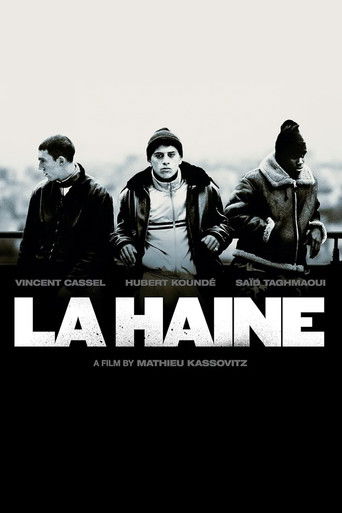
La Haine
1995 · Film · 98 min
Directed by Mathieu Kassovitz
After a chaotic night of rioting in a marginal suburb of Paris, three young friends, Vinz, Hubert and Saïd, wander around unoccupied waiting for news about the state of health of a mutual friend who has been seriously injured when confronting the police.
11 positive1 negative7 neutralfrom 19 commenters
Where to watch
No streaming data for this title.
Videos commenters linked
From YouTube links in the comments below. Most are clips and trailers; “Full” means the uploader says so.

19 comments on Hacker News
> Mathieu Kassovitz, who is currently working on an AI-enabled film
in two years, everyone on Earth will eat Oreo cookies, according to a prediction by the CEO of Oreo cookies.
> But Kassovitz, 58, whose 1995 film La Haine won three César awards
cool, he won an award 31 years ago.
looking at his IMDB page [0] the most recent film he directed was in 2011.
I'm not sure that makes him a good source about where the entire worldwide film industry is going.
he's just a guy making an "AI-enabled" film and it's in his best interests to hype it up as the future.
0: https://www.imdb.com/name/nm0440913/
Kinda funny the author fed a visual from French film 'La Haine'[0] to ChatGPT to produce whatever this illustration is supposed to convey ("The world is our/ads"? What does that mean?).
Without crediting the movie of course.
[0] https://www.machina-deriveapprodi.com/post/le-monde-est-%C3%A0-nous
Example of a neonazi who isn't white [1]. The Believer (2001, with Ryan Gosling) is a decent fictional movie about how this could work [2], and I also liked Rompen Stomper (1992, with Russell Crowe) [3] and La Haine (French for 'the hate', 1995, with Vincent Cassel) [4] about the phenomenon in general but there's likely more recent, good material as well as non-fiction available. I also had a colleague student who was IMO racist, but he was himself what we in NL call halfbloedje (in this case: mother black, father white, divorced).
[1] https://en.wikipedia.org/wiki/Michiel_Smit
[2] https://www.imdb.com/title/tt0247199/
[2] https://www.imdb.com/title/tt0105275/
[3] https://www.imdb.com/title/tt0113247/
Movies I rewatch like once a year: Trainspotting (1996), Donnie Darko (2001), La Haine (1995)
Movies I've watched quite a few times and wouldn't mind watching again right now: The Matrix (1999), Akira, Breakfast Club
> getting oppressed and murdered by the police on a systemic basis
I don't think there's any real evidence that people of immigrant background get "murdered by the police on a systemic basis" in France. If you have well sourced statistics on this, feel free to post, but for now it just sounds to me like a parroted talking point.
> is completely different compared to some individual's terrible reaction to a provocation. it's a sick system vs a sick individual, thus it's quite the reach to make that comparison.
Somehow, when the police engage in misconduct that's a systemic problem. But all of the following are just "isolated incidents" attributable to "sick individuals", no systemic issues with their culture or belief system at all right? No reason at all for ethnic French people to be upset or fed up?
https://en.wikipedia.org/wiki/November_2015_Paris_attacks https://en.wikipedia.org/wiki/2016_Nice_truck_attack https://en.wikipedia.org/wiki/2017_Marseille_stabbing https://en.wikipedia.org/wiki/2018_Paris_knife_attack https://en.wikipedia.org/wiki/Paris_police_headquarters_stabbing https://en.wikipedia.org/wiki/2020_Nice_stabbing
> your argument fails on the premise that it assumes a symmetry of power between these groups, which is not the case.
Seems like you can never have a conversation about certain groups where they're afforded any agency.
Seems like you and people like you have this belief system where people of an immigrant background can't be held accountable for anything. Basically it seems like if immigrants (and their descendants) come to a country and they're poor, don't learn the national language, don't respect the existing culture and political order, or engage in criminality, there's always a group of people like you who say the blame lies with the host country or the majority demographic population.
> should watch La Haine(1995)[0], it's a movie but it gives a good glimpse into what's going on.
I don't think watching a fictional film from nearly 30 years ago is going to be particularly valuable for improving my understanding of the current situation in France.
Getting oppressed and murdered by the police on a systemic basis is somewhat different compared to some individual's terrible reaction to a provocation. it's a sick system vs a sick individual, thus it's quite the reach to make that comparison.
Furthermore, your argument fails on the premise that it assumes a symmetry of power between these groups, which is not the case. anyone who doesn't know much about france's history with immigrants should watch La Haine(1995)[0], it's a movie but it gives a good glimpse into what's going on.
[0] https://www.imdb.com/title/tt0113247
> Since it's a political organization with stated political goals
Who cares about it's recent political pivoting? Why are you trying to stir the discussion away from the fact that Azov first and foremost in its recent origin is a military organisation born of banal street-level neonazi skinhead sorts? It's not your typical US Republican or German AfD talks-kinda-maybe-like-nazi-apologist, it's an actual physical organizied force.
And the scandal of integrating it into Ukraine's National Guard back when it was openly waving the Third Reich's symbolics tells us quite a lot of its role in post-revolution Ukraine power structure.
> Right now you're going "symbol scary!". By that logic German AfD, the French Front Nationale, or UKIP are totally above board in that respect...
Are any of these also military organizations at their core? And specifically, what symbols so commonly associated with the Thrid Reich are they using?
> Thanks for your racial theories...
Beg your pardon? You were the one to bring up the topic of ethnicity, not me.
> It was indicative of the culture though. This is why today you won't see a popular game with such rhetoric as Duke Nukem anymore.
Duke Nukem had a reboot and an aniversary edition a few years ago... And the abundance of wierd rape fanasy porn games on Steam doesn't really add up.
> But Russians still don't realize Brat 2 is racist.
Is this a verifiable claim? Cuz you're referring to a 20 smth y.o. lowlife trashy criminal drama, not some "Brat N+1". Is it any different from a movie like La Haine (1995)?
I do wonder if my response to La Haine has been tempered by me seeing the movies that came after it and were even more blunt and raw. It's a fantastic watch none-the-less.
Thank you, I'll have to watch the other films you mentioned. :)
Other interesting scenes:
https://www.youtube.com/watch?v=IFkHadvj4DI
https://www.youtube.com/watch?v=sSfciVMm5IM
Fun fact: la Haine was filmed in color because the coproductors didn't believe a b&w movie would be a hit
La Haine (1995)[0]: not so much that I saw it differently, more that I felt less crazy for seeing it as it was. I come from those exact areas and times, and even twenty years later there is a terrible amount of similarity in how things are unraveling.
Children of Men (2006)[1]: for the combination of cinematography and the dystopian atmosphere.
Departures / Okuribito (2008)[2]: the subtlety and elegance of the Japanese touch when brushing against Life and Death.
Persona (1966)[3]: I can and can't wrap my head around this movie. I think it left a trace on me in a way that my conscious self doesn't address but the subconscious plays with.
The Diving Bell and the Butterfly (2007)[4]: there are few things that can put a person against their own mind more than the locked-in syndrome. There's a lot of confusion, humility and strength to find in such apparent helplessness and lack of control. I think of it when I encounter people with ALS or other neuro-degenerative illnesses, and I think of it when I explore my own journey throughout the depths of mental illness.
Amour (2012)[5]: when you go through certain inevitable journeys with people you love, there's so much to be found in the most essentially simple things.
I'm sure there are other impactful things out there but my memory is pretty spotty at times.
[0] https://www.imdb.com/title/tt0113247/
[1] https://www.imdb.com/title/tt0206634/
[2] https://www.imdb.com/title/tt1069238/
[3] https://www.imdb.com/title/tt0060827/
[4] https://www.imdb.com/title/tt0401383/
[5] https://www.imdb.com/title/tt1602620/
>No, it's a problem of target audience. If you produce films for a Dutch audience, you have two options: either appeal to a sense of Dutch pride or history, or go for something so generic that a decent swath of the population will like it; otherwise you won't have enough of an audience to make a profit. This is what they do, so Dutch films are generally about about our navy in the 16th to 18th century, about WWII, a romcom or some adaptation of a Dutch Children's book. You cannot locally produce a film about something which lies outside of the realm of interest of most Dutch people; Hollywood can, since they have a larger audience, and therefore do have the ability to target niche markets.
Well, EU has 400 million people. One can very well create a movie that appeals to EU audiences. We have lots of shared sensibility and modern problems and history (and it doesn't have to be BS like "16th century dutch navy" or "17th century french villagers").
Movies like Blow Up or Dolce Vita or For a Fistful of Dollars etc where shown successfully all over Europe at one time (and we still have films by people like Lars Von Trier, Almodovar, and so on).
Just because you make something that has a Dutch or Swedish or French etc sensibility, it doesn't mean it can't have pan-European (or even global) appeal. Trainspotting is as British as it gets, for example, but hit Europe big, as did La Haine, La vita e bella, Amelie, and others.
Besides, not all movies have to be blockbusters and multi 100 million dollar productions. Even from the US, I'd rather have the chance to watch some Hal Hartley or Jarmusch, or Cronneburg, that barely pushed 5-10 million dollars in the box office than the nth repeatitive formulaic shit from Hollywood.
I suppose it's a quote from La Haine (1995) http://www.imdb.com/title/tt0113247/
> Heard about the guy who fell off a skyscraper? On his way down past each floor, he kept saying to reassure himself: So far so good... so far so good... so far so good. How you fall doesn't matter. It's how you land!
I would agree if we were talking about center-right or center-left politicians, where the biggest criticism is "being too much like the previous person".
Trump, for example, lost the popular vote and seems to anger many of the people who voted for him. The only voices of support we hear are from Vladimir Putin and Marine Le Pen.
People are afraid and feel the impulse to do what they can to counter what is happening right now.
On a tangential note, I would recommend the 1995 French (fiction) movie "La Haine" (Hate). https://en.wikipedia.org/wiki/La_Haine
I beg to differ. My experience was really the opposite.
I come from the maghreb region and lived in France for a while. I experienced racism at work and outside of it.
If you are arab looking or black, you better emmigrate to another country like UK/US or even germany for a better chance. If you don't you are doomed.
For those who don't understand what I'm talking about check a movie called "La Haine".
And I agree with you, it might be different in other cities.
Reminds me of the opening narration to the French movie La Haine. Approximately translated:
"This is the story of a man who fell from a 50-story building. The man, as he fell he kept repeating to reassure himself: 'So far so good, so far so good, so far so good.' But the important part is not the fall... it's the landing."
https://youtu.be/Uz9vgtXq_Hs
For anyone interested, La Haine (Hatred) is a fascinating film about a day in the life in the Paris suburbs anno 1995 http://www.imdb.com/title/tt0113247/
This quote has stuck with me ever since I first saw it:
"C’est l’histoire d’un homme qui tombe d’un immeuble de cinquante étages. Le mec, au fur et à mesure de sa chute se répète sans cesse pour se rassurer : jusqu’ici tout va bien, jusqu’ici tout va bien, jusqu’ici tout va bien. Mais l'important n’est pas la chute, c’est l’atterrissage."
Which loosely translates as:
"This is the story of a man falling from a fifty-story building. The guy, during his fall reassures himself by constantly repeating: so far so good, so far so good, so far so good.
But the important thing is not the fall, it's the landing."
> Anyone know if the 3rd photo down from the top is part of the setting for the 1995 movie 'La Haine'?
It is not, but your rightly recognized its style - both Les Tours Nuages and La Cité De La Noé in Chanteloup Les Vignes were designed by architect Emile Aillaud.
In 'La Haine' the Cité De La Noé appears as 'Cité Des Muguets'.
http://www.yannarthusbertrand2.org/index.php?option=com_datsogallery&Itemid=27&func=detail&catid=39&id=1186&p=5&l=1366
Wow, amazing architecture.
Anyone know if the 3rd photo down from the top[0] is part of the setting for the 1995 movie 'La Haine'[1]? It reminds me of the housing projects in the movie where the main characters live, especially that great scene where a dj points his speakers out his window to play for the neighborhood.
The linked wikipedia article about the movie mentions only the Parisian suburb of Chanteloup-les-Vignes as a filming location, but a cursory web search isn't turning up more evidence.
[0] https://img.washingtonpost.com/news/in-sight/wp-content/uploads/sites/35/2015/09/Laurent-Kronental-Washington-Post-1.jpg
[1] https://en.wikipedia.org/wiki/La_Haine
May I recommend the interested reader to watch La Haine[0] ("hatred") by Mathieu Kassovitz. This movie really sets the mood, and things barely changed since '95.
To be fair, such "ghetto" (la cité) people† mostly don't speak "verlan"[1] ("l'envers" with reversed phonetic syllables) anymore, but both the people and slang is usually referred to as "wesh"[2], from an arabic informal salute interjection. It's mainly poorly syntactically and grammatically worded French combined with limited vocabulary and heavy hand gestures and exaggerated arabic accent borrowings (e.g Rs are more pronounced) with various word borrowings from English or Arab.
Interestingly enough, I watched it recently in close proximity with The Wire[3], which provided great contrast yet striking similarities, and brings an interesting light into how we used to consider surveillance. In that regard, things have changed a lot. An awful lot, and certainly not for the better.
† It should be noted that many people and families that live there have adequate education levels and just live there because the rent is cheap and they can't afford anything else.
[0]: http://www.imdb.com/title/tt0113247/
[1]: http://en.wikipedia.org/wiki/Verlan
[2]: http://en.wiktionary.org/wiki/wesh
[3]: http://www.imdb.com/title/tt0306414/