 Hacker Cinema
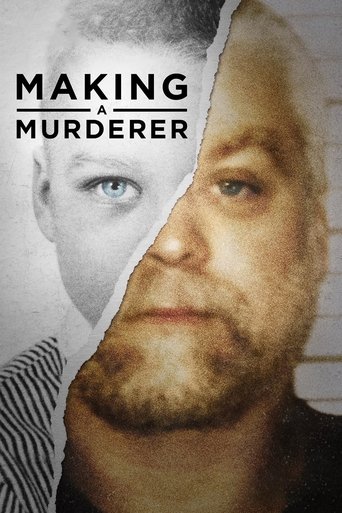
Making a Murderer
2015 · TV series · documentary · 60 min episodes · 2 seasons
Created by Moira Demos, Laura Ricciardi
Filmed over 10 years, this real-life thriller follows a DNA exoneree who, while exposing police corruption, becomes a suspect in a grisly new crime.
7 positive4 negative2 mixed6 neutralfrom 19 commenters
Where to watch
No streaming data for this title.



20 comments on Hacker News
I'm going to list just a few of the best I have seen so far:
- The Last Dance [https://www.imdb.com/title/tt8420184/]
- Night Stalker: The Hunt for a Serial Killer [https://www.imdb.com/title/tt13651632/]
- Indie Game: The Movie [https://www.imdb.com/title/tt1942884/]
- The Staircase [https://www.imdb.com/title/tt0388644/]
- Making a Murderer [https://www.imdb.com/title/tt5189670/]
- Icarus [https://www.imdb.com/title/tt6333060/]
- Apollo 11 [https://www.imdb.com/title/tt8760684/]
The thing I find interesting with Netflix is how much they spend on content and what a terrible rate of return it has. Look at Apple TV+, they're absolutely TINY compared to Netflix in both library size and money spent on new production, but they have arguably more hits than Netflix. Like, since when has any drama on Netflix been as buzzy or as good as Severance on Apple TV+? When was the last time they had a comedy success like Ted Lasso?
They have a couple of things that are very good (including Russian Doll, which is better than the article gives it credit for). But it's the ratio the that's troubling: the value of [good shows] / [shows produced] is absurdly much lower for Netflix than for Apple TV+, HBO Max or Disney+. All their spending seems to result in is endless mediocre True Crime documentaries that try recapture the magic of the first season of Making a Murderer, and the occasional golden nugget you binge in a weekend.
The article makes a big deal of the binging thing, and I agree it's a terrible model compared to weekly releases. But I feel like Netflix's real problem is that they just don't make enough good stuff.
I only really noticed this when I watched Making a Murderer on Netflix. After each episode my opinion switched between "They were definitely set up by the police" and "They're definitely guilty." If the show had ended after one or the other episode I would have probably firmly held either view. Definitely impacted the trust I put in any media. Or rather the trust in myself to not be manipulated.
I'd go even further and say that the way most people treat "documentary" to be equivalent to "unbiased recitation of factual events" is problematic itself.
I love docs but often research the subject after watching and it's INCREDIBLY rare to see a doc that doesn't play fast and loose with the facts for the sake of creating a dramatic arc or thrilling moments.
It's ESPECIALLY true in "true crime" docs. The director has an idea of painting the subject as either sympathetic guy who was wronged by a corrupt system (Making a Murderer) or evil mastermind (The Jinx) just to give two recent examples.
Turned out years later the giant reveal at the center of The Jinx which made it such a viral hit was 100% manufactured by the director cutting up audio to make Durst say things he didn't. He also lied to the police about the audio so it wouldn't spoil the ending of the doc.
Jarecki never had to apologize for the blatant dishonesty in the doc, never had to give back the Emmy. It's still universally acclaimed.
https://www.nytimes.com/2019/04/24/arts/television/robert-durst-the-jinx.html
Sorry to rant, but the "documentary" film industry is a fucking joke. I have so many more examples...
> Either he's a scammer or Netflix is
From what I understand, Making a Murderer is basically one big lie-by-omission so my faith in other Netflix funded documentaries to value truth over sensation is quite low.
- https://time.com/4167699/netflix-making-a-murderer-evidence-left-out/
Are you saying Netflix hasn’t made quality shows that will last through 2039? I’d like to know which company you think has made close to the amount of quality shows Netflix has since 2014. Here’s part of a list I have for a content project. No company comes close to this output in recent history.
House of Cards launched February 2013 (7 seasons, finished)
Orange is the New Black launched July 2013 (7 seasons, finished)
Stranger Things launched July 2016 (3 seasons, 1-2 more)
—
Dark (2 seasons, 3rd is last)
Glitch (2 seasons, 3rd might never come)
Russian Doll (1 season)
Haunting of Hill House (1 season, anthology)
American Vandal (2 seasons)
Black Mirror (anthology, last season not that good)
The Crown (3 seasons)
When They See Us (mini-series, 2019)
Unbelievable (just came out)
—
Glow (3 seasons)
Kimmy Schmidt (4 seasons, finished)
Arrested Development (they tried, hard to get it all back together after years of being done)
Sex Education (1 season)
Bojack Horseman (5 seasons?) #animated
Mindhunter (2 seasons)
The OA (2 seasons)
Maniac (mini-series)
Wet Hot American Summer (2 seasons, but season 1 is the top notch one)
F is for Family (3? seasons) #animated
Big Mouth (2? seasons) #animated
—
Documentary mini-series
—
Staircase
Making a Murderer
Evil Genius
The Jinx
Wild Wild West
——-
There’s more I’m missing and I didn’t include a number of shows Netflix helps finance but isn’t the main financier or producer or original place of distribution. Shows like Glitch.
Of all the shows you mentioned the only ones I have watched is, OITB (left it at after watching S04 I think), Master of None (both the seasons), I realise that its a drama that leans toward being a rom-com but I do not watch rom-coms at all. Kudos to Mindhunter, indeed that was entertaining and right in my ballpark. Liked House of cards till the time Spacey was there, S06 disappointed me. Season 1 of Making a Murderer was outstanding, season 2 didn't catch my interest. Also the last comedy I watched end-to-end I think was Entourage (which was produced by HBO), The Office (US) and Parks And Recreation, not surprisingly Netflix doesn't stream any of these in my region, Prime Video does the last two and Hotstar streams Entourage.
These are good shows not great ones like The Wire, The Sopranos, Mad Men, BB, Six Feet Under you know about the stuff that critics rave about etc. I don't care if Birdbox was watched by all of Netflix's subscribers, thats precisely the sort of thing that I don't watch the majority of the time, you watch that thing once and you forget that you ever watched it again. I'm now on probably my sixth or seventh rewatch of The Wire, that should tell you something about my viewing habits and why Netflix's content just doesn't work for me. I don't expect a network to consistenly churn out shows like that but at least some of the shows should be somewhere close to that level which HBO continues to do with The Deuce, Succession, True Detective(I know they fucked the dog on S02) etc.
Also you have the time to watch ALL of that, I don't. I work in tech too, I have an hour on weekdays and maybe 2-3 on weekends for leisure, so its only natural that I would be picky about what I watch, the absolute best, currently that would mean shows like The Americans, Escape from Dannemora and shows from the past like Halt and Catch Fire(from AMC), Six feet under, Deadwood which not surpisingly were also made by HBO. Netflix doesn't stream any of that.
I also don't understand how you think AMC won't exist, are they going to be insolvent ? Doesn't look like it, they have a cash-cow in The Walking Dead(I only watched till S06 then got bored) They got two of the best TV shows I liked BB and BCS, BCS is gonna kill it in the next season. They also produced The Terror, a brilliant mini-series which Netflix didn't stream as well and again Prime Video did. As a viewer I don't care about Netflix's subscriber numbers or HBO's lack thereof, I want to watch content I like which sadly Netflix doesn't produce on a consistent basis, this is entirely subjective and I realise that I might be one of the edge-cases in all the millenials when I say Netflix don't tickly my fancy.
I'm not biased towards HBO, hell HBO doesn't even stream in my country, I'm incredibly picky about what I watch since I'm short on time, Netflix churns out a LOT of shows, its only natural that some of them turn out to be brilliant and some of them indeed are, but the rest, like 90% of the shows are just average, they don't work for me, I simply do not have the time to watch them.
In that sense, Netflix is like the Y-Combinator of producing original content. You produce(invest in) hundreds of TV shows(startups) and hope one of them makes it big (becomes a unicorn) and the rest of them, well they would be probably cease to exist after some time.
Mad Men didn't even have an audience when it aired (<2 million viewers most episodes), and airs on a network that likely won't exist in 5-6 years (or at least won't be producing new content), so it's not super clear to me what your point is about those shows as evidence of how a network grows. The way a network grows is by producing content people want to watch, whether that's disposable content made to last a minute or content made to last the test of time. HBO isn't growing because people are subscribing to watch Sopranos re-runs.
Past reporting suggests churn in most subscription content services is very low, so your Netflix cancellation may be unusual. I'd also add that exclusive content is one part of the story, but there's also a lot of licensed content that's very good on Netflix as on other services.
But for what it is worth, I would rank the following Netflix originals to be "top tier" within their genre -- some of these genres lend themselves more to rewatching than others, and some are closer to my taste than others, some held up in quality through their run more than others, so in a sense I am ranking shows based on their peak quality --
Orange is the New Black; Bloodline; Stranger Things; The Crown; Gilmore Girls AYITL; The OA; A Series of Unfortunate Events; Mindhunter; The Haunting of Hill House; Unbreakable Kimmy Schmidt; Master of None; Love; Lady Dynamite; Santa Clarita Diet; GLOW; American Vandal; Maniac; Bojack Horseman; F is for Family; Disenchantment; Hilda; Dark; The Rain; Elite; Chef's Table; Making a Murderer; Shot in the Dark; Wormwood; Wild Wild Country; Salt Fat Acid Heat; Queer Eye; The Curious Creations of Christine McConnell; My Next Guest Needs No Introduction; Lilyhammer; Terrace House; Alias Grace; The End of the Fucking World; Collateral; Wanderlust; Longmire; Black Mirror; Comedians in Cars Getting Coffee.
In addition to these, the following shows are Netflix originals in my region, indicating that although someone else initially funded them, Netflix bought them for exclusive distribution here, and also meet the above requirements:
Babylon Berlin; Bodyguard; Casé; Crashing; Cuckoo; Derry Girls; The Great British Baking Show; Happy!; Happy Valley; The Investigator; Peaky Blinders; River.
I have pretty broad taste in TV and watch a lot of TV while I am programming or running data analysis, so maybe the breadth of stuff I include here is surprising to most. But to the extent your post is a useful anecdote about how Netflix has no great shows, I'm responding to your challenge to "Name one show" that would meet that criteria.
(These are TV shows only, not films. I haven't really liked many Netflix original films although there are a few I would say are great, like Okja and Roma)
Someone recently commented elsewhere that they were tired of paying for streaming access to a bunch of shows nobody wants to watch, and they wanted access to the most popular movies/network shows/whatever.
I didn't comment then, but FWIW: some of the best shows available are now streaming originals from Netflix, Prime, etc. If you haven't checked out specifically any of the Netflix originals, you're missing out. It's a complete replacement for the non-sports watcher.
As posted in response elsewhere below, here's a list of Netflix's best work:
- Stranger Things - Narcos - The OA - The Haunting of Hill House - Marvel series. All of them! - GLOW - Ozark - Altered Carbon - American Vandal - 13 Reasons Why
Also good:
- Atypical - Love - Flaked - Maniac - Master of None - Chef's Table - Making a Murderer
This is by no means a complete list, you can find that here: https://en.wikipedia.org/wiki/List_of_original_programs_distributed_by_Netflix
I tried to skim through it and provide my own short list of what I really liked, so this is just one person's opinion.
Keep in mind that 'Making a Murderer' is heavily dramatized for television purposes. Also the show purposefully leaves out information,
https://onmilwaukee.com/movies/articles/evidenceagainstavery.html
Making a Murderer season 2
You're going to have to provide a lot more than that one example to show me that Singapore is a "totalitarian" state. Just recently the entire State of Louisiana's "Justice" system was shown to be in cahoots with the private prison industry, for example. And judging by the "Making a Murderer" documentary, our entire judicial process resembles a totalitarian police state circus much more than any other developed nation. Singapore is a "totalitarian" state? Fine, by your standards, the US is a 2nd rate Banana Republic.
While compelling, the most frustrating thing about "Serial" was the narrative manipulation. Audience manipulation is the hallmark of any documentary, but in the type of chronological style that "Serial" and Netflix's "Making a Murderer" chose, it is much more deceptive. "Serial" didn't pay off--the central enlightenment is tepid observations that "memory is faulty" and/or "it's hard for journalists to ferret out truth". "Making a Murderer" at least sounded a ringing indictment against the criminal justice system as a whole, and corruption of petty incompetents holding power. "Serial" seemed like disjointed TAL thinkpieces strung together.
This reminds me of "Making of a Murderer"[1] documentary on Netflix.
[1]https://en.wikipedia.org/wiki/Making_a_Murderer
Making a murderer season 2?
Shouldn't a man with a cudgel be able to beat a dog in a duel?
>But neither “Serial” (which is otherwise notable for its thoroughness) nor “Making a Murderer” ever addresses the question of what rights and considerations should be extended to victims of violent crime, and under what circumstances those might justifiably be suspended. Instead, both creators and viewers tacitly dismiss the pain caused by such shows as collateral damage, unfortunate but unavoidable. Here, too, the end is taken to justify the means; someone else’s anguish comes to seem like a trifling price to pay for the greater cause a documentary claims to serve.
Aww come the hell on! The public has a very strong interest in monitoring the criminal justice system. We cannot do that without knowledge of the crimes and the victims. Yes, it sucks for them. Crime is bad. But the public cannot hope to establish and direct a justice system capable of deterring crime without learning facts about actual prosecutions, which unfortunately includes information about the victim and what was done to them.
Besides, the vast majority (possibly all, IIRC) of the footage of Hallbach's family consisted of public interviews of her brother. You can't repeatedly and voluntarily thrust yourself into the media spotlight and then cry foul when people use that footage.
What serious journalist really thinks this is a reasonable argument to make? Are we supposed to turn a blind eye to police corruption and inadequate due process because it makes one person and their family uncomfortable?
Yes, Serial first season engaged by laying out a larger and deeper story as it progressed, and was driven by the audience's curiosity to see what new evidence comes up that may change their view on previously presented evidence. Making a Murderer seems to (I'm only 6 episodes through) feed off the audience's impotent rage at injustice.
> But what the documentary really showed me was how utterly corrupt, venal, incompetent and evil the entire system of justice can be, from the 'court appointed lawyers' all the way up to the sheriffs that clearly, unequivocally framed Avery.
Which is an example of what the article was actually about. You've seen a documentary that by some accounts is very biased, and is presenting information to you in a specific way, and neglecting to mention other information that is not conducive to the opinion they are pointing the audience towards. Is it impossible to believe that the evidence presented to you might have lead you to believe something "clearly, unequivocally" which when all the facts are present may not seem nearly as cut and dry?
For that matter, Making a Murderer was not really the subject of the article, just the prime example with which to express its point; Courts of last resort have little oversight, and can be used to manipulate the public when not held accountable for biased presentation. If anything, your comment unwittingly bolsters the original point.
The article equates prosecutorial misconduct to force a guilty sentence with editorial choices in a documentary. Because both show "bias". In the one case it's utterly illegal and it undermines the moral validity of the justice system and in the other case we're talking about a simple exercise of free speech, but apparently this distinction isn't meaningful in the eyes of the author.
The quote in question: "The point of being scrupulous about your means is to help insure accurate ends, whether you are trying to convict a man or exonerate him. Ricciardi and Demos instead stack the deck to support their case for Avery, and, as a result, wind up mirroring the entity that they are trying to discredit."
This equivocation is morally repugnant.
The article also gets their facts wrong. They claim: "Investigators subsequently found DNA from Avery’s perspiration on the hood latch—evidence that would be nearly impossible to plant.". This is a fabrication. There is no distinction between blood DNA, sweat DNA, skin DNA. DNA was found under the hood latch, but no blood was seen. Hence a logical conjecture is that the source is perspiration, but it could have been any other source. As for it being hard to plant, that's laughable. Simply swipe a t-shirt or dirty sock on any surface and it will leave DNA behind. None of Avery's finger prints were found on the car, and finger prints ARE hard to plant. In contrast to DNA, which IS trivial to plant if you have access to somebody's apartment.
The charge that the documentary is bad because doesn't display a clear timeline of the events doesn't make sense, because it's the responsibility of the prosecution to explain what happened, and they didn't have a single narrative that was consistent with all the evidence. Which is why the prosecution's story of what happened was completely different in Avery's and Dassy's trials.
Juries don't believe police officers would ever lie during testimony. They believe the police are the good guys who just want to catch the bad guys. The public has to let go of this naive view of the world, and look at all evidence presented during a trial with healthy skepticism. The 'Making a Murderer' documentary teaches people to be skeptical about claims by the police, which is a great public service.
The article closes by reiterating the terrible equivocation they made earlier. That exposing prosecutorial misconduct is somehow only permissible in a completely unopinionated format. The New Yorker should be ashamed for publishing this trash.
If this is indeed forced by content creators, I think it is counter productive. They will just give more incentive to Netflix (and Amazon and others) to create they own content, as third part content lose them money.
Perssonal view: the "Original Netflix Content" sign already give me a more value perception. Between a recycled TV show and a new one by Netflix, I always chose the new on by Netflix. So far I watched all of: Daredevil, Jessica Jones, Making a Murderer, House of Cards, Narcos, Sense8, Bloodline, Orange is the new black, Master of None, Better Call Saul.
And I'll probably keep watching the next seasons of all of them.
Outside of Netflix, I only follow the very best ones (IMO): Game of Thrones, Breaking Bad (that's over) and Walking Dead.
What this means? I consume only the very best hits that these other content creators produce. For casual, day-to-day entertainment, that covers 90% of the time, I stay with Netflix.