 Hacker Cinema
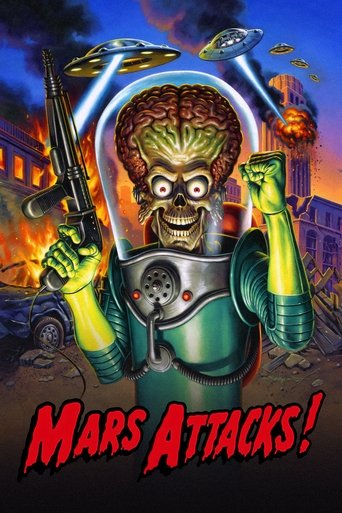
Mars Attacks!
1996 · Film · 106 min
Directed by Tim Burton
A fleet of Martian spacecraft surrounds the world's major cities and all of humanity waits to see if the extraterrestrial visitors have, as they claim, "come in peace." U.S. President James Dale receives assurance from science professor Donald Kessler that the Martians' mission is a friendly one. But when a peaceful exchange ends in the total annihilation of the U.S. Congress, military men call for a full-scale nuclear retaliation.
3 positive1 negative12 neutralfrom 16 commenters
Where to watch
No streaming data for this title.


16 comments on Hacker News
I could live with Mars attacks. The portrayal of Colossus' inhumanity was unbearably sadistic. I can understand why it was never made into a movie.
For any one not familiar with this cult classic film from the 1980s, you can view the trailer here: https://www.youtube.com/watch?v=PeB3vdxF_jM
In short, aliens have invaded earth, but wear a special skin to appear human. To average people, they appear and sound identical to real humans. The lead character discovers that special sunglasses can show the aliens without their human-like skin. (They look a bit like the aliens from "Mars Attacks".) When wearing the sunglasses, most outdoor adverts are replaced with bland single-party-state-style propaganda encouraging people to consume, work hard, and follow the rules.
I can honestly say that the trailer does no justice for the film. It is much better than the trailer. When I saw first saw this, I was genuinedly spooked. One half of the film is good fun 1980s alien invasion beat 'em up, and the other half is a thoughtful commentary on the age of consumerism.
The American Sign Museum in Cincinnati (https://www.americansignmuseum.org/) is good if you like neon and advertising. They have an on site shop where you can view repairs being performed.
The Boneyard in Las Vegas is also worth seeing. It was featured in one of the Danny DeVito scenes in Mars Attacks.
> You're saying there is no objective truth, and there is not point in trying for it?
Not exactly but kinda. I'd like to think it's less nihilistic than this makes it sound, at least. Here's a definition which I think is a good working one:
https://www.wordnik.com/words/bias
> A preference or an inclination, especially one that inhibits impartial judgment.
To attempt to answer the question directly, there is still agreed truth, such as in the practice of law where a judge decides what facts are relevant to the case. In that context, the legal framework is, barring appeals, simply to accept the judge's "truth"; at least, once they've made their decision. To prevent that from devolving into madness, we train lawyers and judges to understand the meaning of certain legal terms so that they all have a similar understanding and can argue using terms which have an agreed-upon meaning. Still, there is much bias in this. If there wasn't, there would be no need for lawyers. The closest thing we get to objective truth is something like 1 + 1 = 2, but it's still agreed truth.
There are facts, but even the reporting of facts can be biased. Which facts you report, the context in which they're reported, the details that are included, the order in which they're reported. These choices have an effect on how the facts are interpreted; they are a bias. If I want to say, "The sky is blue and the Blue Man Group are entertainers," but you want to say, "Mars is called the red planet and Mars Attacks! is a movie," who is being less biased? Is a news article that reports, "Mars is called the red planet and the sky is blue," more or less biased than either of the other statements? Is one more objective than the other? How come the author didn't mention the tall smurfs if they're unbiased? Surely reporters aren't required to report all of the facts in every instance. How do they, unbiased, decide which facts are relevant to their report?
With the idea of "reducing bias", it is obvious that in order to verify that bias has been reduced, one must accurately measure "how much" bias there is. So how do you do that? Further, how do you do it in an unbiased way? How do you even know if you're doing it in an unbiased way without an unbiased measurement?
Another way to think about it is in terms of opinions. How do you express an opinion without bias? How do you express the same opinion with less or more bias? Is, "I don't care," less biased than, "I care a lot."? Is, "This makes me angry," more biased than, "I'm indifferent to this."? I would say they're equally biased. At least, I can't come up with a good reason to claim that indifference is not a bias. So, neutrality is a bias. I'm not sure what isn't a bias. I guess a bare fact. But, again, that doesn't mean the presentation of a fact is not without bias.
To give an example, it is a fact that Donald Trump is serving his second term as President. Do people often present that fact without bias? It's also a fact that Donald Trump has not served two consecutive terms as President. Is that presented without bias? Both of those decisions are biased: minimally, why would one present either of these facts in a given context?
Or an example of indifference: if someone says, "I don't care about Biden's capability to serve as President," does their indifference suggest a lack of bias? Is it more or less biased than, "I think it's bad that Biden is President given his apparent senility."? Is it more or less biased than, "I think it's good that Biden is President given his apparent senility."?
Biases are simply different or the same, neither lesser nor greater. I don't know how I could even go about measuring bias without introducing bias.
it's sad to see this location go. it was such an amazing store on the inside. the theme had some great homages to Mars Attacks!, as well as a great many other sci-fi films. this album has some good pictures of some of the more notable sculptures in there, but the theme went even farther than just sculptures: https://www.flickr.com/photos/selfishcauses/albums/72157714056311057/
I work at Google, and I didn't even know that there are good movies you can watch for free with a YT Premium subscription until I saw this article:
https://www.youtube.com/feed/storefront
Includes Roger Rabbit, Billy Madison, Good Will Hunting, Wayne's World, Mars Attacks, Grumpy Old Men, Osmosis Jones, the 90s TMNT movie…
As already mentioned in the movie Mars Attacks, the more interesting question is whether there is intelligent life on Earth.
Here are some of my favorite movies: The Graduate, Taxi Driver, The Fearless Vampire Killers, Badlands, Mars Attacks, The Grand Budapest Hotel.
Most of them don't really satisfy this formula, except for trivial points like the protagonists wants something and the protagonist has changed or if you're deliberately trying to fit them by being extremely vague.
The reason is that there are many different types of stories and these can have very different internal structure. For example, Space Opera in science fiction is often just a fight of good vs. evil set at many different interesting locations. Of course, some protagonist should develop, hence change, and it's good to have some kind of unexpected plot twist, but these are trivialities.
Stern only does themes that are a licensed intellectual property, since around 2003. And even more specifically, they only do licenses that are a franchise rather than any specific individual movie, since that will become dated. (The one notable movie exception was Avatar, and original property exception was Whoa Nellie.)
Also, Williams' Attack From Mars wasn't a knockoff, it predated the Mars Attacks movie by a year, it was just coincidence that the two industries parodied the same thing around the same time.
Believe it or not, that actually happened back in in '96. There's a documentary on it called 'Mars Attacks.'
Akakakakakakakakakak
what do I learn from that? I will not talk with a Microsoft representative before they pay me at least 5000 US$ consulting fees.
Never give them something for free, not one minute of my precious lifetime.
They seem to me as 'friendly' as the aliens in the "Mars attacks" movie.
> I have thousands of non-fiction (mostly self-improvement) books in my reading list on GoodReads, but almost never bother to read any.
> The last few books I read were mostly filled with fluff, anecdotes, stories, jokes, and trivialities.
> I thought that online content was roughly equivalent to 80% of what I'd get from reading actual books for 20% of the effort.
For self improvement and pop-business books, it's more like you can get 99% of the value from 5% of the effort by reading about the book, or skimming it, rather than reading it closely.
> Are books worth it?
You need to know what this "it" is first. I don't mean that flippantly. Do many people find reading books useful or enriching or valuable? Oh, yes, certainly. Now: worth what? To you? Are films worth "it"? Are Casablanca, The Seventh Seal, the Up documentary series, Manos: The Hands of Fate, Cave of Forgotten Dreams, Mars Attacks!, and Debbie does Dallas, worth "it"? Are they all replaceable with a bunch of 5- to 15-minute Youtube videos?
> Is it more true for some fields than others?
Self-improvement, pop-business/leadership books, and generally anything written to sell consulting services (there's a lot of that in both those categories) are regarded as kinda jokes. If you're looking there for wisdom you're combing the desert for a pearl.
> Is it more true for older books?
The filter is that if a book is still considered good decades, centuries, or millennia after it was written, it very probably is good. Good books somtimes don't pass this filter (these are periodically rediscovered) for various reasons. But almost no bad or low-value books pass it.
> Isn't most of the information from books freely available online?
Not at all. Start studying any topic past the surface level and the only way you'll get any further "online" is buying or pirating ebooks. Keep digging—not even that far—and you'll find some that do not exist in digital form, not even on Library Genesis. If you want to seriously learn about a topic, pick up a good academic book on it, then follow up on all the books they (very probably) mention in their introduction as other major works on the topic, and maybe also the books that book directly credits as references. Often this is a faster and more accurate way to learn what the expert consensus of "foundational" works in a topic is than trying to find that out online, let alone trying to learn the information contained in those works purely online, without books (usually impossible).
> Am I missing out?
What is "it"?
> One issue for me is that books are a very big time investment. I read very slowly and I don't remember everything I read either.
Take notes.
> Even if I wanted to read books, I just don't know which ones I should start with, out of the 1000 "must-read" books in my reading list.
Stop. Pick, like, five that seem really important or that you just most want to read. Aim for variety, don't pick five all on the same topic. Ignore the rest until you're done. Don't even think about them. If you're not going to finish five there's no damn point in maintaining and stressing out over a list of 1,000. They'll still be there when you've finished your five.
One further note: as hinted at by the movie comparison above, reading a book is a process and that process is part of the effect of the book. The time it takes, the curation or generation of material by one author or editor or a team of same working together, the focus and intention of the creators, these matter. Reading 200 blog posts is not the same experience as reading a book, even if they mostly cover the same territory. A tree can become boards, but boards cannot become a tree.
remember that movie "mars attacks" how the humans kept falling for the ruse, martians want peace we just had some misunderstandings, lets try again, then the martians screw them?
This whole situation looks like that movie. MS has started convincing people to trust them once again, after capturing sovereign territory. The thing that allowed this was the hope that a centralized service [github] will stay as is forever. this should be the poster child for distributed peer to peer sharing.
I think that, like Mars Attacks and Starship Troopers, it's a movie that one benefitted a lot from expecting a B- or C, and being pleasantly surprised by a B (or B+)-ish experience.
Every time I hear Thai language spoken I'm reminded that this tonal language inspired the creators of "Mars attacks" to what the fictional language used by the aliens should sound like, just because it sounded so alien.
I have to say though that the Thai language can be spoken relatively calmly and soothingly, but when spoken by in anger or in a particular kind of formality, it sounds quite similar to the language used in the movie. Doesn't matter if it's a male or female speaker, to a westerner it sounds like.. well, the crazy martians from Mars Attacks.
This is actually mentioned in the extras bits on the original Mars Attacks DVD from like 1998 or 1999 or so. They did use Thai language as the main inspiration for the language of the martians.
Just like "Mars Attacks!" is a good movie about the perils of an alien invasion. If things that will never happen in our lifetimes can legitimately be described as perils.