 Hacker Cinema
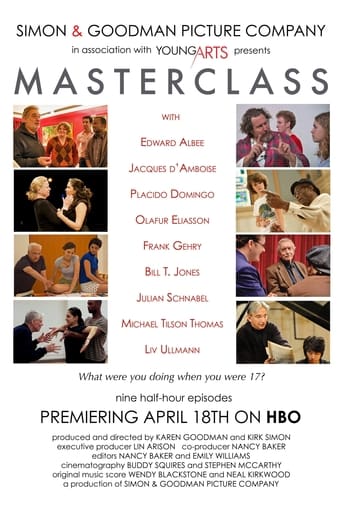
Masterclass
2010 · TV series · documentary · 30 min episodes · 3 seasons
Created by Karen Goodman, Kirk Simon
MasterClass is a documentary television series airing on HBO. Each half-hour episode documents the experience of a small group of young artists working with a famous mentor. The series premiered on HBO on April 18, 2010 with opera star Plácido Domingo working with three aspiring young singers. The students in the program are chosen from participants in the Miami-based organization, YoungArts, a program of the National Foundation for Advancement in the Arts, which supports emerging artists. The series is produced and directed by Karen Goodman and Kirk Simon of the Simon & Goodman Picture Company. The Executive Producer is Lin Arison. In July 2011 the series was nominated for a Primetime Emmy Award for Outstanding Children's Nonfiction, Reality or Reality-Competition Program in 2011.
1 positive2 negativefrom 3 commenters
Where to watch
No streaming data for this title.



3 comments on Hacker News
I just watched the first 8 out of 12 episodes and I was disappointed. There were certainly a couple good nuggets but I'm afraid that Masterclass puts too much emphasis on making things simple such that he spends most of the time talking about really simple ideas.
I'm the same.
I've always despised (for example) Gordon Ramsay's abusive style and never quite understood the appeal of a show that demonstrated such bad treatment of fellow humans. I don't care how you dress it up -- high standards, toughening them up etc. etc.-- it's just a fucking horrible way to treat people.
And even if you can somehow justify it, what is it about working in a kitchen of all places that necessitates treating staff like utter shit? I can think of much higher stakes careers where this type of treatment would never happen nor be deemed to be "required" for any reason whatsoever.
It's even more reprehensible when you consider the position of power these people are in, and how those keen to get into the industry are more likely to submit themselves to this demeaning behaviour for the sake of their career.
And even even more so when you consider what a wide reach these people have in terms of audience. How many young people are they being a bad role model for.
Finally, an admission of hypocrisy on my part (given the above); I recently watched and enjoyed quite a few episodes of Gordon Ramsay's courses on Masterclass, where mercifully he is alone in his kitchen, with no one to abuse, and is actually quite cordial and charismatic. I've never given a crap about cooking before, and watched an episode on a whim and found myself quite inspired. So that at least seems to imply that there is an alternative way of presenting cooking shows without ripping junior staff to shreds. (Or alternatively, it implies that I'm a hypocrite and you should ignore everything I say).
On the flip side, this approach to learning means you know next to nothing beyond the dozen first bits of terminology or buzzwords for each new topic, much less the concepts. The moment you finally meet someone interested in discussing one of these things, its going to be immediately apparent the basis of your knowledge is a brief article/book or a weekend watching videos on youtube. Furthermore, these are all going to be little self-contained treatises without any prerequisites -- they are written for a general audience, so you are completely limited to, as the article describe it, the appearance of mastery to people who don't know better.
What's worse is that you seriously have to question the qualifications of any single source claiming to be a valid resource for a wide range of topics. Even if the individual course is written/taught by an expert, they are paid or motivated by another entity with their own set of bureaucracy and expectations. What works for learning tennis isn't going to produce the same class format as what works for learning Film Scoring (I'm looking at you Masterclass, for producing that joke of a class).
In my mind, the best approach to learning requires you to initially commit to either a top-down or bottom-up strategy. If you want to master the topic, you should go bottom-up; focus initially on theory and gradually more on practice/experience. If you want to ramp up as quickly as possible, go top-down and experience something for a more general audience to get a taste. If you like it, you can keep pursuing that route or commit towards a more bottom-up approach, which provides a higher ceiling albeit on a longer timeline. But don't go to a general resource like the one in the article, go directly to the expert's material, first-hand, for the raw, unadultered version.