 Hacker Cinema
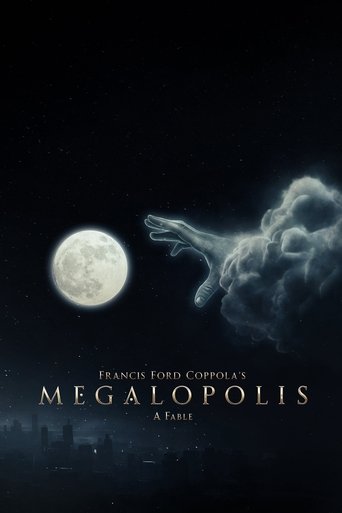
Megalopolis
2024 · Film · 138 min
Directed by Francis Ford Coppola
In a futuristic New York known as New Rome, visionary architect Cesar Catilina dreams of building "Megalopolis," a utopian city that redefines society’s limits. Opposing him is the corrupt Mayor Franklyn Cicero, who clings to power and profit. Between them stands Julia, the mayor’s daughter, whose love for Cesar forces her to choose between loyalty, ambition, and the fate of humanity.
7 positive13 negative3 mixed11 neutralfrom 34 commenters
Where to watch
No streaming data for this title.


35 comments on Hacker News
Corporations want a reproducible formula that can scale. Creating movies (and TV) is an inherently creative process. The people who end up running these businesses hate that but creativity doesn't scale. This is why reputation and track record is so important in getting any project greenlit. So the likes of Steven Spielberg, James Cameron or Christopher Nolan have a lot of freedom. They can't quite make what they want. A studio still has to bankroll the project and they may not like it. This is how Francis Ford Coppola ended up self-funding Megalopolis and, well, the studios were right to pass, let's be reeal.
This is also why we get so many sequeals, remarks and reboots. It's a property with a proven track record. That's so much easier to get greenlit.
The other thing that happens is that corporations (including studios) can only increase profits by cutting costs and raising prices. And this last one has basically killed the ecosystem upon which movies (and TV) depend. Let me explain.
Once upon a time, LA was relativvely cheap to live in. This allowed people to live there and work on getting their break while working flexible, often service jobs. Waittressing, hosting, that sort of thing. It could be anything, really. But it has to be flexible enough to take time off to go to auditions and jobs and whatnot. It is very difficult to make a full-time career out of working in this industry. If you're an actor and you, say, get a principal guest role on a TV series you might make $1000-2000/day but you only end up working 1-2 days on that every 3 months. You can't live on that. Recently there was a piece on the actor who played Sam in Lord of the Rings having to sell his house even though he made $250k for the 3 movies. That was over several years.
This isn't just for acting. Lighting, camera work, production, direction, editing, writing, special effects, costumes, etc etc etc.
What sustained people were residuals and the relatively low cost of living. Residuals for TV basically got killed by streaming. A lot of movie projects became unsustainable when the VHS/DVD/Blu-ray revenue pipeline dried up. Matt Damon spoke about this.
But the other thing streaming killed was the network TV pipeline. A bunch of screenplays would be written (and sold). I'm talking hundreds. A handful of those would be made into pilots. These days that's maybe 10-15 per year. Previously it was 50-100+. A certain number of those went to a half then full series order of 22+ episodes. Getting one job could sustain you for the year.
Streaming came along. The residuals went away. Those 22 episode seasons became 8-12 episode seasons every 2-3 years if you're lucky. There was no syndication money anymore. Working people in the industry relied upon residuals in dry spells to make a living. And suddenly you needed 2-3 jobs a year instead of 1 and that's really difficult to get and, even if you get it, to schedule so they don't conflict.
And then obviously ticket sales in movie theaters were in decline and fell off a cliff with the pandemic. Starting in the 2000s you had the shift to save costs to places like Atlanta, Vancouver and Toronto. Productions started chasing tax credits all over the world and would immediatley leave when they ended.
Let me elaborate on just one example: writing. To get into this field you generally would start as a production assistant ("PA"). This would generally be an unpaid position initially (an "internship"). At some point if you didn't screw up, you might start getting paid. Then you'd be the assistant to a writer. This would give you experience in a writers room. Hopefully whoever you worked for would give you feedback and teach you things. The next step would be to get a staff writer job. Back in the day you'd get paid for 22 episodes. You'd be on set for filming and you'd learn production. Most producers came from a writing background. Eventually, this career would lead you to being a showrunner. Think Shonda Rhimes or Vince Gilligan or Matthew Weiner. Weiner in particular learned his craft and earned street cred as a staff writer on The Sopranos and he tried to sell Mad Men to HBO.
Now what happens if you get hired to write 8 episodes instead of 22 so you'd getting one-third of the pay. Your job is over before shooting starts so none of these young writers are getting experience to become producers and ultimately showrunners.
It's a bit like how some companies stop hiring juniors and just overwork seniors with the threat of layoffs. Well, those seniors used to be juniors. Don't hire and train juniors and eventually there won't be any seniors. Same thing.
I guess the short version is: streaming killed Hollywood.
To be fair: the quality of movies produced by Hollywood has gone rapidly downhill already in the 1990s. You only need to compare the movies Quentin Tarantino makes; now personally I think Pulp Fiction is still by far his best work, but I concede that the movies he created lateron were above average (though I would not go as far as many others, who'd rate these in the 8 to 10 point ranges; I'd go more between 6 to 7 or 7.5, largely because there are a few smaller issues cropping up and I always notice these when I compare them with Pulp Fiction, which was really good; actually really well-made).
I noticed this in the 1990s in many movies. For instance, Independence Day - the computer animation pissed me off. I found them bad. Even Terminator 2, where evidently many people say it was great, I was nowhere near as convinced; I found the first terminator better and more "logical" and more consistent, too. But things decayed quickly in the 1990s really. Even movies such as Avatar I find total garbage. And while I am not totally against superhero comic/marvel adaptations (I liked xmen and in particular Hugh Jackman as wolverine), these are always the same formula. Tons of CGI, big fights where nobody knows what is going on, very little thought elsewhere in that formula. There are exceptions, but by and large these things keep on happening. Individual directors manage to break out of the mold (Chris Nolan) but by and large movies really SUCK now compared to the "oldschool days". And while some of this may be due to me becoming more critical, the production quality just sunk. Take movies such as Megalopolis - this captures what is going wrong. It seems as if the whole movie industry has partially collapsed in the last +25 years and they don't really know what to do to change this. The same has happened to games, by the way. It is almost as if only one formula exists only now.
One of the more ridiculous scenes in the movie megalopolis highlighting the downfall of modern civilization by putting the oligarchs into a feast/orgy around a satirized version of a Roman coliseum.
quite odd. atmosphere is the right word. the financial failure almost guarantees Megalopolis is unique. id say its ripe for reevaluation in 10 years but good chance nobody really checks in out by 2034. Criterion might be able to give it a cult following?
i liked it a lot but was the only person in my tiny audience who seemed to genuinely enjoy it. other audience members couldnt help but talk about their confusion with each other afterward
it seemed like Coppola genuinely believed he could fix the world with the movie and spending any amount was worth it. instead we have an odd, artistic, and self-indulgent movie
Pretty sure for all the examples given at the beginning, these can easily be explained as natural parts of the writing process.
The Gladiator II example is just lampshading. If you just wrote "the prisoner grabbed the weapon the guard brought in to the cell, and then killed the guard with it" the very first thing someone's going to ask is "well why did the guard bring a weapon in?" and then the writer says "oh well he didn't consider it a usable weapon" and then "but clearly it is, so that doesn't really solve anything" and rather than coming up with a better escape method the writer just leans into the absurdity of it - the on the nose dispensing of folksy wisdom establishes that the guard is just an idiot rather than leaving the audience to contemplate the contrived situation.
For Megalopolis, “What do you think of this boner I got?” [he shoots her] isn't exactly a compelling scene when reading it. It makes a lot of sense to punctuate the scene with some emotion to make it make some sort of sense. Can this emotion be shown on film without dialogue? Possibly, but the writer can't be sure how it'll actually look, and they need to convey to both the actor and director what emotion needs to be conveyed. It sounds like placeholder dialogue which could be cut or changed as needed.
For the Apprentice, again the writer likely doesn't know exactly how the scene is going to turn out. Is "Trump Tower" going to be clearly legible on the model as the scene is shot? Do you even want to spoil it by showing the name on the model? The point is this is supposed to be a reveal.
In all three cases, these lines very well could be great with proper setup and delivery, or perhaps could have been reworked into great lines. The issue is just these are mediocre films. None made any serious attempt to polish their scripts. It's not a deliberate tactic to dumb down movies or deal with poor attention spans, it's just the makers of the movie saying "eh, good enough."
Quite a bad piece, the end note is ironic: the author doesn’t seem to be paying a lot of attention for a film critic apparently interested in litteralicity.
> An earlier version of this article incorrectly described the ending of “A Complete Unknown.”
I cannot see any common denominator in the multiple examples that the author gives and cannot relate to them (what point is there to put on an equal footing a micro analysis of a dialogue in Megalopolis -voluntarily grotesque- and the choice of film format in The Architect?).
Maybe there’s an intuition here, but I feel it is not well illustrated. The author probably hopes that she will be remembered for coining this wishy washy concept.
I'm glad you bring up Kojima, because I think he's a master of this New Literalism. I just watched my partner play Death Stranding 2, and it feels like every other cut-scene has an NPC turn to camera and explain the themes of the game. And I love it! And it doesn't detract from the games ability to express those themes through metaphor and game-play.
Obviously subtlety is good, but choosing to be very literal can be an interesting artistic take. I don't think Kojima was thinking about how to dumb-down his message for audiences. I think its a genuine artistic choice rooted in his style. While I didn't like it for other reasons, I think the same can be said for Megalopolis. I loved the scene were it's just a full screen interview with Catiline, even if it was kinda dumb.
There's probably something interesting about how both the ten thousandth grey-CGI marvel movie and these more experimental artists are drawn to hyper-literalism in the now, probably with some thoughts about the social internet thrown in. I'll have to think about it.
Hollywood has always been a little bit dumb, a little bit over-written. It's hard to have both artistic individualism and a reliable business. This is not a new trend.
The examples are not very good. I would take Gladiator II, but Megalopolis was a self-funded project which is completely out of left field, and The Apprentice... I'm not sure what it's an example of. Many more titles are dismissed with a couple words. They really lose me when it comes to Anora. That's quite possibly the worst take I've heard about that film yet, and I've read some Letterboxd reviews.
> What feels new is the expectation, on the part of both makers and audiences, that there is such a thing as knowing definitively what a work of art means or stands for, aesthetically and politically.
Before rushing to judge today's movies, shall we remind ourselves what popular movies 20 years ago were? There were some real stinkers there, too, and they were not more smartly written in this regard. They just weren't.
> The point is not to be lifelike or fact-based but familiar and formulaic—in a word, predictable.
Has this person forgotten Titanic, one of the best-selling movies of all time? It's extremely formulaic, predictable, and intentionally so. It's basically opera, not really a new genre.
> Nearly every movie released by a major studio in the past year based on an original script or a little-known book has been a box-office disappointment. Before this weekend’s flops were Warner Bros. Discovery’s “Mickey 17” and “The Alto Knights,” Paramount’s “Novocaine,” Apple’s “Fly Me to the Moon,” Amazon’s “Red One,” and the independently financed “Horizon: An American Saga Chapter 1” and “Megalopolis.”
These were all bad movies (Below 7 on IMDB), including "Drop". Most had a redeeming feature though.
The problem is multiverse that's bad still does OK, "Snow White" hopefully will make a loss but it's still pulled in $181 million so far.
2024 Box Office, hard to find an independent movie too low - https://www.boxofficemojo.com/year/world/2024/
"Juror #2" is probably the worst as a solid movie for the genre and probably Clint Eastwood's last. It was mistreated by Warner Bros.
Megalopolis. I didn't love everything about the movie, but it did come across to me as completely divorced from art created to benefit commerce. I loved that about it...
You could argue the movie being made outside of the traditional studio system is case and point of this phenomenon.
Maybe I'm confused then. So one would be permitted to post on Twitter:
"khazhoux said yesterday: 'Megalopolis is the greatest film of the 21st century'"?
I thought the point was you can't attribute -- no names. And without a name, it's not actually a public quoting...
>Coppola is 85. How many octogenarians are still creatively significant?
Can they even be in the eyes of the audience? I saw Megalopolis a few days ago and I think it's more creatively ambitious, weirder and interesting than a lot of the stuff he's made. But people even in principle won't grant this because of the narrative you describe.
People don't judge output by old artists on their own merits, they always project their age and biography on it regardless of the content. The reverse is also true, a lot of "young genius" work often isn't what it's made out to be, but the fact alone that some Wunderkind made it convinces the audience. David Foster Wallace I think is someone who heavily benefited from this. If a young artist made Megalopolis today as their first film I think it'd be framed very differently, but because of how much legacy Coppola and the movie have it's just not going to be treated the same way.
>> "... artists lose their ability to make art when their brain is infected by money and power."
I disagree. It's largely age based. Especially for filmmakers as novelty is part of the appeal of movies. As the artist ages, I think Yeats said it best: "What can I but enumerate old themes".
Coppola is 85. How many octogenarians are still creatively significant? Yes, they can still put out an album or a film or a book, but their best days are behind them.
Coppola paid for "Megalopolis" out of his own pocket. He wrote and directed the story and cast the actors that he wanted. What is art in its purist form but the self-expression on an individual?
Previously, Coppola mortgaged his home and went legendarily overtime and overbudget for "Apocalypse Now". That's regarded as a classic and was lauded in its time. "Megalopolis", not so much, though time could add a new perspective, as sometimes art becomes more favorably viewed upon reflection.
That happened to Spike Lee, with his "Malcolm X" movie. The big problem was length. The completion bond company pulled the plug at one point. Lee found enough rich black people to bail out the production, and eventually released the 202 minute version. It was a critical success, but just too long to make money in theaters.
With the notable exception of "Gone with the Wind", few Hollywood films over 3 hours made money.[1] This is less of a problem today, because there are alternatives to theatrical distribution. Long-form mini-series are a thing, and home screens are good enough for epic movies.
IMdb says of Megalopolis, "It's 138 minutes long, but feels like it exceeds the three hour mark." The worst of both worlds.
[1] https://www.digitaltrends.com/movies/the-longest-hollywood-movies-ever-ranked/
I saw Megalopolis and loved it. Mind you I went in knowing that it was apparently a $100 million Neil Breen flick. That only made me want to see it more though, since I've sat through all of Neil Breen's movies in awe of how bad they were.
Hard for me to call Megalopolis bad though.
It's operatic and impressionistic. People keep asking what it all means, I've never thought you had to know what a movie means to enjoy it.
Something like Southland Tales, meets Tree of Life, meets Neil Breen.
I liked “Megalopolis” a lot, but admittedly I have a high tolerance for cult movies. (Well-engineered by-the-book storytelling feels increasingly boring. It’s a much greater pleasure to be constantly surprised and occasionally frustrated by an earnest attempt for cinematic poetry.)
I loved the “Jean Cocteau meets Showgirls” overall vibe. The madcap acting and superficial dialogue recalls silent movies and even Guy Maddin’s work. The visuals are like the world’s most expensive B-movie — in a good way.
It seems people have a hard time seeing movies as an artificial composition. Actors and their lines are referential elements within a work, not a reflection of reality.
Everybody understands this in theatre and opera, but somehow cinema audiences seem to have regressed in this regard. (I’m assuming viewers of Cocteau’s “Orpheus” didn’t complain that it’s not actually possible for a man to walk into a mirror. Yet that’s the kind of criticism we hear about elements in “Megalopolis.” The whole architecture thing is a metaphor, not an actual proposition for redesigning cities.)
I’m glad Coppola got to make his film, and I look forward to rewatching it in decades to come.
It seems like this review can find little to praise beyond the abstract idea of a benevolent visionary who struggles against a world full of philistines.
I thought Kate Wagner's review was a lot more insightful:
> Even though architecture, being drafted and built by many human hands, has never been a solitary art, writers and filmmakers like Rand and Coppola cling to the image of the sole male architect for a reason beyond mere misunderstanding of how architecture works. Architecture, to them, is public-facing, rooted in space, an art exacted upon the landscape. It can be forced – as Megalopolis is – into existence in spite of or to acculturate an ignorant or philistine public that knows no better. Being in the world, it must be reckoned with, thus eliminating the challenge of cultivating an audience that plagues other artistic endeavors. In other words more fitting to the theme of gender: architecture is the least consensual of all arts. Its power lies in being inescapable, unlike, say, seeing a really bad movie.
Excerpted from https://www.late-review.com/p/megaflopolis
Original works of art that don't conform to the conventional norms of their time are likely to be panned by critics and ignored by the public at first. Only with the passage of time are we able to reevaluate more objectively those works of art which are truly original. In the cacophony of the moment, it's hard to distinguish genius from folly.
It happens with original music that doesn't conform to the norms of its day: https://www.honest-broker.com/p/why-did-the-beatles-get-so-many-bad
It happens with original paintings that don't conform to the norms of their day: https://medium.com/@parkwestgallery/park-west-gallery-review-picasso-147efeccdf31
It happens with original films that don't conform to the norms of their day: https://screenrant.com/great-movies-panned-critics/
By all accounts, "Megalopolis" is an original work of art that doesn't conform to today's conventional norms. Only with the passage of time will we be able to recognize if it is genius or folly.
I agree with many points in the review. Of course people expect the world from the person who directed Godfather and Apocalypse Now. Megalopolis is a mixed bag, but not a bad movie. Its good moments are actually pretty good. It's like we got the real Copolla for half of the movie.
I try to see most movies that way.
You can pick movies by looking up the film in wikipedia and immediately jumping to "critical response" without reading anything else.
(though I should have paid MUCH more attention with megalopolis)
This didn’t used to be a problem and I don’t want to risk $15-$20 and my inner peace trying out new theaters.
I saw Megalopolis with 6 other people in the theater and all of them were talking the whole time. I’m just flabbergasted why they would waste their own time with such an odd movie.
It's not like The Room. Tommy Wiseau wanted to be Marlon Brando, a serious actor in a serious drama. He just so happened to write the most embarrassingly revealing movie ever made. All his insecurities are laid bare on the screen, and they're presented so transparently that you can't help but laugh.
Megalopolis is like a Neil Breen movie. A power fantasy with magical powers, with a cadre of power-hungry demagogues who must concede to the morality of the main character.
It was one of the worst movies I've ever seen, IMO. It came across like a combination of a high school shakespeare parody and someone retelling The Fountainhead from memory but if they read it five years ago. The story was nonsensical, the message and themes were a muddy mess, the dialog was both stilted and overwrought. Basically the only positive thing I can say about the movie was the costume design was good. I didn't walk out of the theater because I thought I might as well watch to see how they finish up the story: that was a mistake. I should have walked out. You should not see Megalopolis.
It's too long. Rocky Horror is 100 minutes, Megalopolis is 138 minutes. The bad movies that endure have shorter runtimes.
https://www.theguardian.com/film/article/2024/may/14/has-this-guy-ever-made-a-movie-before-francis-ford-coppola-40-year-battle-megalopolis
Having not heard about this movie until right now, I thought I'd go searching but really all I needed was Wikipedia, which has a really long article on it: https://en.wikipedia.org/wiki/Megalopolis_(film)
Caught Megalopolis. I'm confident it's intentional, it's clearly the film Francis Ford Coppola wanted to make. If at 85 I can spend 100M of my own money on such a wild, ambitious, optimistic, critical, often camp but often very human film, I will have lived my best life.
Coppola's going out with something big and weird. My respects.
https://archive.ph/2024.09.26-163434/https://www.nytimes.com/2024/09/26/movies/megalopolis-review-francis-ford-coppola.html
It is not moving the goalposts to point out that we use different measures of ubiquity. Your measure is things you have heard from your friends, mine is the nearly inescapable pile of generated garbage that has swamped the internet.
I do not understand your point about agents other than I’m assuming that you’re pointing out that the flood of garbage has made their jobs more difficult as well.
Anyway, it does not make any sense to believe that humans are especially not-lazy when it comes to generative AI in particular.
https://www.vox.com/24141648/ai-ebook-grift-mushroom-foraging-mycological-society
https://en.m.wikipedia.org/wiki/Willy's_Chocolate_Experience
https://variety.com/2024/film/opinion/megalopolis-trailer-fake-quotes-critics-1236115983/
https://www.forbes.com/sites/mattnovak/2023/05/27/lawyer-uses-chatgpt-in-federal-court-and-it-goes-horribly-wrong/
https://www.businessinsider.com/chatgpt-essays-college-cheating-professors-caught-students-ai-plagiarism-2023-1?op=1
https://www.nytimes.com/2024/06/06/movies/francis-ford-coppola-megalopolis-godfather.html?unlocked_article_code=1.yU0.I_6F.FGj0dQ7N6eIt&smid=url-share
This was my experience. Same thing happened to gaming for me at the same time.
It was around 2015 that I burned out. The last film that I tried to watch was the Force Awakens. It was incoherent, frenetic, poorly acted, and filled with in-vogue nonsensical pandering. Any interest I had in cinema as a medium evaporated.
There's nothing filmmakers can do to make me want to watch films, let alone pay for the privilege--even if they somehow pandered to all my weird whims.
Megalopolis is honestly the first film that I've heard about in almost a decade that sounded even remotely interesting, but then I saw the trailer and all desire to see it disappeared.
> A movie about an architect redesigning a city.
It's a movie about the Catilinarian conspiracy:
> An accident destroys a decaying New York City-like metropolis. Cesar Catilina, an idealist architect with the power to control time, aims to rebuild the city as a sustainable utopia, but is opposed by corrupt mayor Franklyn Cicero, who remains committed to a regressive status quo. Torn between them is Franklyn's socialite daughter, Julia, who, tired of the influence she inherited, searches for her life's meaning.[4][5][6]
* https://en.wikipedia.org/wiki/Megalopolis_(film)
> The Catilinarian conspiracy, sometimes Second Catilinarian conspiracy, was an attempted coup d'état by Lucius Sergius Catilina (Catiline) to overthrow the Roman consuls of 63 BC – Marcus Tullius Cicero and Gaius Antonius Hybrida – and forcibly assume control of the state in their stead.
* https://en.wikipedia.org/wiki/Catilinarian_conspiracy
Coppola’s new movie Megalopolis is according to him primarily inspired by the works of Graeber and Wengrow including Dawn of Everything
When it’s reported to be a political film, it may be specifically anarchist, very interesting
The amazing thing is that at age 84 and not having made a film in over a decade, Coppola has used a considerable amount of his own personal wealth to film the sci-fi epic Megalopolis, from a concept he came up with in the 1980s. Adam Driver stars, filming is wrapped, and it comes out next year. Should be interesting.
https://en.wikipedia.org/wiki/Megalopolis_(film)
> I am shocked he has to put his own money into this movie. It must be really off the wall for a studio to not invest in that.
Coppola had to mortgage everything to do Apocalypse Now, and that was following the very successful Godfather II. This is probably why he's so confident about making a big bet on himself again while doing an "off the wall" film. It worked out well previously.
(Megalopolis honestly sounds like a much lower risk thing than sending late seventies Dennis Hopper and Marlon Brando into the jungle...)