 Hacker Cinema
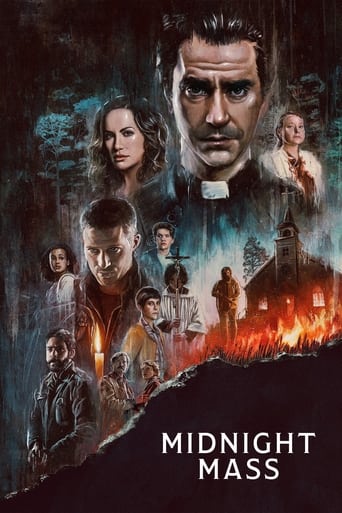
Midnight Mass
2021 · TV series · 1 season
Created by Mike Flanagan
The arrival of a charismatic young priest brings glorious miracles, ominous mysteries and renewed religious fervor to a dying town desperate to believe.
5 positivefrom 5 commenters
Where to watch
No streaming data for this title.


6 comments on Hacker News
I'm not sure if it counts, but my favorite vampir-esque movie/show/whatever was Midnight Mass. It was such an interesting take on the core ideas.
It's an interesting question: can filmmakers actually use this newfound range in a meaningful way? I feel the same about those two scenes -- one I can follow, one I cannot. But I wonder if anyone out there is filming high range scenes at night in a good way, and the Battle for Winterfell is just a failed experiment in figuring that out?
The final episode of Midnight Mass comes to mind. And much of The Vvitch. Both aren't totally ideal -- they can be difficult to follow at times -- but I think they use the range to convey chaos and fear of the unknown in a meaningful way.
Curious if anyone has other examples of this pulled off well.
Discussing only on the merits of their content, and stipulating that this is neither here nor there with respect to Netflix's long-term prospects vs. HBO:
Breaking Bad isn't an HBO show. So I assume we're just asking, "has Netflix produced any world-class content". The answer to that is yes.
The jewel in their crown, their "Game of Thrones", is clearly Stranger Things. It's undeniably successful, each new season a cultural event. I'd put Stranger Things up against any HBO show for relevance and impact. (Perhaps not for artistic excellence; but, The Wire is the best show that's ever been on television, and it's far from the most watched).
Add to that Black Mirror, Bojack Horseman, Sex Ed, the annual Flanagan miniseries (Hill House, Bly Manor, Midnight Mass), Master of None, and Big Mouth.
They're doing about as well as any premium cable channel ever has. Doesn't, of course, mean you like their content! But I have about as much faith in Netflix coming up with a new prestige show than I do in HBO, most of whose recent stuff has left me pretty cold.
Streaming services truly flip the "economic calculation problem" [0] on its head: the stakeholders would supposedly gain more reliable information on the value of different IP licenses if we all made purchases a la carte. As it is, they have little idea which program I'm hate-watching ironically, vs what's good enough to convince me to stay on the service (Midnight Mass), vs what I'd pay for exorbitantly out of pocket if I could (OA season 3).
Yet clearly market forces have spoken: the desirability and convenience of the "club goods" model is strong enough to overwhelm any advantages of the transaction model; and the streaming services clearly believe their usage data and analytics are good enough to give them reliable correlations with subscriber acquisition and retention, so they can decide what to license and produce. (While telemetry surely helps, it's worth noting that HBO made this model work for decades based solely on surveys and brand cachet.)
See also: https://www.versobooks.com/books/2822-the-people-s-republic-of-walmart
[0] https://en.wikipedia.org/wiki/Economic_calculation_problem
The McDonald's of TV show production. With very, very few exceptions (Midnight Mass, maybe?) I at least know what I'm getting into: designed-by-committee, very very "safe", out of place (most likely contracted) references to other Netflix shows to try to cross-pollinate viewers... not exactly a recipe for success.
Similar to how Amazon Originals now seem synonymous with "we cut the writer's outline from 12 episodes to 6, enjoy the rushed character and plot development!"
Have you seen midnight mass? The protaganist from that movie in the final scene, says something along those lines... as she herself is dying. She was asked earlier in the movie: "What happens when we die"... and iirc she gave a more christian-themed notion as she herself was very religious, but you can see her shift from the dogma of catholicism to one more pantheistic.
When the memory of Riley asks her what happens when we die she responds:
“Speaking for myself? Myself. My self. That’s the problem. That’s the whole problem with the whole thing. That word: self. That’s not the word, that’s not right, that isn’t — that isn’t. How did I forget that? When did I forget that? The body stops a cell at a time, but the brain keeps firing those neurons. Little lightning bolts, like fireworks inside, and I thought I’d despair or feel afraid, but I don’t feel any of that. None of it. Because I’m too busy. I’m too busy in this moment. Remembering. Of course. I remember that every atom in my body was forged in a star. This matter, this body, is mostly just empty space after all, and solid matter?
It’s just energy vibrating very slowly and there is no me. There never was. The electrons of my body mingle and dance with the electrons of the ground below me and the air I’m no longer breathing. And I remember there is no point where any of that ends and I begin. I remember I am energy. Not memory. Not self. My name, my personality, my choices, all came after me. I was before them and I will be after, and everything else is pictures picked up along the way. Fleeting little dreamlets printed on the tissue of my dying brain.
And I am the lightning that jumps between. I am the energy fighting the neurons. And I’m returning. Just by remembering, I’m returning home. It’s like a drop of water falling back into the ocean, of which it’s always been a part. All things, a part. All of us, a part. You, me, and my little girl, and my mother, and my father, everyone who’s ever been. Every plant, every animal, every atom, every star, every galaxy, all of it. More galaxies in the universe than grains of sand on the beach.
That’s what we’re talking about when we say God. The one. The cosmos, and its infinite dreams. We are the cosmos dreaming of itself. It’s simply a dream that I think is my life, every time. But I’ll forget this. I always do. I always forget my dreams. But now, in this split second, in the moment I remember, the instant I remember, I comprehend everything at once. There is no time. There is no death. Life is a dream. It’s a wish. Made again and again and again and again and again and again and on into eternity. And I am all of it. I am everything. I am all. I am that I am.”
This monologue gave (continues to give me goosebumps)... I'm exmormon/agnostic, but still inspired and have some spirituality...I believe there's something bigger and better and our 'energy' continues on in some respect, or we're at least in a simulation and maybe will respawn and get another chance to get life 'right'.. either way, I think death isn't the end, and this was just a very beautiful way to think of it...